Tag: Baking

Springtime in Paris: the bakeries of Belleville

Springtime in Paris: the bakeries of Belleville

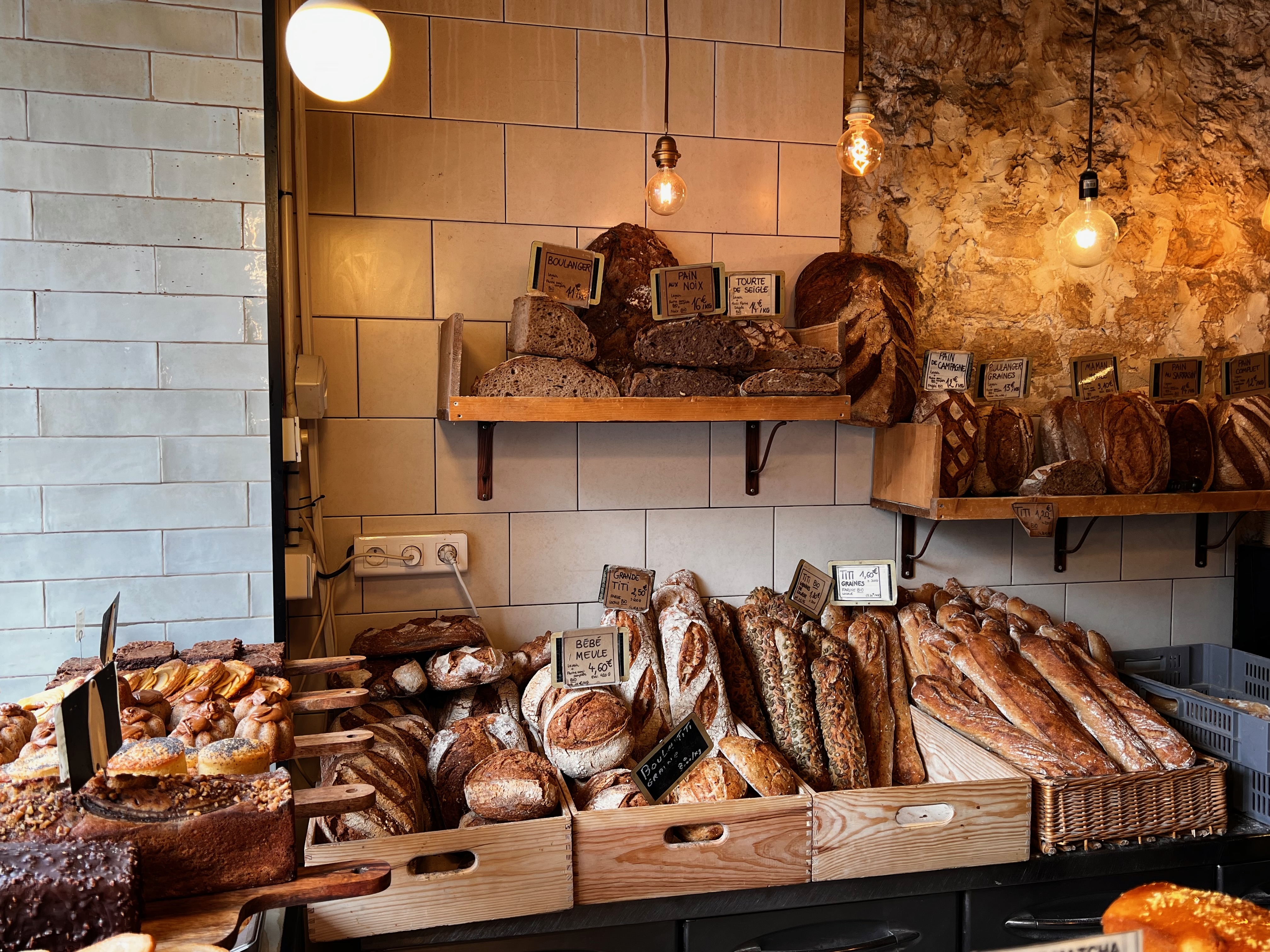
When people think about Paris, the top things they think about are the landmarks (the Eiffel Tower, the Arc de Triomphe and so on), the great public buildings (the Louvre, the Opera),  and the cafés and restaurants. But there’s one aspect of Paris that isn’t necessarily on everyone’s list: the place is a baker’s paradise.

We’re currently on a two-month stay in Paris. Rather than being in a standard tourist area, the apartment we’ve rented is somewhat north-east of the city centre in Belleville, made famous by Sylvain Chaumet’s wonderful animated film Belleville Rendezvous (aka The Triplets of Belleville). It’s an ethnically mixed residential area, with a large population of North African origin as well as a lot of Chinese and Vietnamese mixing with the white population. Our apartment is on the Rue du Faubourg du Temple between Belleville and République metro stations. In the course of that one kilometre stretch, without going into the side streets, I counted fourteen bakeries of different kinds. Most of them are places I’d be more than happy to patronise near my home; the best are utterly outstanding.

Here’s a little guided tour – in no particular order (and not geographically).

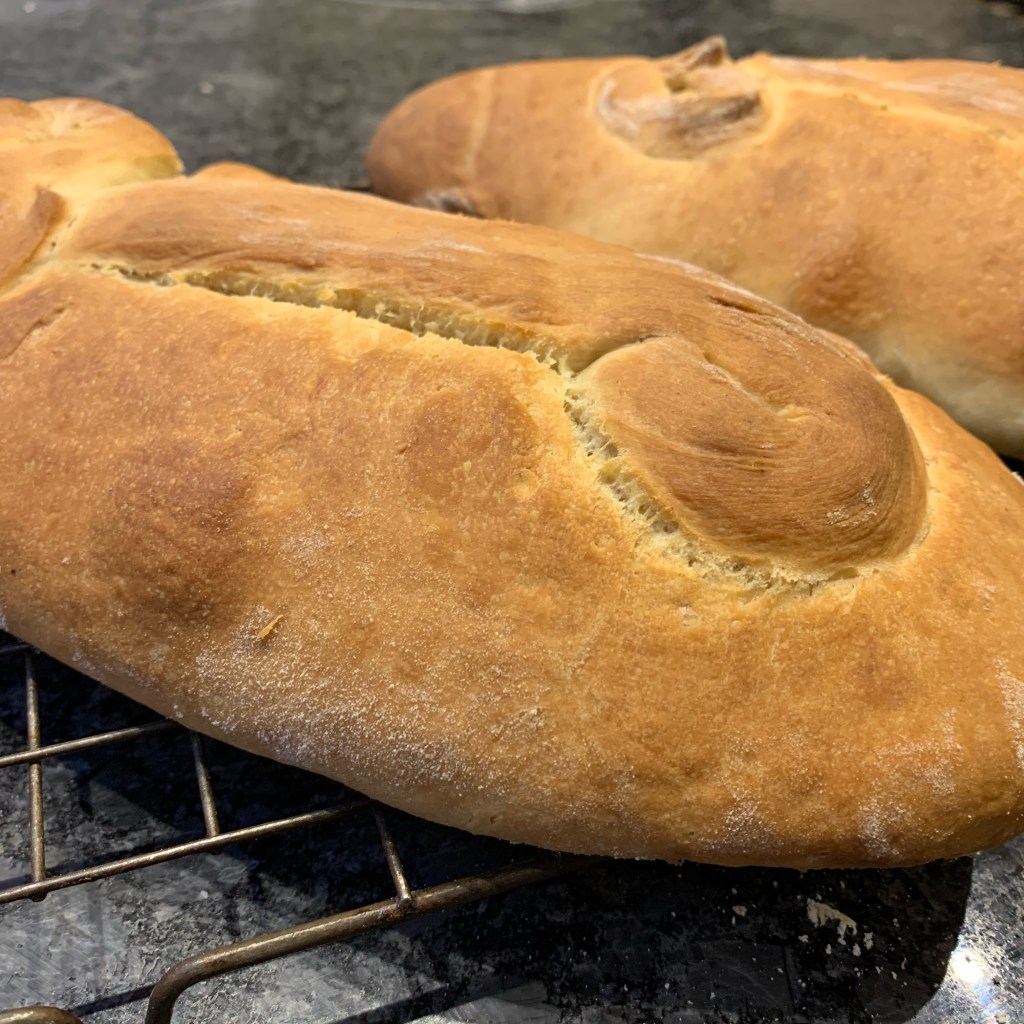
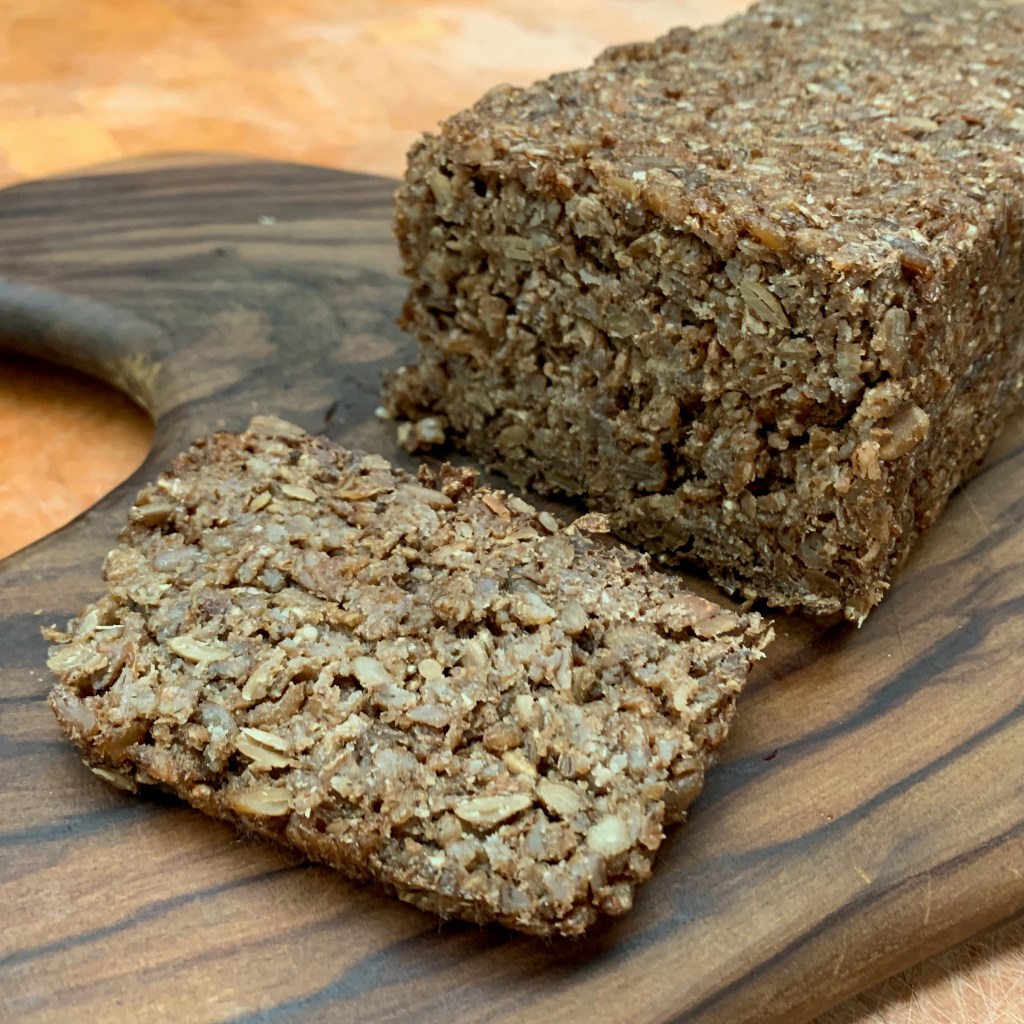
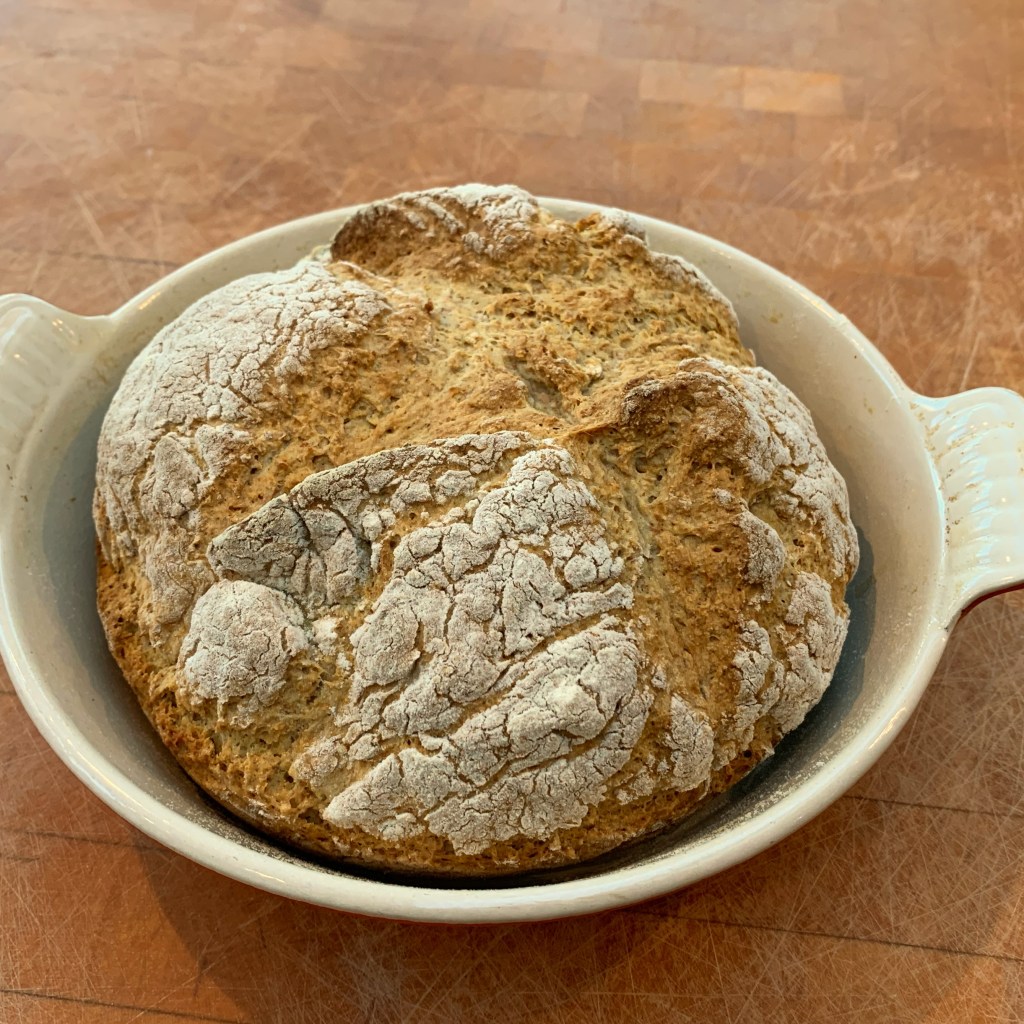
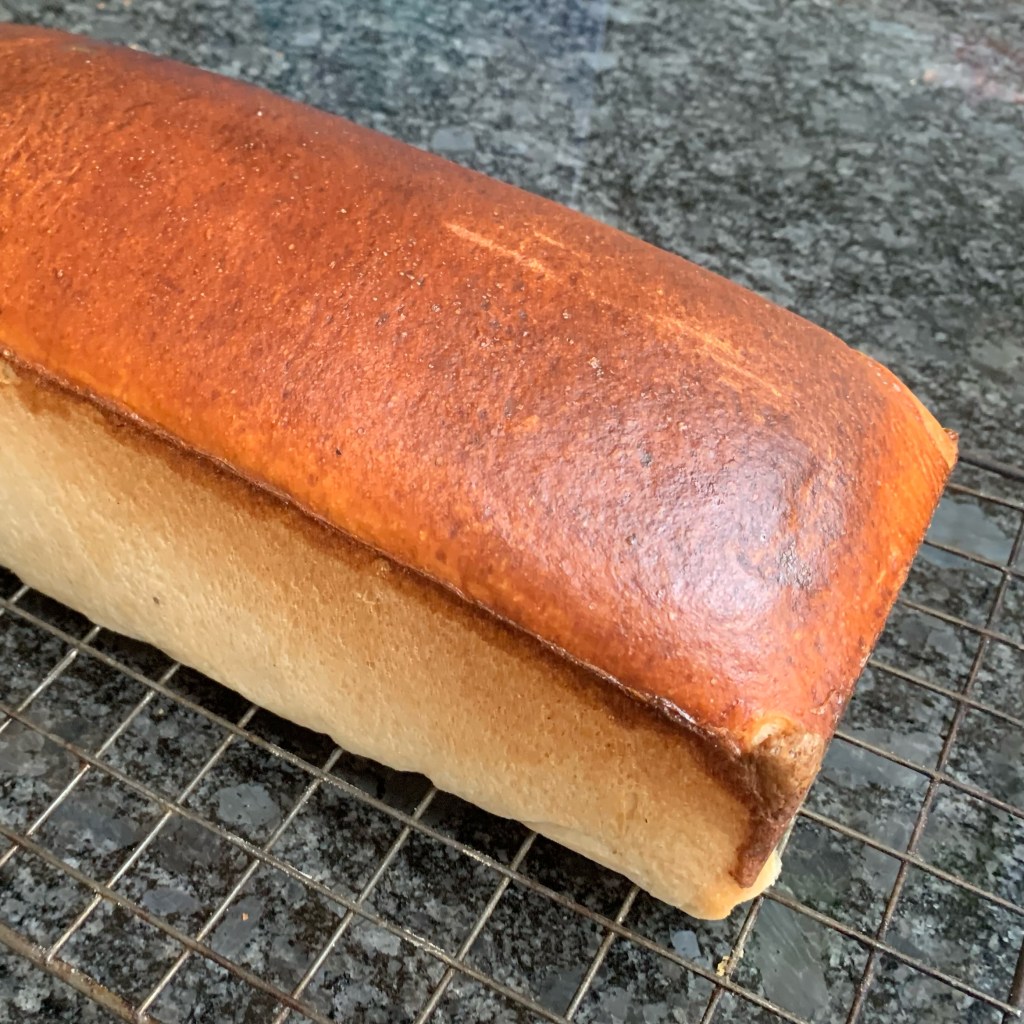
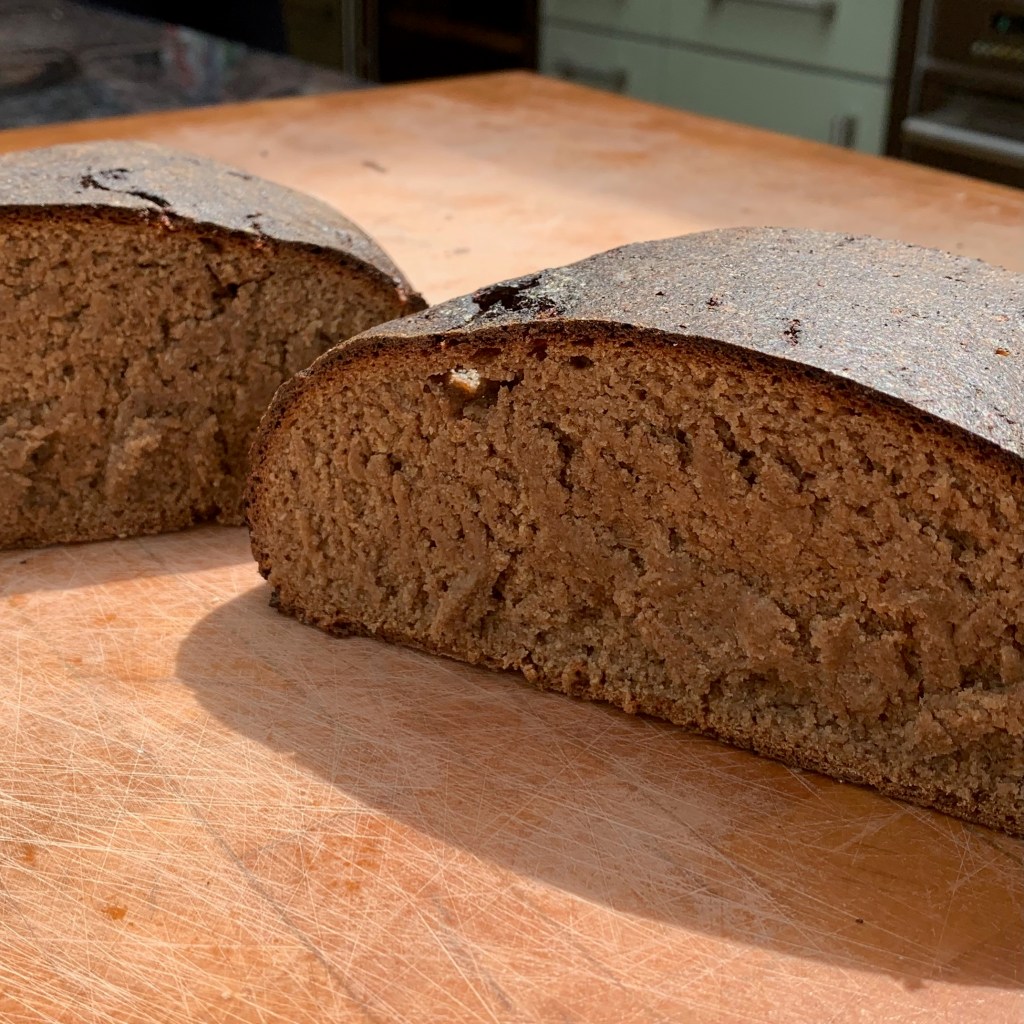
The most outstanding bread so far came from next to Goncourt metro: the Urban Bakery Goncourt, a branch of a small chain, with ten shops across Paris, which descibes itself as a “Boulangerie Engagée”. They do a wide selection of breads with different grains – rye and buckwheat as well as standard wheat – which  simply burst with flavour.
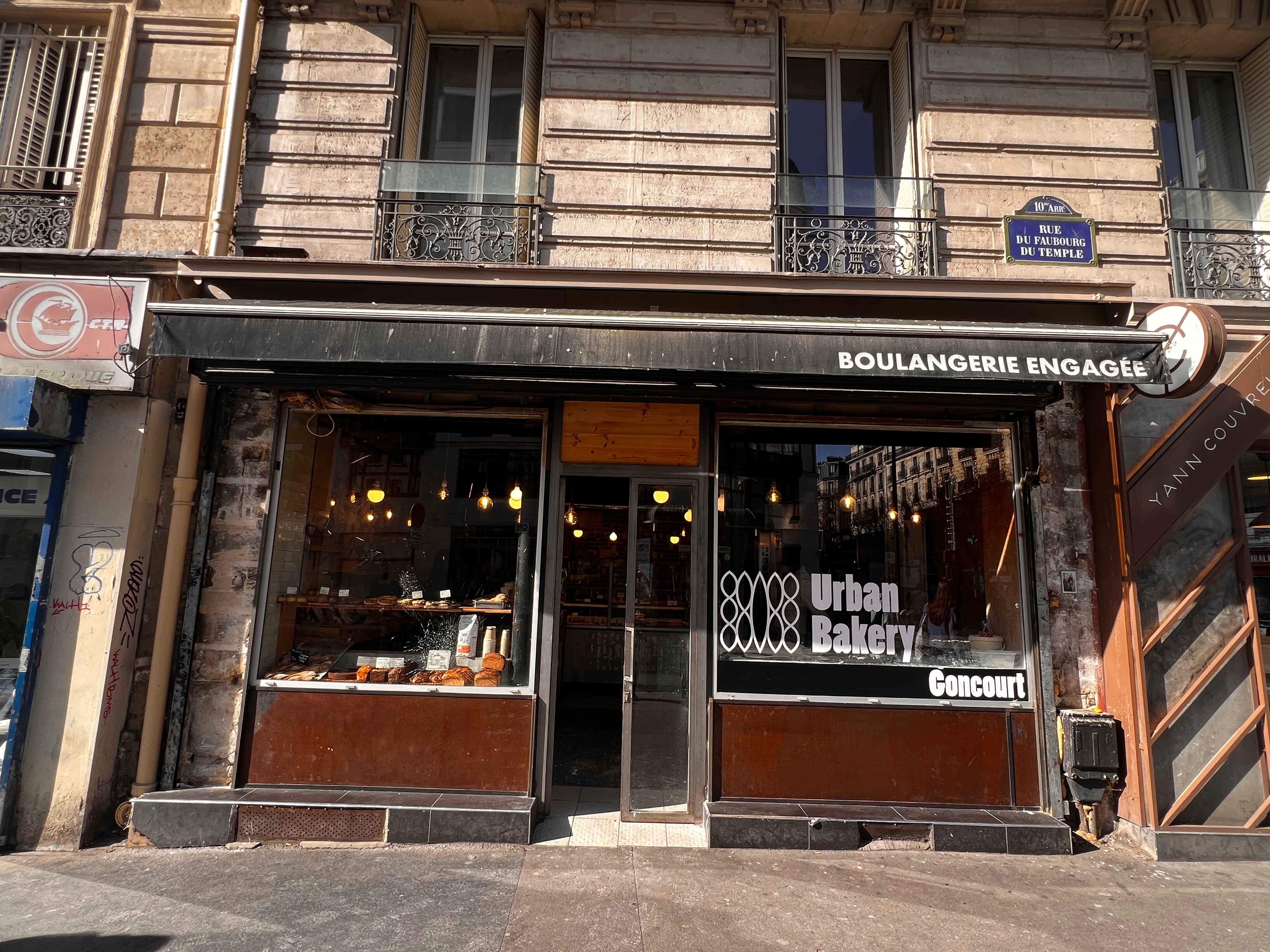
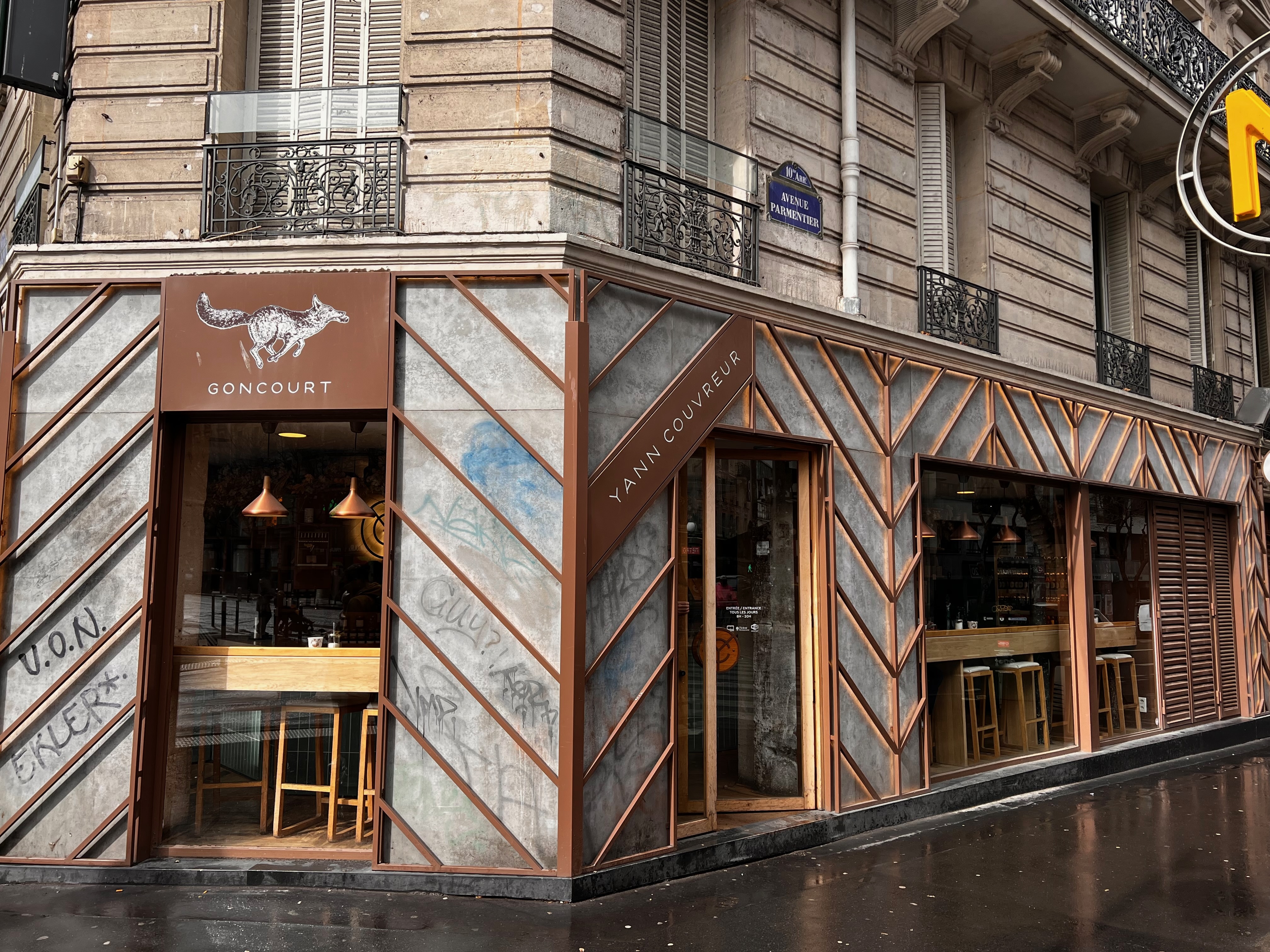
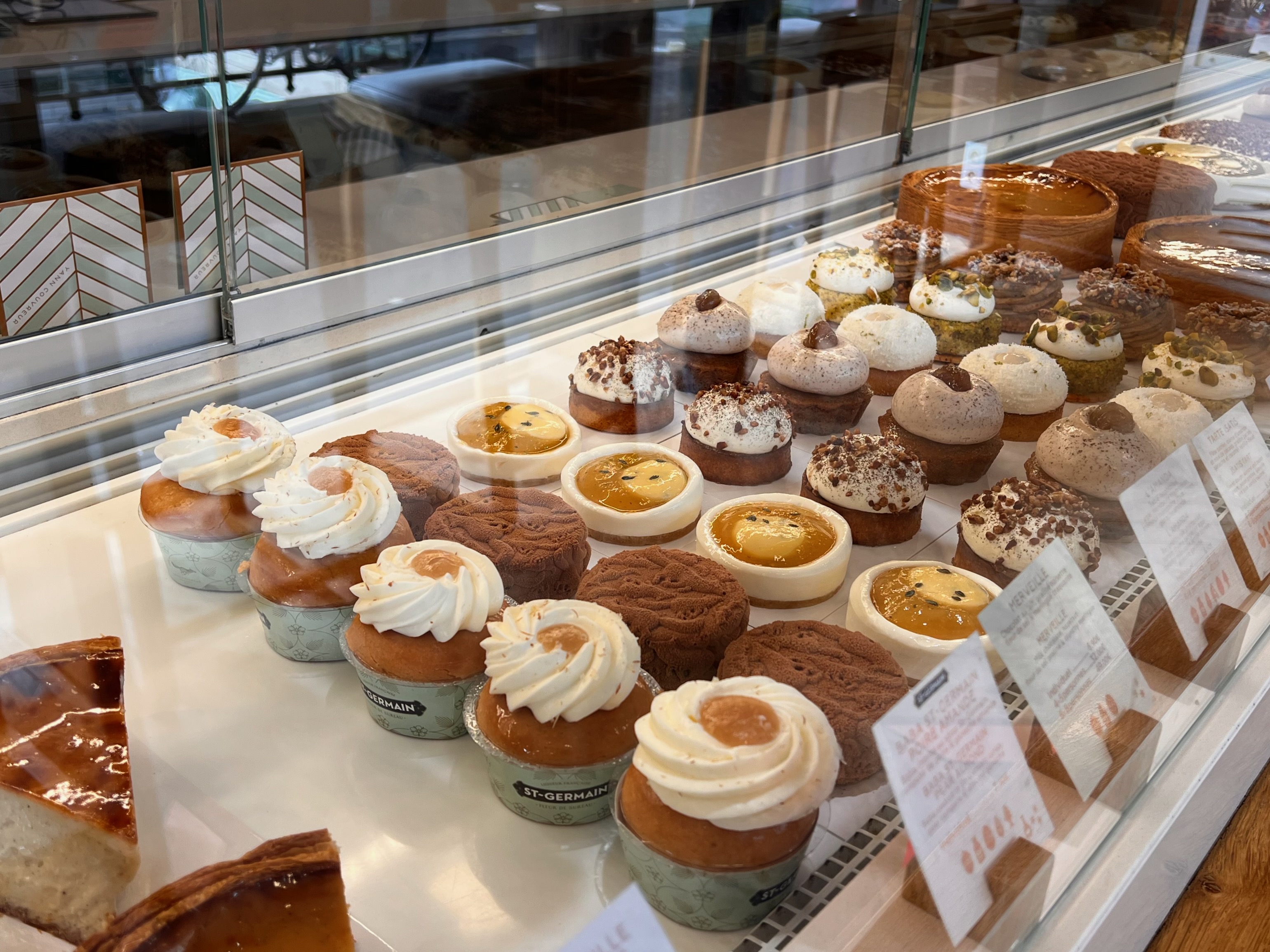
The Urban Bakery does some pâtisserie, though bread is clearly its main focus. However, it’s next door to Yann Couvreur, which doesn’t do bread but does uber-posh, innovative pâtisserie (at eye-watering prices, one has to admit). Couvreur is a famous pastry chef who also has branches in the Marais and in the main Galeries Lafayette, plus a café in town.
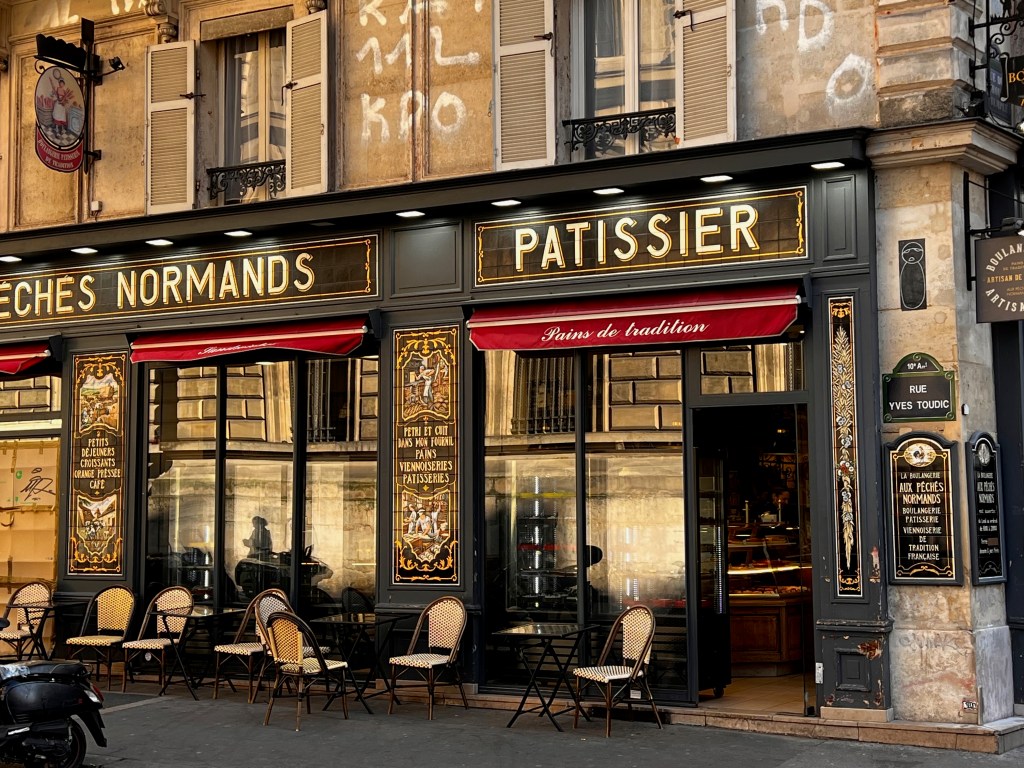
Nearer to République, Aux Péchés Normands does great bread and fabulous croissants and pastries, if perhaps not quite up to the refined levels above. But I can attest that their lemon meringue tartlets are a thing of beauty.

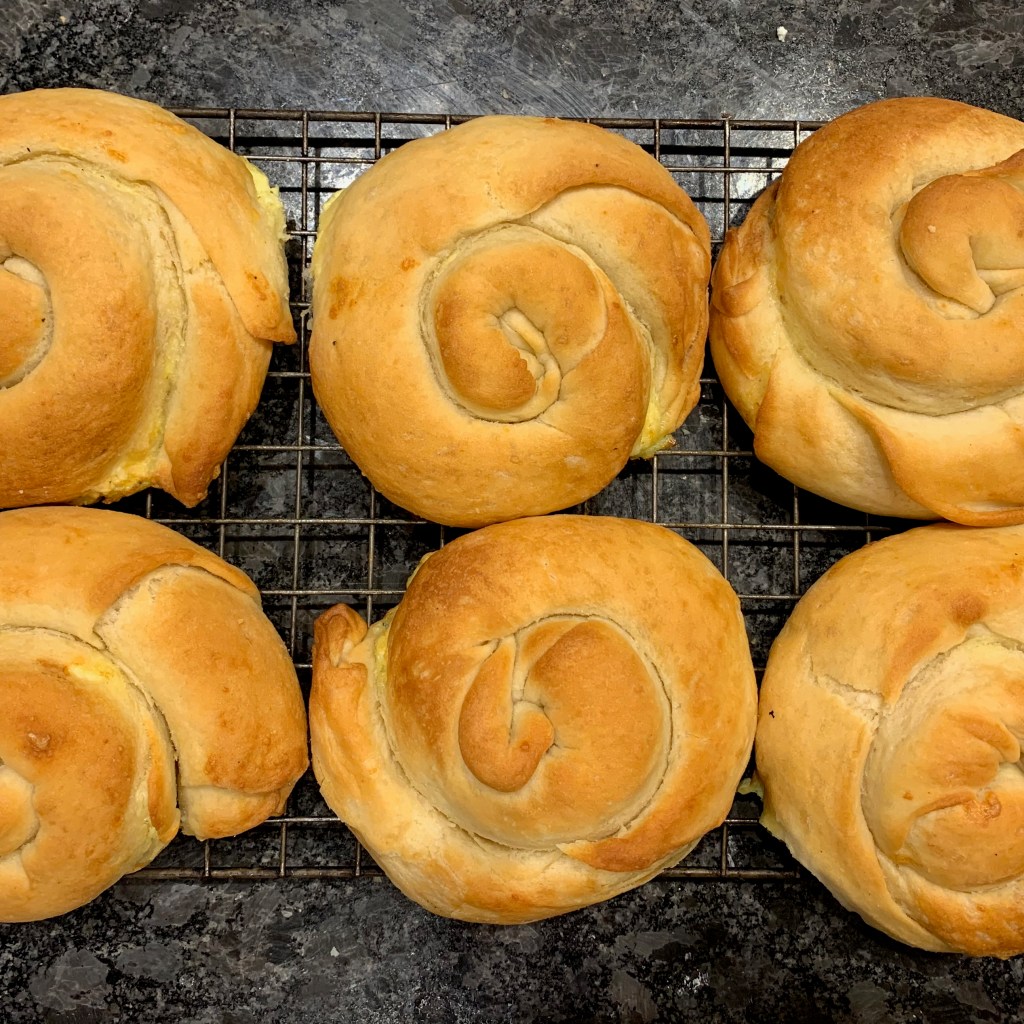
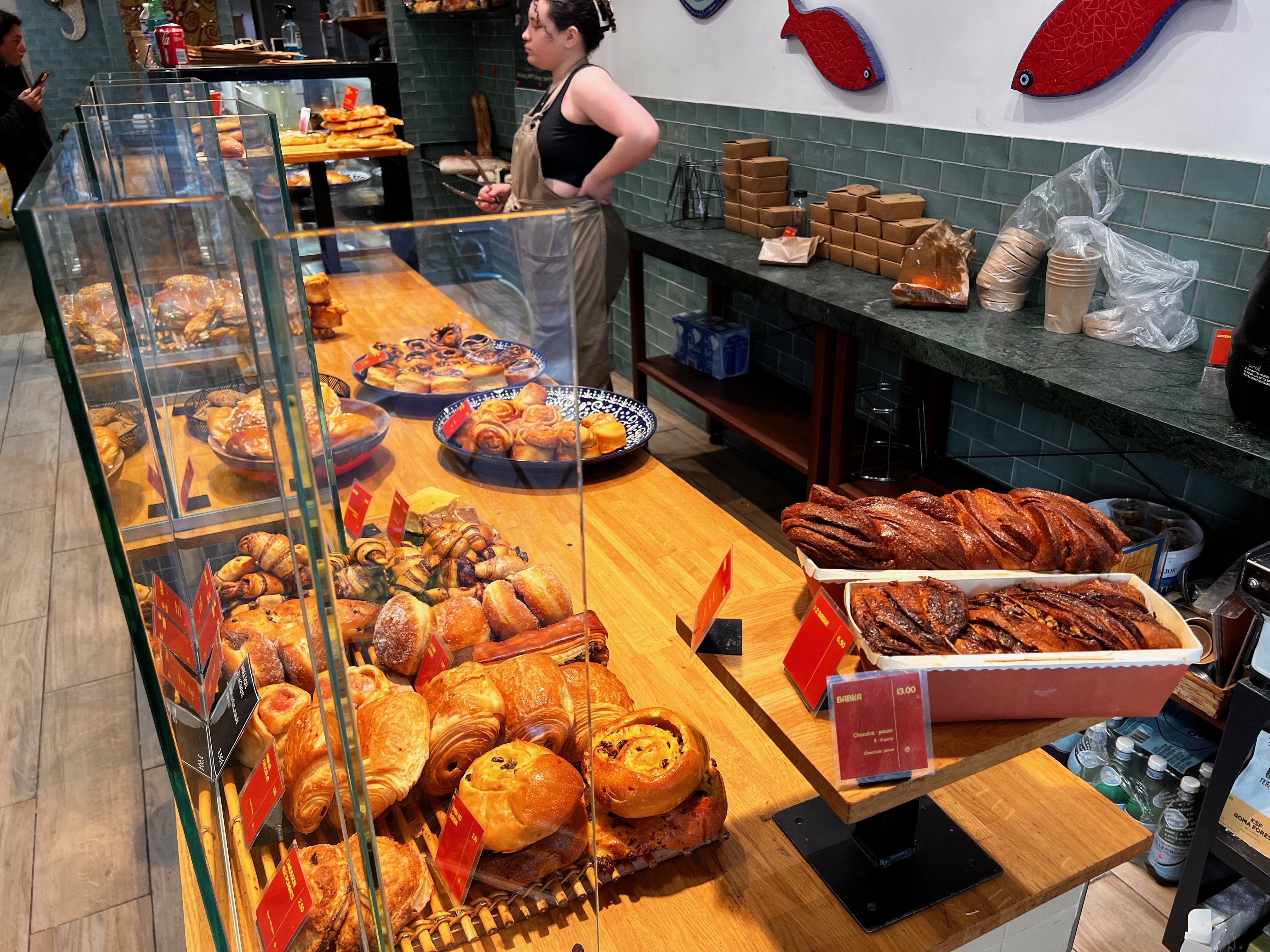
The really unexpected one was Mami, which describes itself as a “Boulangerie Levantine”. Taking its inspiration from all things Jewish and Middle Eastern, it has mouth-watering Babkas and a variety of Challahs, including a Za’atar-flavoured Challah, which is something I’ve never seen before but is quite delicious.
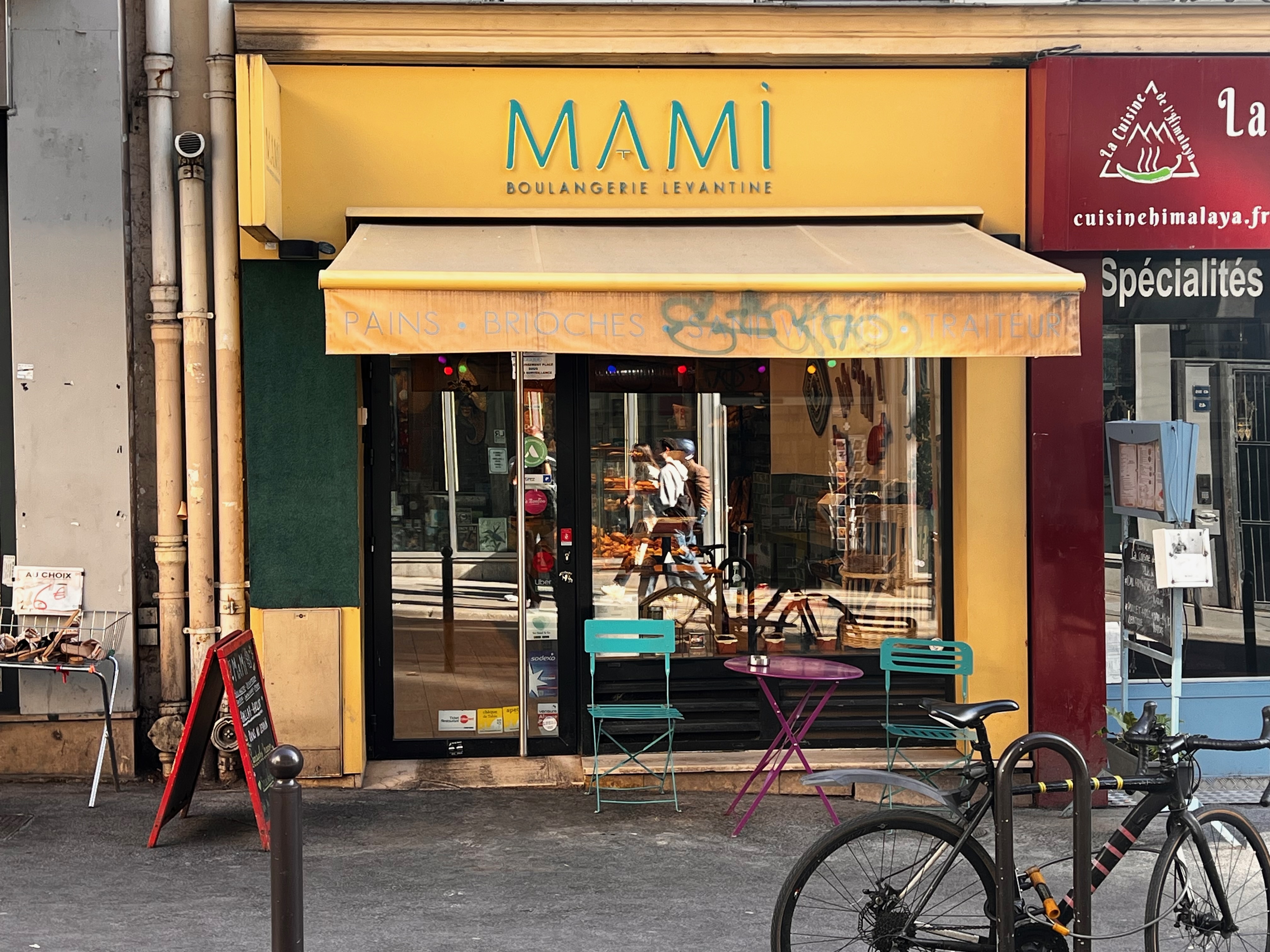
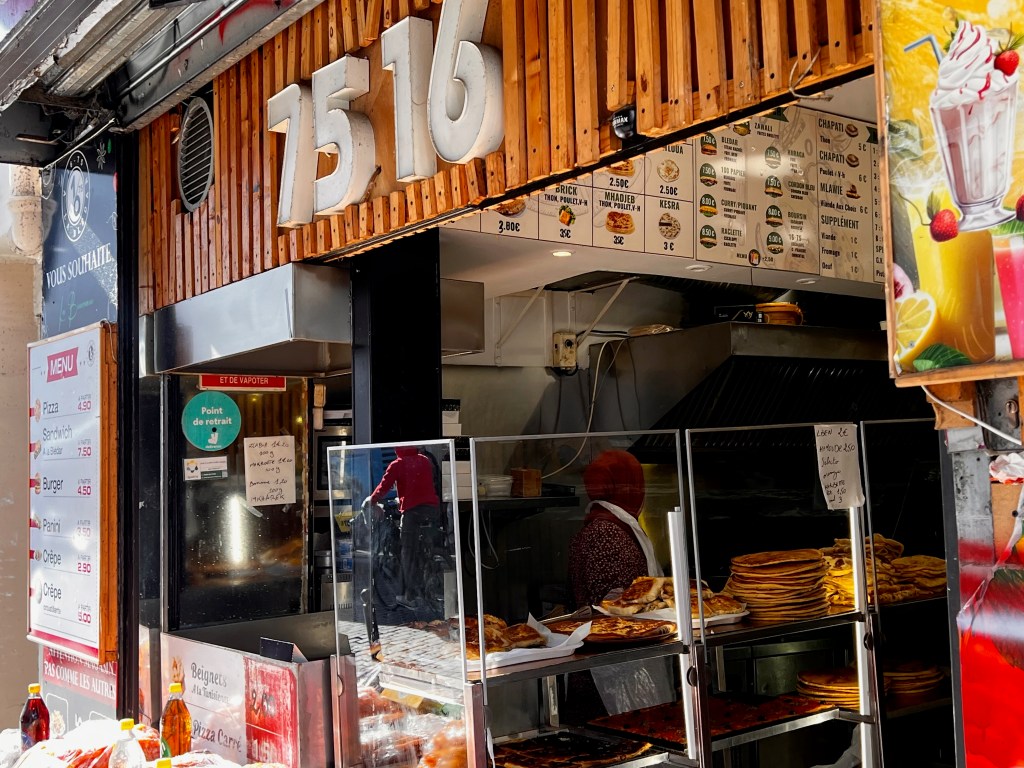
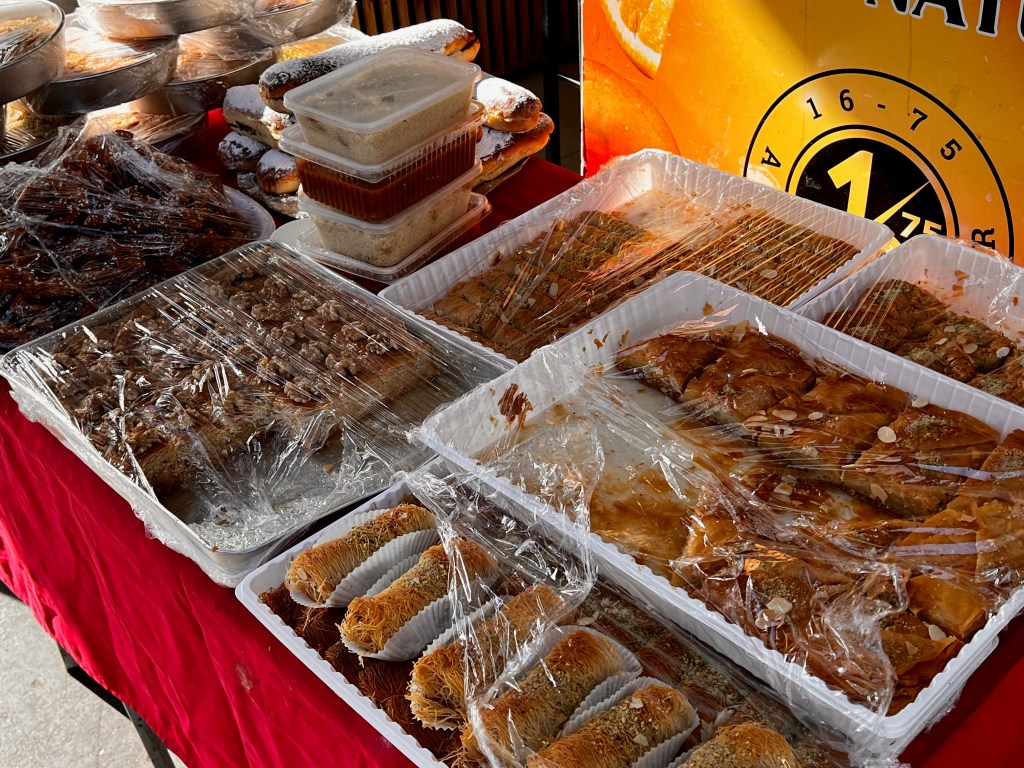
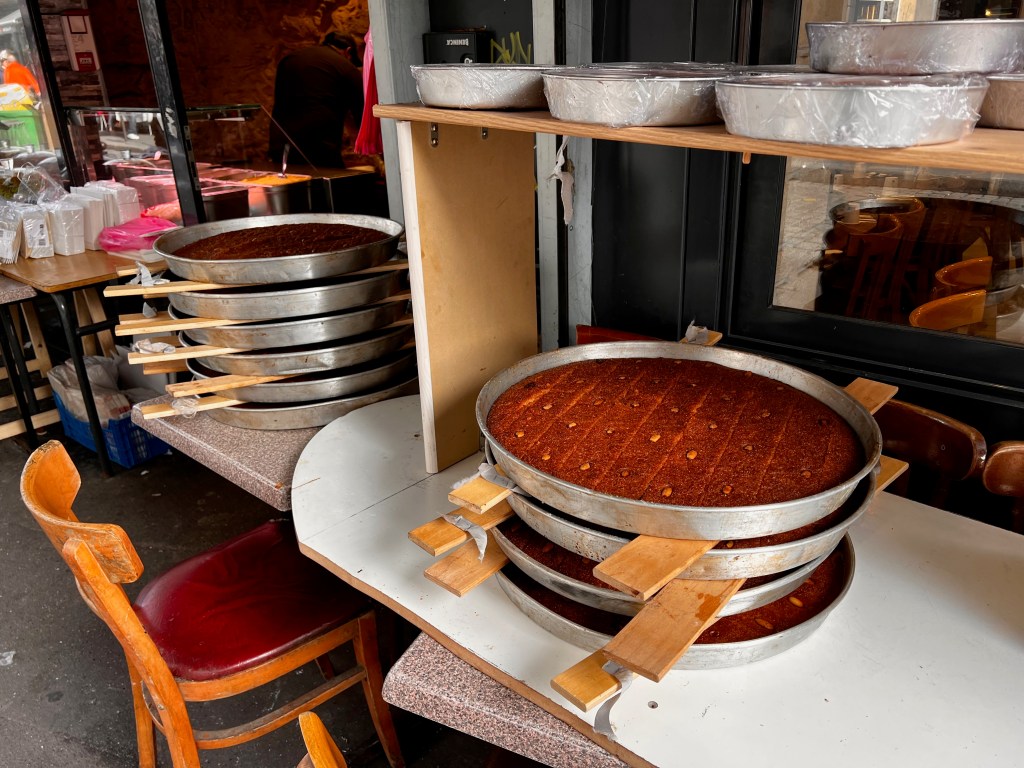
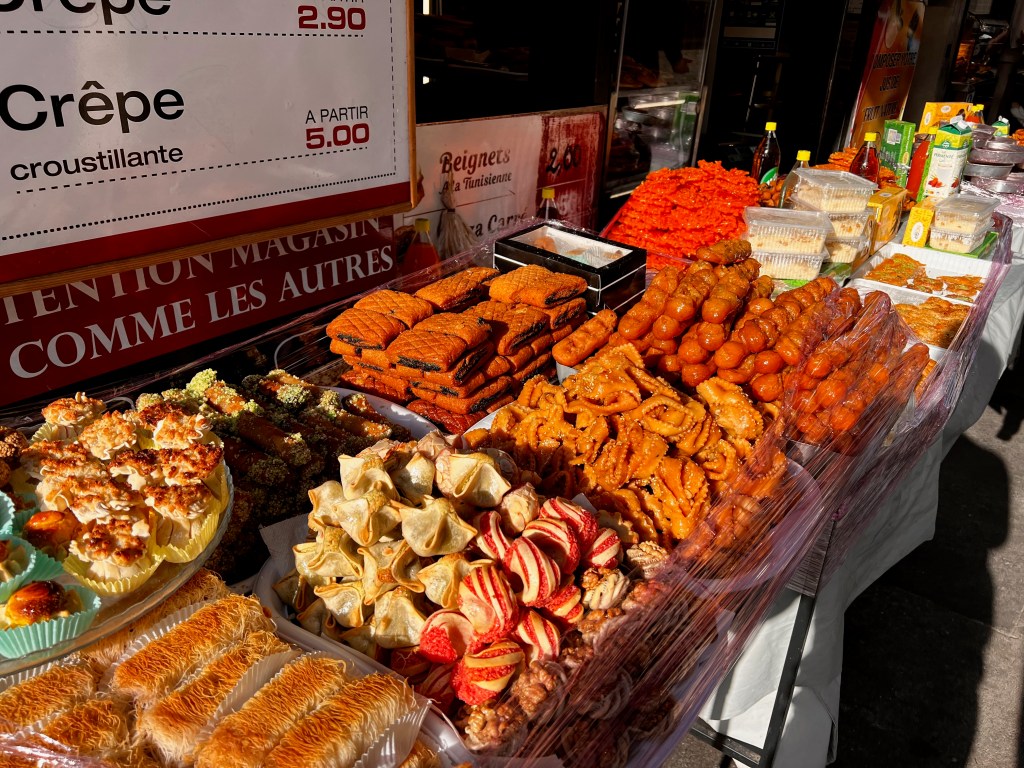
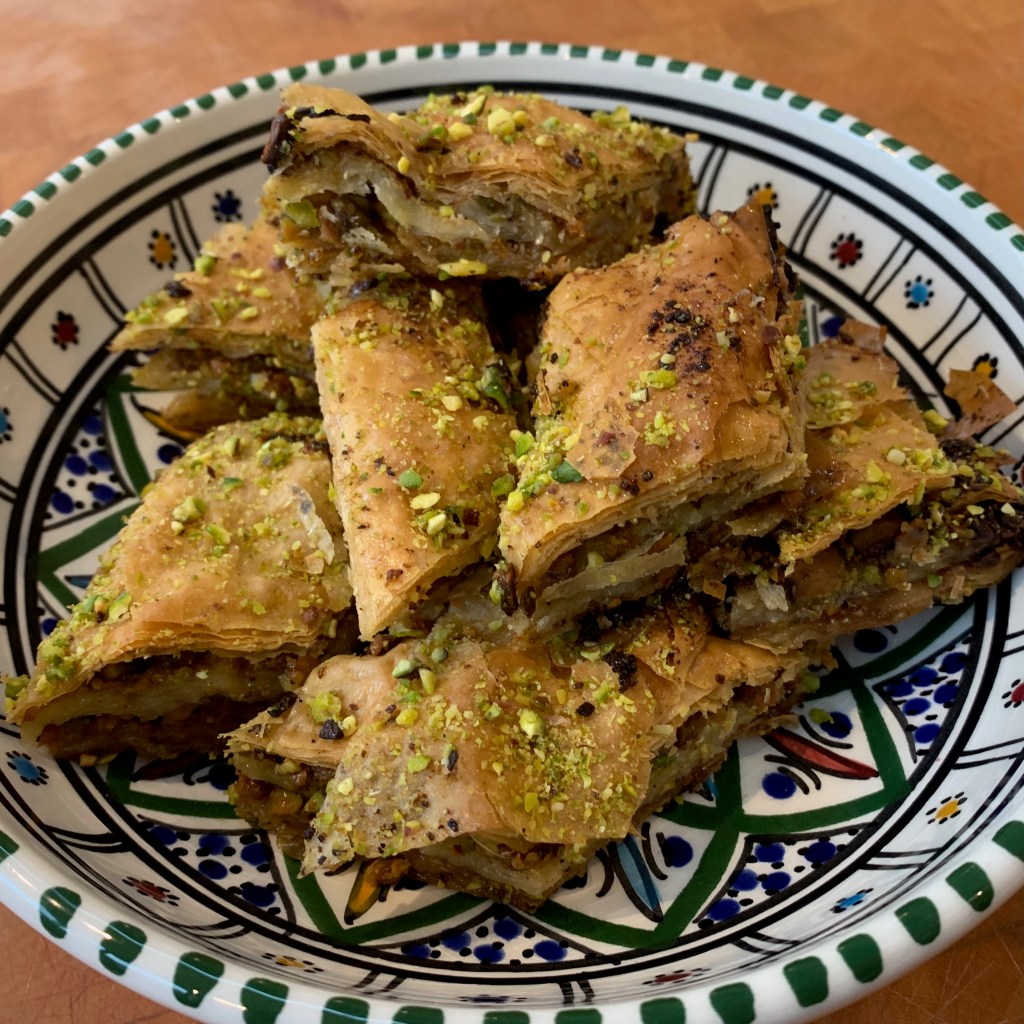
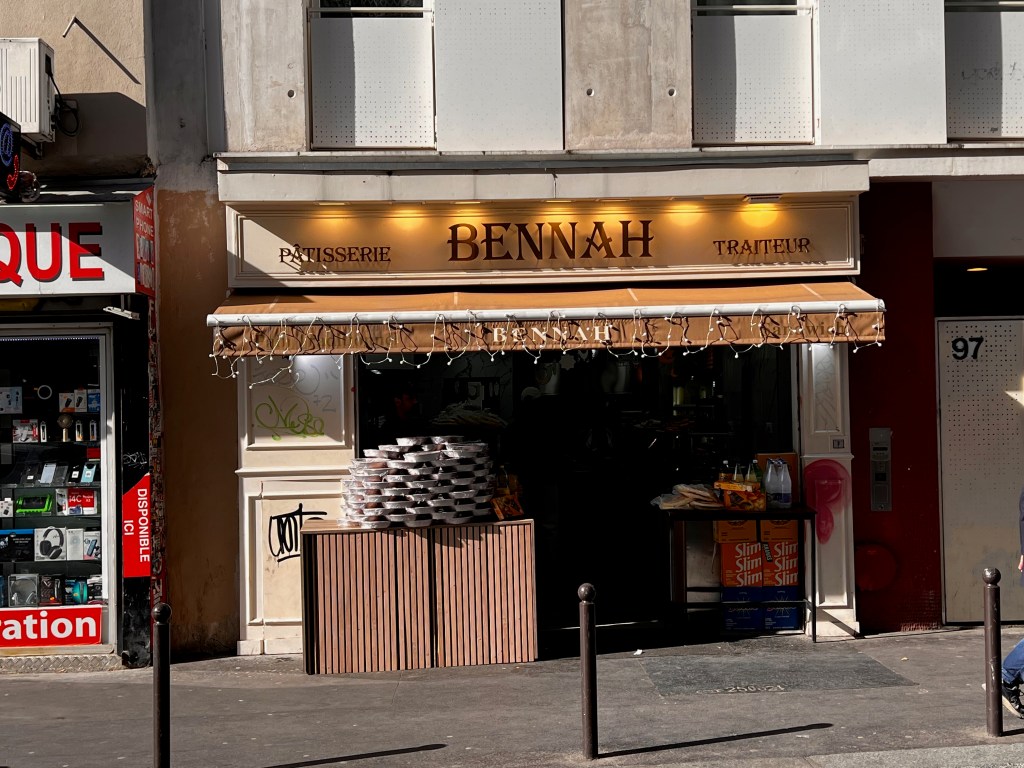
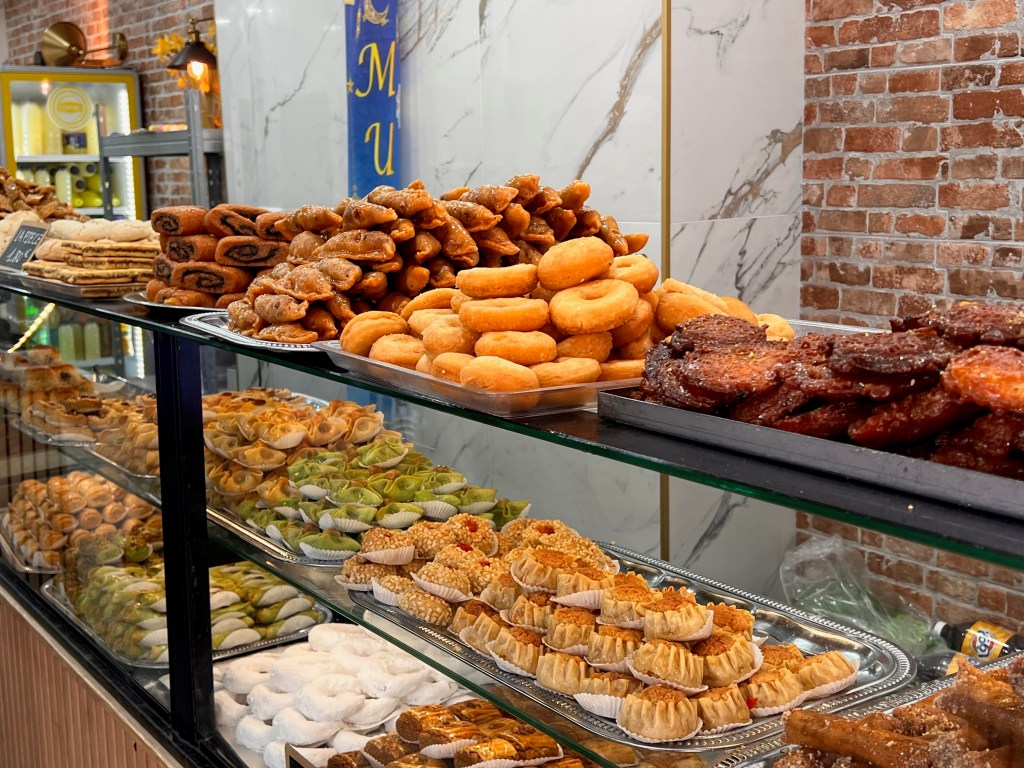
The area has many North African inhabitants (particularly Tunisians, it seems to me), resulting in the presence of many shops specialising in Arab and Maghrebi breads, sweets and pastries. It’s Ramadan at the moment, so every evening, there are vast arrays of goodies stacked on trestle tables outside the shops, which  wolfed down when the fast ends at sunset (to be fair, they also seem pretty busy through the day from both Muslim and non-Muslim shoppers). The one that seems permanently rammed is called Bennah – I took photos of three others and I probably missed a few.
For something completely different, there’s Le gâteau doré fiesta Pâtisserie. It’s a cake shop which sells large cakes for birthdays and other events, apparently in large volumes. Its unusual feature, however, which has led me to dub it the “pornographic cake shop” is the array of scantily-clad plastic women in the window, waiting to adorn the birthday cake of your fantasies. (To be fair, there are also more conventional figures of brides and grooms, furry animals, national flags and so on).

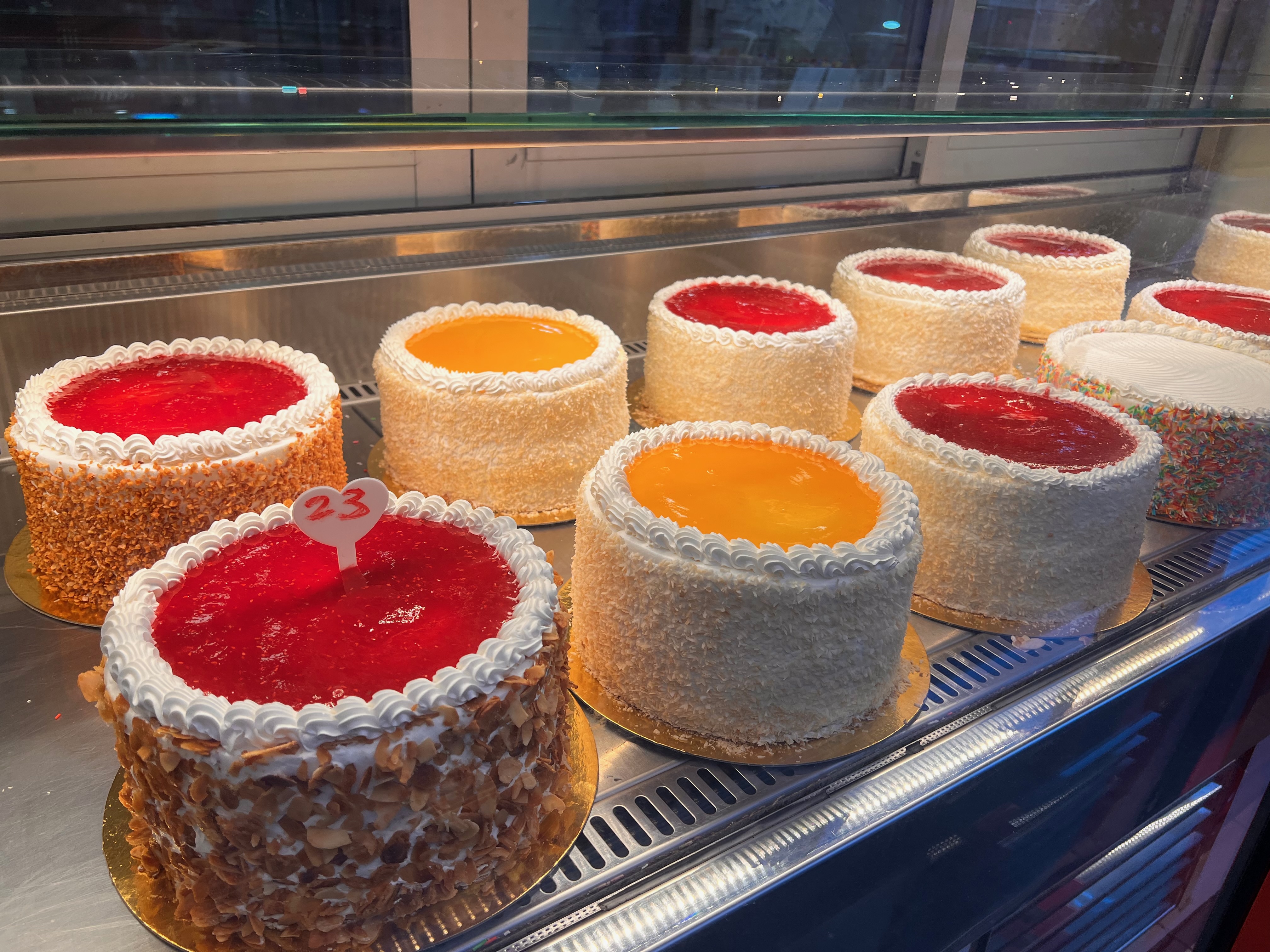
On the other side of the road from Le gáteau doré is a more demure looking (and possibly more upmarket) shop specialising in cakes for events, the Pâtisserie La Romainville. Another cake shop – the one nearest us, Délices de Belleville – is also labelled with the Chinese characters for “happy cake”.
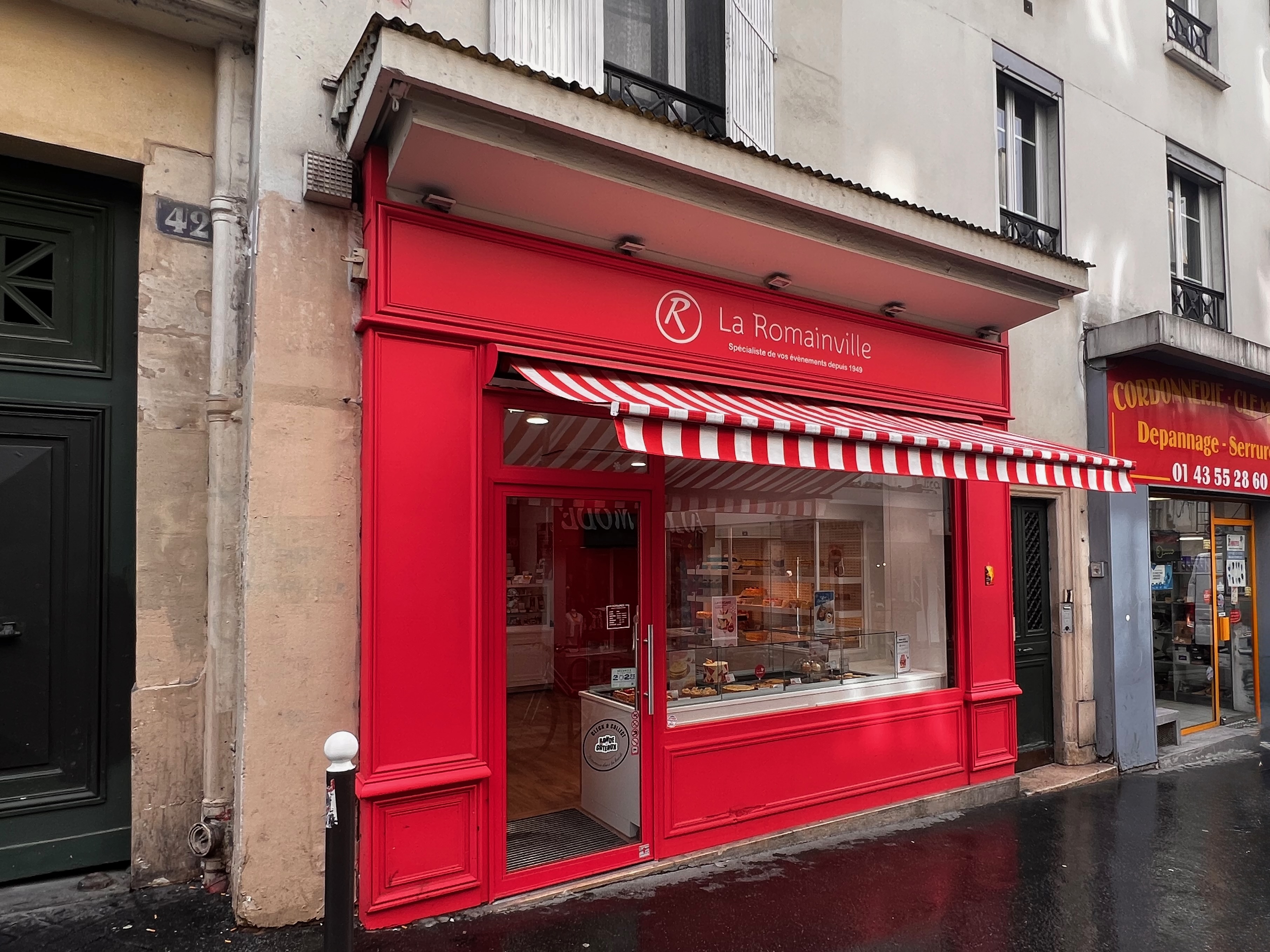
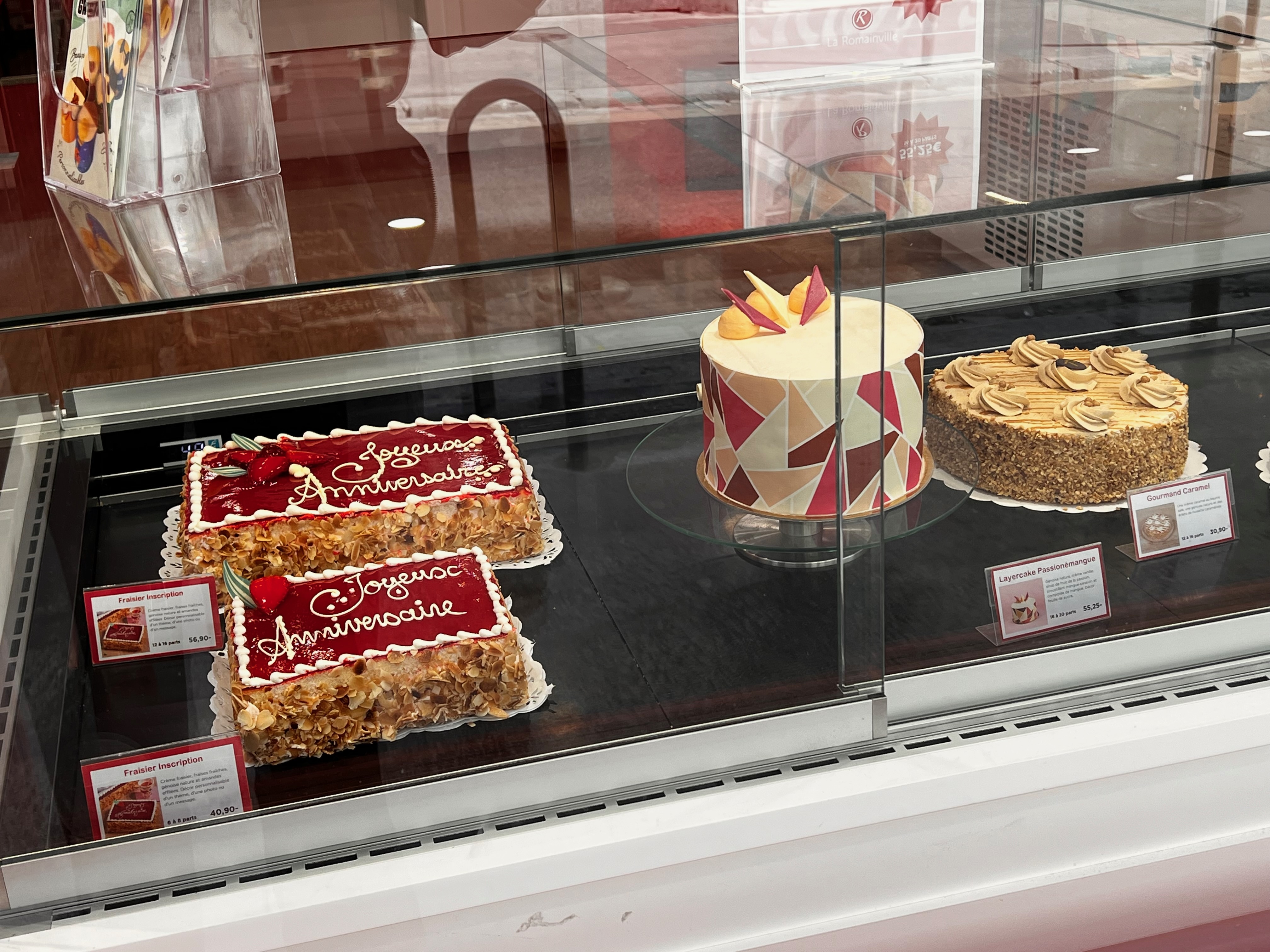
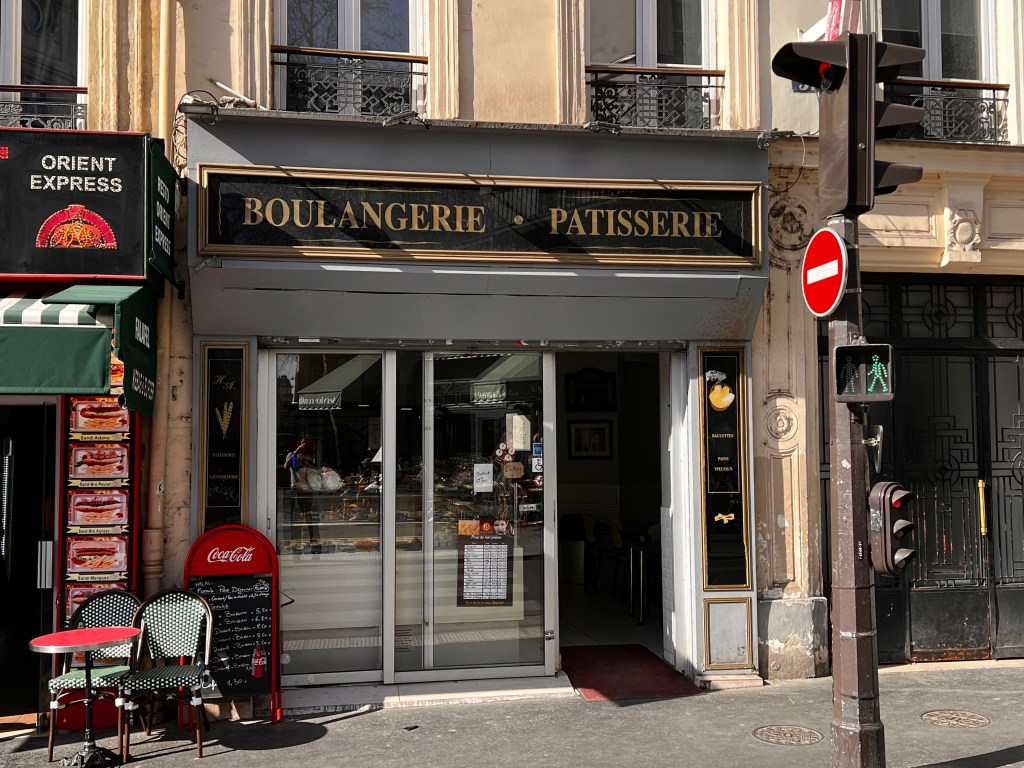
And there is no shortage of standard boulangerie-pâtisseries, the sort that will sell your morning baguettes and croissants as well as a variety of other stuff. Several of these don’t even have a brand name attached and are just labelled Boulangerie Pâtisserie or Artisan Boulanger Pâtissier or similar.


And that’s not counting the several supermarkets along the way that will sell you bread, croissants and cakes. I don’t think I’ve ever seen a place where you can’t walk for 50 metres without running into a bakery, and I’ve certainly never lived in one. And I love it.
Chocolate mousse

For anyone planning a Seder night (the Jewish celebration of Passover eve), the question raises itself of how to make a flourless dessert. There are various standard tricks, like using ground almonds or matzo meal to substitute for the flour, but here is a fabulous, indulgent dessert that avoids the tricks altogether.

This chocolate mousse started life as one of my mother’s standards, taken from the classic American cookbook Joy of Cooking (still in print and being revised, 93 years after its first edition – my own copy is now so tattered that it needs replacing). I’ve made things metric and changed various quantities, mainly to suit what you buy in English supermarkets, although, to be honest, it’s incredibly forgiving: the recipe will still work OK even if you change the ratios of cream to chocolate to eggs sugar, so you can make sweeter, lighter or more intensely chocolatey at will.

Recently, I’ve been making a more substantial change: making the egg whites into an Italian meringue before folding them into the rest of the mixture. The result is a far lighter, stable consistency which, in my view, is well worth the extra effort. This needs a thermometer – if you don’t have one, just go for standard sweetened beaten egg whites.

By the way, I tend to use the egg yolks for crème pâtissière, for use in éclairs or fruit tarts.

The Italian meringue

  • 4 large egg whites
  • 200g sugar (this is less than most recipes, so you can up it to 300g if wanted)
  • 5oml water
  • Juice of half a lemon
  1. Pu the egg whites into the bowl of your stand mixer, equipped with the whisk attachment.
  2. Put the sugar and water into a small saucepan and heat: for the first part of the process, make sure you mix things until the sugar is properly dissolved. 
  3. Monitor the temperature regularly with a thermometer: you will be using the syrup when it reaches 121℃.
  4. Well in time for the syrup to be complete (I tend to start when it’s at around 90℃), whisk the egg whites until they form soft peaks. Stop the mixer.
  5. When the syrup reaches 121℃, restart the mixer on full speed, and slowly pour the syrup into the bowl, in as thin a dribble as you can manage.
  6. Add the lemon juice, then continue mixing for at least 10 minutes while the meringue cools.
  7. Remove the whisk – you meringue is now ready to use.

The mousse

  • 50g sugar 
  • 80g rum
  • 350g dark chocolate, at least 70% cocoa solids
  • 500ml cream
  1. Put the sugar and rum into a saucepan and warm gently until dissolved into a syrup. You do NOT want the syrup to caramelise.
  2. Take the syrup off the heat and leave to cool somewhat.
  3. Break up the chocolate, then heat in a double boiler until melted
  4. Mix in the syrup
  5. Mix in 100ml of the cream, a bit at a time, until everything is smoothly blended
  6. Whip the remaining 400ml of the cream until stiff
  7. Fold in the chocolate mixture until completely blended (you don’t really want white blotches).
  8. Now fold in the Italian meringue. Try to do it without overworking, which will lose the air – but at the same time, you want it completely mixed. It’s a good idea to fold in about a quarter of the meringue first, and then the remainder, which you’ll be able to do more gently.
  9. Put the mousse into a large bowl for serving, or into individual ramekins or glasses if you prefer.

I like serving this with a red fruit coulis, made from reducing and sieving frozen red fruit and sugar, with a bit of lemon juice added. The sharpness of the coulis cuts through the richness of the mousse, and anyway, raspberries and chocolate are a marriage made in heaven.

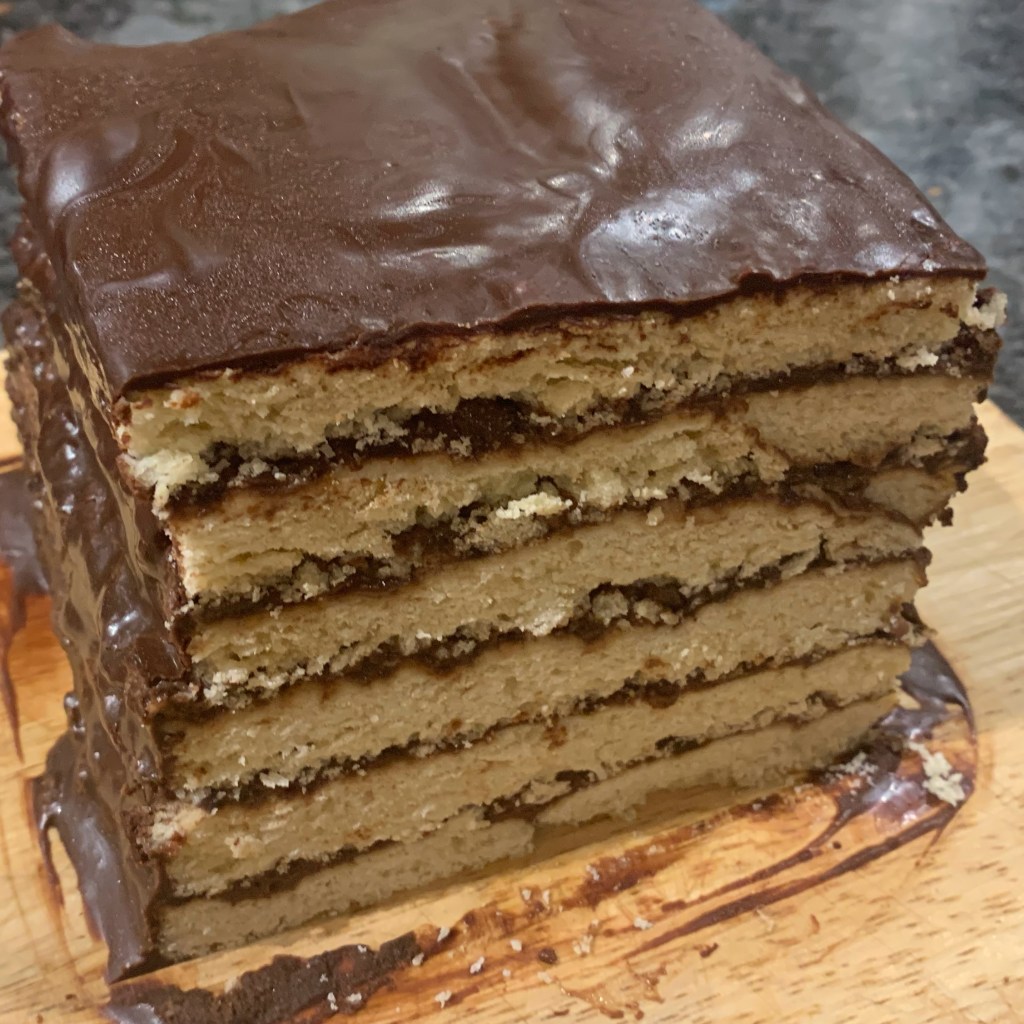
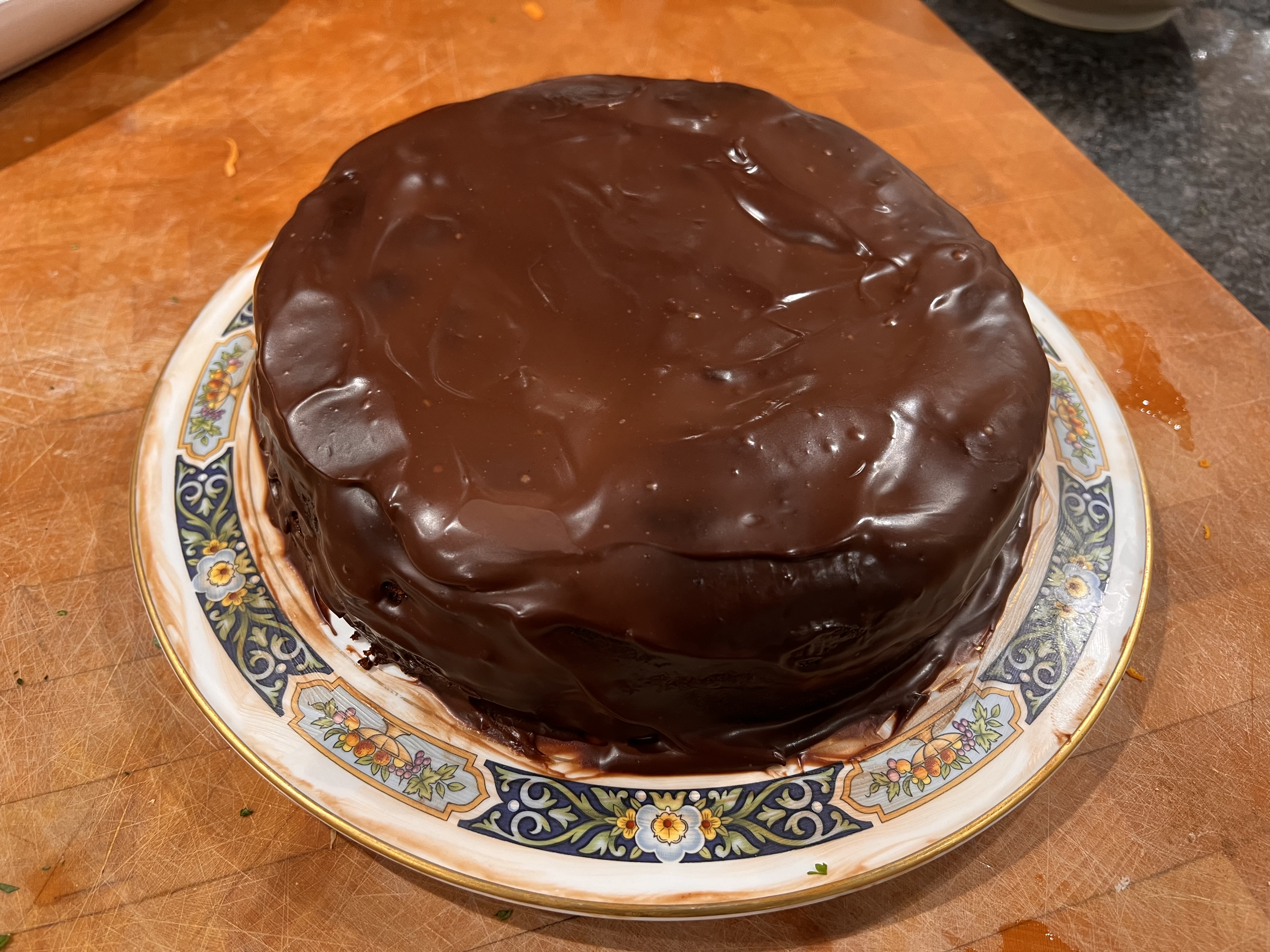
Sachertorte revisited – for diabetics

Sachertorte revisited – for diabetics

The words “diabetic baker” are something of an oxymoron: diabetics really shouldn’t be eating high carbohydrate foods, which pretty much rules out bread, cakes, biscuits, pies, pastries and just about any kind of baked goods. That makes my series of blog posts on baked goods from around the world a totally inappropriate project to have done (or, viewed more positively, a rash thumbing of my nose at the health gods).

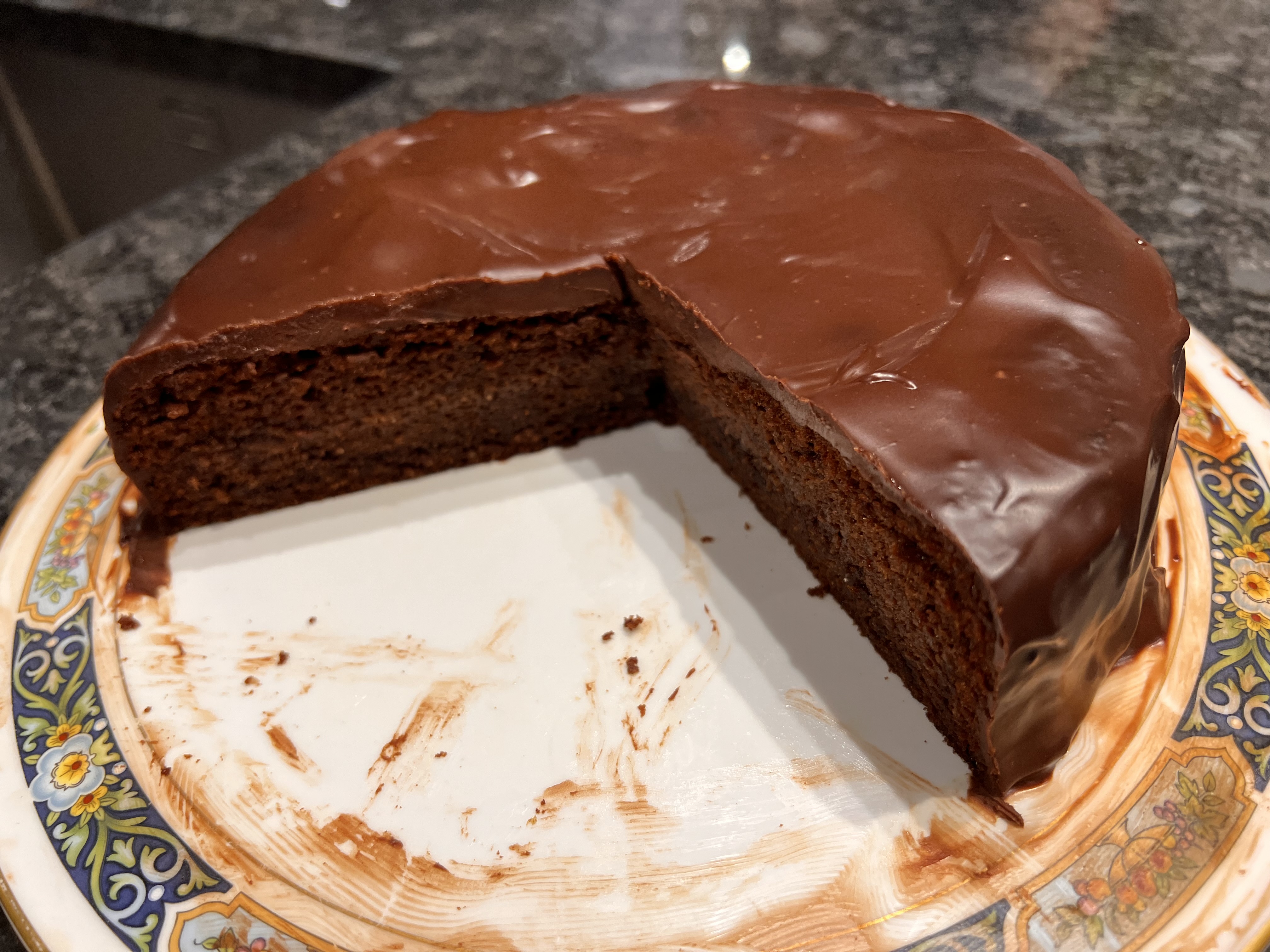
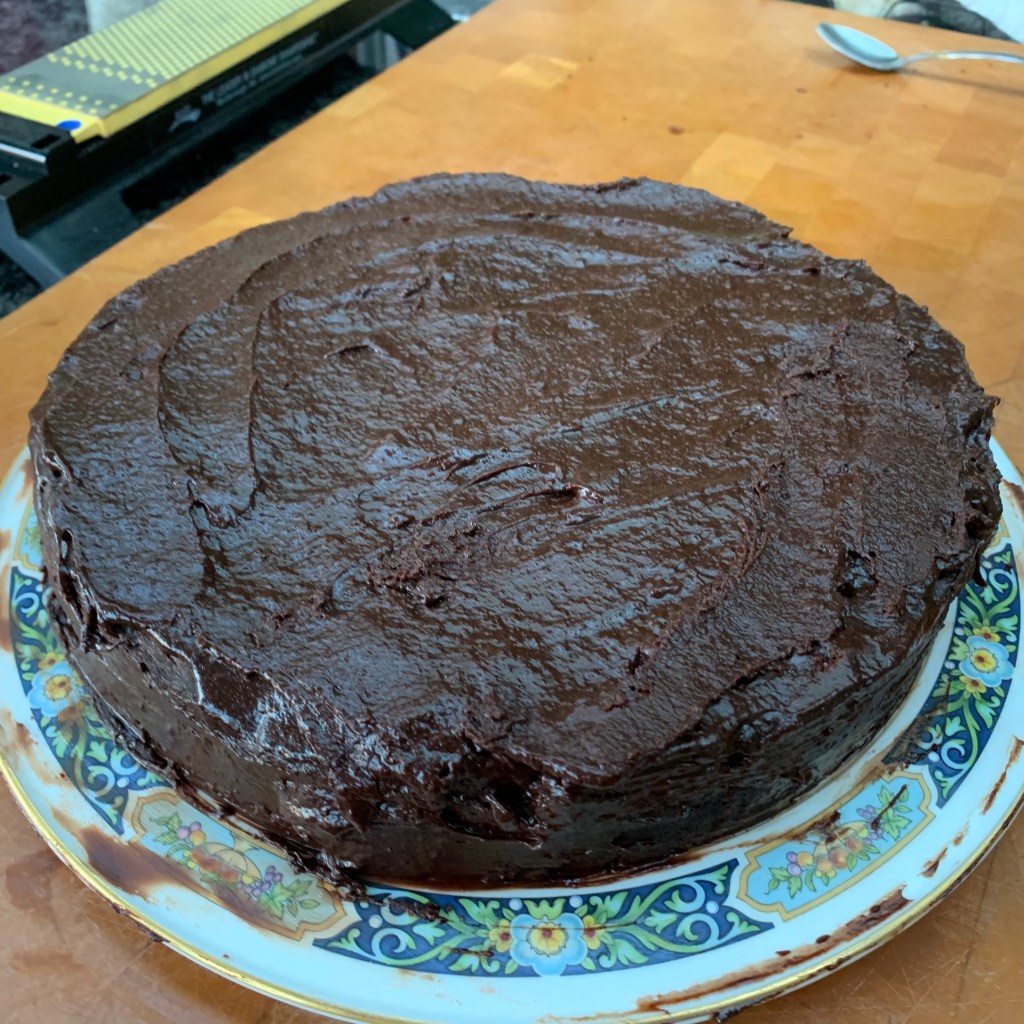
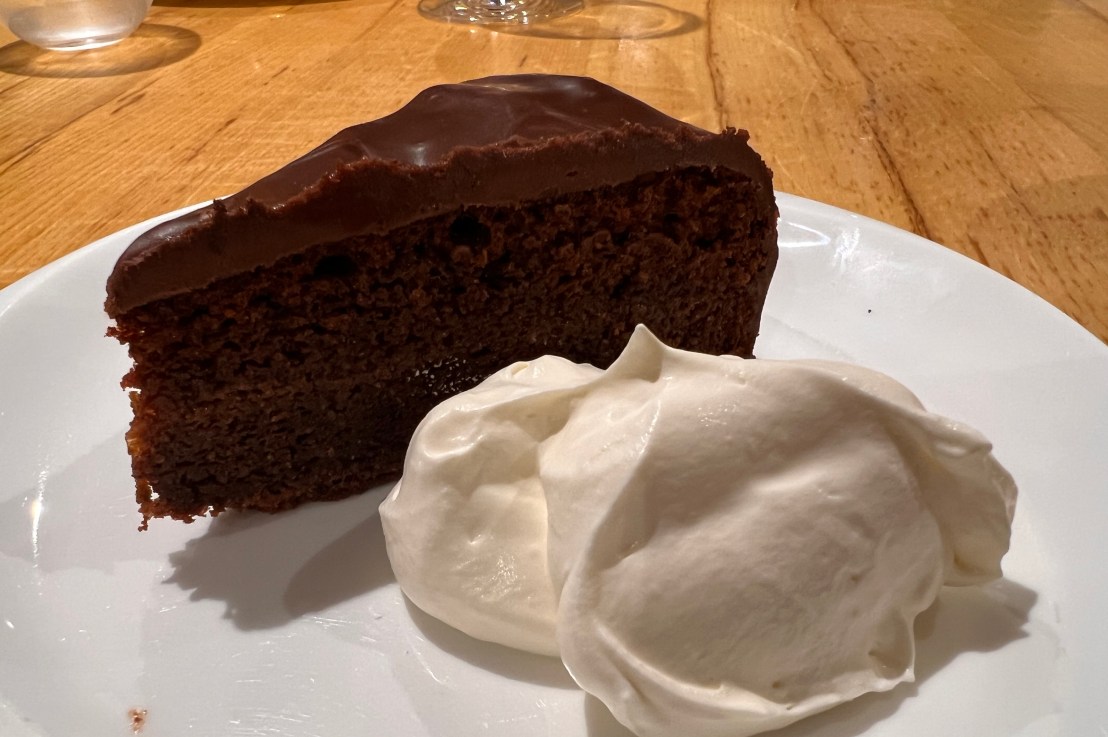
But there are times when you can cheat. I just ran an experiment to see how far I could minimise the carbohydrate content of my favourite cake – Sachertorte – and it was outstandingly successful.

Starting with my recipe for normal Sachertorte, I did four things:

  1. Replace the flour with ground almonds
  2. Replace the sugar with allulose
  3. Replace the icing with a chocolate ganache
  4. Keep careful control of the amount of apricot jam in the filling

With more time available and apricots in season, I could have made my own apricot compote with allulose, but there really wasn’t time.

If you aren’t aware of allulose (aka Psicose or D-ribo-2-hexulose): it’s a naturally occurring sugar which you can’t digest normally. It tastes something like 70% as sweet as sugar. I find that it has little or none of the aftertaste of most non-sugar sweeteners – and in a recipe with this one, with its strong-tasting dark chocolate, I could detect no aftertaste whatsoever. People have questioned whether there any health risks, but the US FDA have approved it with a maximum consumption of 33-36g per day for a 60kg adult (a portion of this cake uses under 20g, so I reckon it looks OK). 

Comparing the two recipes, the carbohydrate budget looks like this. In rough numbers, the new recipe’s carbohydrate count is a quarter of the standard one.

NormalDiabeticSaving
Dark chocolate 300g90g90g
Sugar to allulose150g0150g
Flour to ground almonds76g19g57g
Remove icing200g0200g
Apricot jam 90g to 60g53g35g18g
Total for a 1kg cake569g144g425g
Total for a (generous) 125g portion71g18g53g

I can’t fault the results. My family proclaimed this to be better than the original, which we attribute to liking the extra flavour of the almonds and preferring the creaminess of the ganache to the extra sweetness of the chocolate icing. It’s a winner.

For completeness, here’s the modified recipe. Make it in a greased, 8-9 inch, removable-rim pan.

Ingredients

Cake

  • 150g dark chocolate (70-80% cocoa solids)
  • 150g allulose
  • 30g granulated sugar
  • 170g butter, softened
  • 100g ground almonds
  • 6 eggs
  • 60g apricot jam mixed with the juice of half a lemon
  • 1/2 tsp baking powder
  • vanilla essence or vanilla paste to taste (different brands are so different in strength that I can’t give an amount)

Ganache

  • 150g dark chocolate (70-80% cocoa solids)
  • 200g double cream

Method

Cake

Preheat the oven to 160°C fan. Grease the sides of an 8-9 inch, removable-rim cake tin with butter and line the bottom with baking paper or parchment.

  1. Separate the eggs into yolks and whites
  2. Melt 150g of the chocolate in a double boiler. Then leave it to cool.
  3. Cream 120g of the allulose and the butter until the mixture is fluffy.
  4. Beat in the egg yolks gradually until the mixture is light in colour.
  5. Add the melted cooled chocolate.
  6. Add the ground almonds. Add the baking powder and mix everything thoroughly.
  7. Beat the egg whites until they are beginning to be stiff. Add the remaining 30g of allulose and beat on maximum speed until stiff but not dry.
  8. Fold the resulting meringue mix into the cake mixture, about a fifth at a time. The weight of the almond-rich mixture will make this trickier than for a normal cake.
  9. Bake the mixture in the pan for around 40 minutes.
  10. Remove and cool on a rack.
  11. Optionally, slice the top dome from the cake and set aside. Slice the remaining cake in half. Spread the jam on the bottom half and reassemble (optionally, spread jam on the top of the cake also).

Ganache

  1. Break or chop the chocolate into small pieces (less than 1cm square) and put in a reasonably heatproof bowl. Of course, if you’ve bought your chocolate in the form of chips/pellets, this has already been done for you.
  2. Bring the cream close to the boil, and pour it over the chocolate.
  3. Stir rapidly and continuously until the mixture is smooth.
  4. Cool enough that the ganache no longer runs really easily, but is still spreadable with a glossy finish.
  5. Spread over your cake.
  6. Leave to cool completely.
Luxury baking: Mushroom and Comté tart

Luxury baking: Mushroom and Comté tart

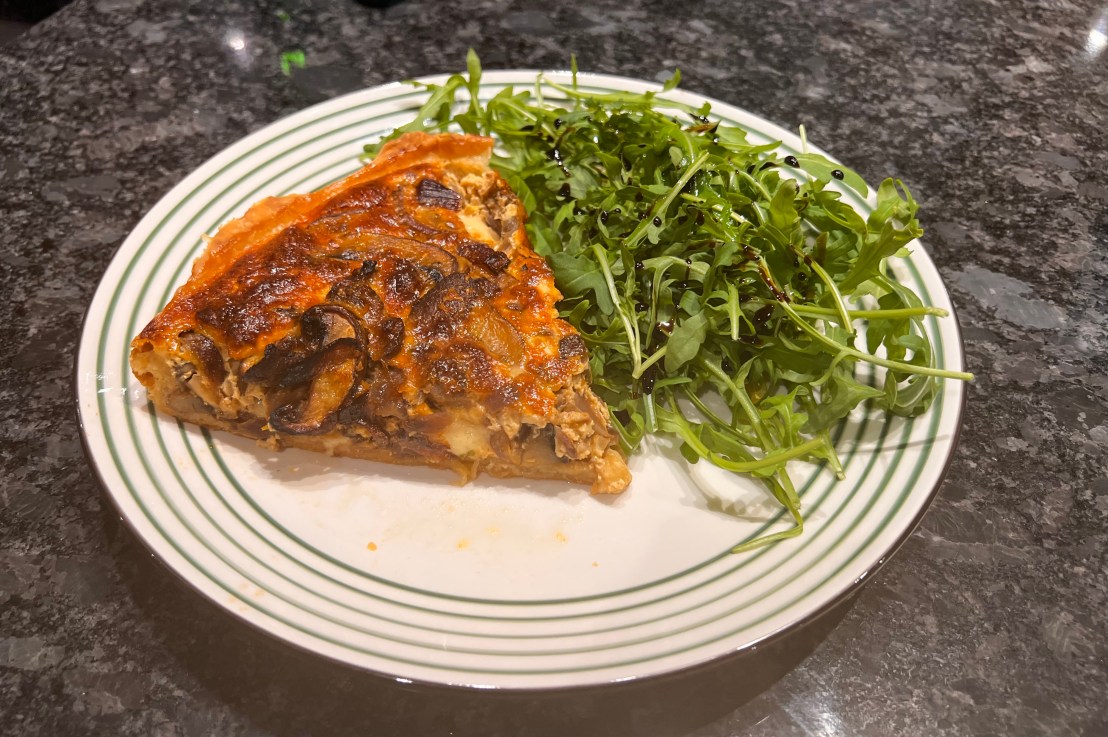
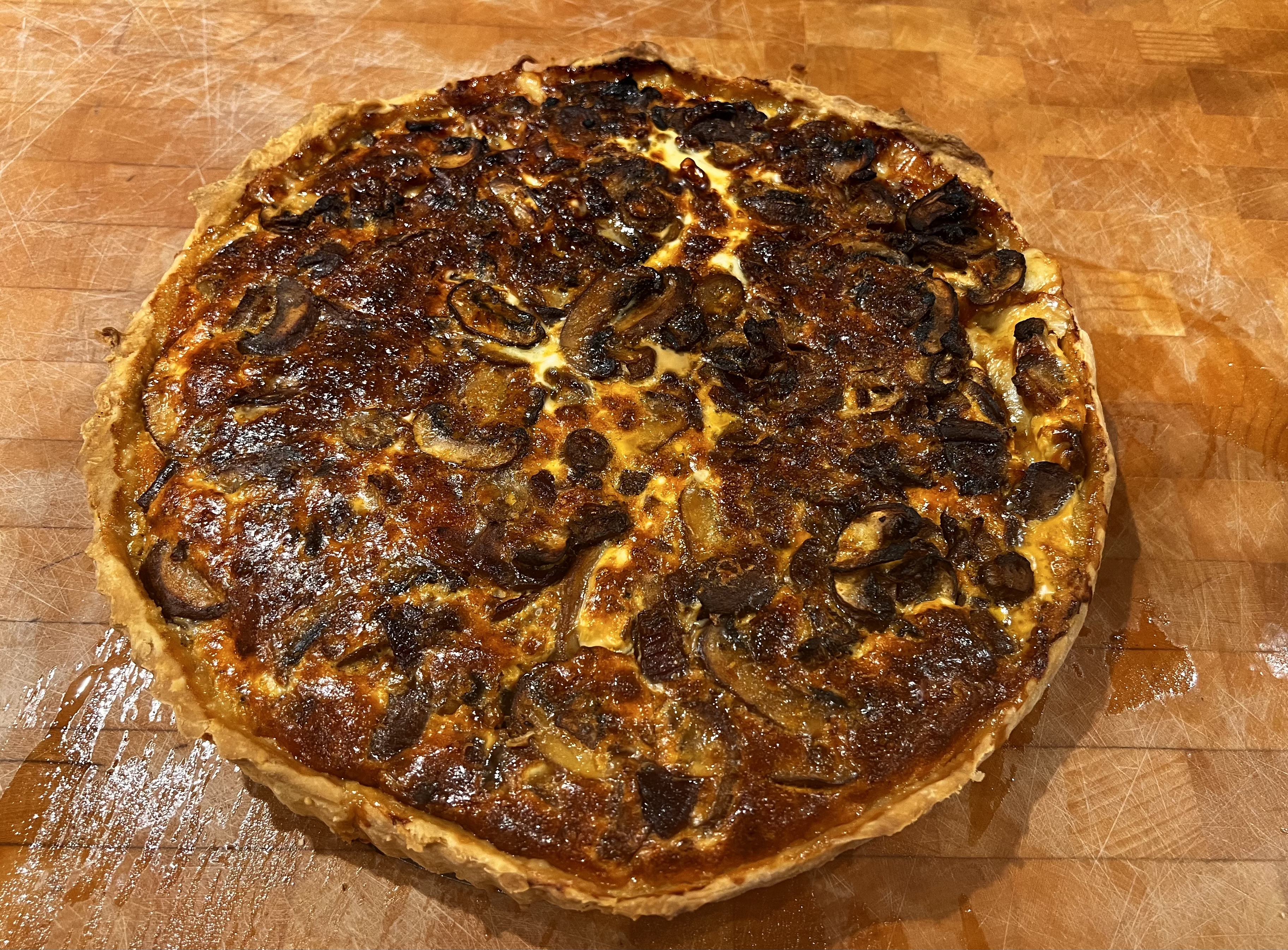
For anyone old enough to remember the 80s and Bruce Feirstein’s Real Men Don’t Eat Quiche: this particular real man not only eats quiche but also loves making them. But I’m picky about what sort of quiche: I’m not particularly fond of the thick version that’s essentially pastry-coated set custard, possibly with a few flecks of bacon. The version I love has thin, crisp pastry and is packed with flavourful ingredients (the egg binds it all together, but isn’t the principal component of the dish) and it’s backed to a gorgeous golden brown.

I make a bunch of variations on this particular theme. This Mushroom and Comté tart is my all time favourite dish to serve to vegetarian guests, but I also make versions with different cheeses and various nuts, peppers or other vegetables. If I’m not serving vegetarians, I will often add bacon or chorizo; if in the mood for spice, different chilies and peppercorns can put in an appearance.

This recipe is on the luxury end of ingredients: the truffle oil at the end is very optional; Cheddar is a perfectly good substitute for the Comté, albeit with a different flavour profile. The dried porcini can get very expensive in the UK (we buy them in bulk during trips to Italy): a teaspoon or two of white miso paste will add plenty of extra umami at noticeably lower price.

With the aid of a side salad or two, the quantities here will serve six generously as a main course and, depending on how hungry your guests are, will do 8-12 for a starter.

For the pastry, I use a stand mixer to combine the butter and flour. You can also use a food processor, or you can just use your fingers; whichever you choose, try to keep the ingredients cold.

Pastry

  • 250g plain flour (preferably OO)
  • 2g salt
  • 125g unsalted butter, cold from fridge
  • 30g yoghurt (I used Greek)
  • 2 eggs
  1. Put flour and salt into a mixing bowl. Cut the butter into small cubes (perhaps 5mm) and add them.
  2. Mix the flour and butter until it reaches the texture of coarse breadcrumbs.
  3. In a small bowl, beat the eggs and yoghurt together, then add to the flour/butter mixture.
  4. Mix until well combined into a smooth dough. Knead a few times with your hands, wrap in cling film and put in the fridge, preferably for 30 minutes or more (this will develop the gluten which will make the pastry stretchy and easier to roll).

Filling

  • Dried porcini to taste (I use around 15-20g)
  • Olive oil for frying – perhaps 20ml
  • 1 medium red onion (could use brown; could use a larger onion – 200g peeled weight)
  • 400g chestnut mushrooms
  • 1 tsp paprika (or choose your favourite seasoning: I’ve used different chilies and chili flakes; the best was some peppercorns my daughter brought home from a holiday in Madagascar).
  • 1 tsp dried oregano
  • A handful of garlic chives (optional, or could choose some other herb)
  • Salt and pepper to taste
  1. Chop the onions finely
  2. Slice the mushrooms
  3. In a small bowl, cover the dried porcini in hot water and leave them for a few minutes to rehydrate
  4. In a deep frying pan or wok on medium heat, fry the onions until transparent
  5. Drain the porcini, add them and fry for another minute or so
  6. Add the sliced mushrooms, paprika and dried oregano; fry until they are cooked and most of the liquid has evaporated.
  7. Add the garlic chives, salt and pepper and mix; take off the heat

Final assembly

  • 200g Comté cheese (Gruyère works fine; so would Beaufort; Cheddar would be a good cheaper alternative)
  • 4 eggs
  • Butter for greasing the tart tin
  • Flour for rolling
  • 200 ml milk
  • 30g Parmesan, grated
  • Truffle oil (optional)
  1. Preheat oven to 200℃ fan
  2. Chop the cheese into cubes, around 1cm.
  3. Separate one egg: you’ll put the white into a small bowl and the yolk into a medium-to-large bowl. Put the other three eggs in with the yolk.
  4. Grease your tart tin with butter
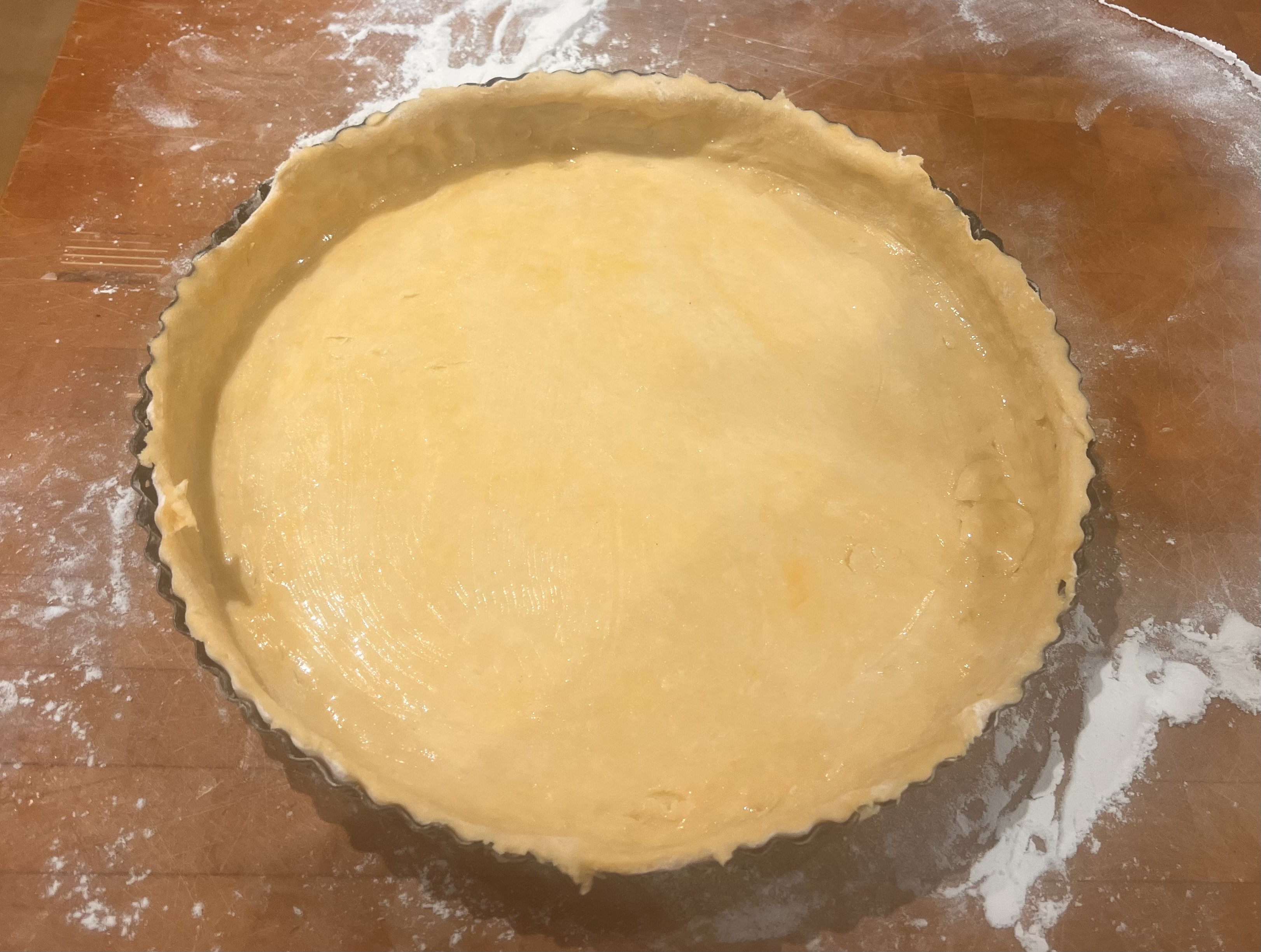
  5. Roll out your pastry and line the tart tin. Prick the bottom with a fork.
  6. Brush the pastry with the egg white, then put any left over egg white in with the rest of the eggs.
  7. Beat the eggs; add the milk and mix; add the Parmesan and mix
  8. Scatter the cheese cubes evenly across the pastry
  9. Scatter the mushroom filling evenly across the spaces pastry, discarding any excess liquid.
  10. Pour the egg/milk mixture over to fill the remaining gaps
  11. Bake until the surface is a deep golden brown, around 35 minutes
  12. Optionally: drizzle the tart with truffle oil
  13. Serve lukewarm to hot. A little rocket, oil and aceto on the side makes a good garnish.
Flourless chocolate and almond cake for Passover

Flourless chocolate and almond cake for Passover

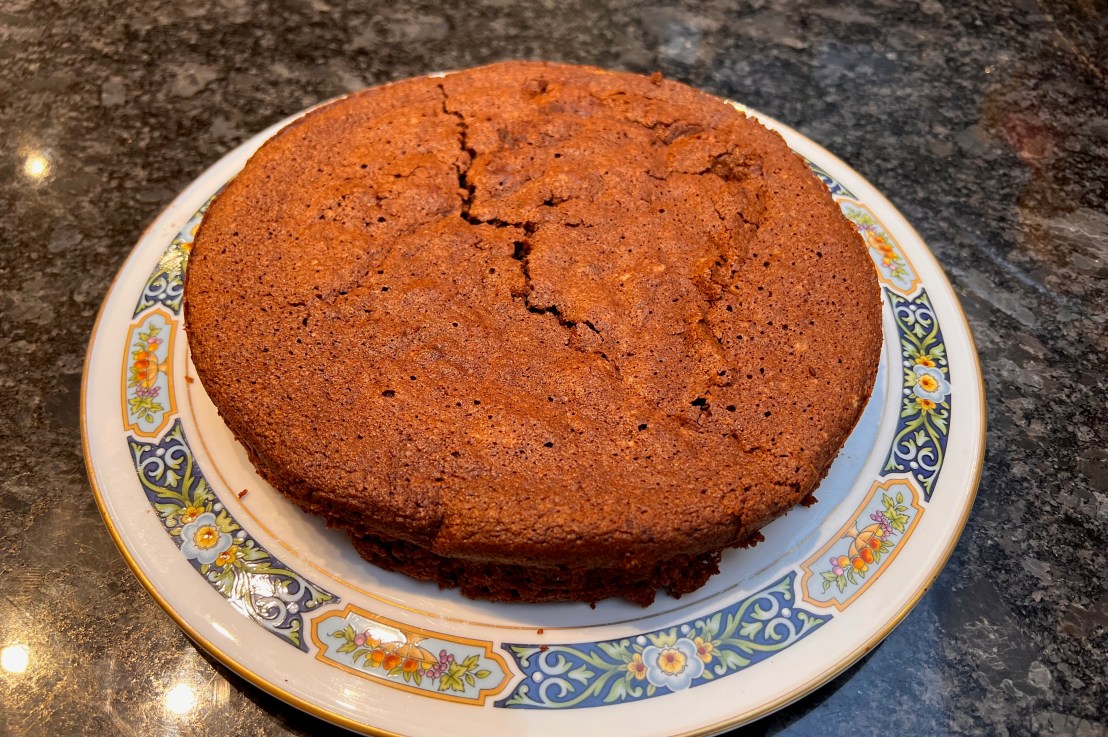
Sachertorte is my favourite chocolate cake, but since it’s based on flour, you can’t serve it at Passover. You can, however, serve this flourless chocolate almond cake, whose recipe was passed down to us by my late mother-in-law and is a firm family favourite (Joan was much loved, by the way – very much the opposite of the Les Dawson stereotype).

  • 3 eggs
  • 100g dark chocolate (as usual, my favourite is 70% Chocolat Menier)
  • 100g sugar
  • 100g ground almonds
  • 100g butter, plus some for greasing
  • 15ml (1tbsp) brandy or rum, optional
  • A small cup of espresso coffee (I made 60ml or so). An alternative would be a teaspoon of instant coffee dissolved in 30ml or so of water
  1. Preheat oven to 135℃ fan
  2. Line the base of a 23cm (or so) cake tin with baking paper, grease the sides with butter
  3. Melt the chocolate in a double boiler. If the butter is hard, chop it into small pieces.
  4. Add the butter and mix until melted
  5. Reserve 25g of the sugar in a small bowl
  6. Add the remaining 75g of sugar, ground almonds, coffee and brandy to the chocolate mixture and stir until smooth
  7. Remove the top of the double boiler from the heat. If you’re feeling impatient, cool it in an ice bath. Otherwise, just wait for it to be not too much above room temperature: you don’t want it scrambling the egg yolks.
  8. Separate the eggs into two bowls
  9. Whisk the whites until soft, add the 25g of sugar, and whisk until you have a stiff meringue
  10. Whisk the yolks until foamy, then add the chocolate mixture and stir
  11. Fold in the meringue until you’ve got rid of any blobs of egg white and any swirls of dark chocolate.
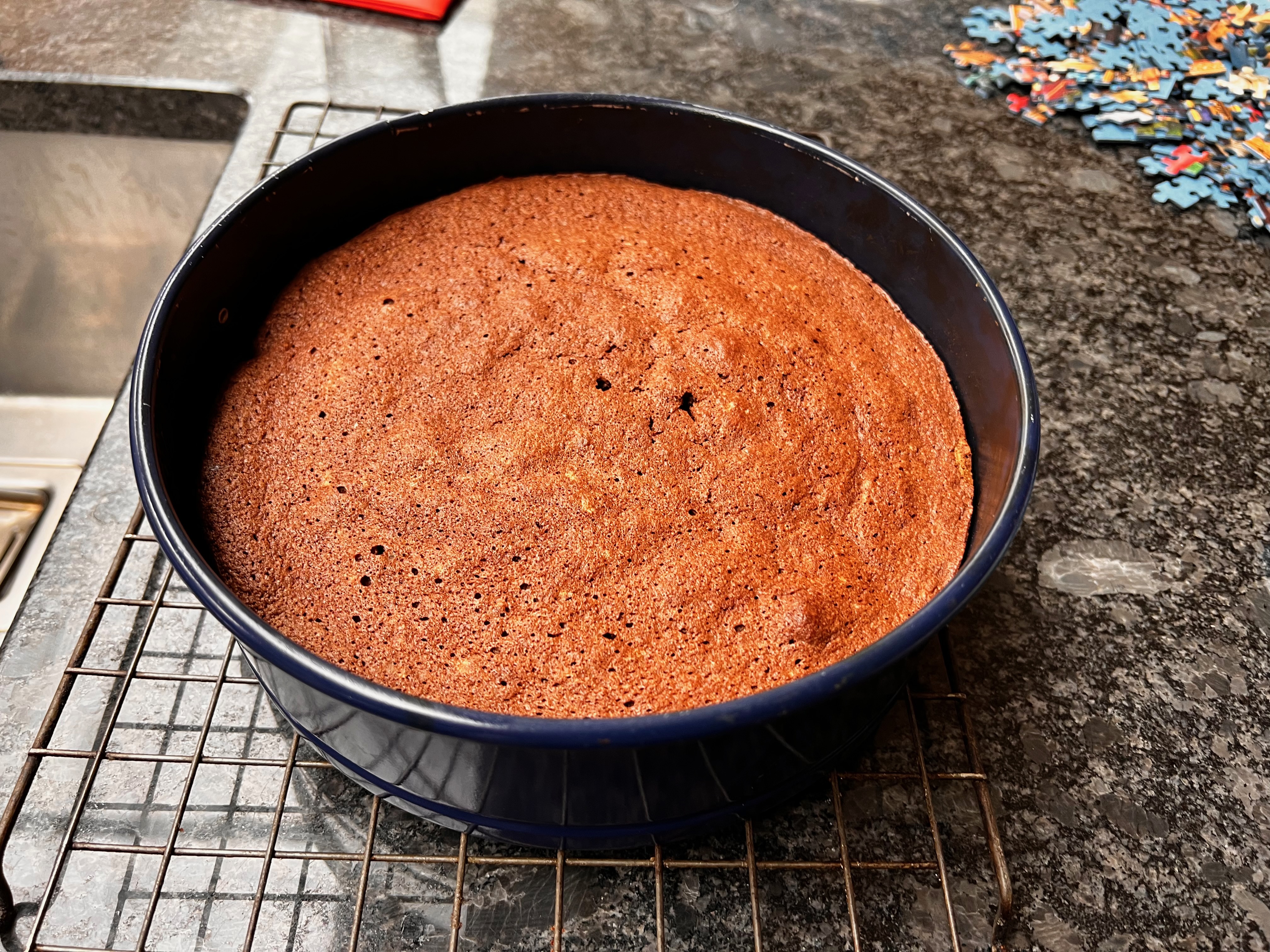
  12. Pour into your cake tin and bake. Everyone’s oven is different: I gave the cake around 40 minutes, opened to check it with a skewer, and then gave it another 10 when the skewer didn’t come out quite dry.
  13. Cool on a rack for as long as you can bear it.
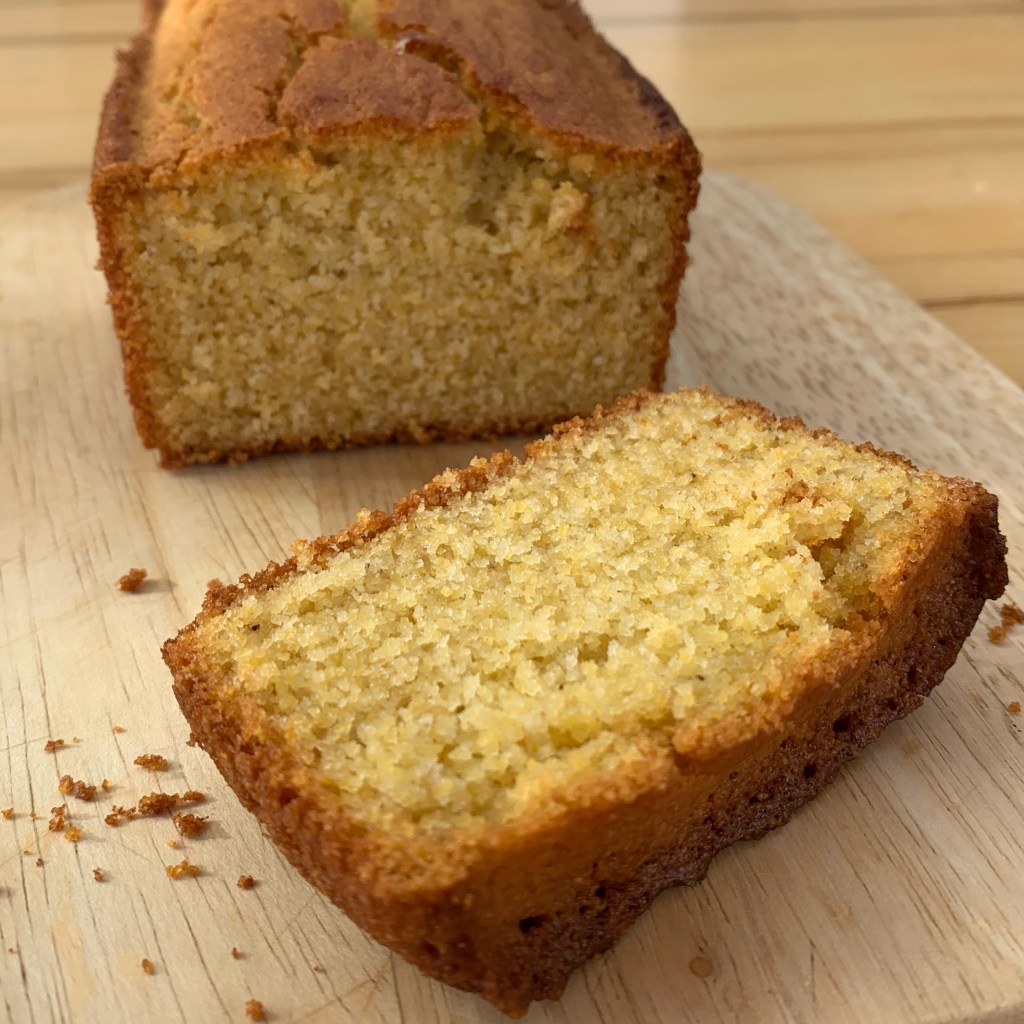
  14. Serve (with whipped cream, if you’re feeling Viennese).

Around the world in 80 bakes: the index

OK, so there are a few dubious categorisations here to make the images line up. But I’ve done my best.

Biscuits (aka cookies)

Breads (loaves)

Breads – sweet

Cakes

Flatbreads

Pastries – sweet

Savoury dishes

Other

Around the world in 80 bakes, no.80: back home with my Spelt Sourdough

Around the world in 80 bakes, no.80: back home with my Spelt Sourdough

For my 80th and final bake, it’s time to come back to my home in London (which is very lovely, if a somewhat humbler edifice than the Reform Club, Phileas Fogg’s final destination).

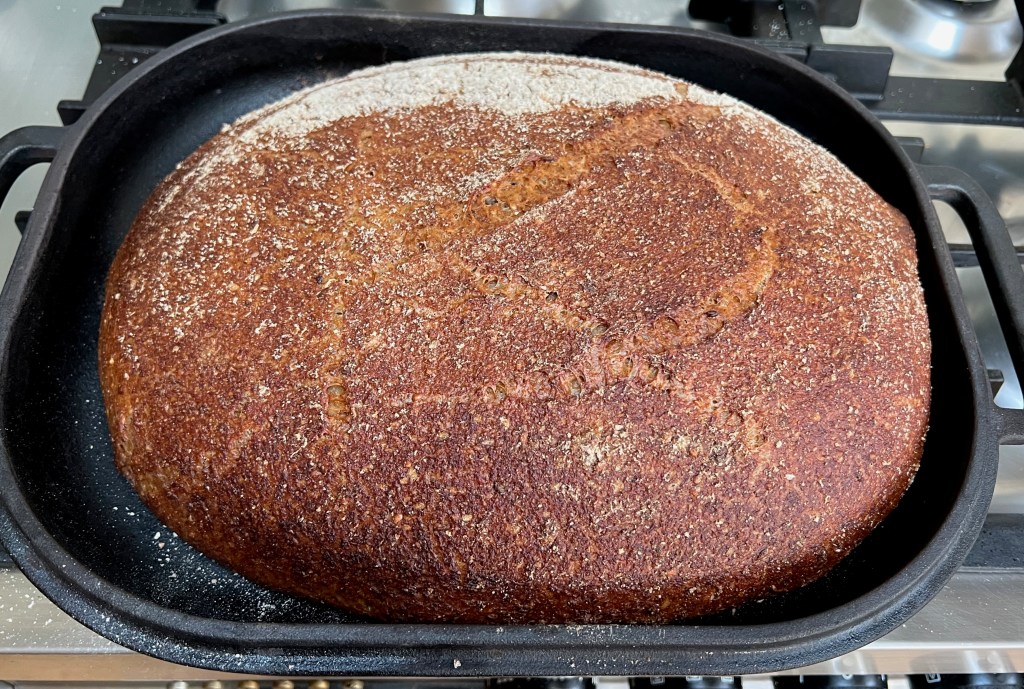
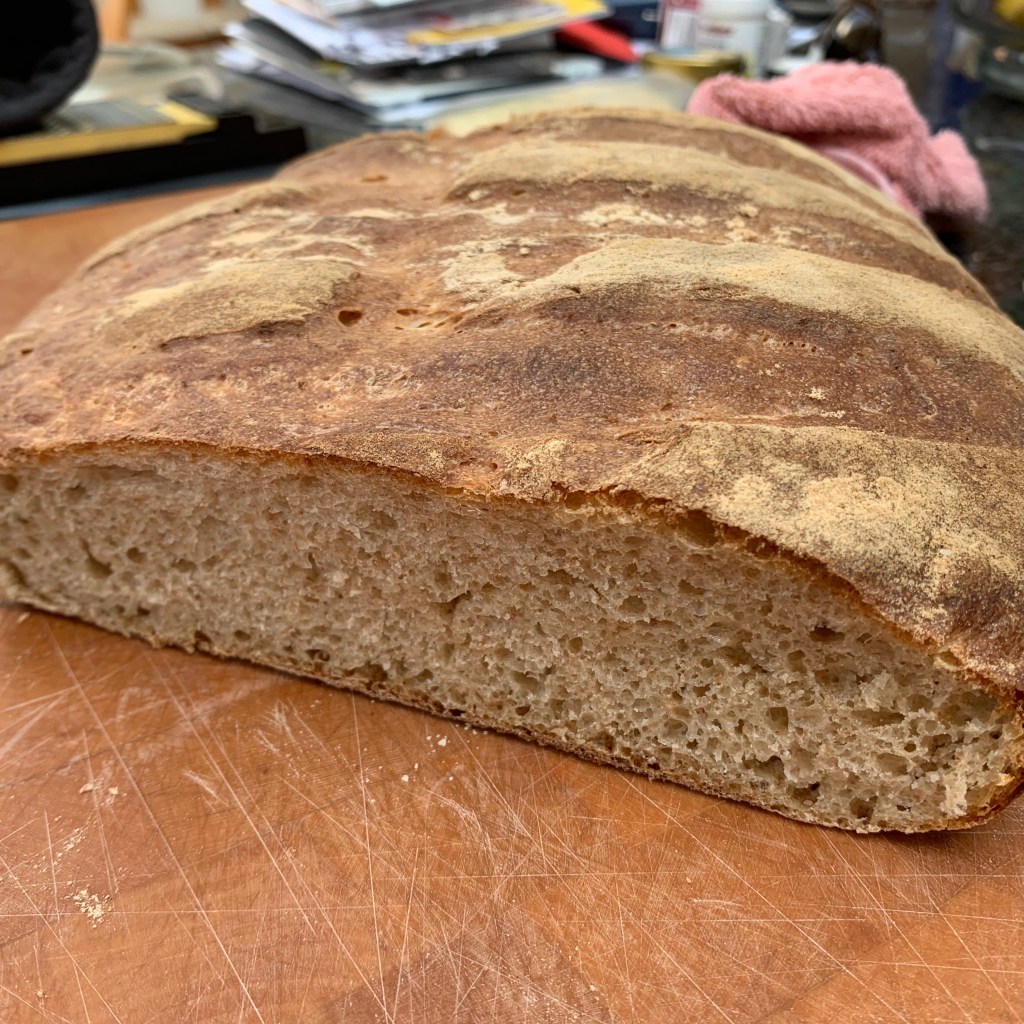
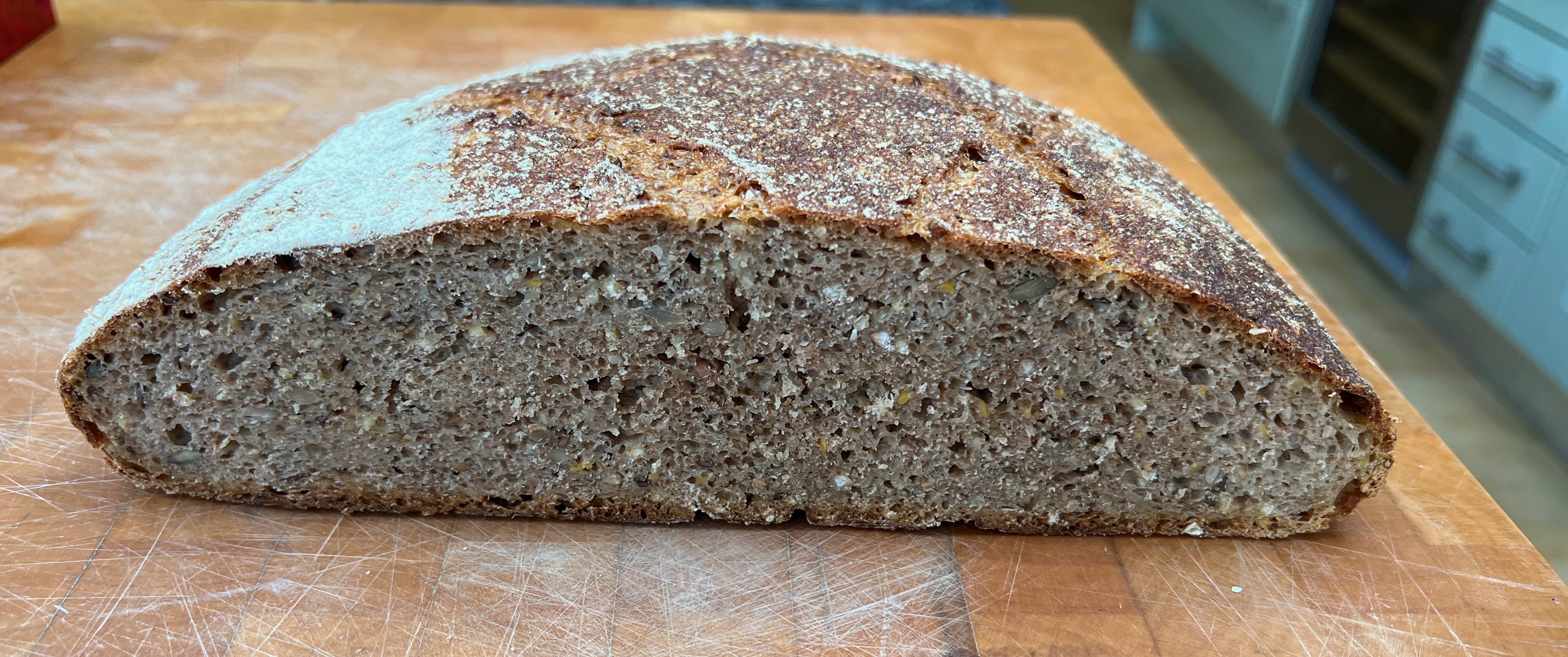
This sourdough recipe is the one that I’ve been making, in variations, almost every week since October 2019. I’ve made breads with more intense flavours (Estonian black bread and its Russian cousin Borodinsky bread are probably my favourites) and I’ve made breads with more wonderful texture (Persian Nân Barbari is the clear winner here). But this recipe fits into my working life with no fuss, particularly now that I have a high number of days working from home: the elapsed time is long, but the amount of actual work (including washing up effort, which seems to get forgotten in most cookbooks) has been pared down to the minimum. And it produces a healthy bread which is packed with flavour and which I’m happy to eat week after week.

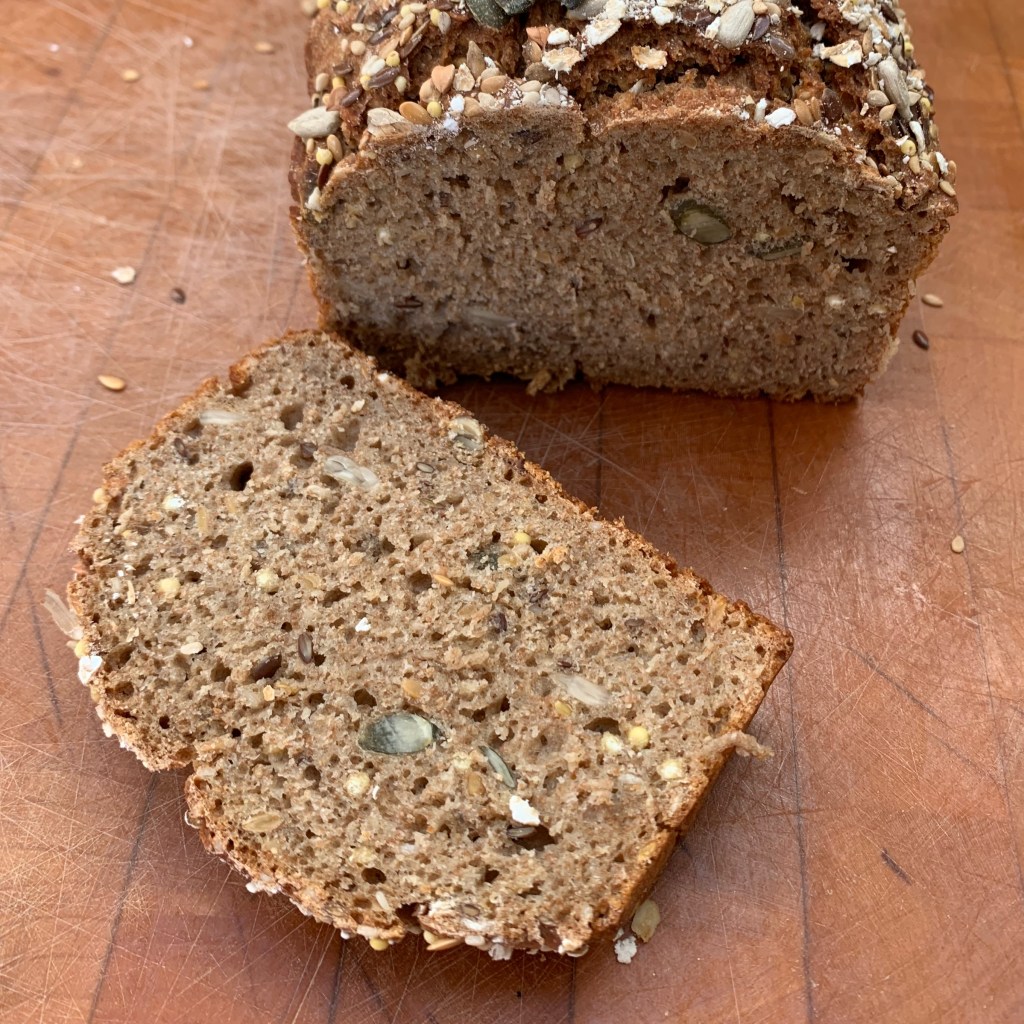
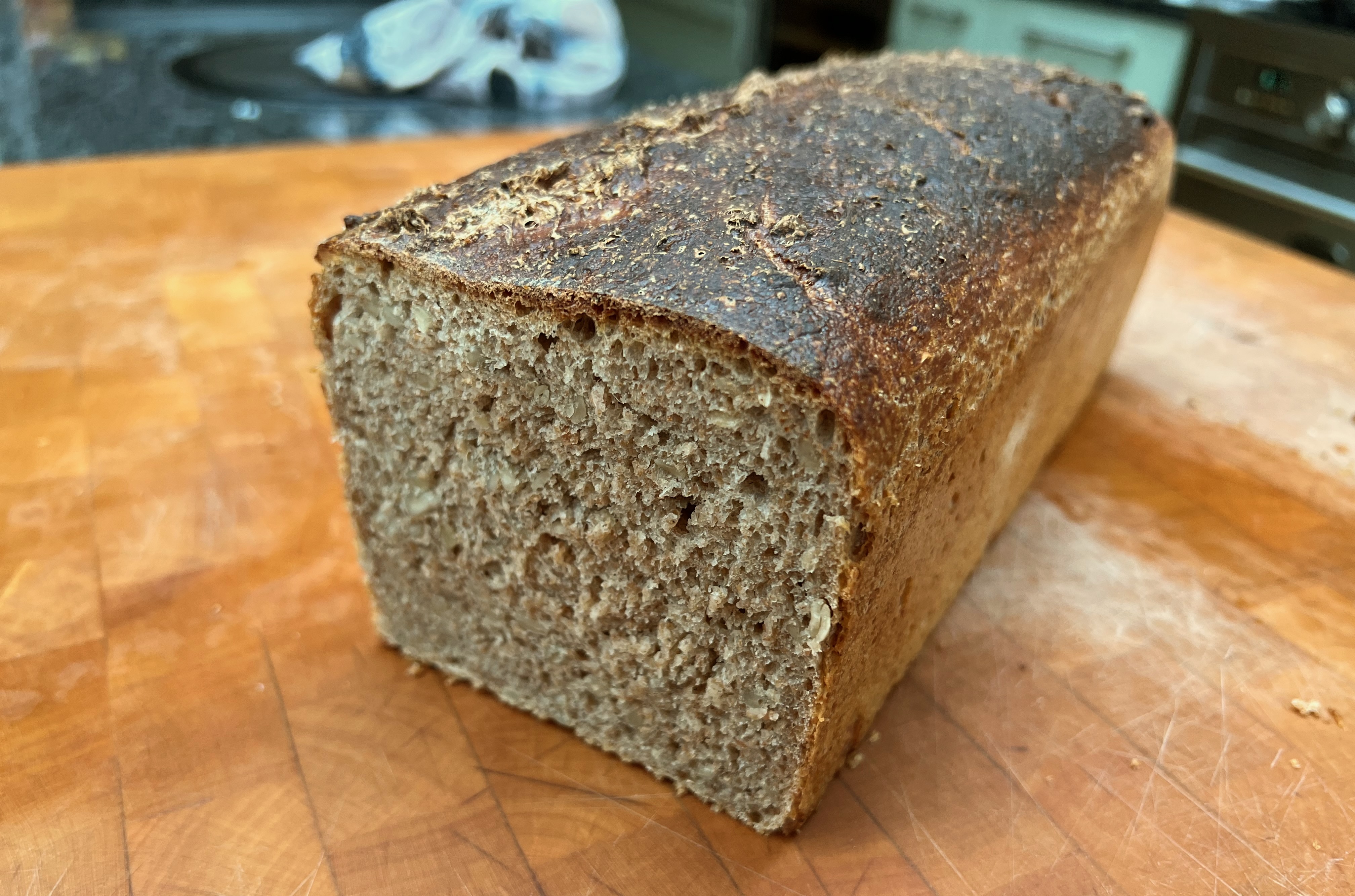
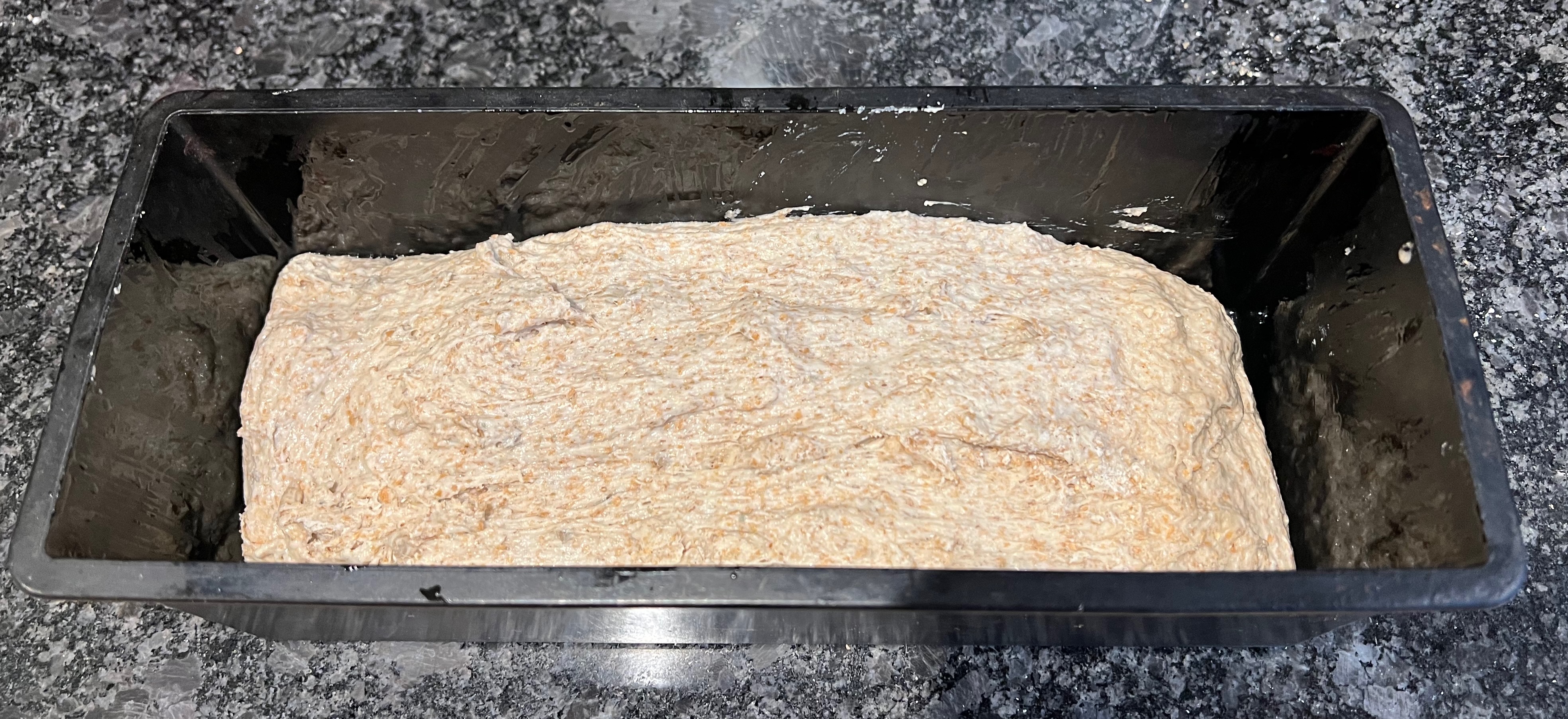
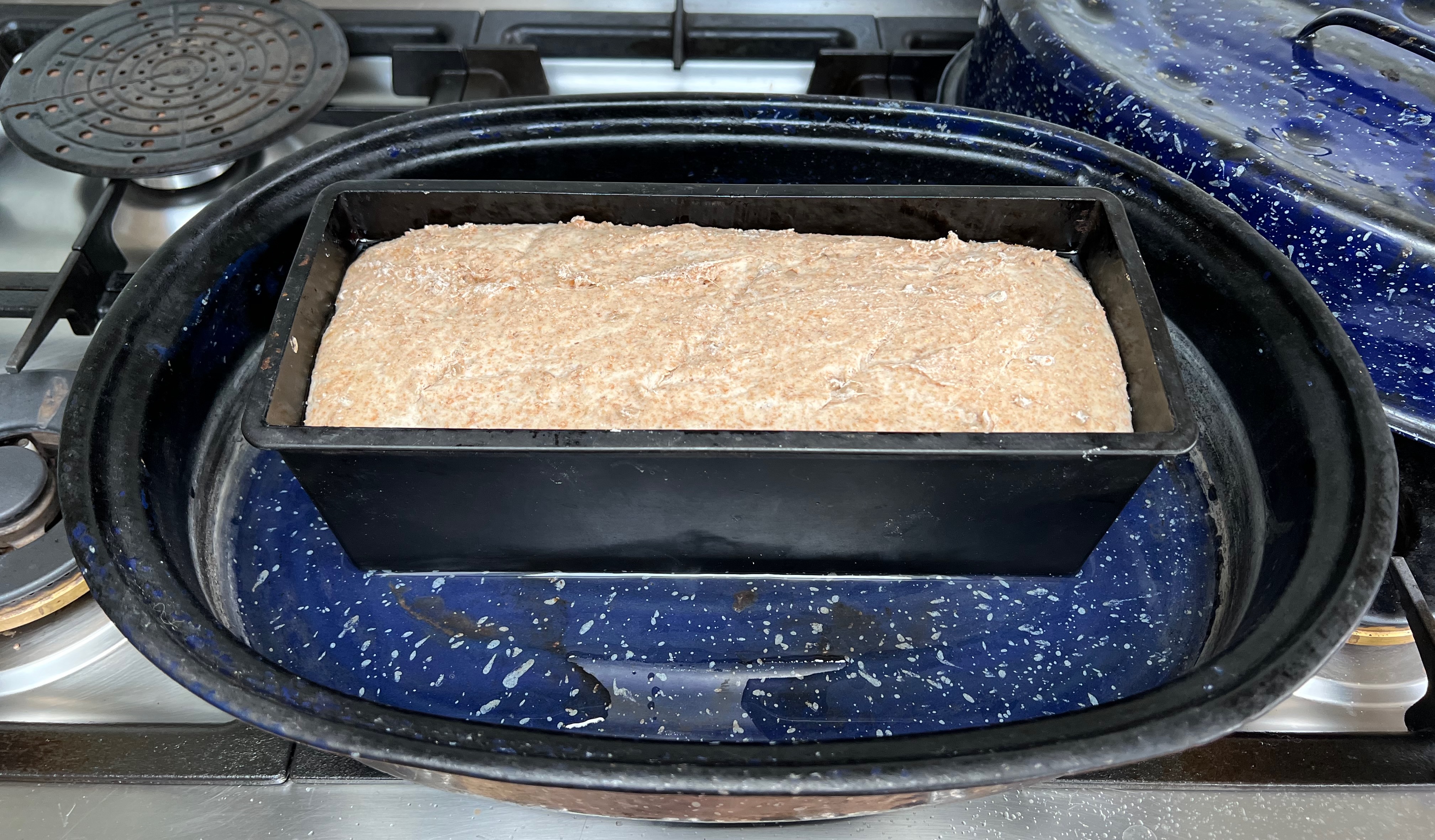
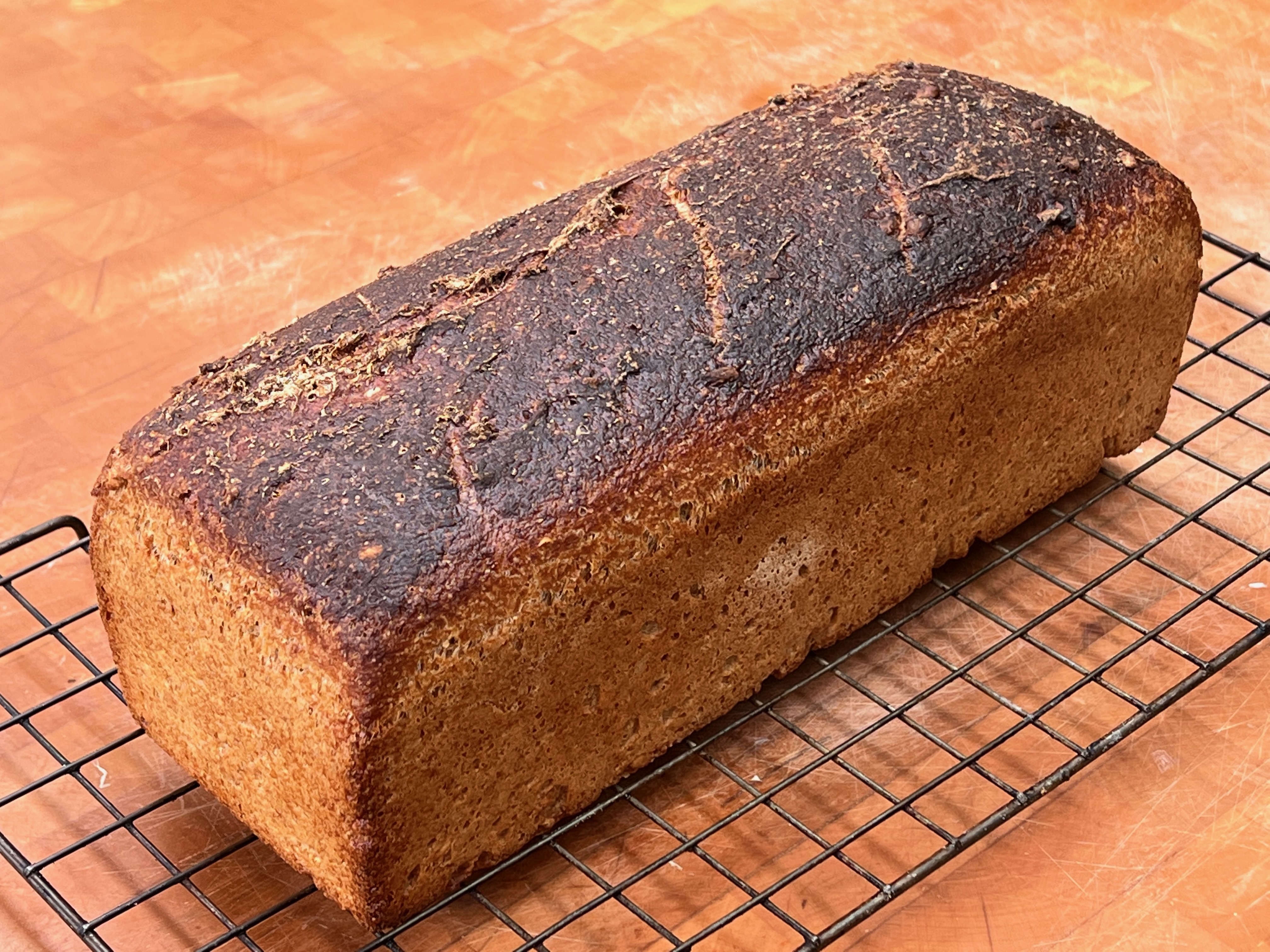
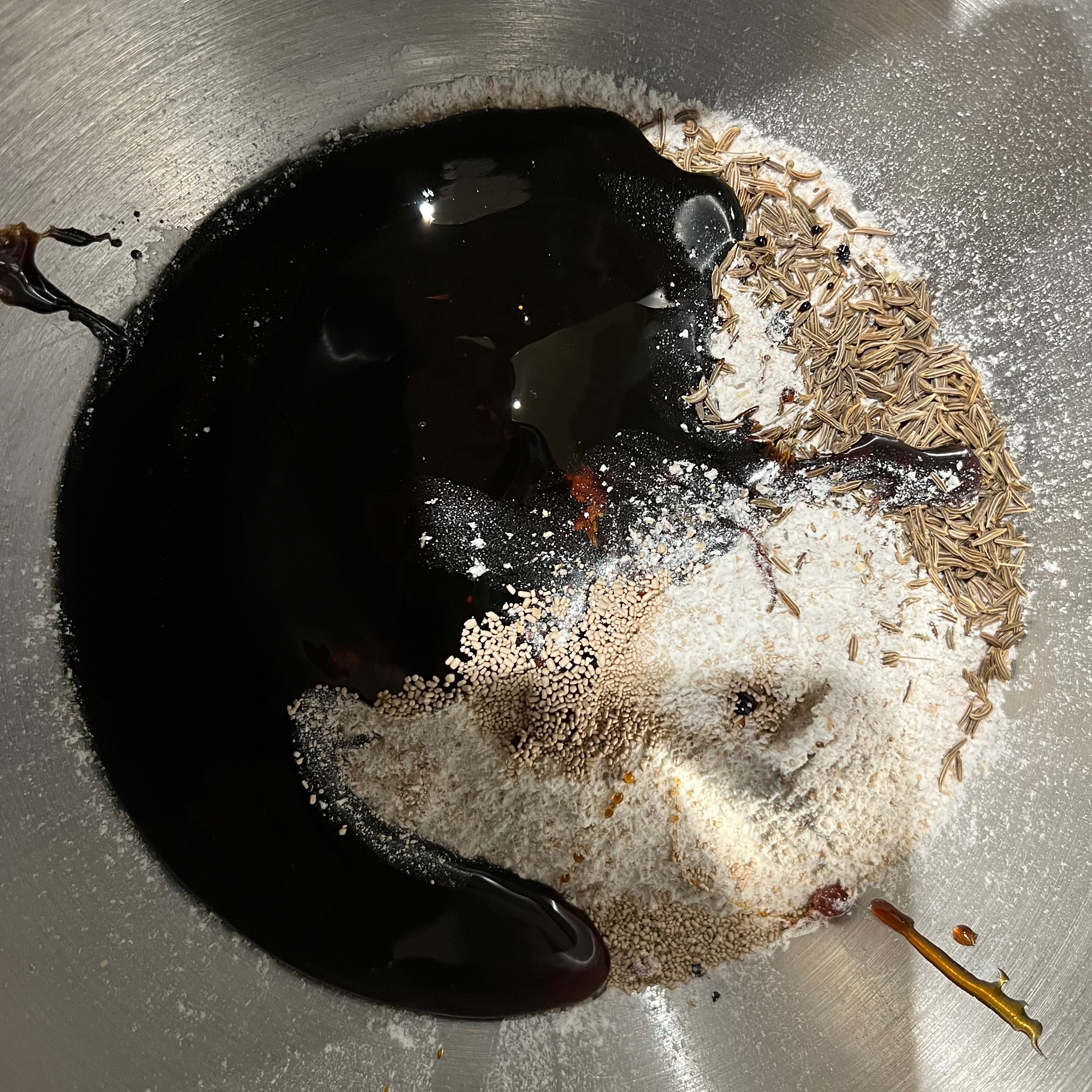
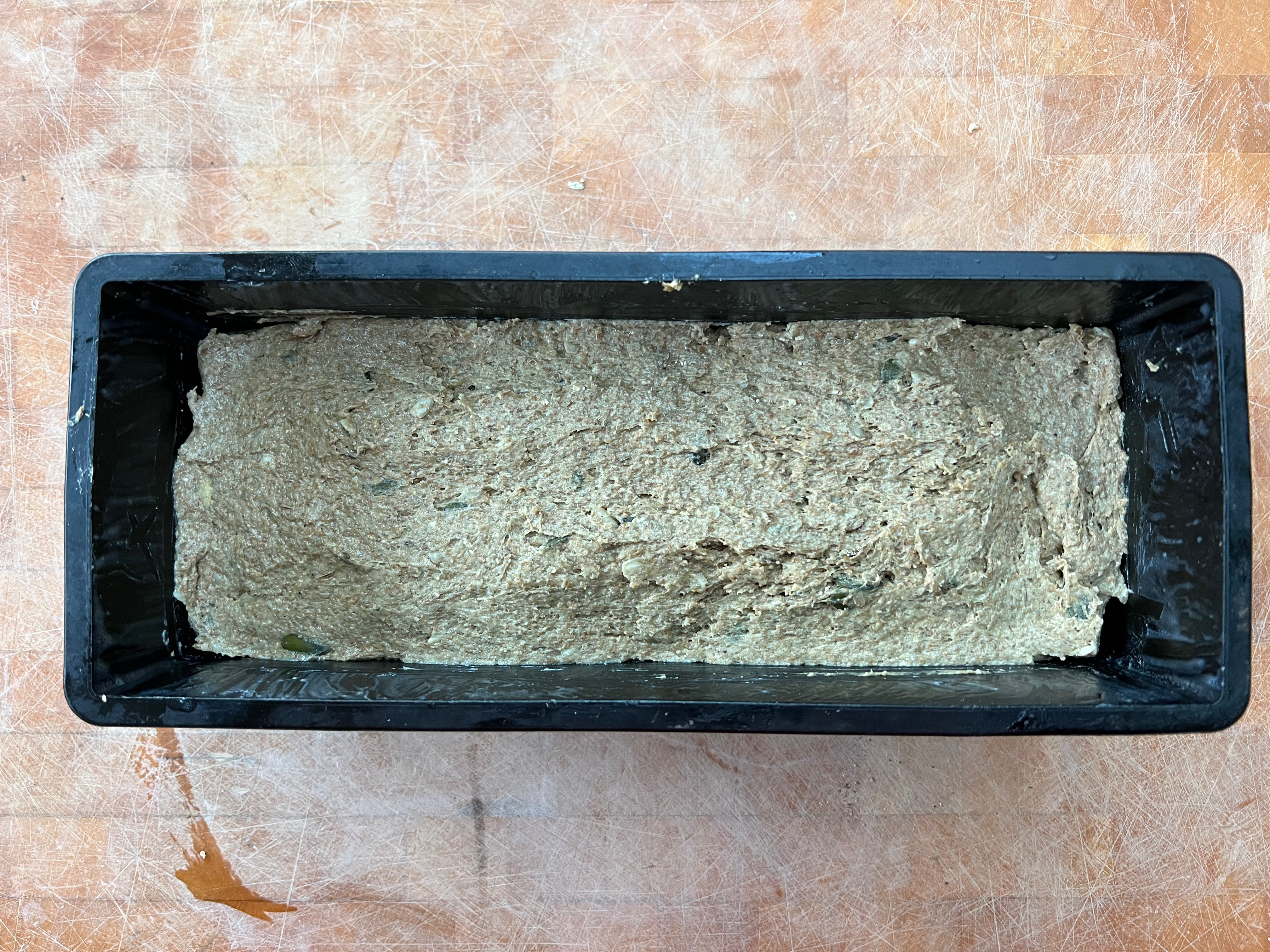
There are several variations possible. The flour mixture in this post is 50/50 strong white/wholemeal spelt, but you can vary the flavour by replacing the spelt by either dark or light rye or wholemeal wheat. Or you can go 60/40 for a less dense, more pillowy result. Or you can increase the amount of seven seed mix, or ditch it altogether and/or replace it with 20-30g of caraway seeds (whose flavour is very much a traditional accompaniment to light rye). In the loaf tin version pictured here, I had run out of seven seed mix so I used sunflower seeds only.

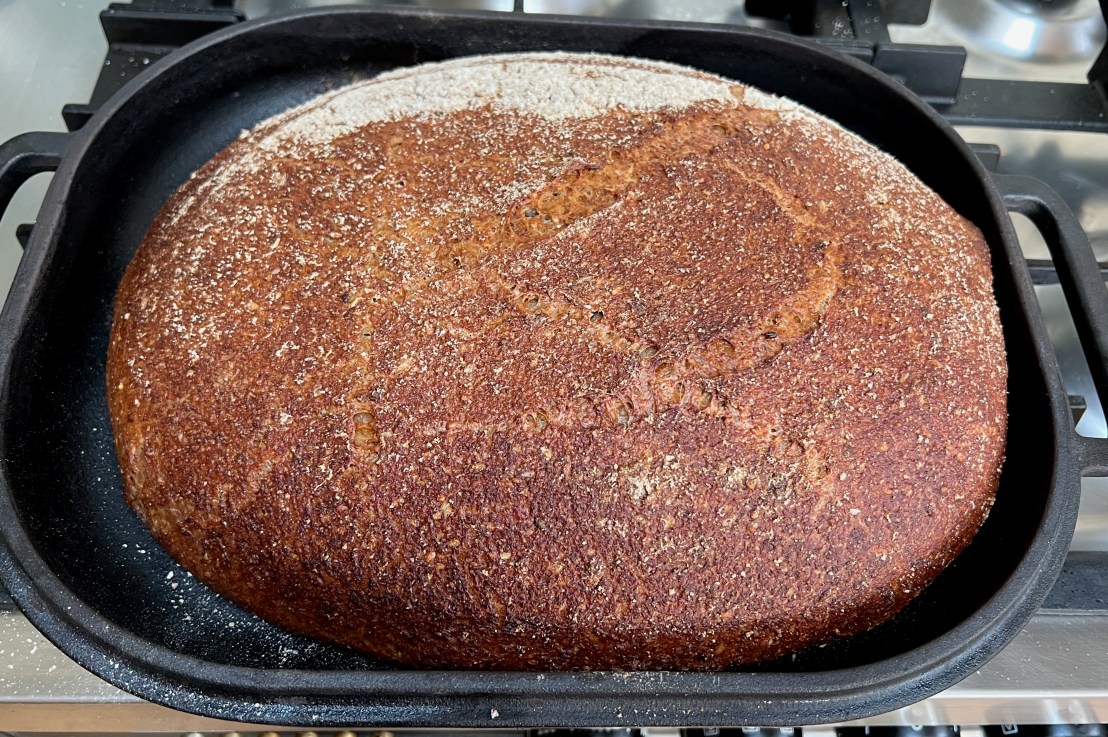
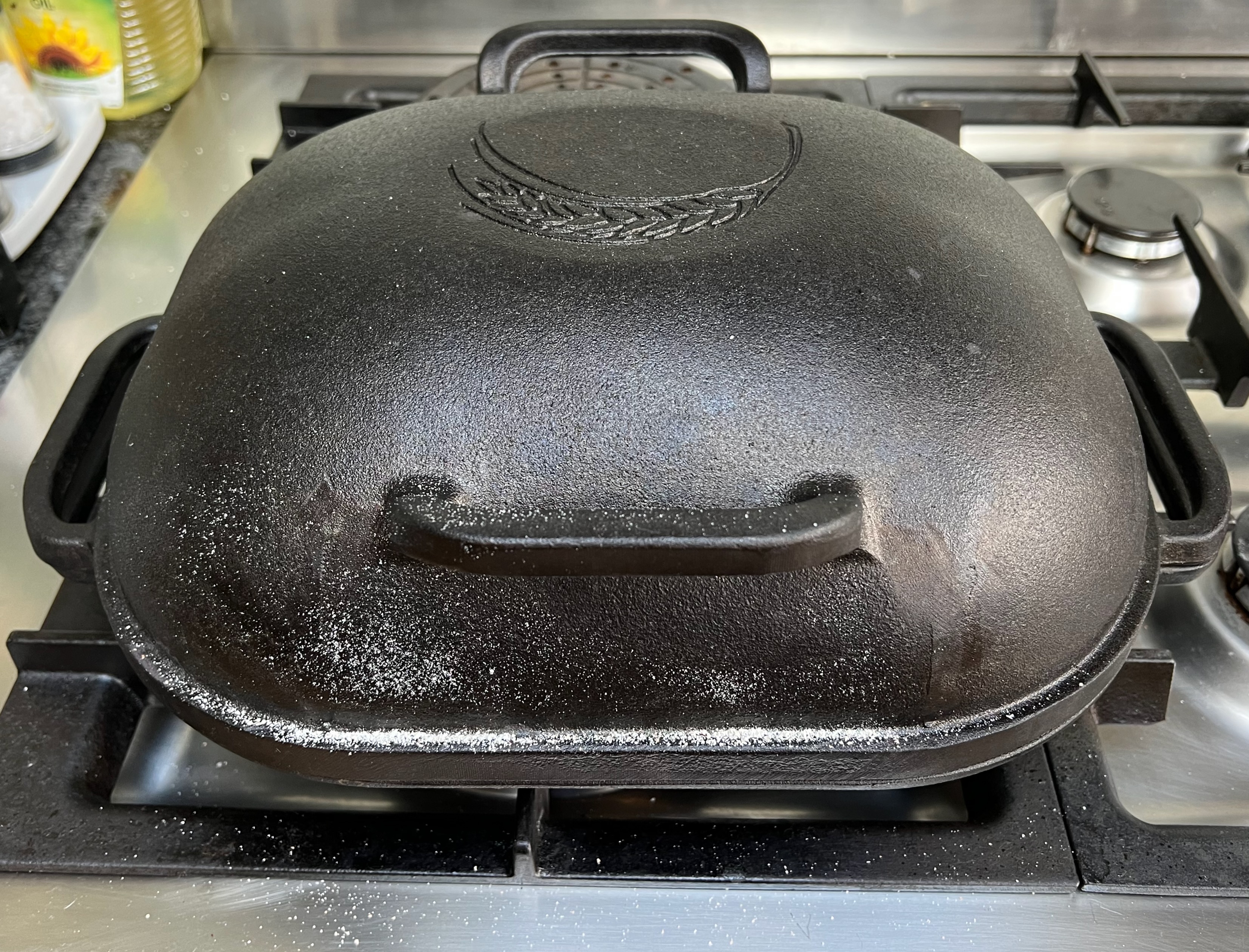
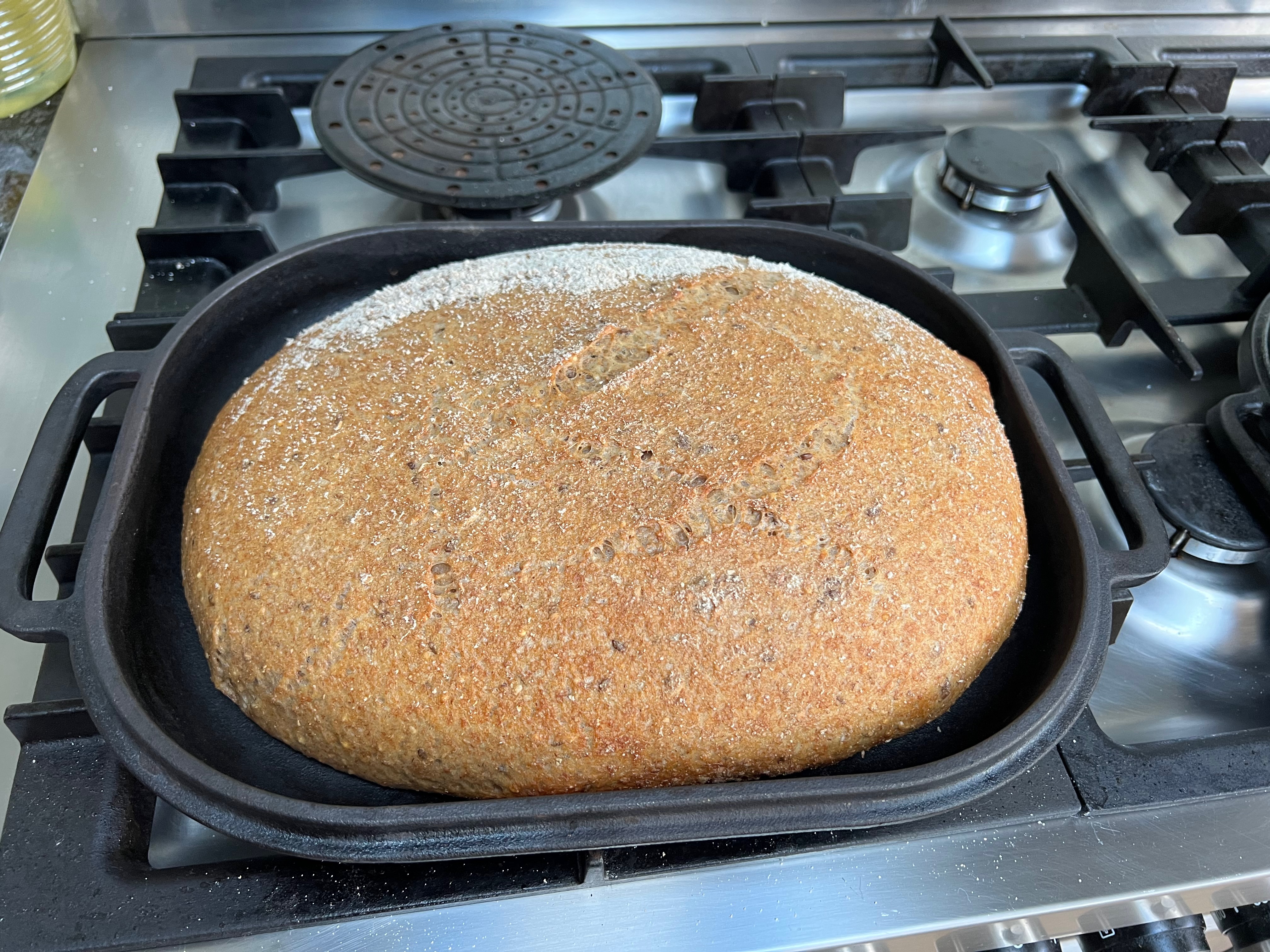
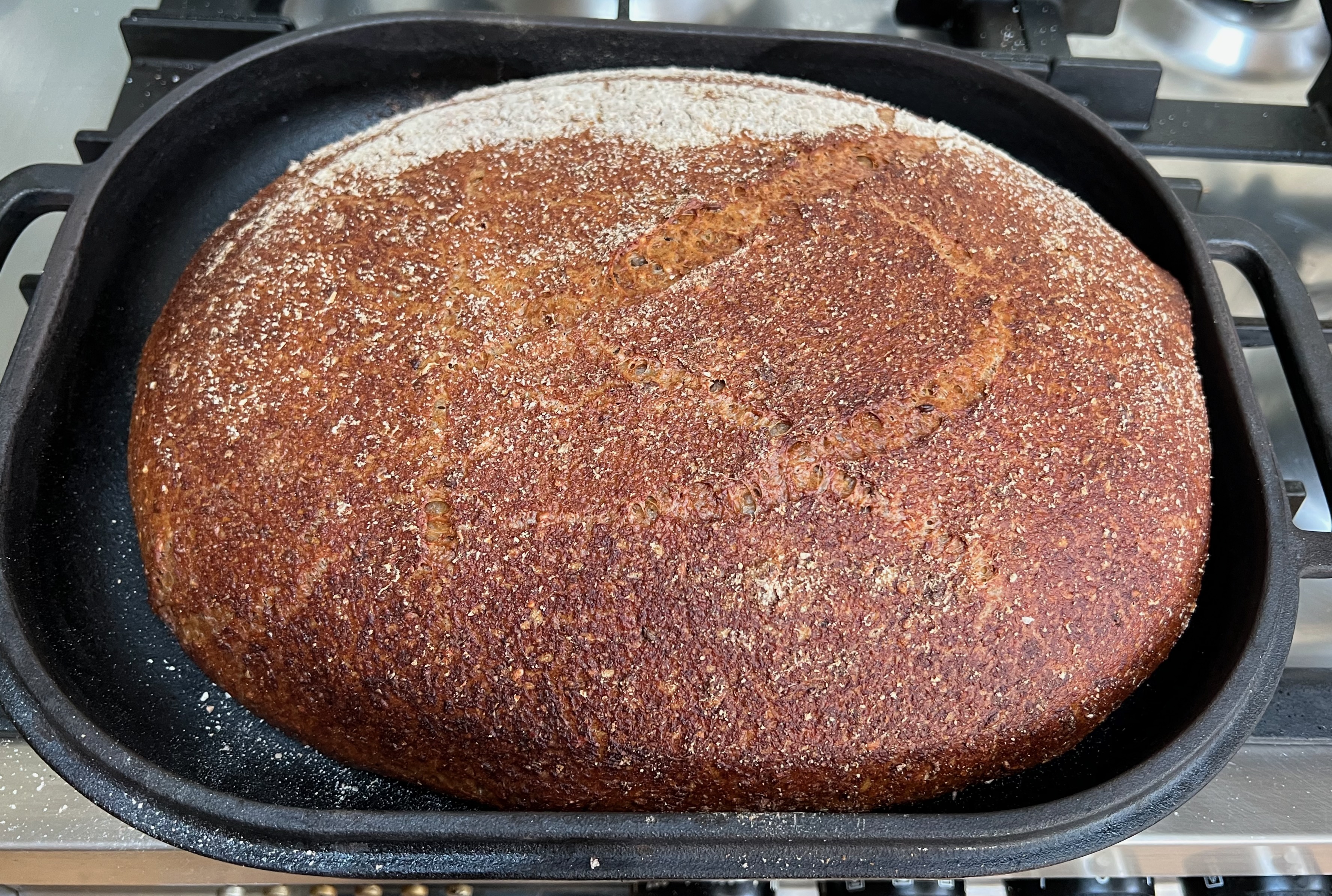
In terms of process, I have two variants. Most often, I use a two stage prove: the second rise is done in a cloth-lined basket after which I bake a free standing loaf in a cast iron Dutch oven made by US company Challenger. But if I’m in a hurry, I’ll just pour the kneaded dough into a greased baking tin, leave it to rise once and then bake.

I adjust timings to suit the day’s schedule by choosing the temperature for the rises: fridge (around 3℃), room temperature (my kitchen is usually around 20℃) or “a warm place” (near my boiler, around 30℃). The fastest option is to heat an oven to 50℃ then turn it off, because you don’t want the yeast getting above 45℃. 

Here are three typical timings: choose your favourite or make up your own. I deliberately haven’t put in numbers of hours because they’re incredibly variable; you just have to wait until it looks right.

  1. Start the sponge first thing in the morning, make the dough at lunchtime and let it rise in a warm place ready to be baked after work.
  2. Start the sponge at lunchtime, make the dough in the evening and leave it in the refrigerator overnight. Take it out and leave it at room temperature or in a warm place, ready to be baked in time for lunch.
  3. Start the sponge in the evening,  make the dough first thing in the morning, letting it rise in a warm place through the morning ready to be baked around lunchtime.

You can use any starter you like. Mine started life in October 2018 as a wheat-based starter, but after the first couple of months, I started refreshing it only with dark rye (which apparently makes for a less fussy starter). The method came from Andrew Whitley’s “Bread Matters”.

The sponge

This is the initial mixture used to give the yeast in the sourdough starter the chance to multiply. It seems to go many names as well as “sponge”: Andrew Whitley calls it a “production sourdough”; I’ve also seen “pre-ferment”, “bulk ferment” or just plain “ferment”. A thicker version appears to be called a “biga”.

  • 90g sourdough starter
  • 90g dark rye flour
  • 180ml water
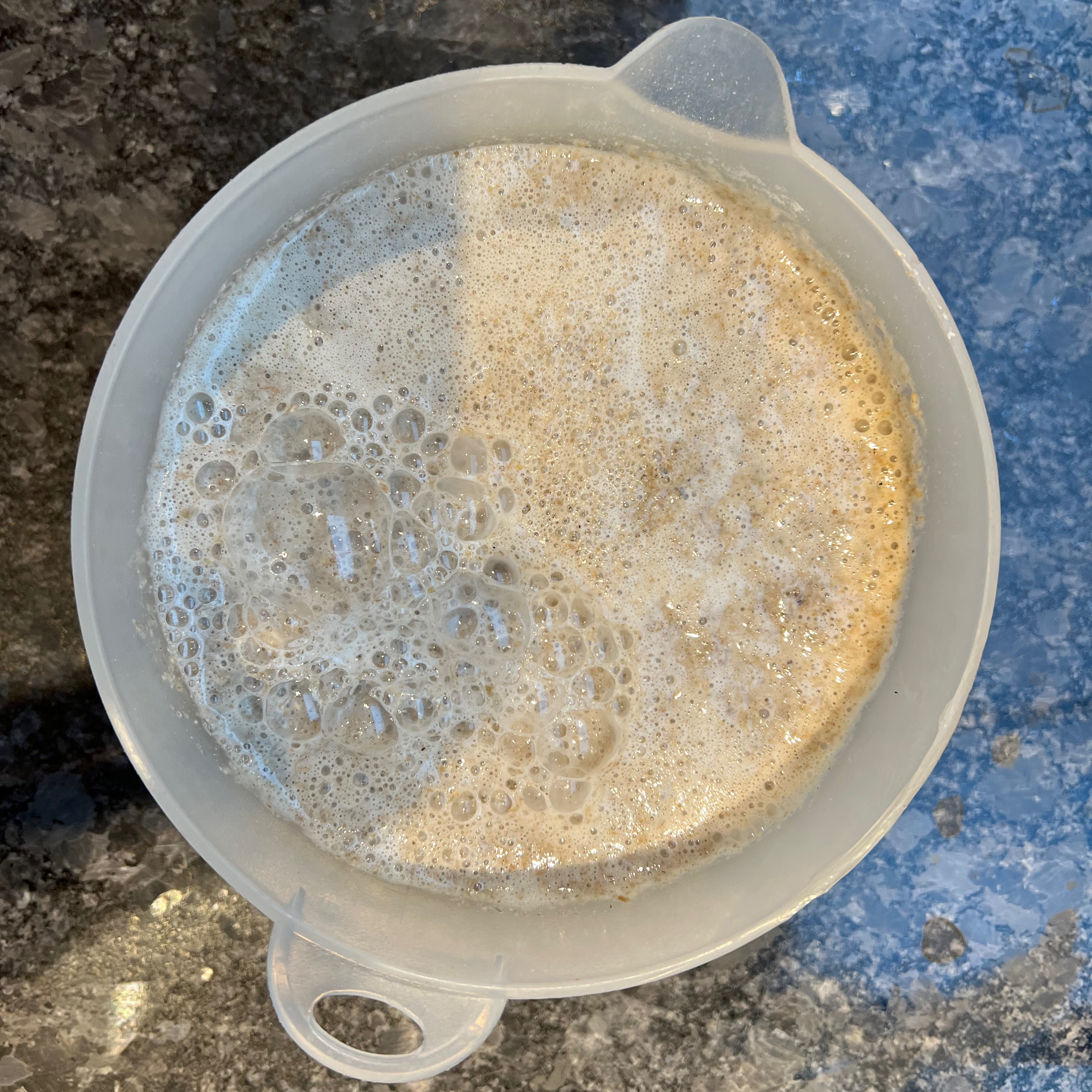
  1. If a layer of clear liquid has separated from your sourdough starter, mix it in thoroughly (some books advise you to discard this: I’ve never needed to).
  2. Mix thoroughly the starter, dark rye flour and water in a bowl. Leave to ferment at room temperature for several hours or overnight.

And don’t forget to refresh your starter:

  • 30g dark rye flour
  • 60 ml water
  1. Adding the flour and water to your starter, mix thoroughly, cover and replace in the refrigerator.

Making the dough

  • 350g Wholemeal spelt flour
  • 350g Strong white bread flour
  • 15g salt
  • 100g Seven seed bread mix (like this one, or your favourite other mixture of seeds)
  • 360ml warm water (warm but not hot to the touch, around 30-35℃)
  1. Put the flours, salt and seeds into the bowl of a stand mixer and stir until reasonably evenly mixed.
  2. Add the water to your sponge and mix.
  3. Add the wet mixture to the dry mixture. With a spoon, mix enough to ensure that you don’t have tons of dry flour at the bottom of the bowl where the mixer might not pick it up.
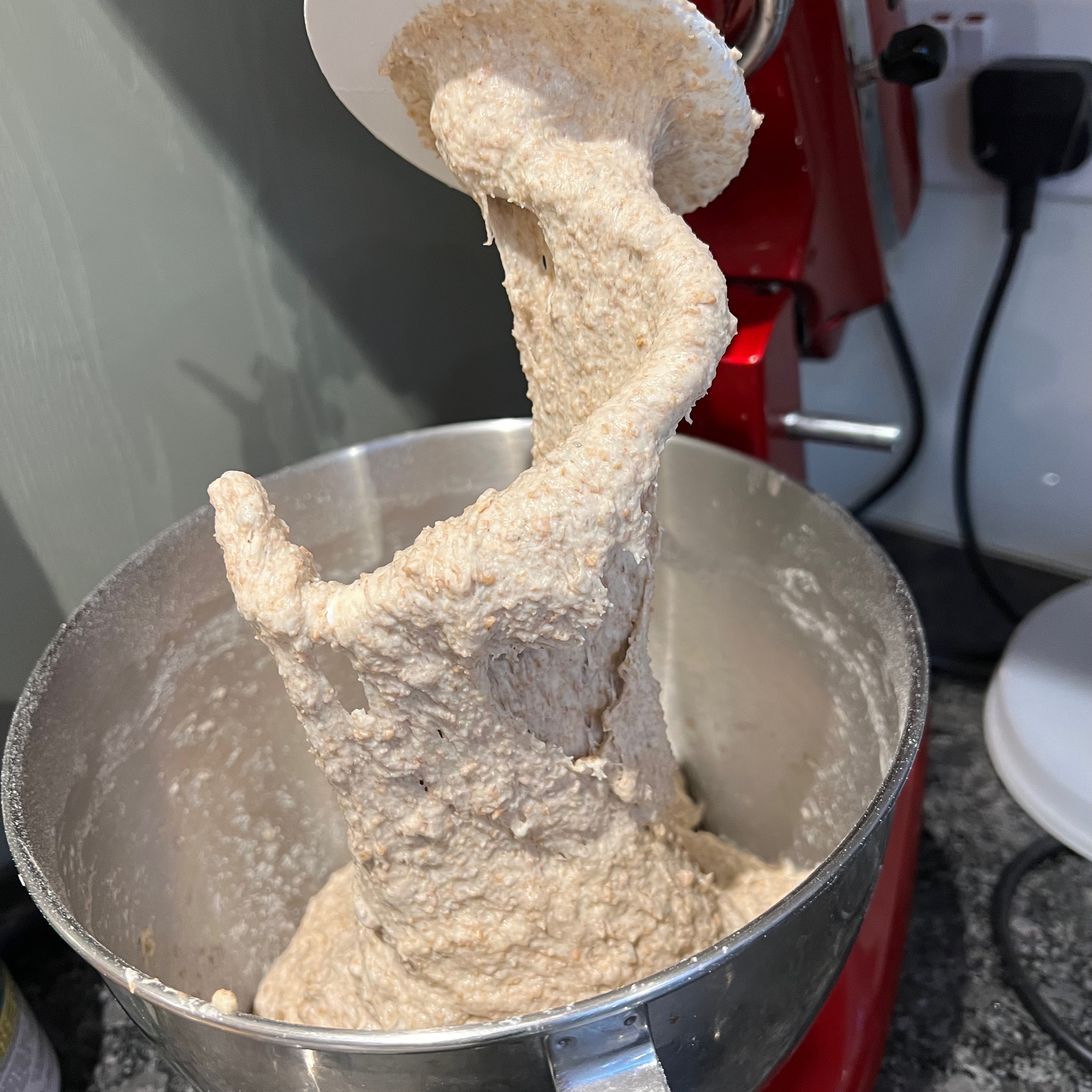
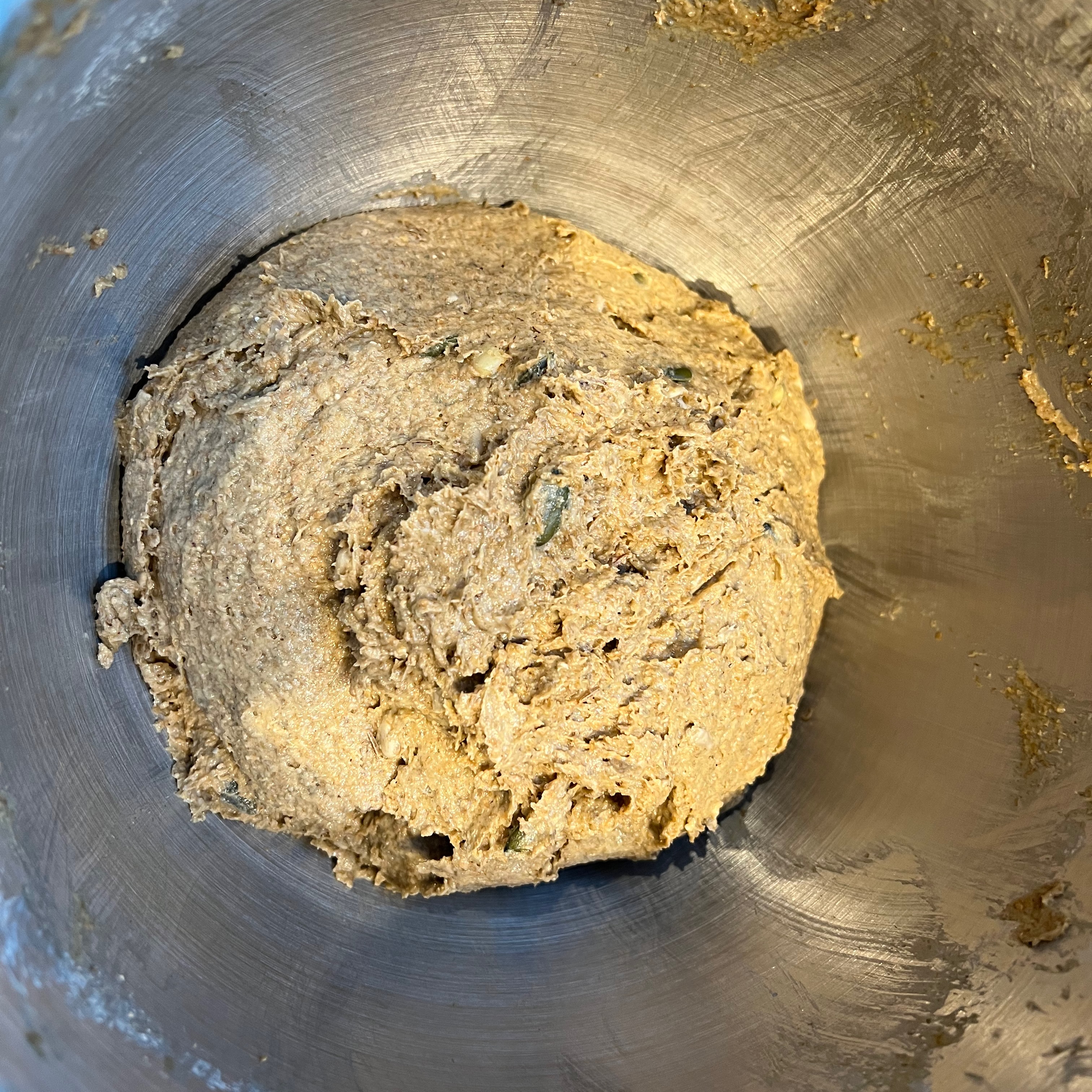
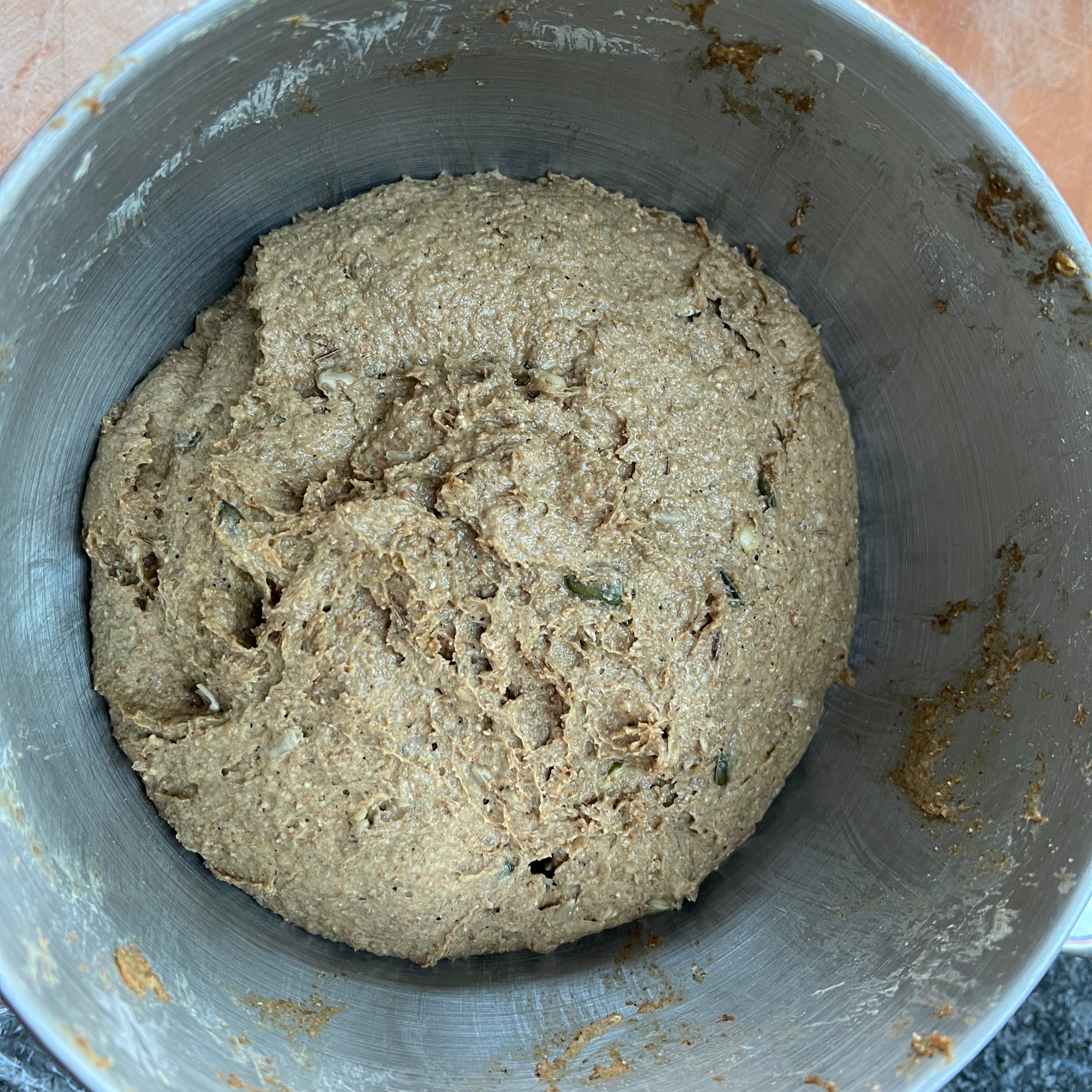
  4. With the dough hook, knead for around 7 minutes: the dough should be very elastic and stretchy. Go for up to 10 minutes if you’re feeling uncertain.
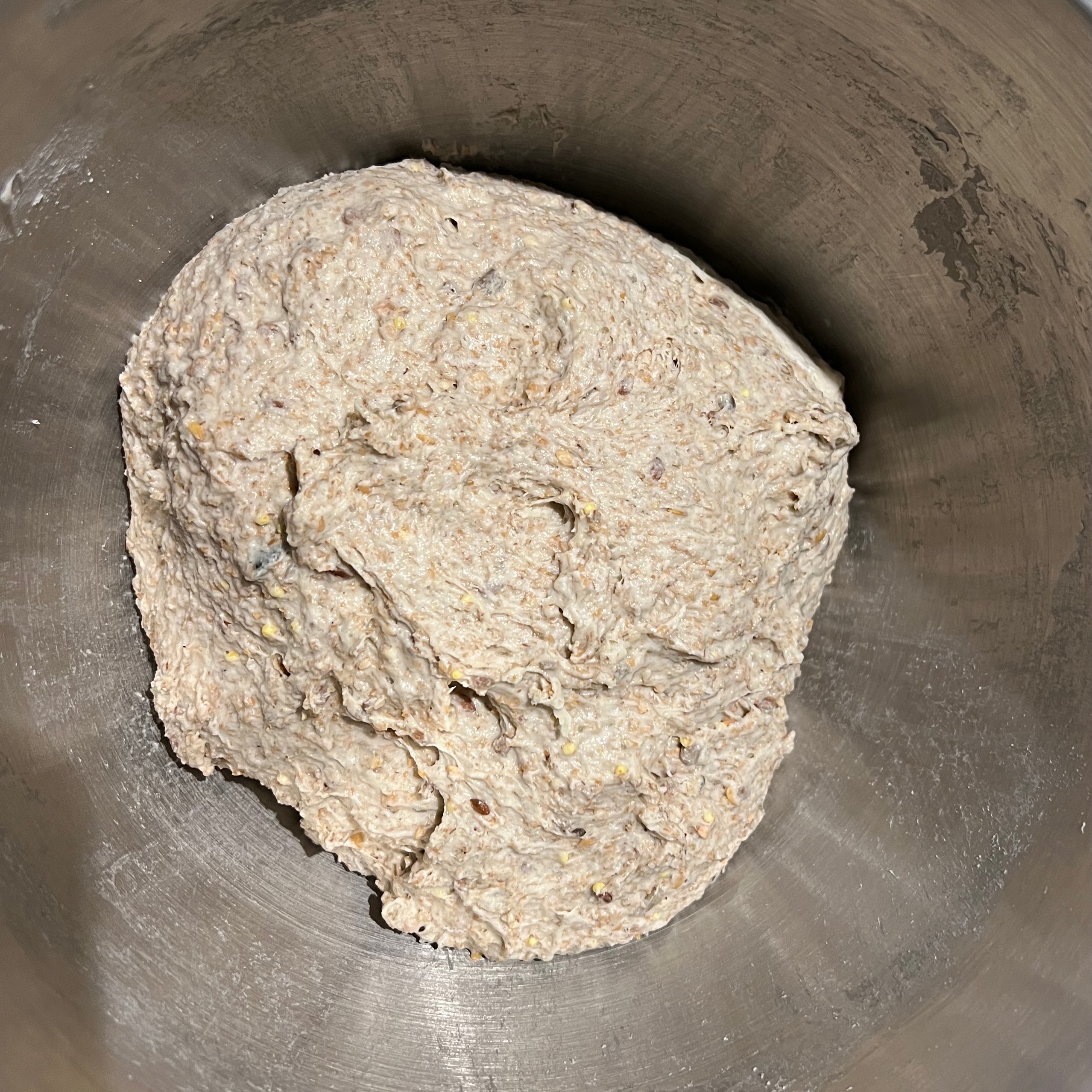
  5. Scrape down the sides of the bowl and make sure the dough is in a nice ball.

Preparing – tin version

  1. Brush oil over the bottom and sides of your bread tin.
  2. Transfer the dough into the bread tin, push it out to the sides and shape it into a loaf.
  3. Cover the tin with its lid or cling film (or non-single-use alternative) and leave the loaf to rise until it reaches the level of the tin.

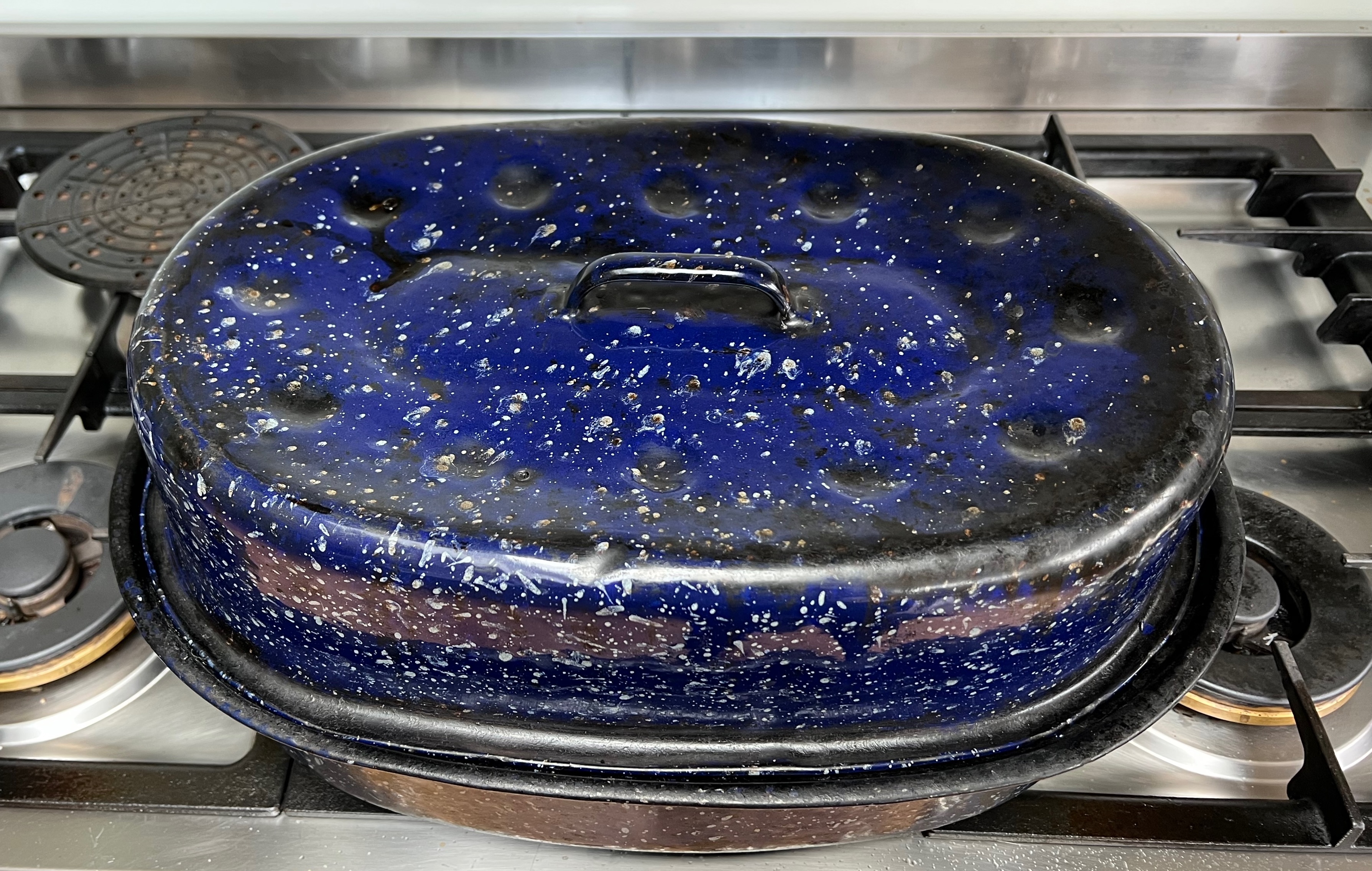
For baking, I’ve assumed here that you have a casserole or covered roasting pan big enough to enclose your bread tin and be used as a Dutch oven. If you don’t, forget anything about making steam and simply cover your bread tin with its lid (if it has one) or with foil.

Preparing – free standing version

  1. Cover the bowl with cling film (or non-single-use alternative) and leave for several hours until approximately doubled in size.
  2. Pour some flour (I use the spelt flour, but it doesn’t really matter) into the bottom of your linen-lined proving basket and shake it out over a board. Put some more flour onto the board.
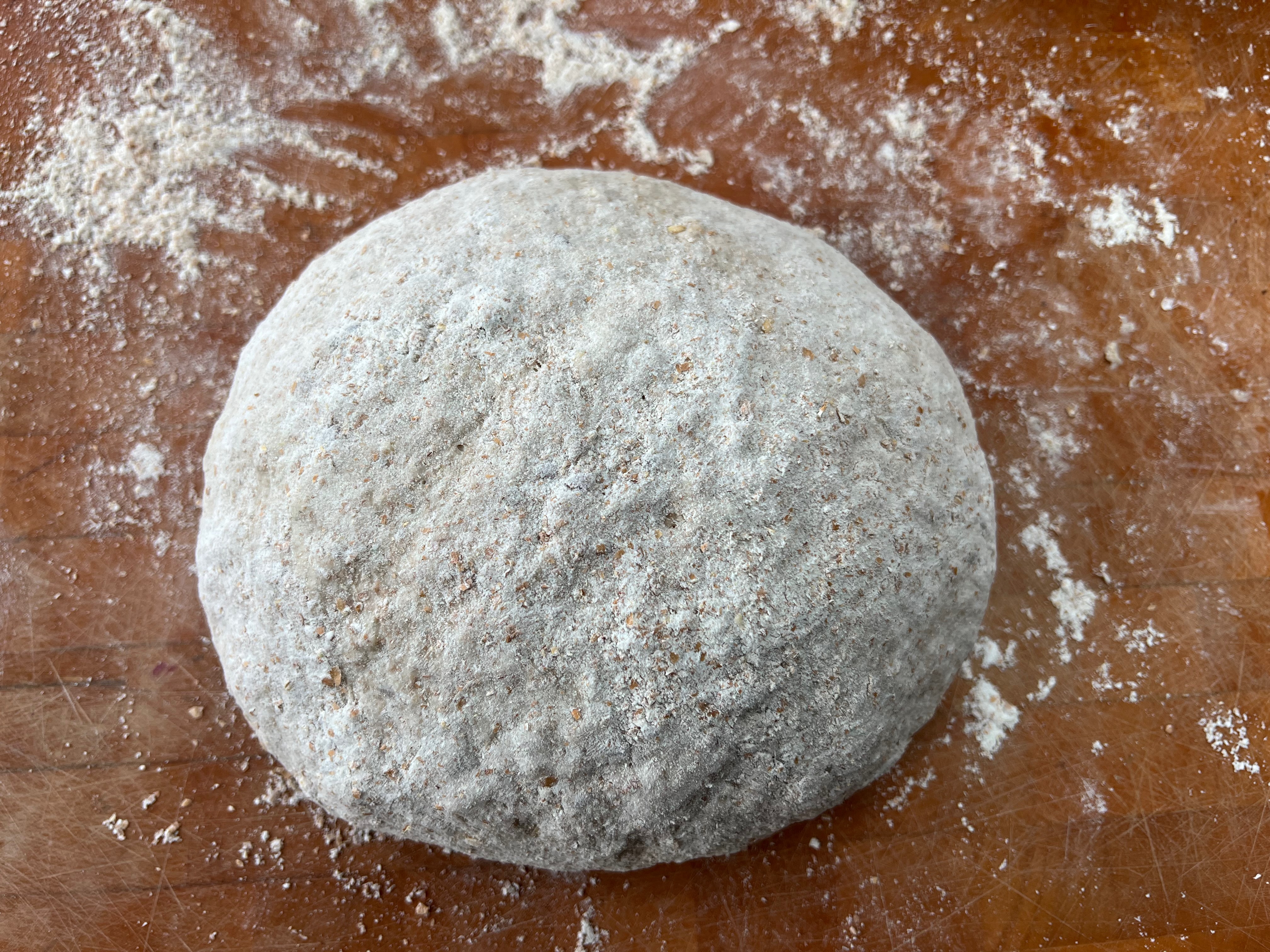
  3. Transfer the dough from the mixer bowl onto the board. Flour your hands and work the dough into a loaf shape: you’ll probably need a metal scraper to scrape some of the dough off the board when it sticks.
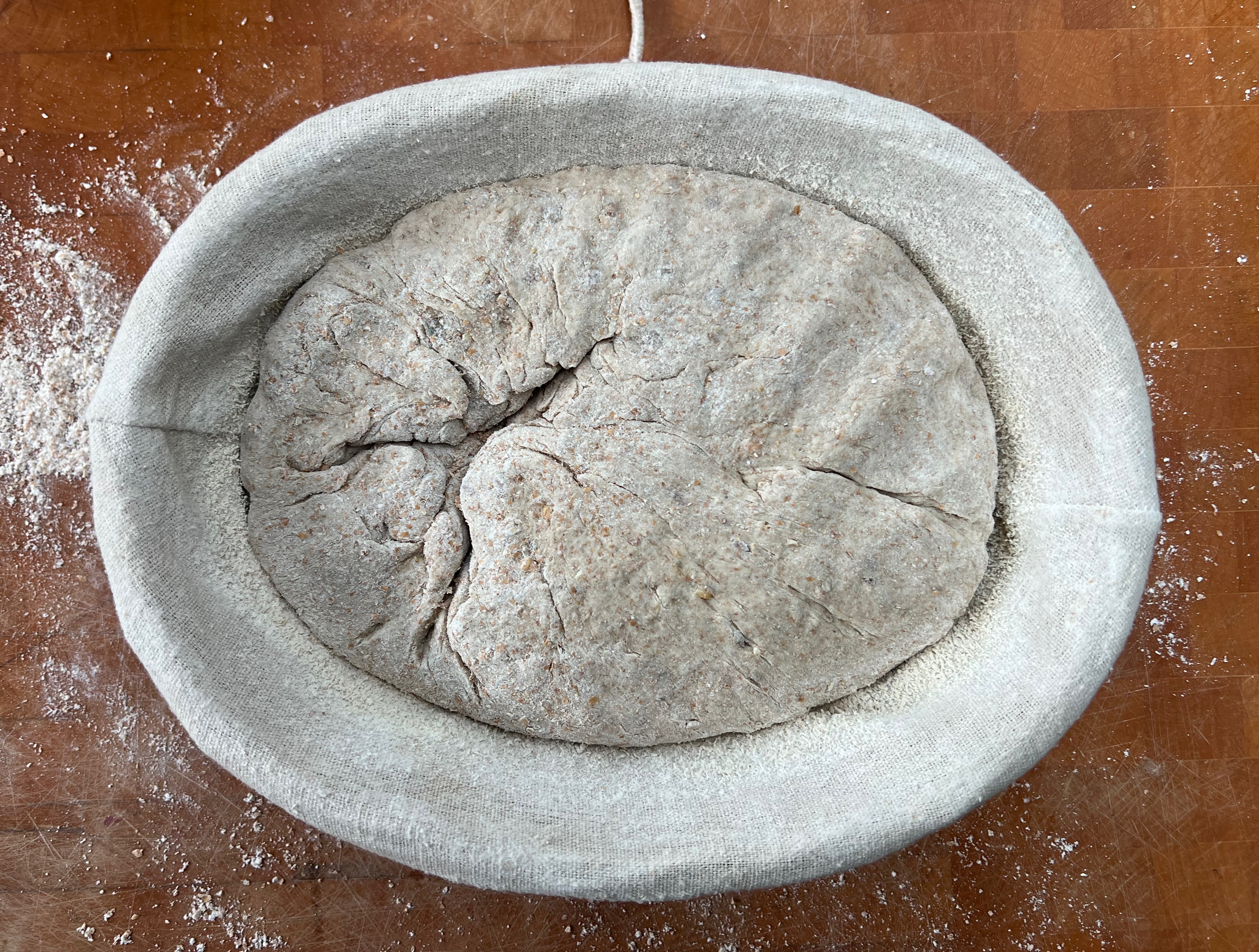
  4. Repeatedly stretch the top of your loaf, tucking the dough under. This will help get a well formed crust. You’re trying to end up with the smallest possible “key” – the gap at the bottom where all the folds have come together.
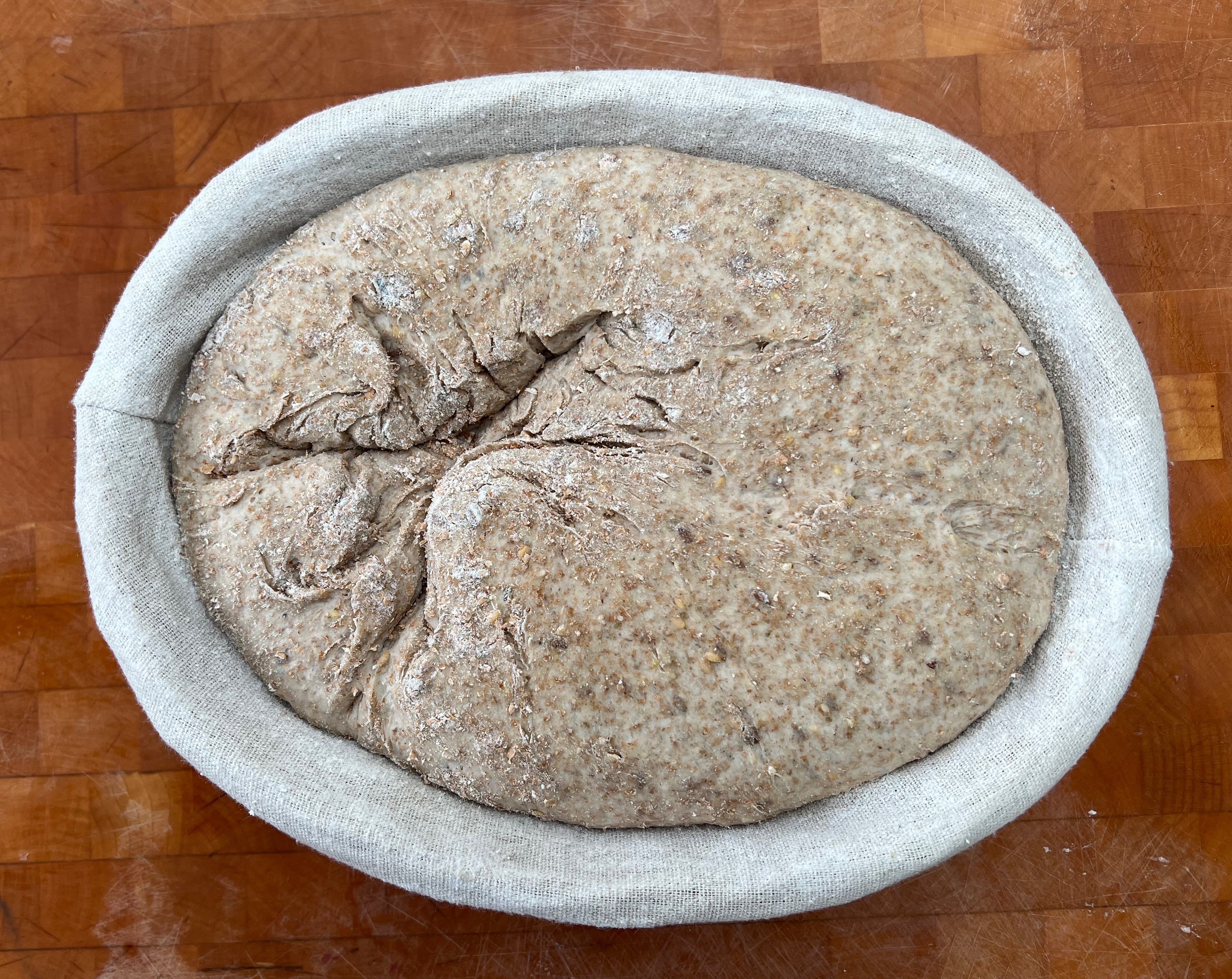
  5. Put the loaf into your basket, smooth side down and cover with a tea towel. Leave to rise until it is close to the top of the basket.

Baking

  1. Half an hour or so before the loaf has risen, start to preheat your oven on the fan setting if there is one, with your Dutch oven in it if you’re using one. You want it to reach 250℃ by the time you start baking.
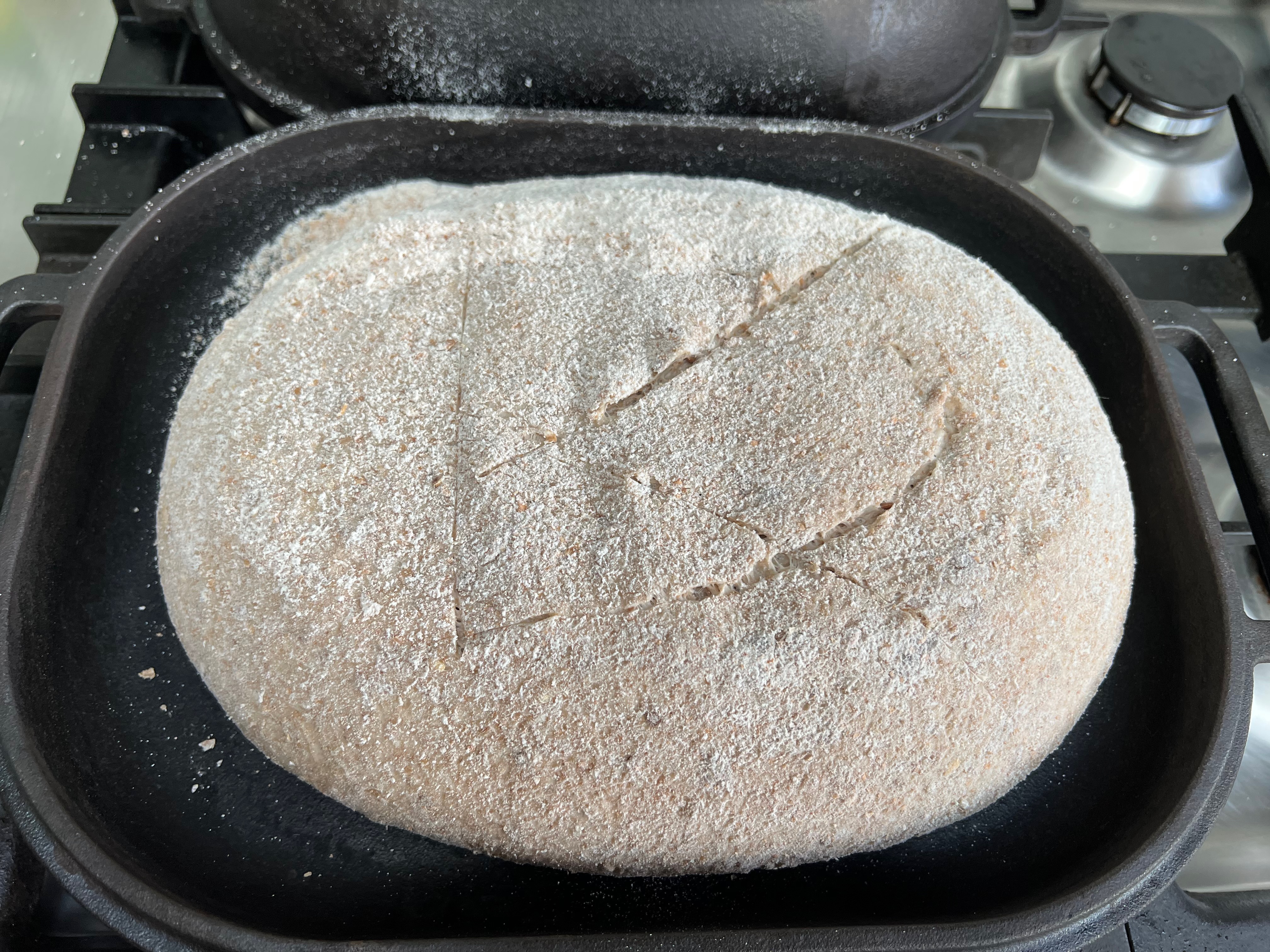
  2. Score a few gashes into your loaf, in whatever pattern you like (I use two or three crossways gashes when using a tin, or I do a kind of signature for the free standing loaf, along the lines of the stylised “P” that Poilâne use).
  3. Now work quickly: remove the tea towel (or cover of your tin), open the oven, remove the cover of your Dutch oven (if you’re using one), place your loaf in it, throw a few ice cubes around the side of your loaf (if using a tin, you can just use water) and cover. Close the oven and reduce the temperature to 225℃.
  4. After 30 minutes, open the oven door, uncover your loaf and close the oven door again. Continue baking for around 20 minutes. By the end of this, the top of your loaf should be medium-to-deep brown and the internal temperature should be around 98℃.
  5. Leave to cool on a rack for at least an hour before cutting and eating.
  6. Half an hour or so before the loaf has risen, start to preheat your oven on the fan setting if there is one, with your Dutch oven in it if you’re using one. You want it to reach 250℃ by the time you start baking.
  7. Score a few gashes into your loaf, in whatever pattern you like (I use two or three crossways gashes when using a tin, or I do a kind of signature for the free standing loaf, along the lines of the stylised “P” that Poilâne use).
  8. Now work quickly: remove the tea towel (or cover of your tin), open the oven, remove the cover of your Dutch oven (if you’re using one), place your loaf in it, throw a few ice cubes around the side of your loaf (if using a tin, you can just use water) and cover. Close the oven and reduce the temperature to 225℃.
  9. After 30 minutes, open the oven door, uncover your loaf and close the oven door again. Continue baking for around 20 minutes. By the end of this, the top of your loaf should be medium-to-deep brown and the internal temperature should be around 98℃.
  10. Leave to cool on a rack for at least an hour before cutting and eating.

So that’s it! We’ve baked round the world, from the great cities of our planet – Paris, New York, Vienna –  to the middle of nowhere in Pitcairn Island. We’ve made breads, cakes, biscuits, pastries, savoury dishes and a few random things that don’t fit into any category. We’ve done some super-easy bakes (soda bread) and some very challenging ones (chocolate eclairs, pannetone). Being diabetic, which means I shouldn’t really have been doing this blog at all, I’ve erred on the less sweet side, but there are a few very sweet dishes indeed. It’s been a grand ride and I’ve learned masses.

There will be one more post in this series, namely a recipe index. But otherwise, it’s goodbye, and time for me to revert this blog to its original intention of being about all my obsessions – travel, software, business, politics and anything else. If you’re interested, stay with me!

Around the world in 80 bakes, no.79: Vanillekipferl, Viennese crescent biscuits

Around the world in 80 bakes, no.79: Vanillekipferl, Viennese crescent biscuits

Austrians don’t necessarily like to think too hard about how close they became to being a Turkish province and quite how much they have to thank the Poles that this didn’t happen. In 1683, the Turks neared the city gates, to be defeated in the Battle of Vienna when the forces of the Holy Roman Empire were joined by the Polish army of King John III Sobieski.

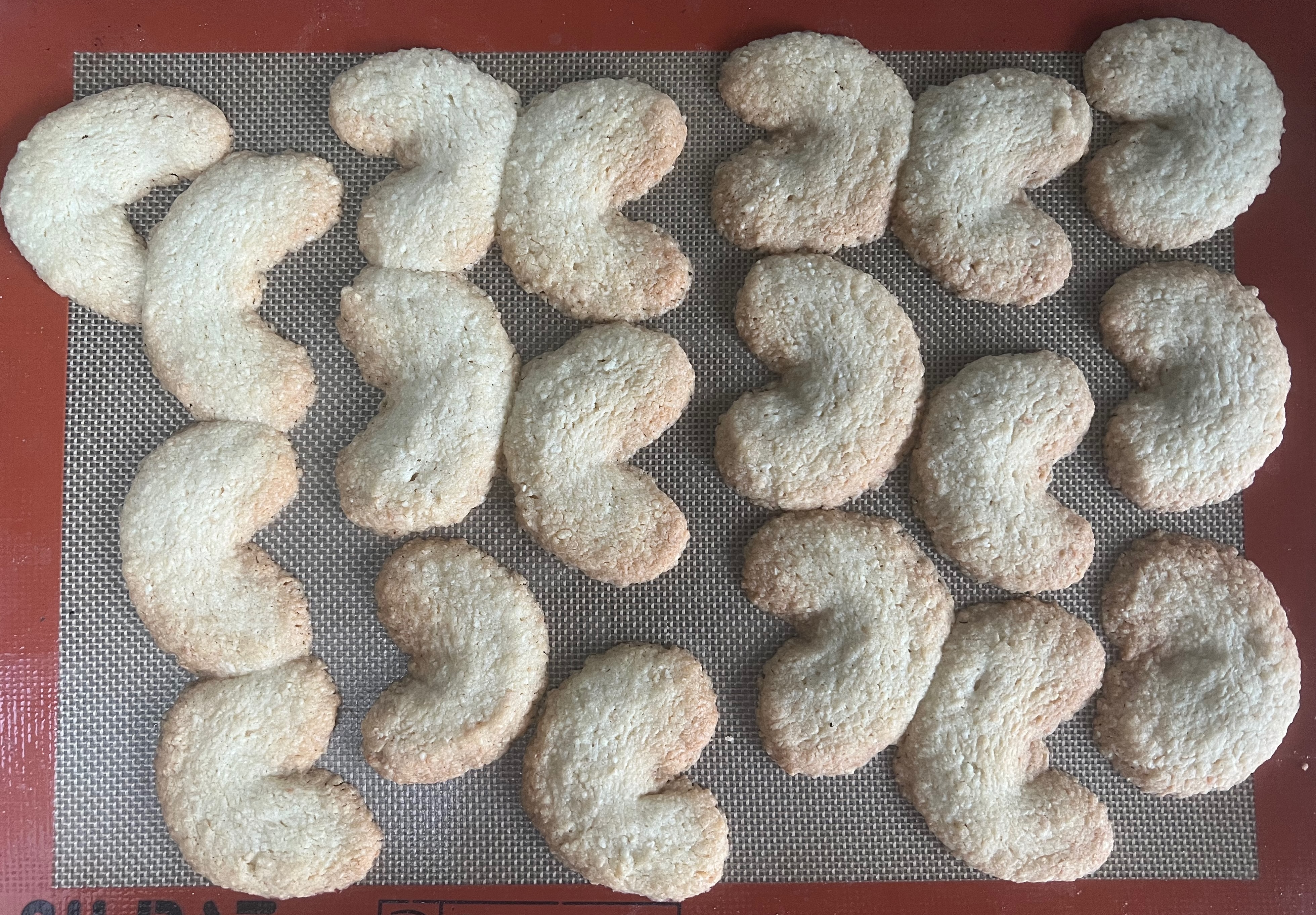
For some reason, however, the crescent moon of the Turkish flag lives on in Austrian culture in the shape of Vanillekipferl (vanilla crescents): delectable, crumbly nut-flavoured biscuits that are particularly popular as a Christmas treat. They’ve spread from their origins in Vienna all over Germanic countries and many Eastern European ones, including (of course) Poland.

My wife has Austrian blood in her if you go back a century or so and this recipe came down from one of her relatives. It’s similar to many Austrian recipes today. There are choices to be made: this uses almonds, but walnuts are a popular choice and you also see hazelnuts. Some recipes have a slightly higher ratio of flour to everything else, and some add an egg to the dough to bind it, giving you a slightly richer and considerably less crumbly result with greater structural integrity.

This looks like a straightforward recipe but it’s trickier than many biscuit/cookie recipes because it’s easy to get the texture wrong. Undergrind your nuts and you’ll get a grainy, rather lumpen biscuit which tastes fine but just doesn’t feel right. Overprocess or overwork the dough – especially if your hands are too warm – and the butter will come out and you lose the flavour. But if you get this right, Vanillekipferl have a crumbly butteriness that makes them a rare treat.

The quantities here give you 300g of dough which will yield 15-20 Vanillekipferl. It scales really easily – just multiply by as much as you want. But be aware that a standard size baking tray won’t take many more than 20, because they spread.

The ground almond mixture

You don’t have to make grind your own almonds: you can just buy a pack of ground almonds and add sugar. But doing your own with good quality almonds will result in a better tasting biscuit.
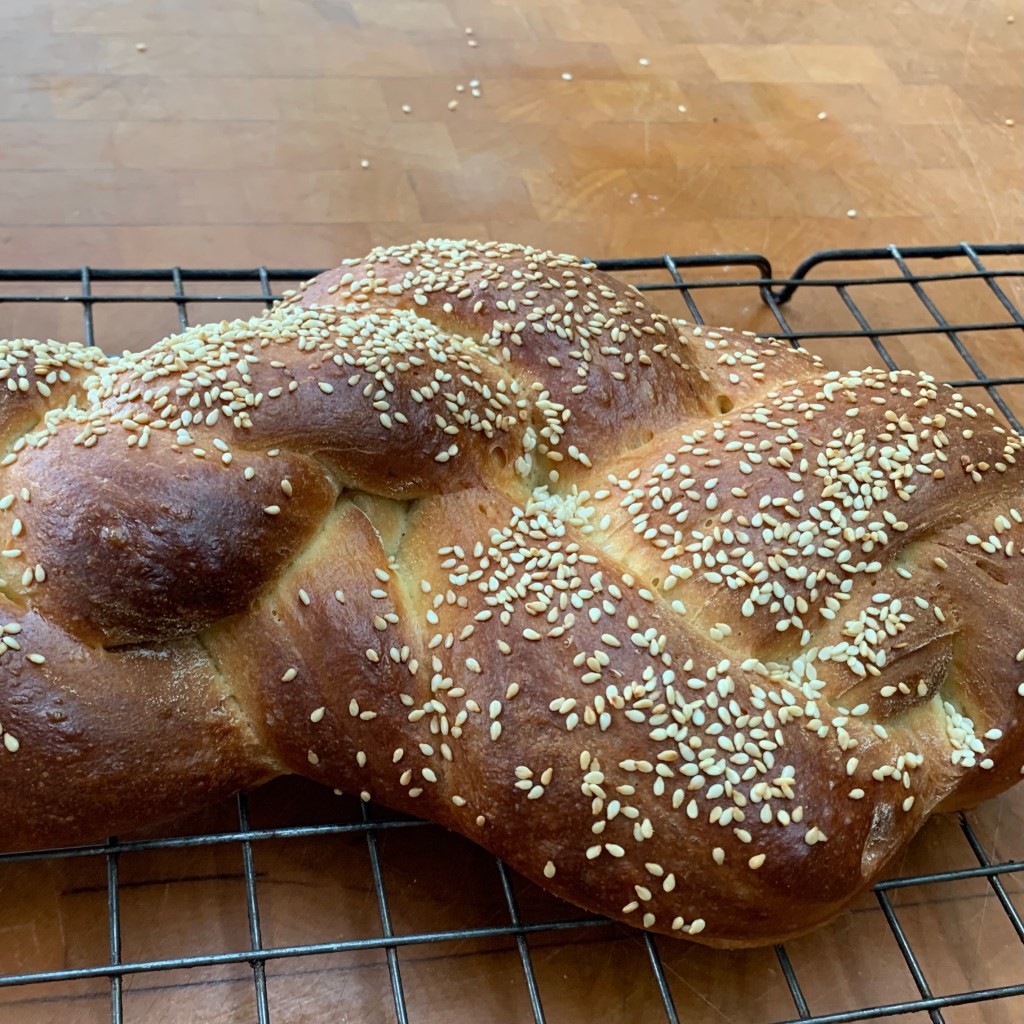
I keep a jar of vanilla sugar, which is simply a jar of caster sugar with a couple of vanilla pods in it which has been left in the cupboard more or less indefinitely. Again, you don’t have to do this: you can either rely on adding more vanilla essence or buy a packet of pre-made vanilla sugar (which is what most Austrian recipes suggest).

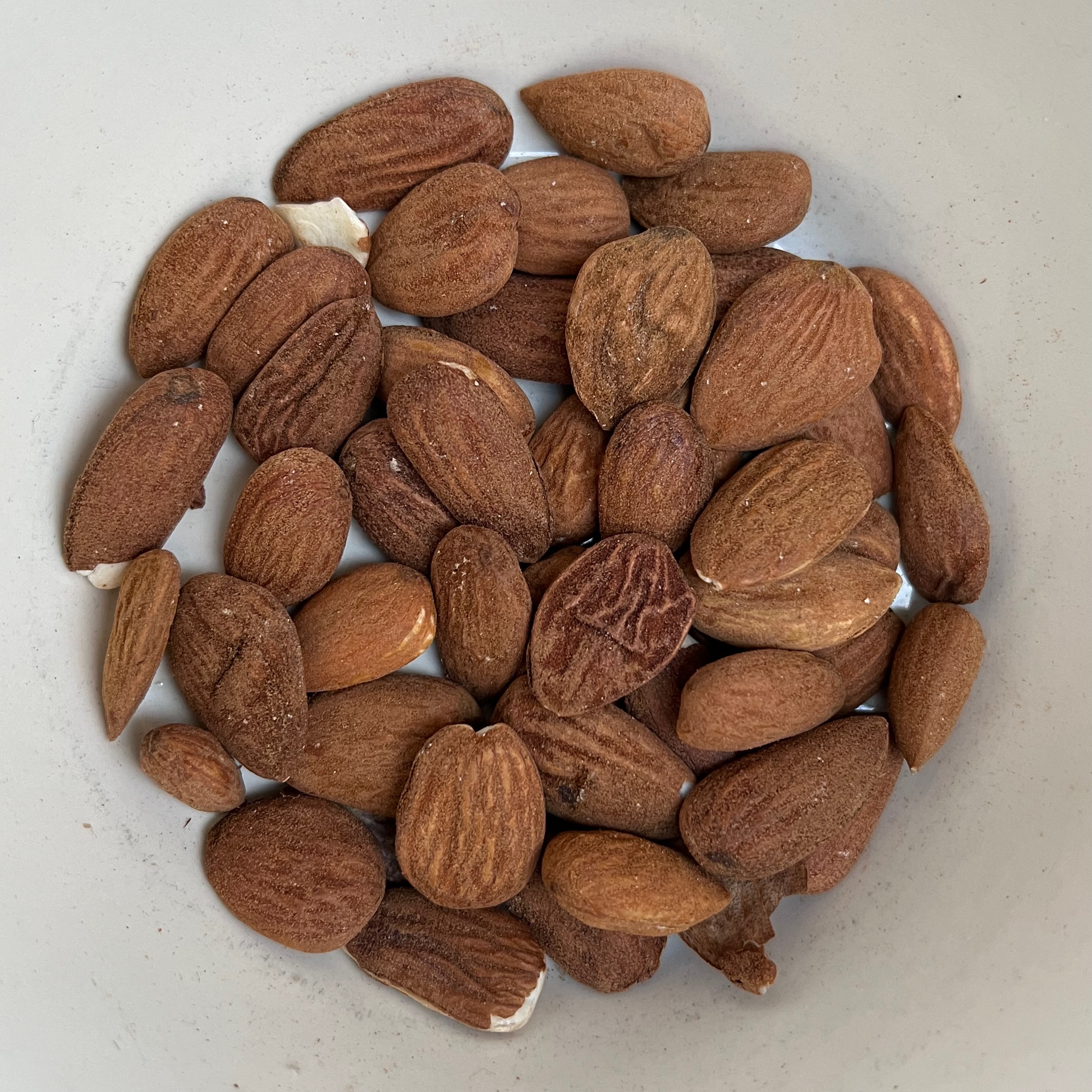
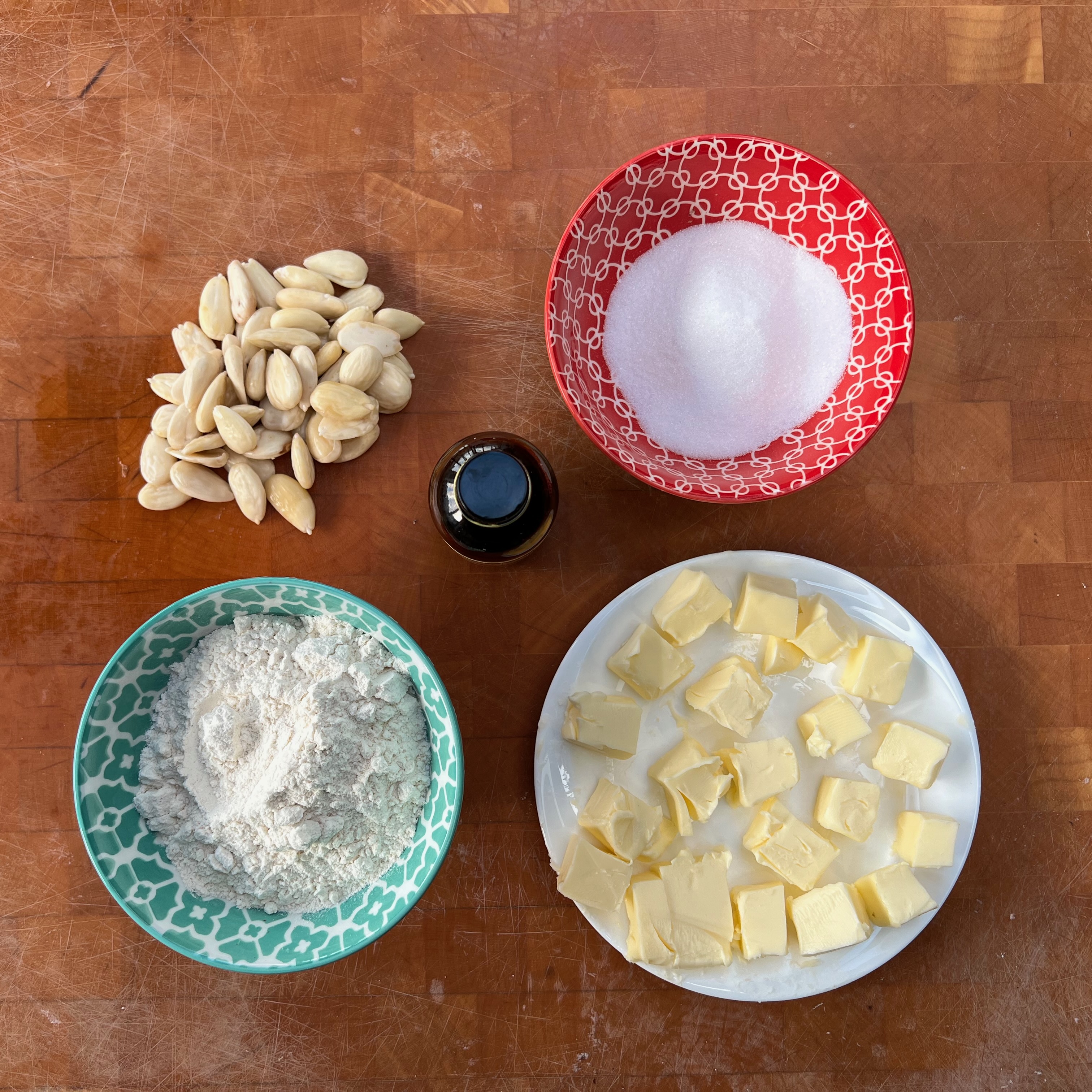
  • 50g almonds in their shells
  • 50g caster sugar (vanilla sugar if you have it)
  1. Put the almonds into a bowl and cover with boiling water.
  2. Wait around 15 minutes, then discard the water and pop each almond out of its skin. When you’ve finished, pat the almonds dry with a tea towel or kitchen roll and discard the skins.
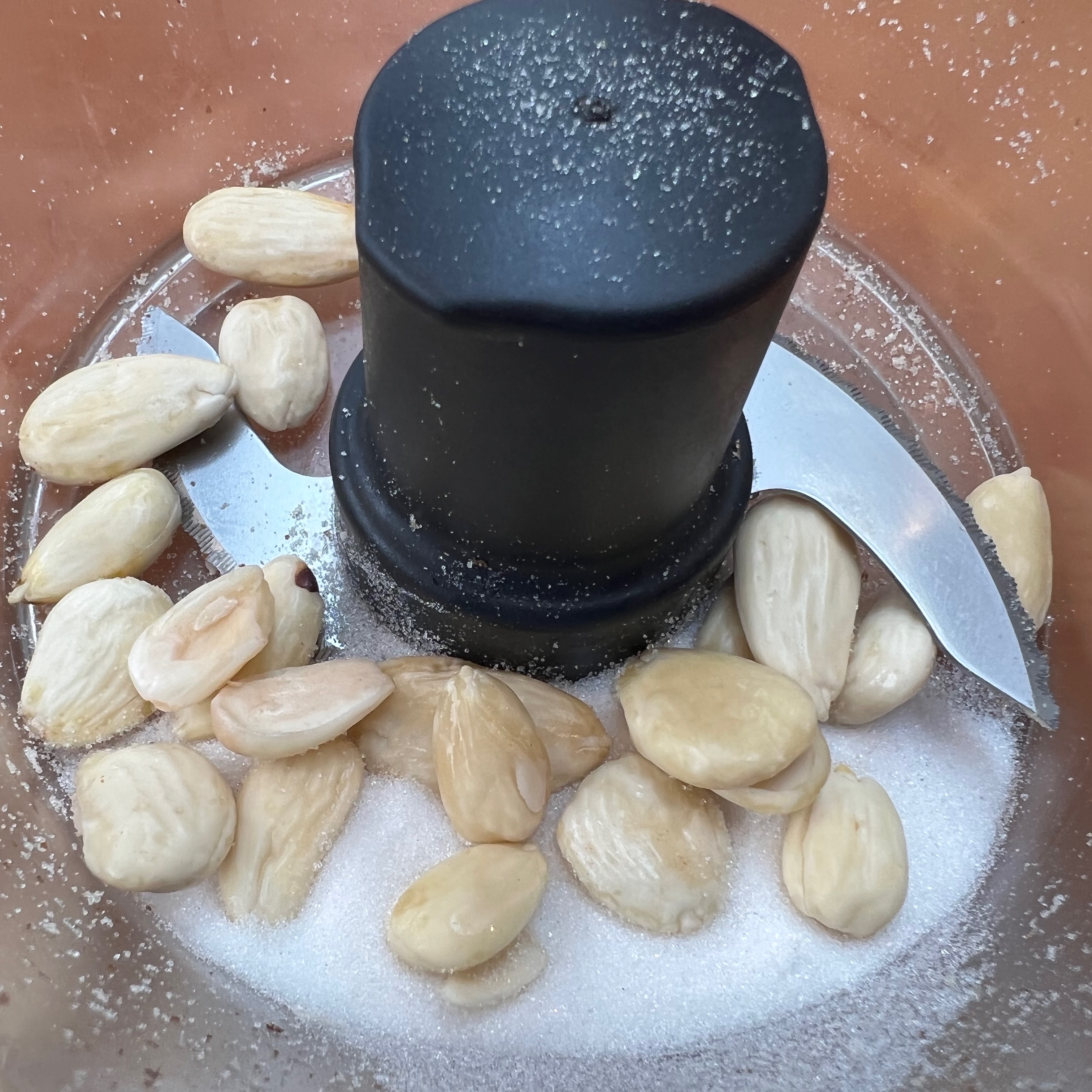
  3. Put the almonds and sugar into the bowl of a food processor and process until the almonds have been ground very fine. This should take around 1-2 minutes. Leave them in the bowl – you’ll be adding the other ingredients shortly.

Making the Kipferl

  • 100g butter
  • 100g plain flour
  • Pinch of salt (⅛ tsp is plenty)
  • Vanilla essence to taste – but be generous
  1. Preheat oven to 160℃ fan.
  2. Line a baking tray with a Silpat sheet, or baking paper if you don’t have one.
  3. Cut the butter into cubes (between 5-10mm).
  4. Add the butter, flour and vanilla essence to your food processor bowl with the almonds and sugar.
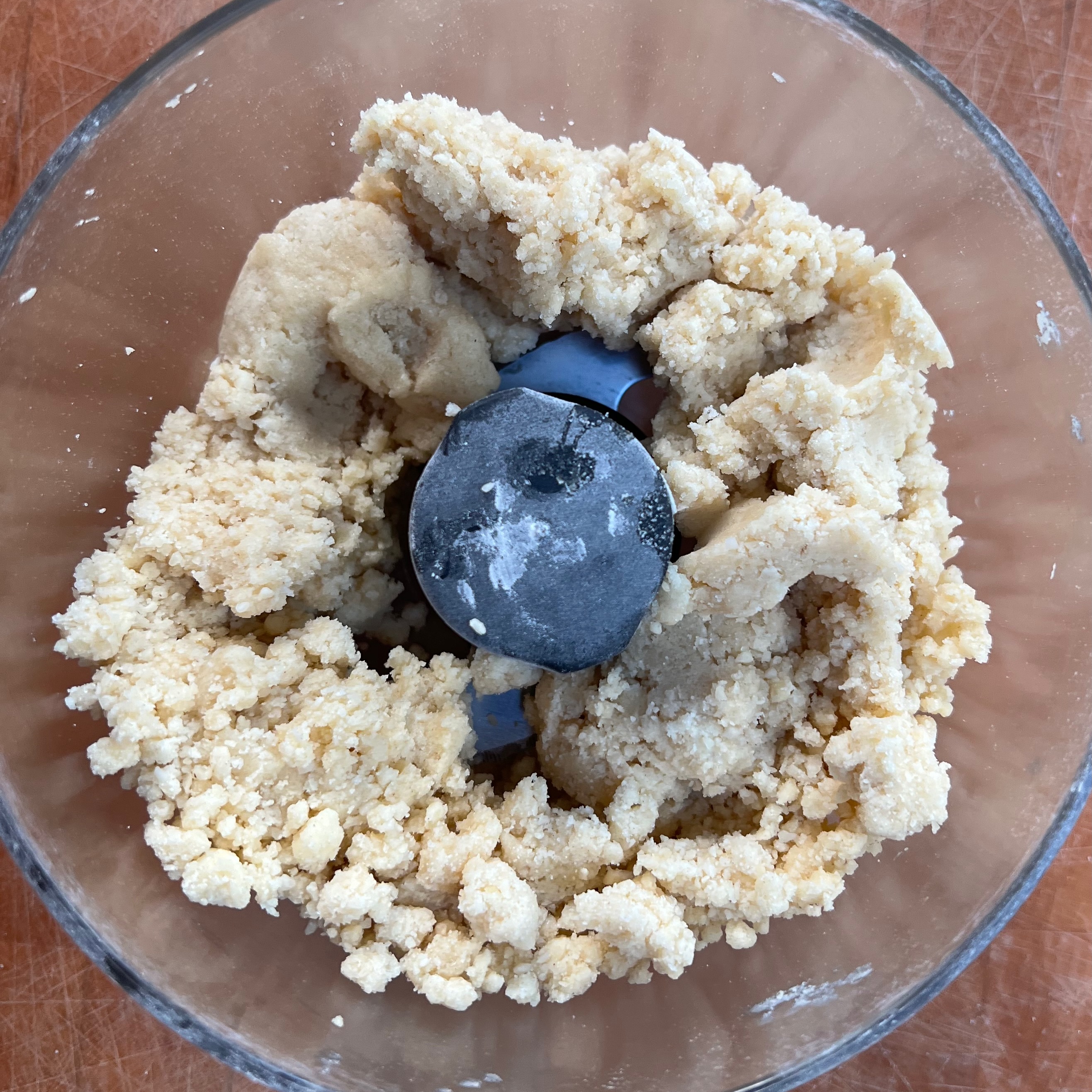
  5. Process the mixture until it comes together into a smooth dough.
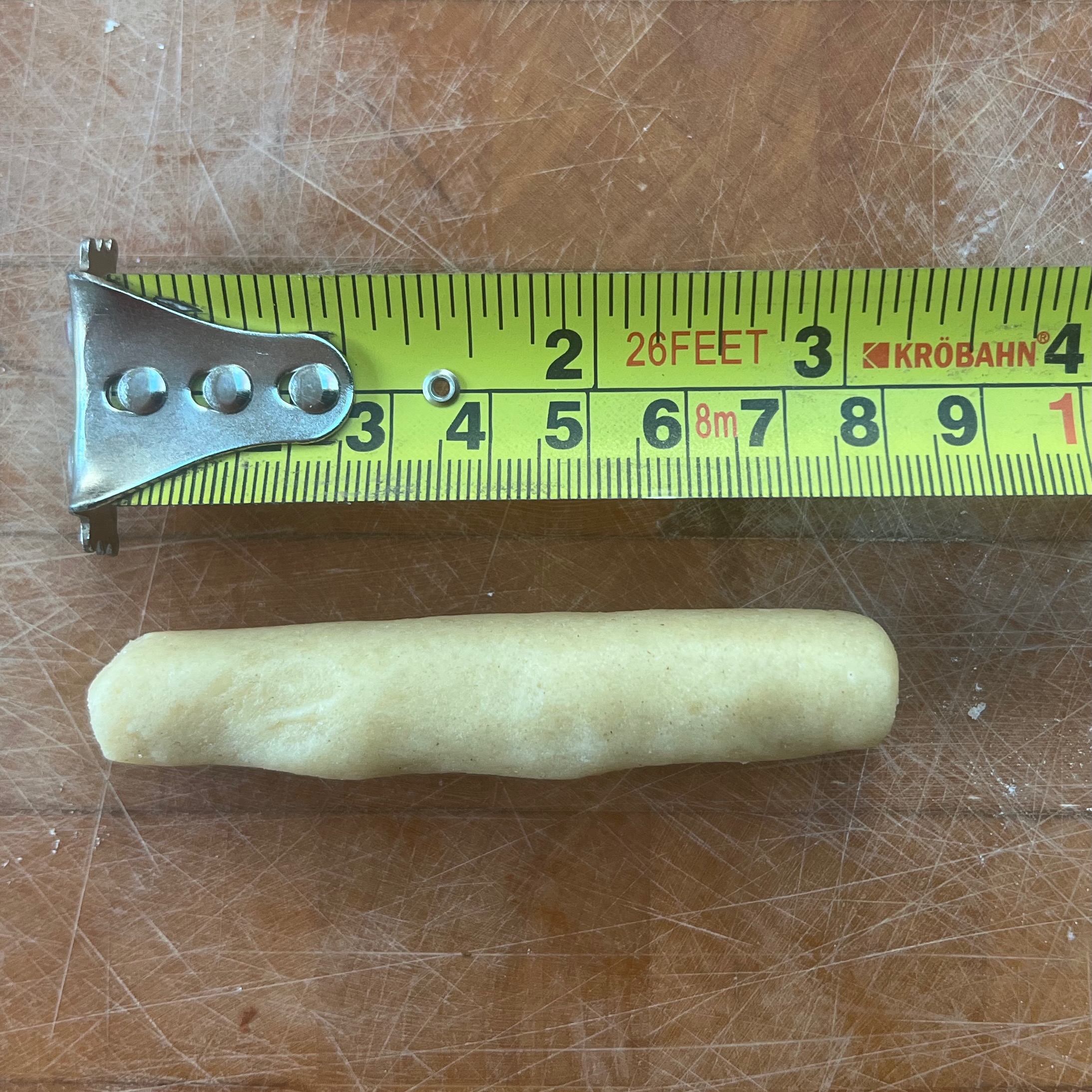
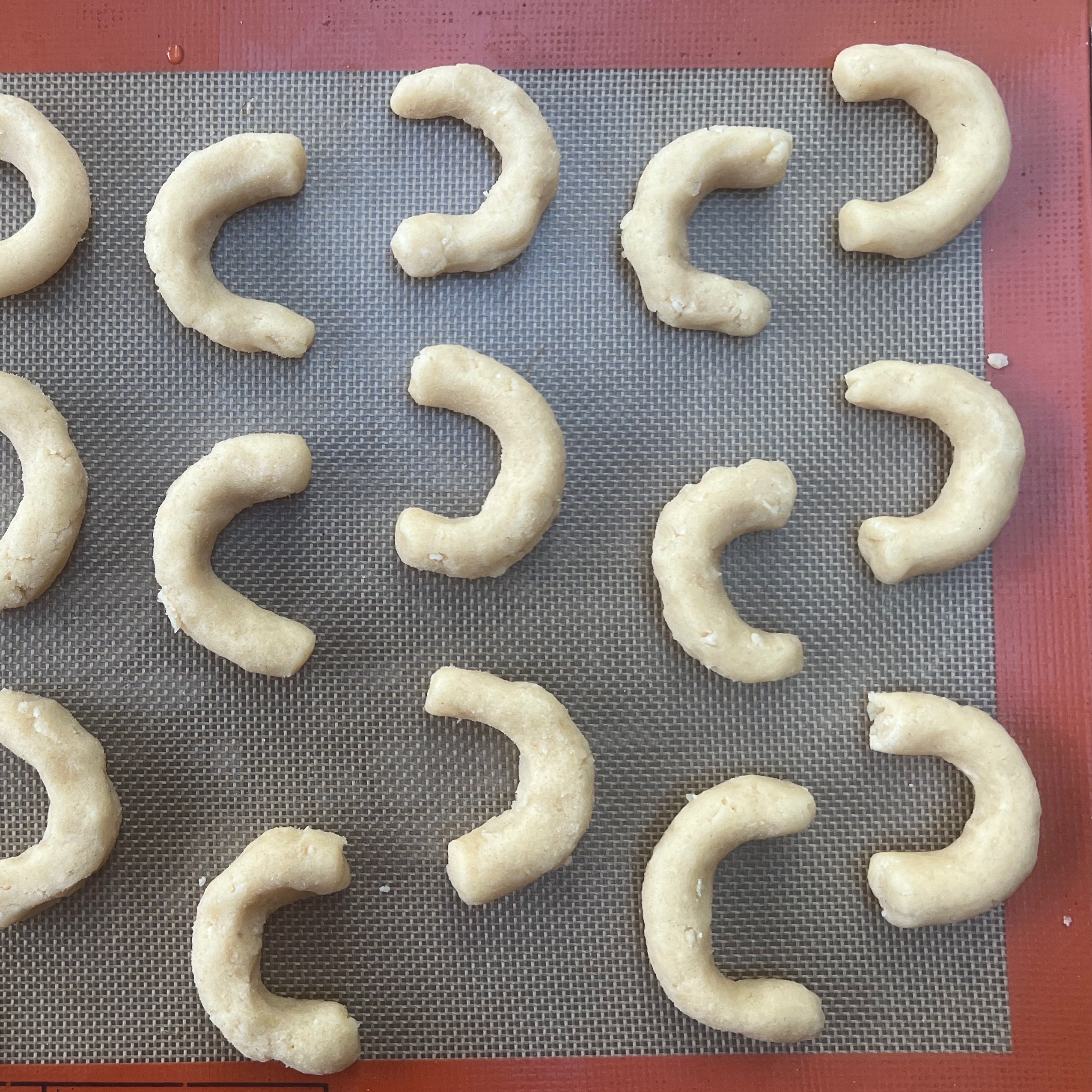
  6. Take a small ball of dough, around 15-20g, compress it in your hands and roll it into a cigar shape around 8 cm long. 
  7. Form the dough into a crescent and place it onto your baking sheet. Make sure to keep at least a couple of centimetres between each crescent, because the Kipferl will spread in the oven more than you expect.
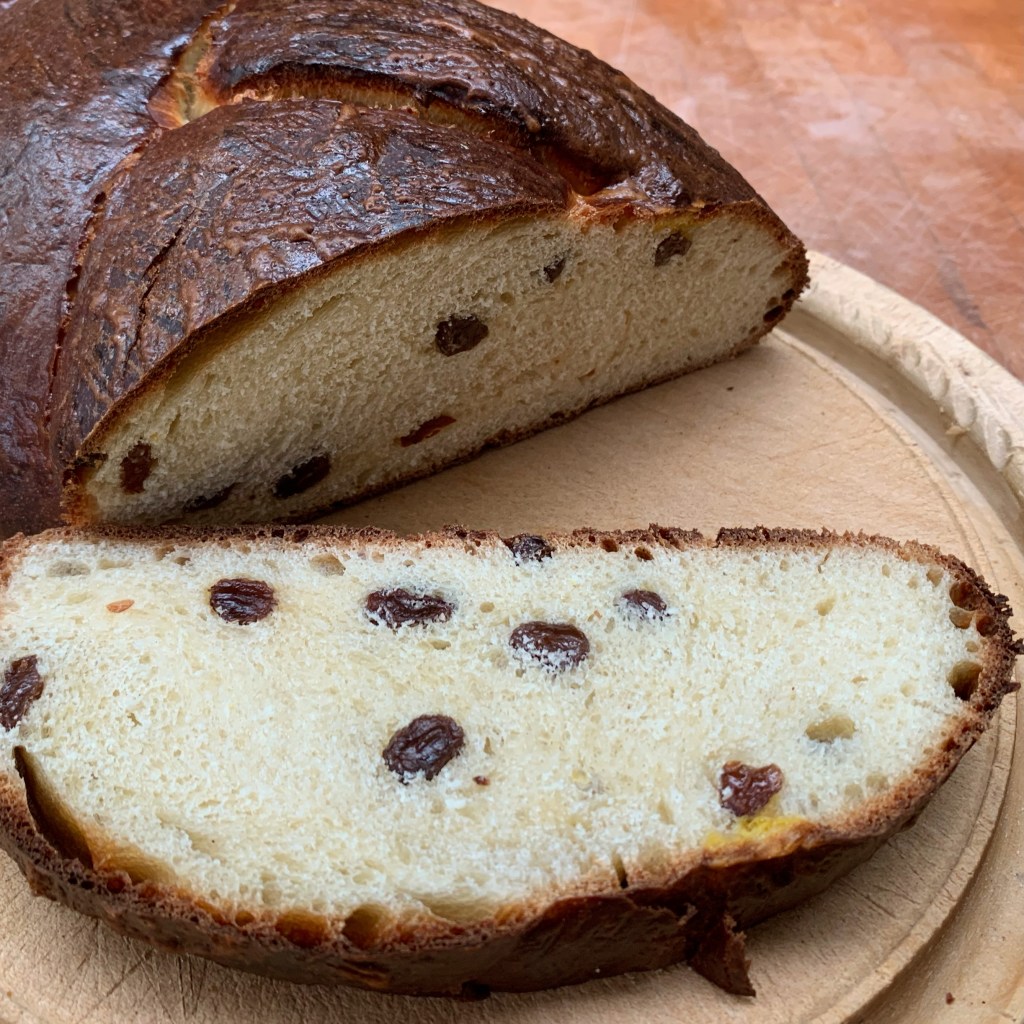
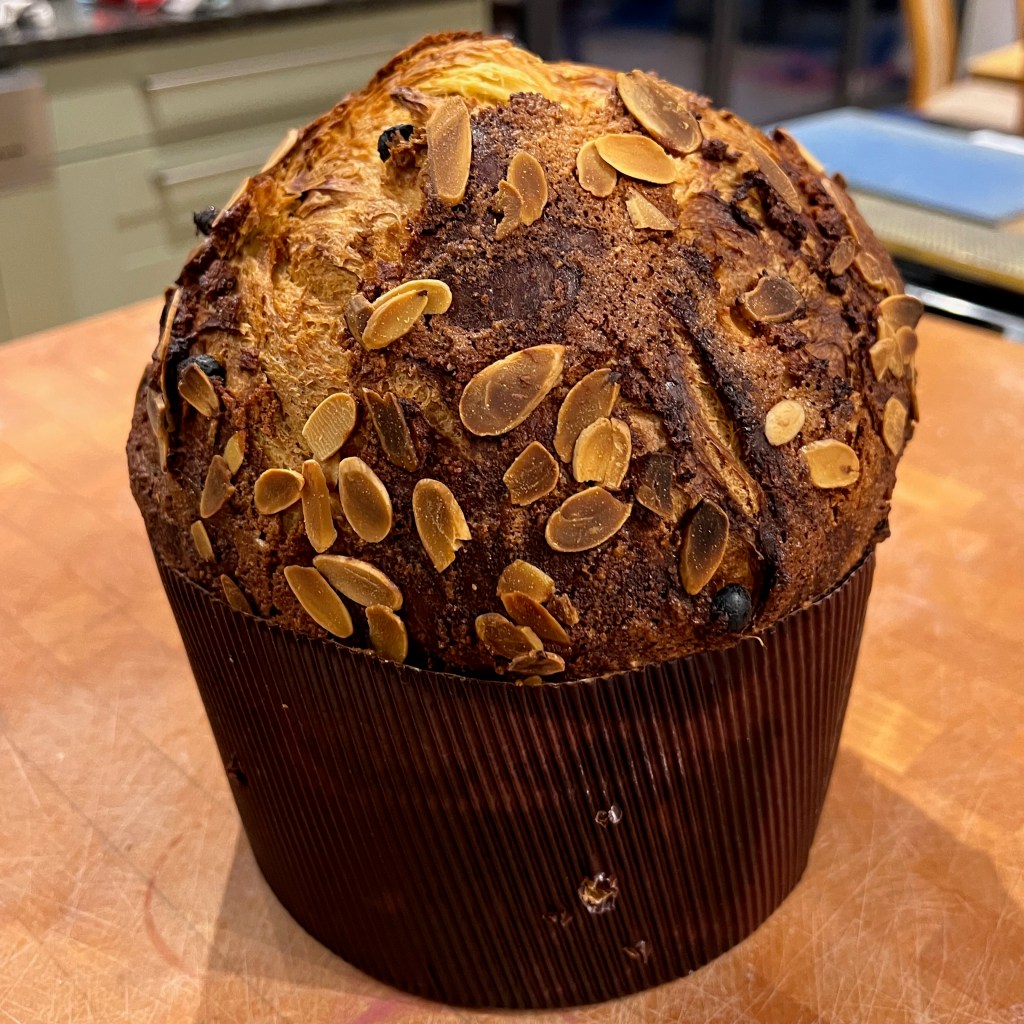
  8. Repeat for the other Kipferl and bake until just beginning to go golden – this will take around 16-18 minutes. You want them fairly pale for the best flavour.
  9. Remove from the oven, slide your Silpat sheet off the baking tray and leave to cool. Handle with care because the Kipferl are quite fragile. 
  10. If any of the Kipferl have merged together when they spread, separate them gently with a knife and serve.

I stop here, because the Vanillekipferl are plenty sweet enough for me already. But Austrian recipes now dust theKkipferl with icing sugar in one or both of the following stages:

  1. Immediately after taking out of the oven. In this case, the icing sugar will be absorbed into the Kipferl.
  2. After the Kipferl have been cooled. In this case, the icing will stay as a pretty powdery dusting on the top.

It would, of course, be close to criminal to miss out on having these with good coffee…

Around the world in 80 bakes, no.78: Potica from Slovenia

Around the world in 80 bakes, no.78: Potica from Slovenia

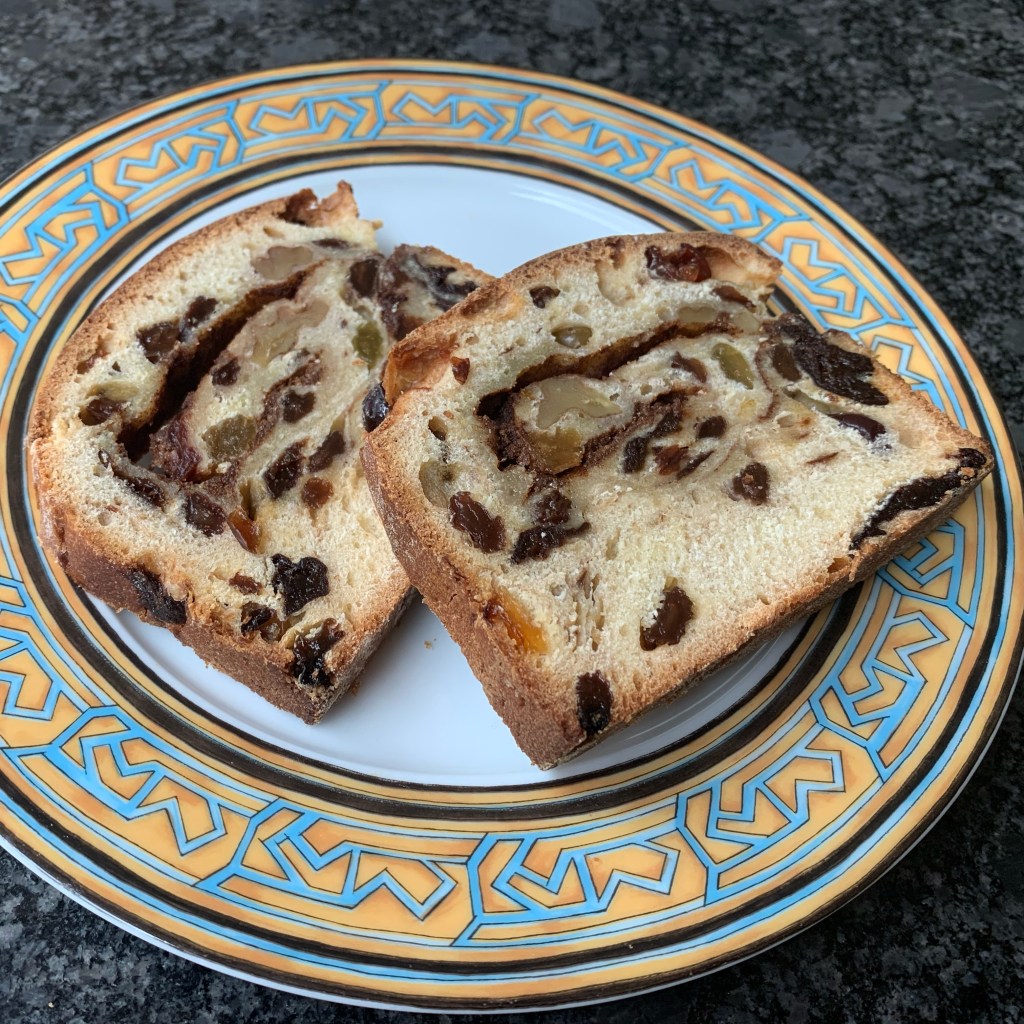
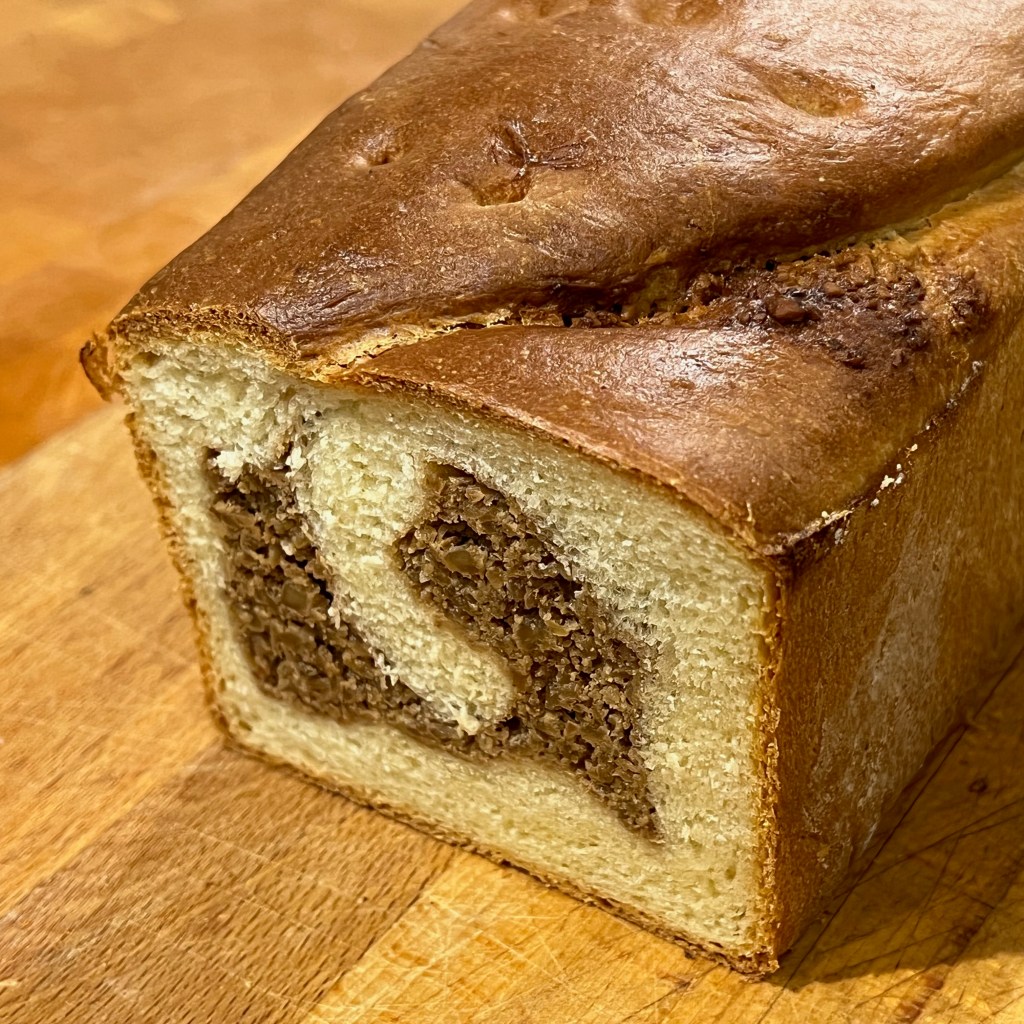
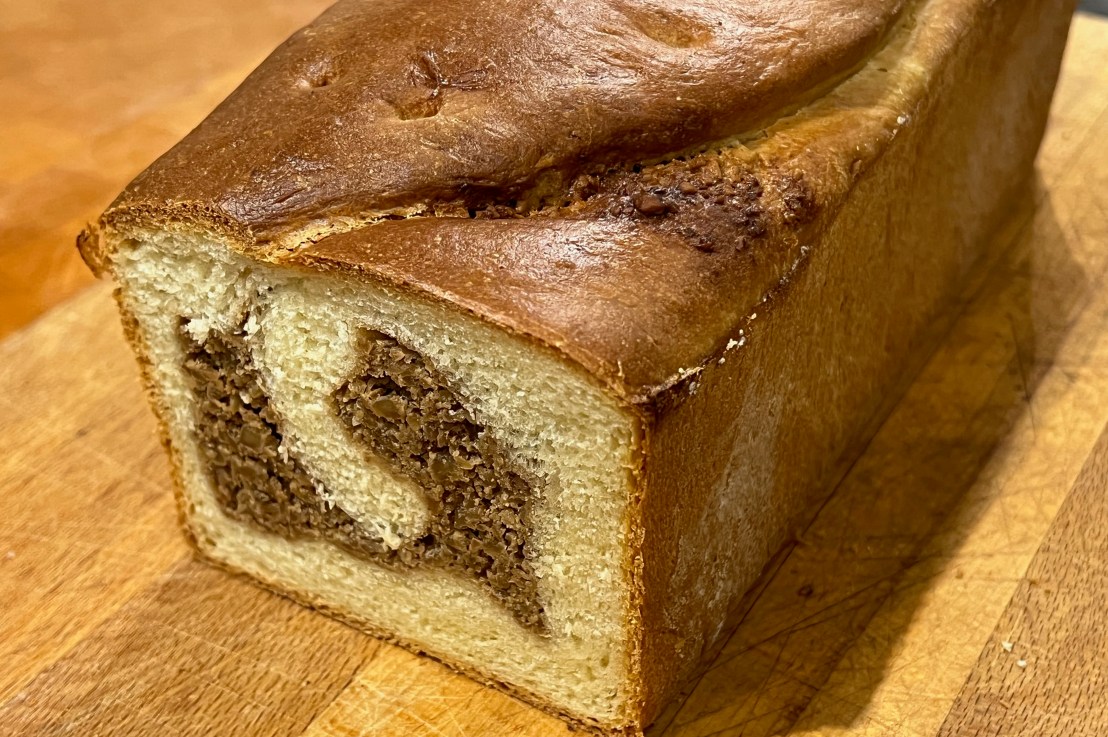
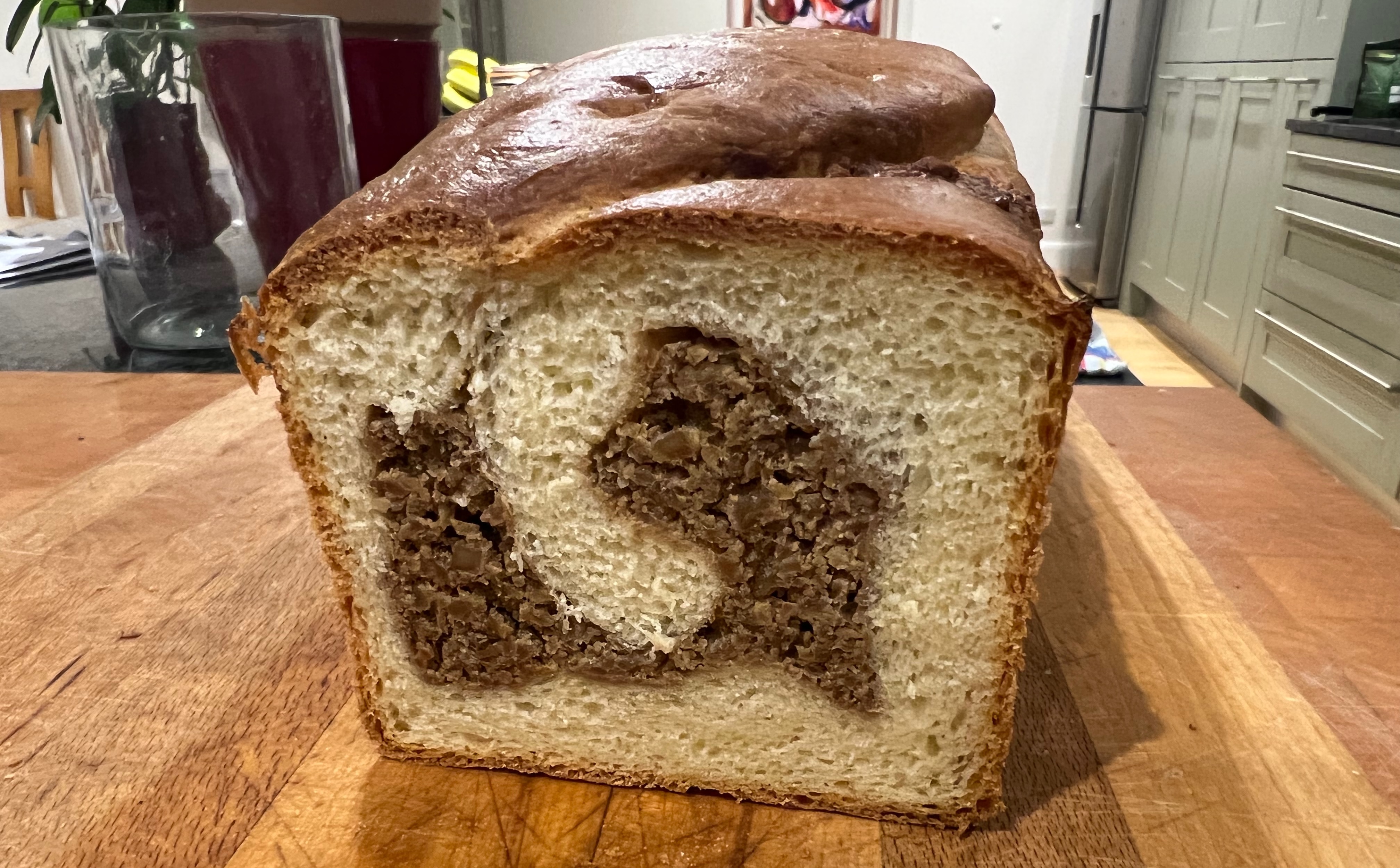
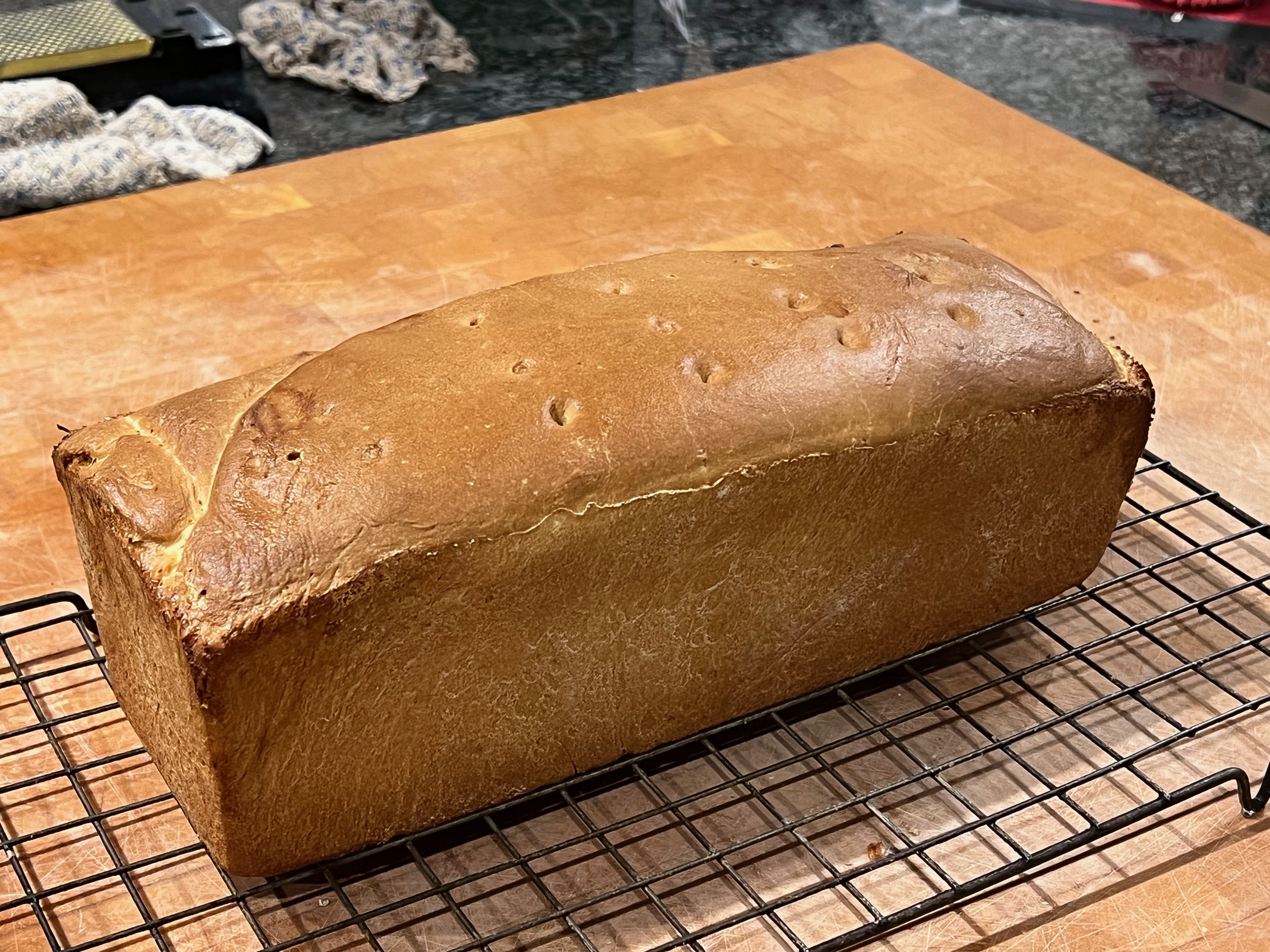
Think of it as the child of a love triangle of brioche, cinnamon bun and baklava, only with a lot less sugar. For Slovenian celebrations – Easter, Christmas, weddings, whatever – the Potica (the “c” is pronounced “ts”) is a favourite baked item. (I’m not really sure whether to call it a bread or a cake). There is even a special mould for it called a Potičnik, which is a relative of the bundt tin more commonly found in the UK or US, but with a different pattern around the top. However, if you don’t own a bundt tin, you can make a perfectly good Potica in a normal loaf tin, as I’ve done here: it just won’t be quite as striking.

The critical part here is to make a beautifully stretchy dough enriched with eggs, butter and some sugar, although really a lot less than you might expect from similar breads around the world. I’ve started with this recipe from Jernej Kitchen and I’m really impressed: it’s resulted in a truly lovely dough: smooth, elastic, non-greasy and deeply satisfying to work with.

Next, it’s the filling. Staying with Jernej, I’ve gone for walnuts and honey, which is probably the most popular version of Potica: apparently, you can choose any of the usual things that Eastern Europeans like in pastries: poppyseeds are a favourite of mine.

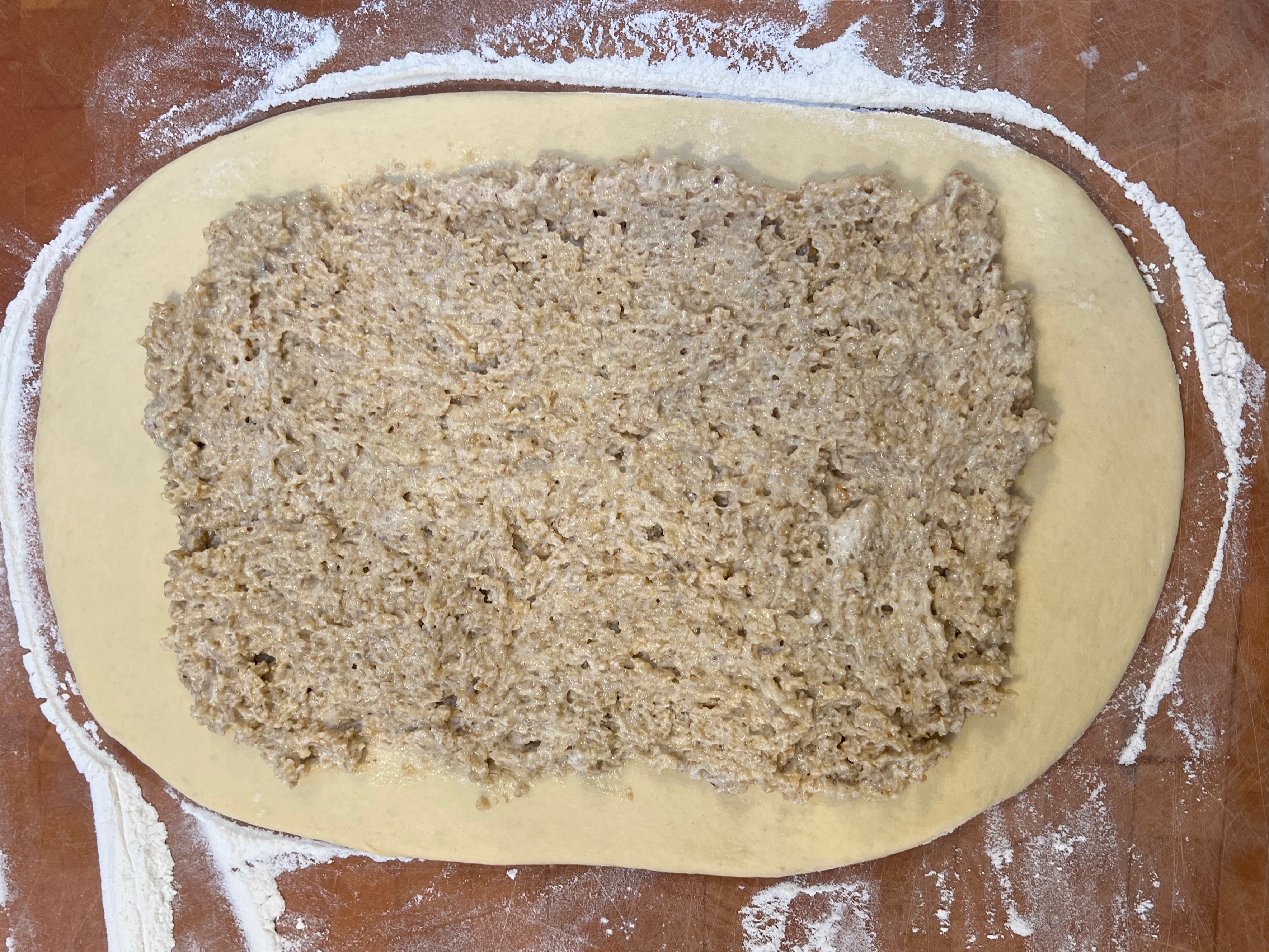
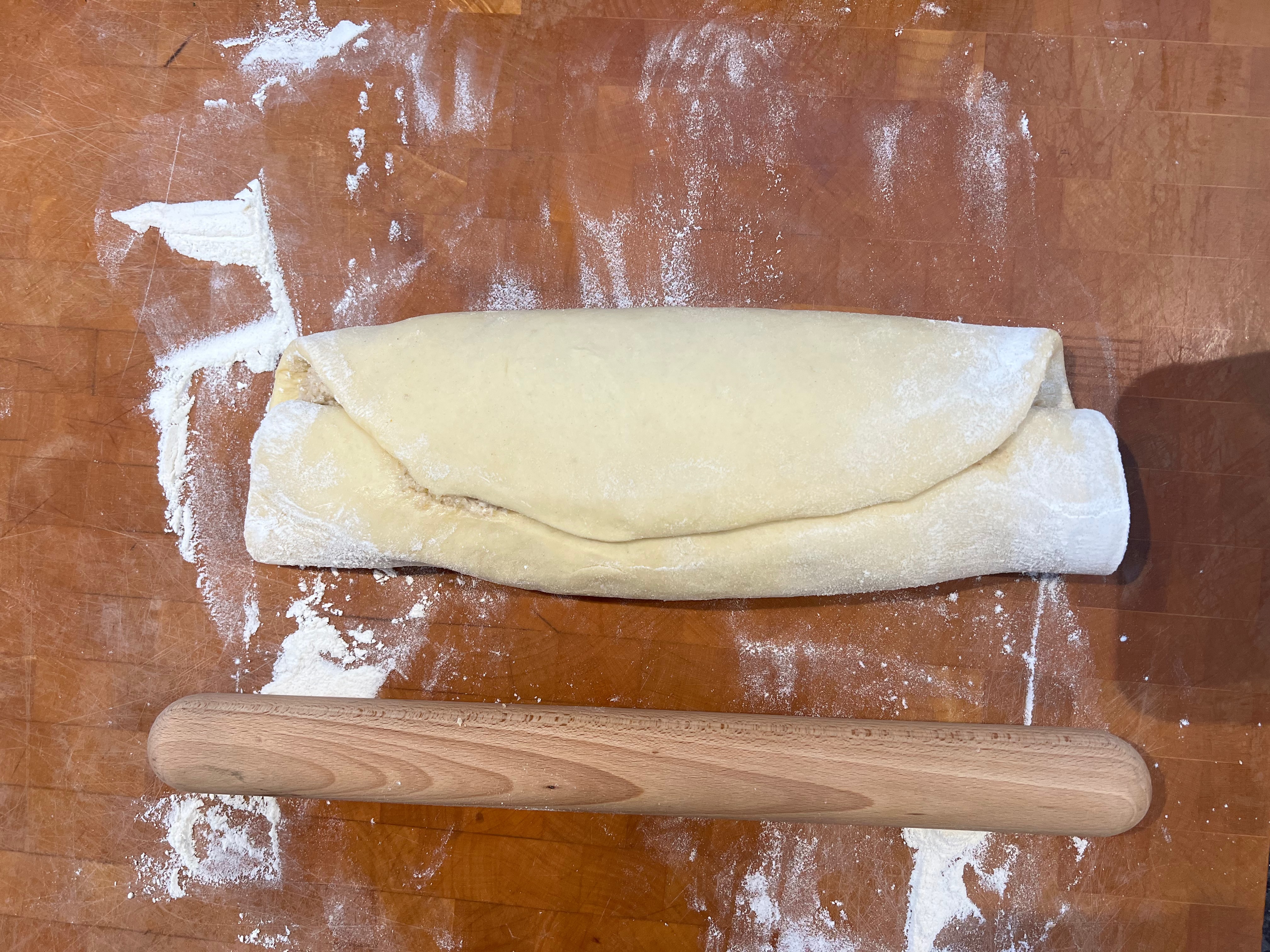
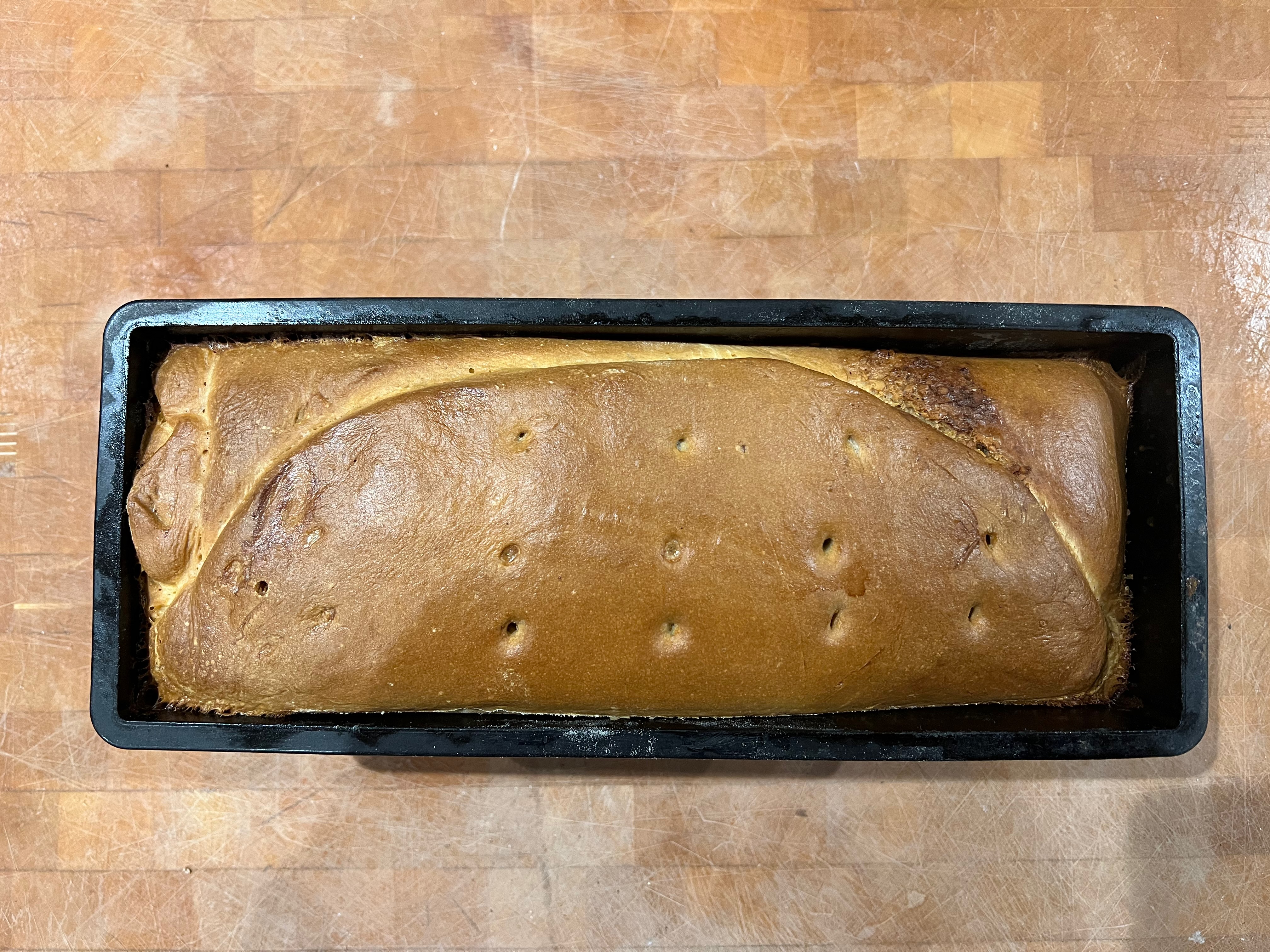
Finally, rolling and baking. Let’s be honest here: looking at the photos, it’s obvious that there aren’t nearly enough turns on my spiral of dough and filling. Partly, that’s the fault of the recipe suggesting that I roll it to 40cm long – I think doubling that would have been good – and partly, I wimped out of how thin the dough was. Next time, I’ll roll out the dough to as close as I can get to the full length of my board and then make strenous efforts to roll the whole thing as tightly as I can.

By the way, proving times are pretty flexible. Jernej gives a couple of options, both of which involve long proves in the fridge; I didn’t have time so I just proved at slightly above room temperature and watched carefully until the dough was risen how I wanted it, which I think worked fine.

The dough

  • 5g dried yeast
  • 25g sugar
  • 270ml milk
  • 500g strong white bread flour
  • 2 eggs
  • 65 g butter
  • 8g salt
  1. Put the milk into a bowl and warm until lukewarm (45s in my 900W microwave got the milk to 34℃).
  2. Put the yeast, sugar and milk into a bowl and leave until frothy (10 minutes or so)
  3. Put the flour into the bowl of your stand mixer
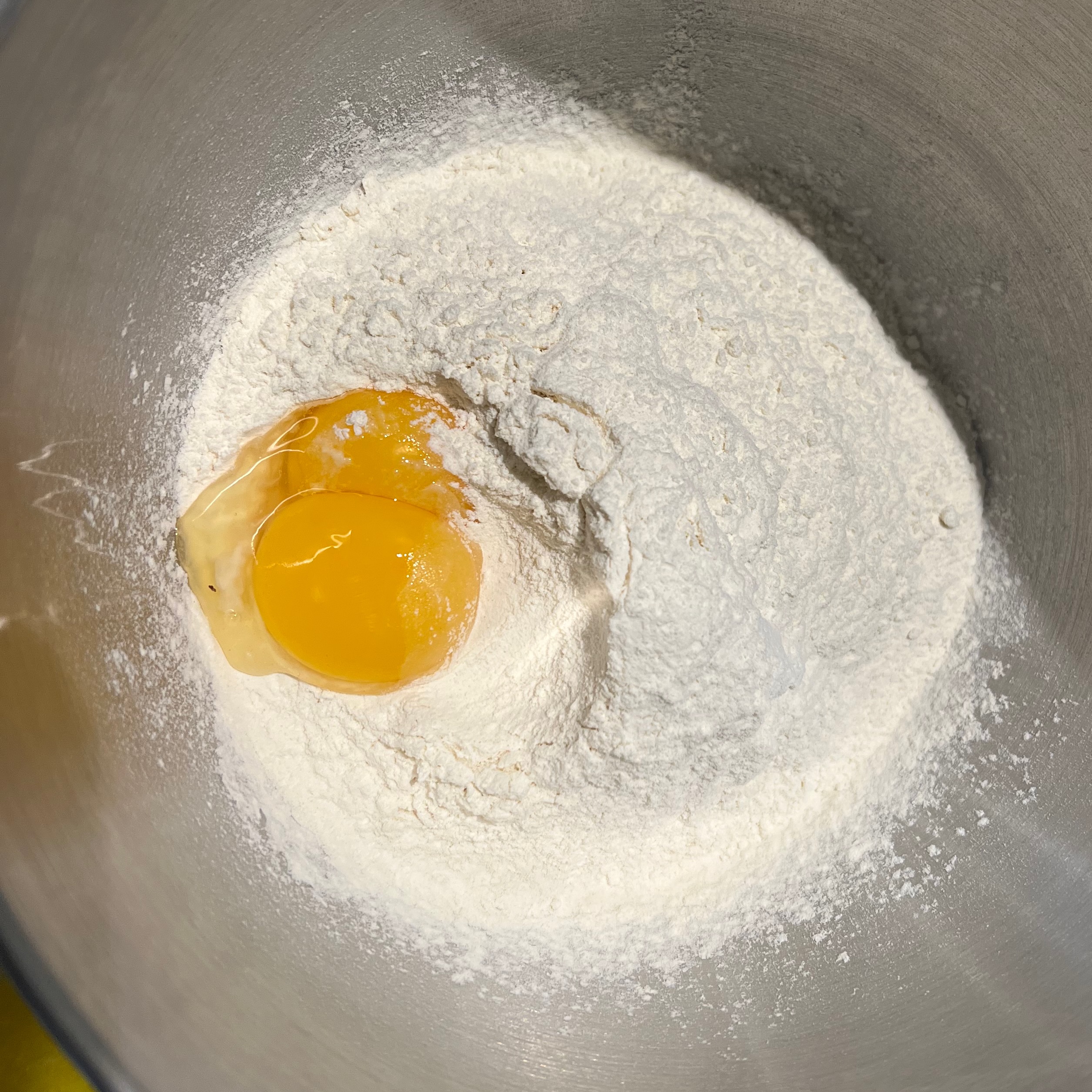
  4. Separate the eggs: place the yolks in the bowl with the flour, setting aside the whites, which you’ll use for the filling.
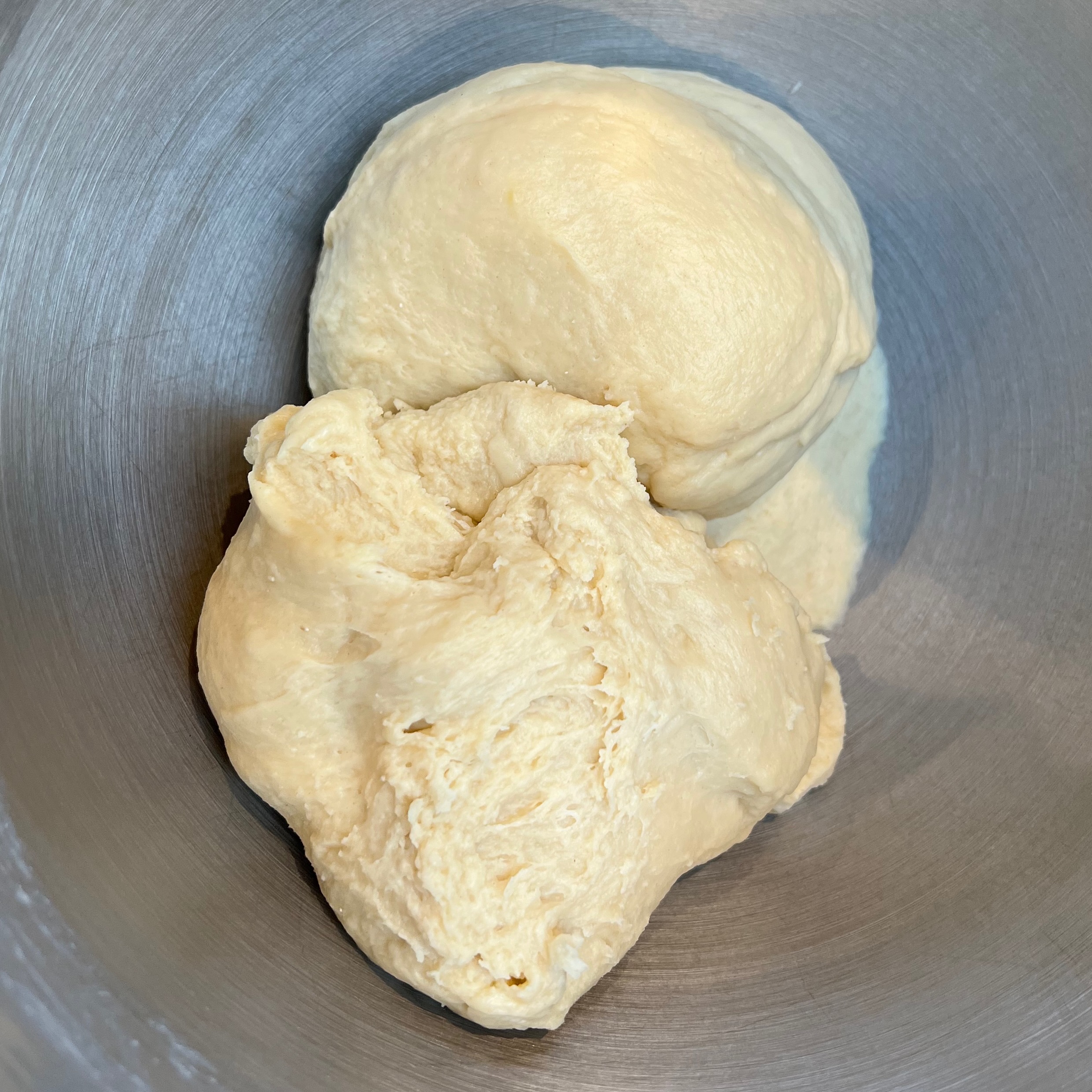
  5. Add the yeast mix to the bowl and mix with the standard paddle until well combined
  6. Melt the butter and add it to the bowl with the salt.
  7. Switch to the dough hook and knead at low speed until smooth and elastic – around 8-10 minutes.
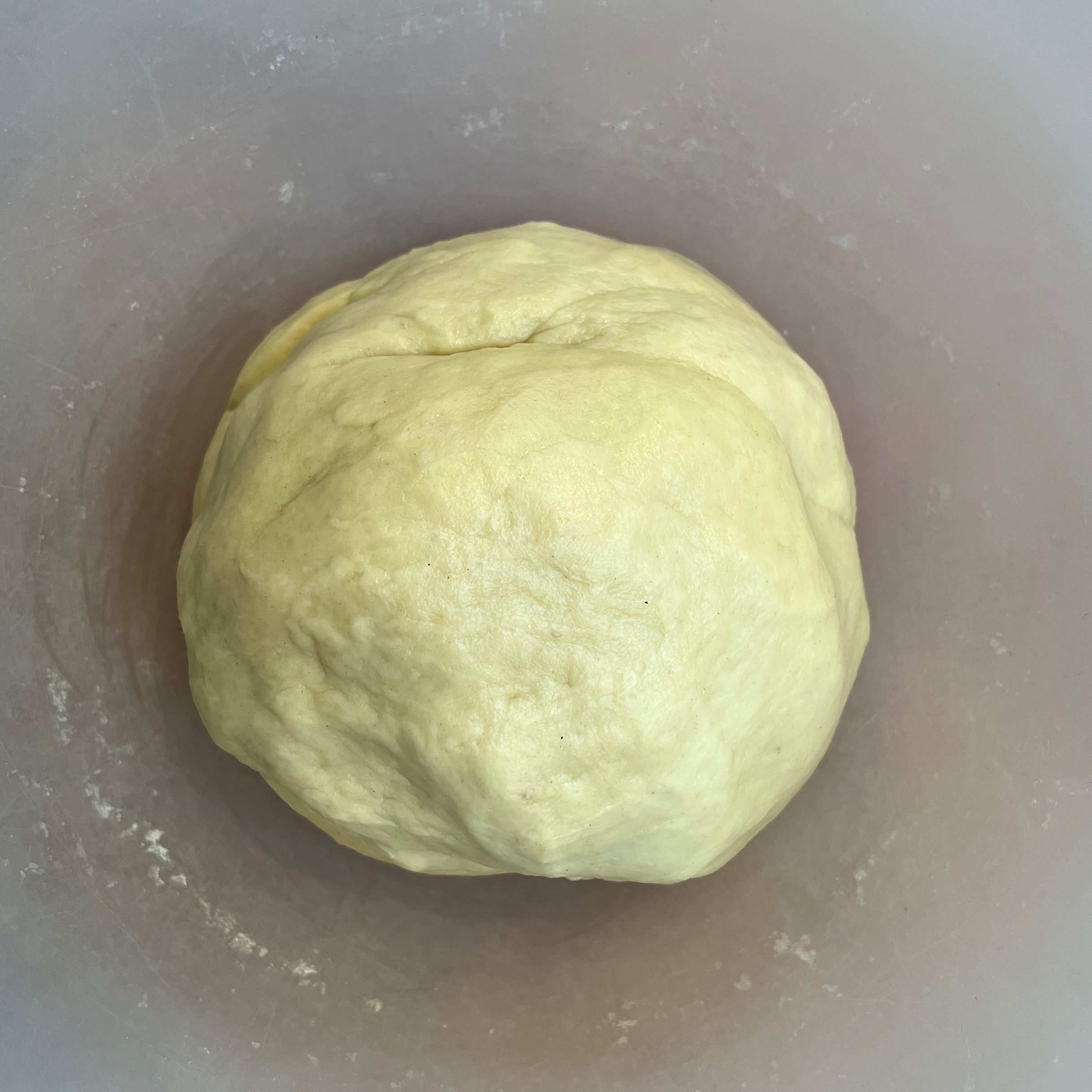
  8. Form the dough into a ball and place in a bowl and cover.
  9. Leave until risen to around doubled in size – around 1-2 hours depending on the temperature of your kitchen.

The filling

  • 300g walnuts
  • 60g honey
  • 30g granulated sugar (or caster)
  • 100g single cream (Jernej went for 75 g heavy cream – single was what I had)
  • 20g butter
  • 20ml rum
  • ½ tsp ground cinnamon
  • Zest of half a lemon
  • 2 egg whites reserved from above
  • 25g caster sugar
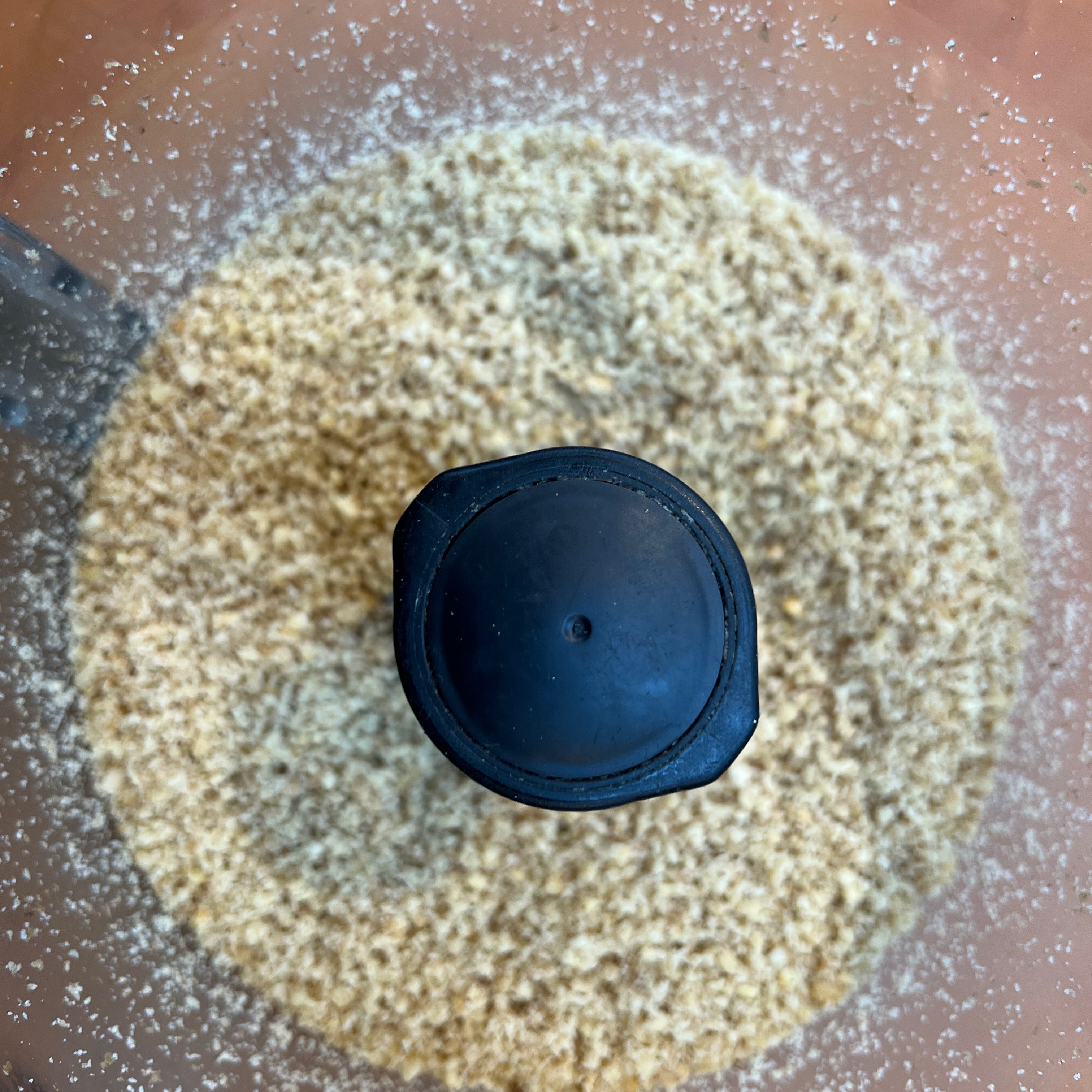
  1. Put the walnuts into a food processor and grind until fine – but don’t overdo it: you don’t want oil coming out of the walnuts.
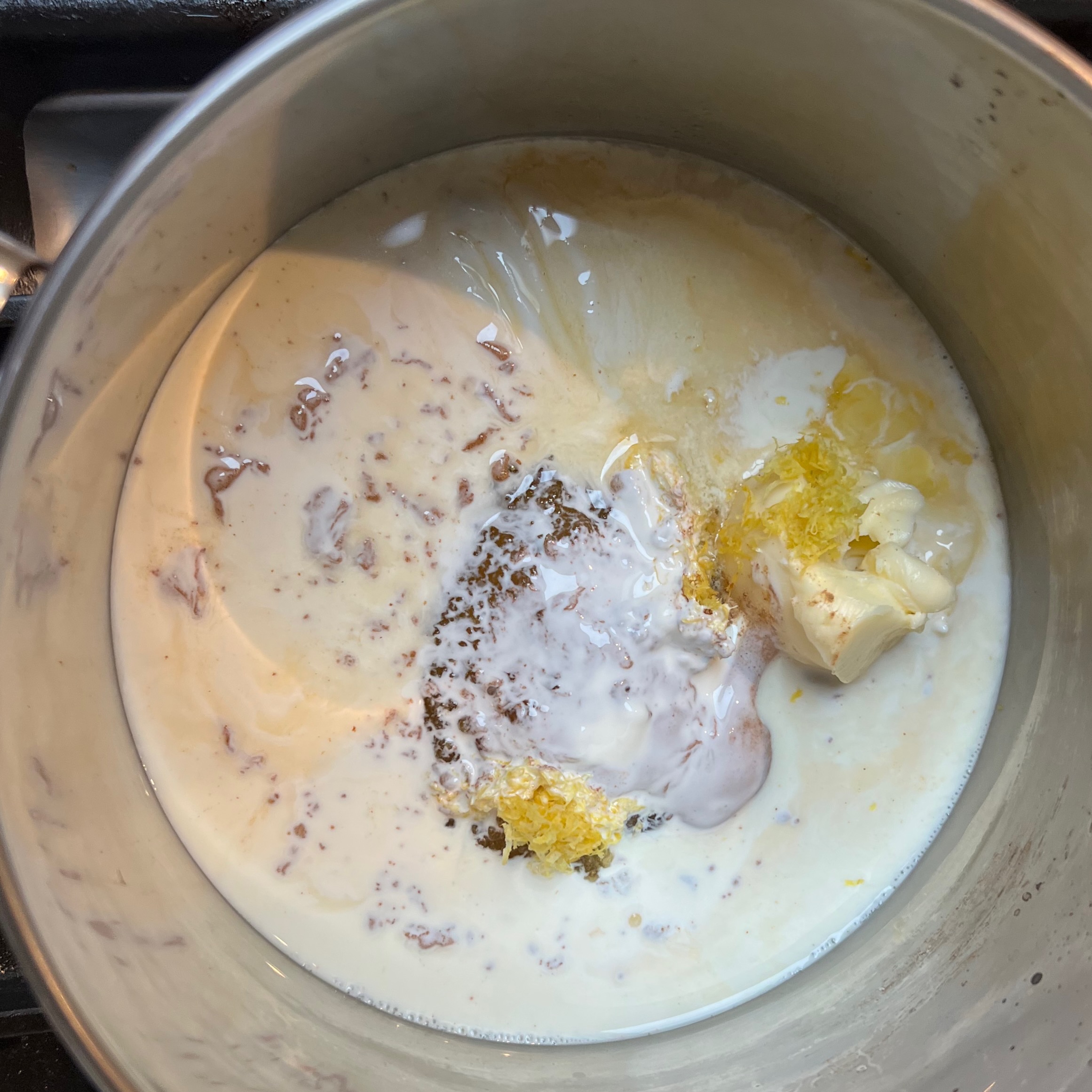
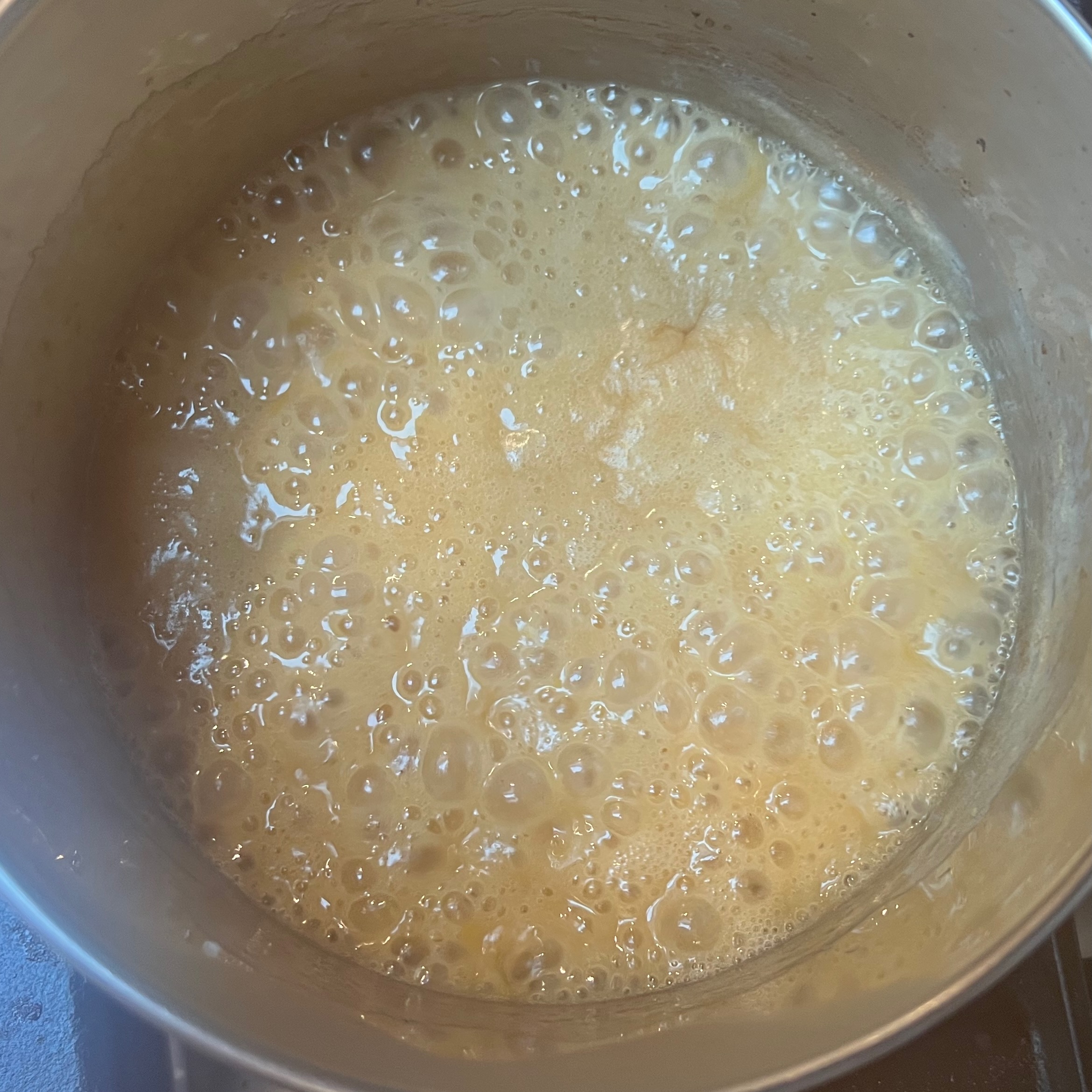
  2. Put the honey, granulated sugar, cream, butter and rum into a saucepan and bring to the boil; simmer for a minute or so.
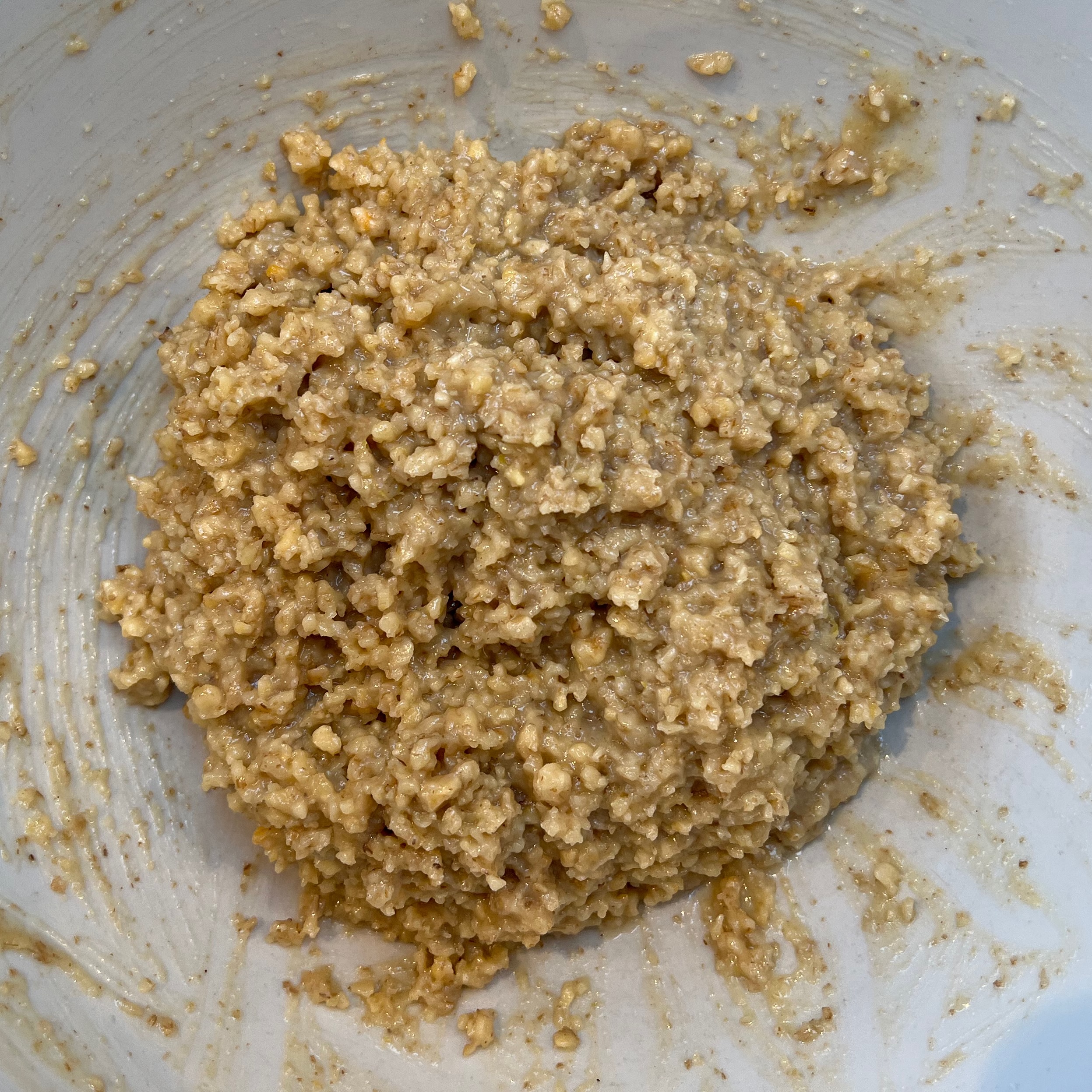
  3. Add the mixture into your bowl with the walnuts, add the cinnamon and lemon zest and stir thoroughly.
  4. Wait until around 10 minutes before your dough is sufficiently risen before the next step, which is to make a meringue.
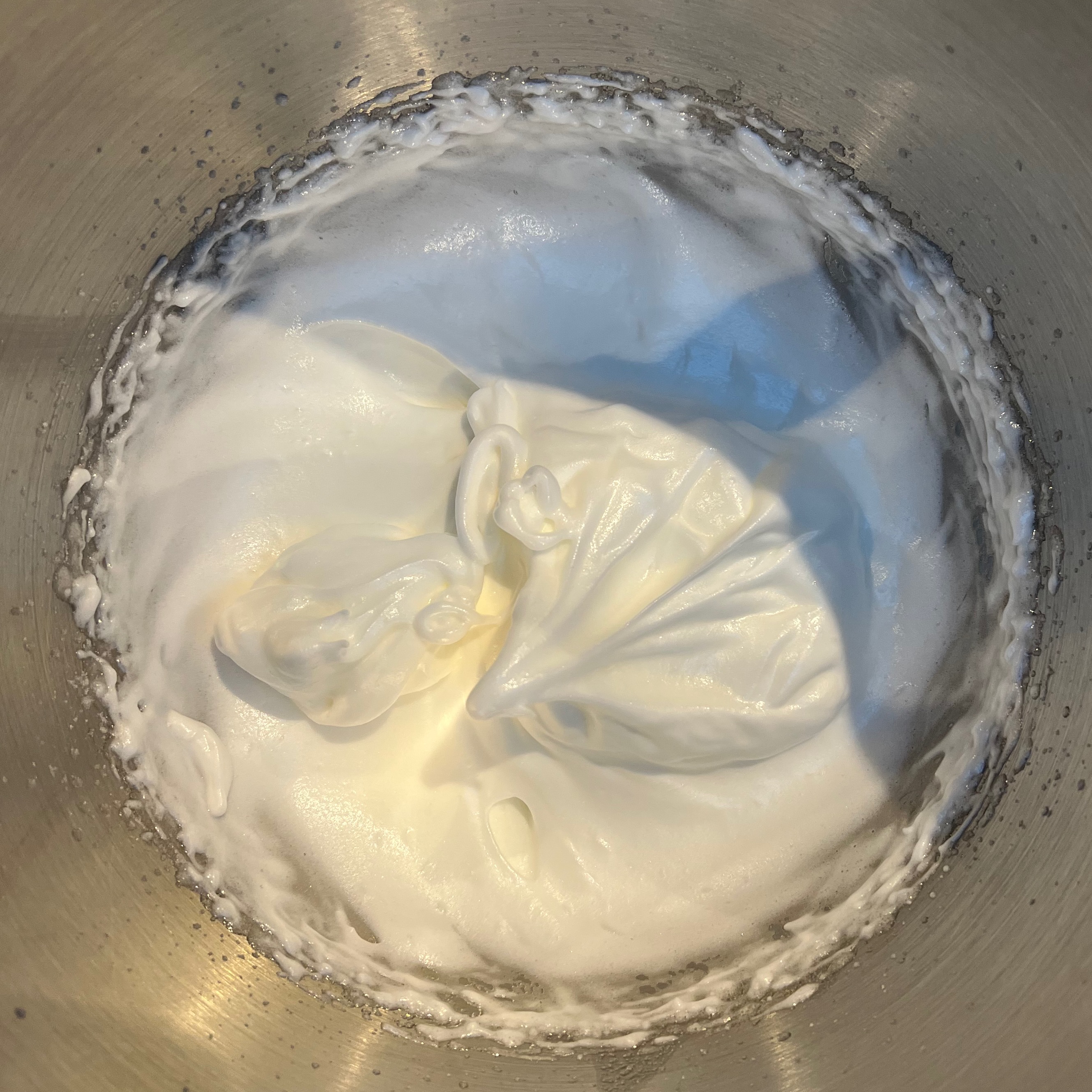
  5. Beat the egg whites at high speed. Once they are soft and beginning to fluff, add the sugar gradually as you beat.
  6. Continue beating at high speed until you have a stiff meringue.
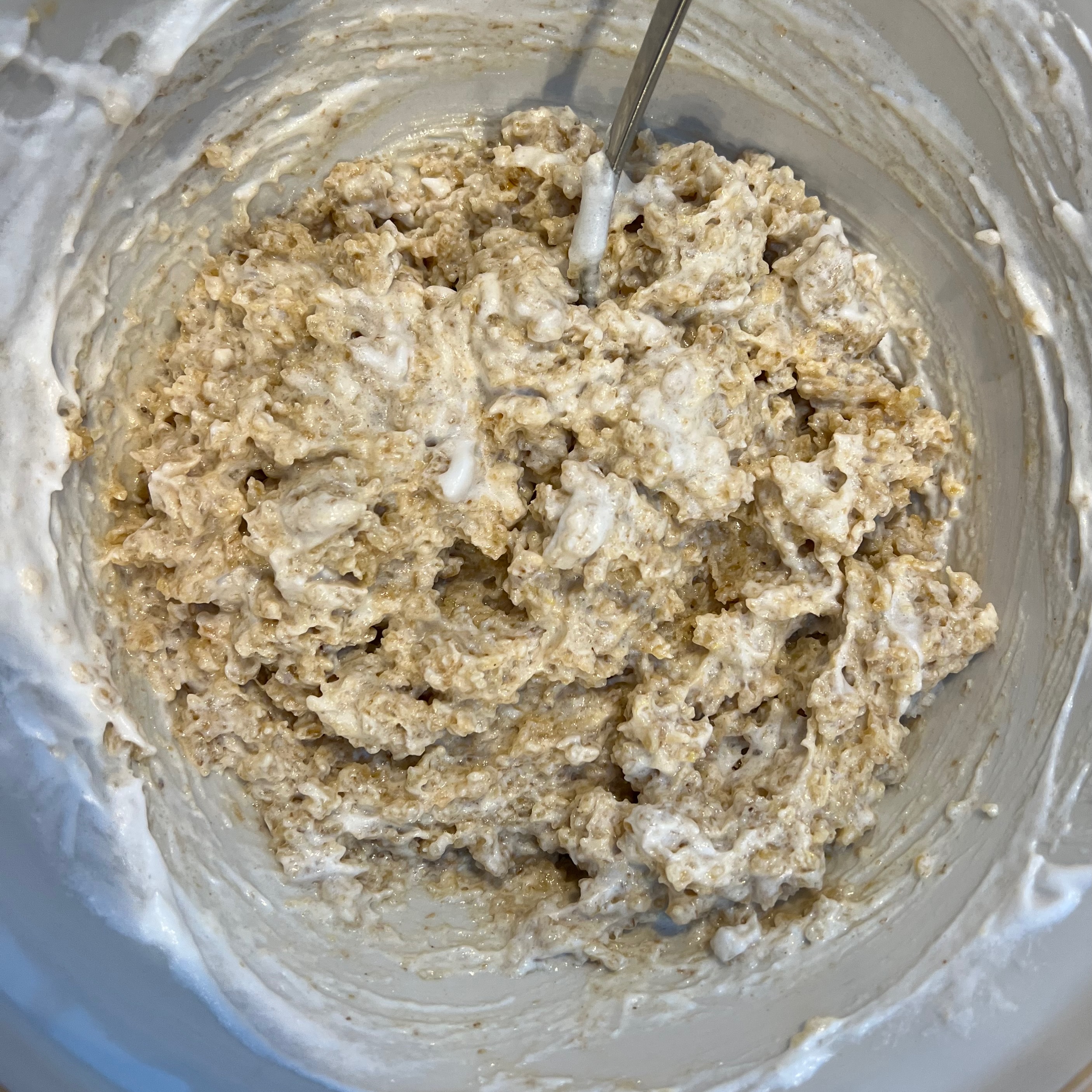
  7. Fold the meringue into the walnut mixture until smoothly combined.

Putting it together 

  • A little milk for brushing
  1. Preheat oven to 165℃ fan.
  2. Grease your baking tin – a bundt tin if you have one, or a loaf pan if you don’t.
  3. Flour your board.
  4. Roll out the dough into a rectangle. The width should be the length of your loaf tin, or around twice the width of your bundt tin. The length should be as long as you can reasonably make it without tearing the dough.
  5. Spread the filling over the dough, leaving around 3-5cm around the edge.
  6. Roll the dough up into a spiral, as tightly as possible: the more turns the better. Pinch the ends to stop the filling leaking out.
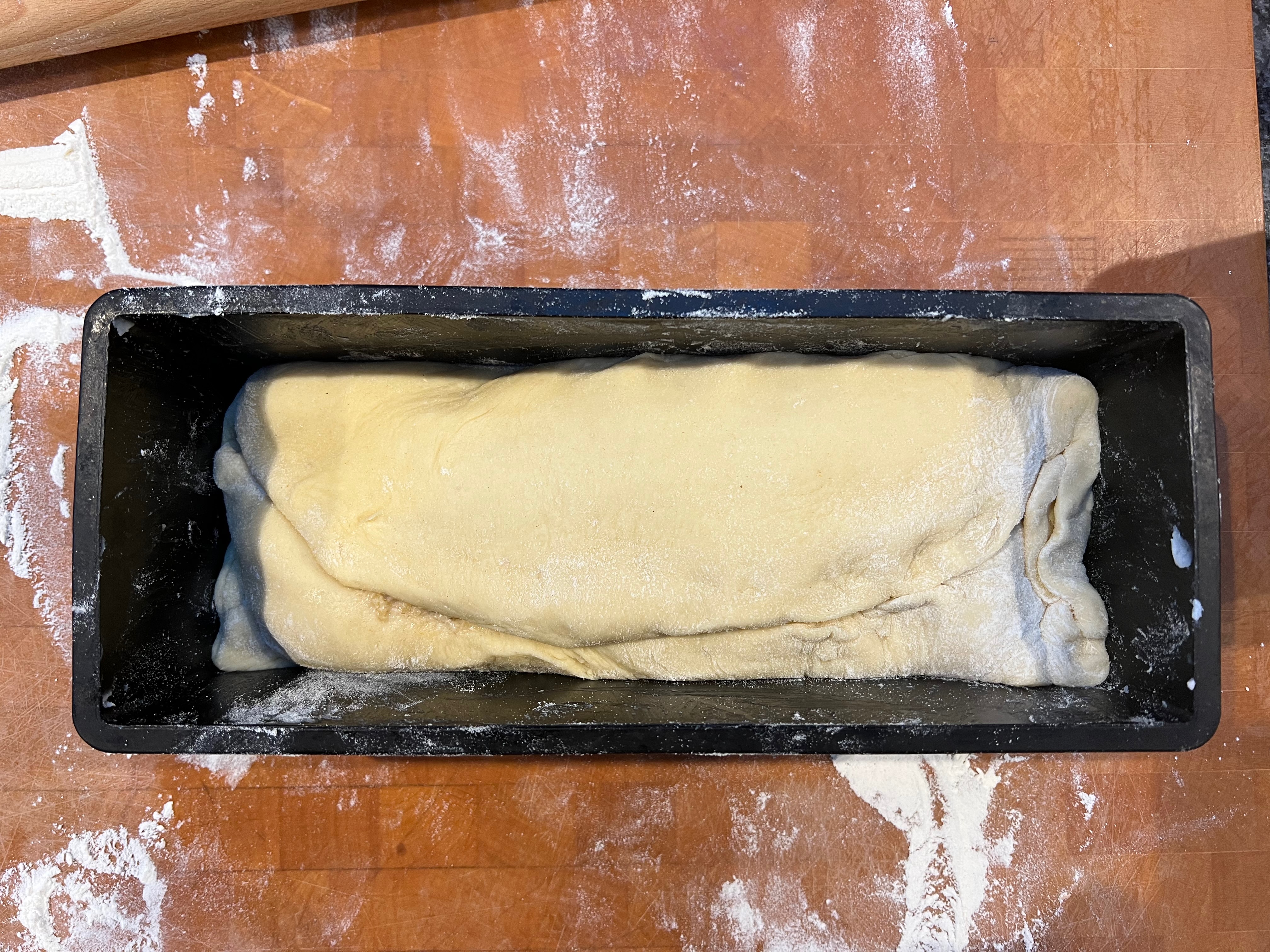
  7. Transfer the dough to your tin, seam side up.
  8. Cover and leave to rise until most of the way to the top of the tin. This took me 2 hours: it will take you more or less, depending mainly on the ambient temperature. Jernej suggests overnight in the fridge.
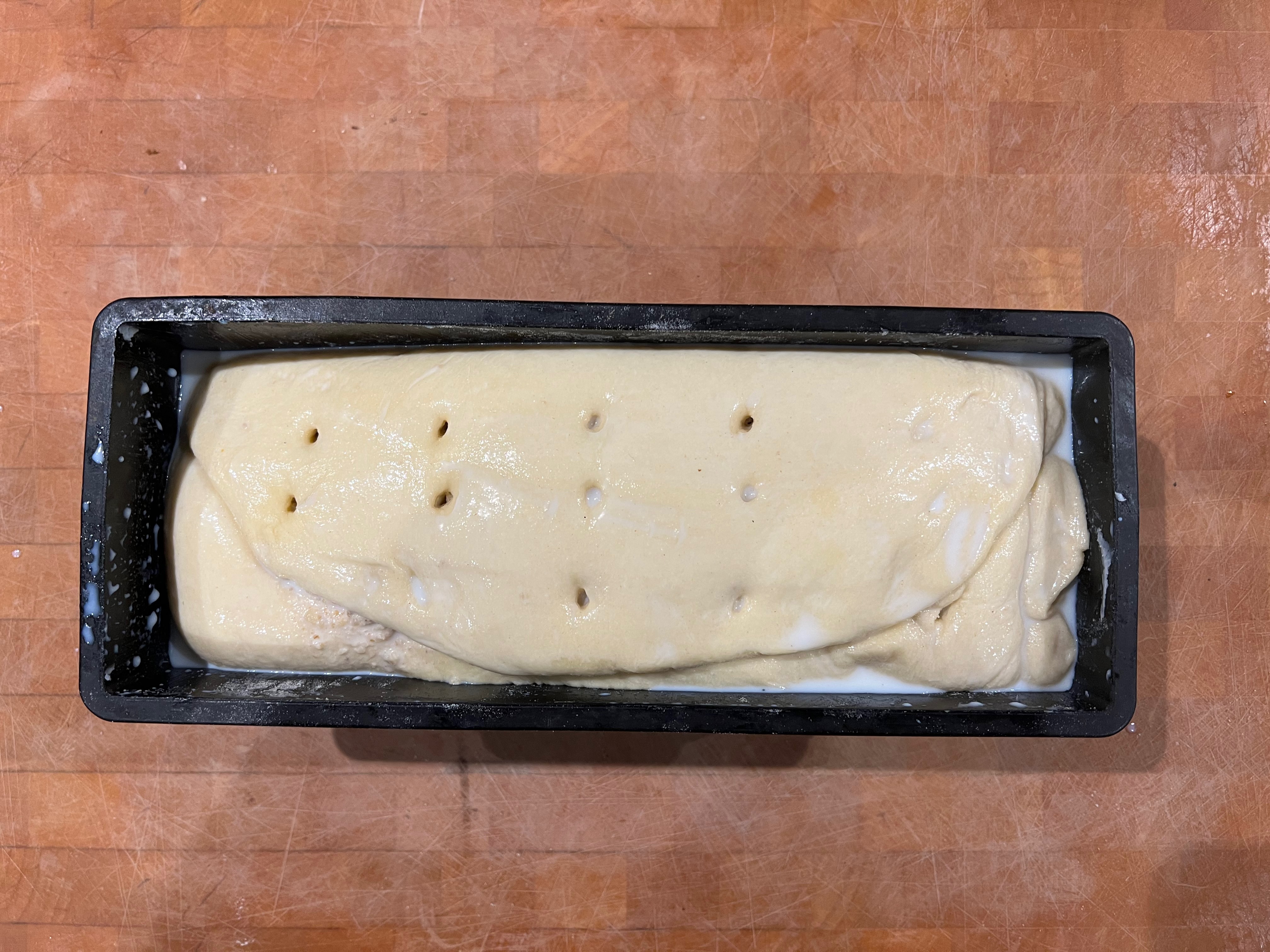
  9. Poke holes in the dough with a skewer to allow moisture from the filling to escape with lower risk of the layers separating;  I probably poked a dozen holes in total.
  10. Brush with milk.
  11. Bake for 45 min; then reduce the heat to 140℃ and bake until a deep gold colour – around 20 minutes more.
  12. Remove from the oven, cool for a couple of minutes, then remove the loaf from the pan and leave to cool.
Around the world in 80 bakes, no.77: Must Leib – Estonian black bread

Around the world in 80 bakes, no.77: Must Leib – Estonian black bread

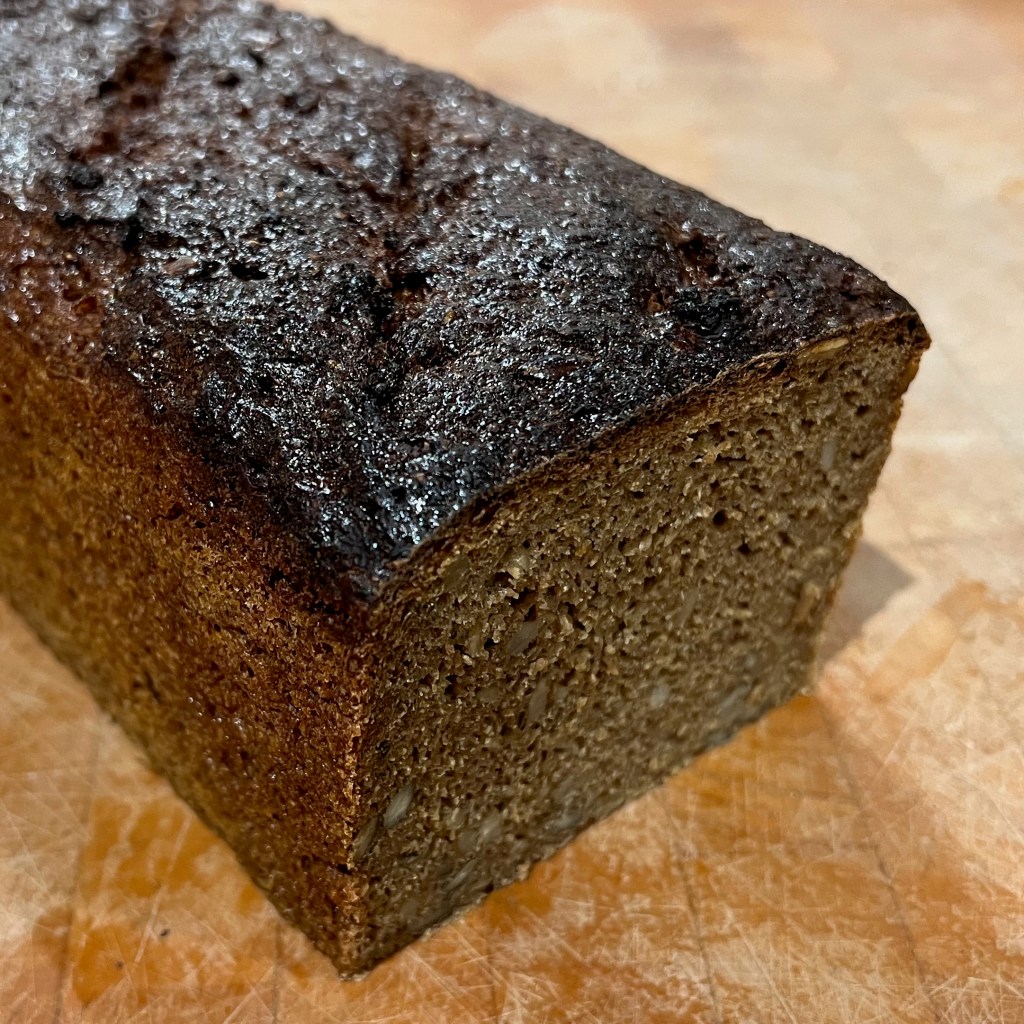
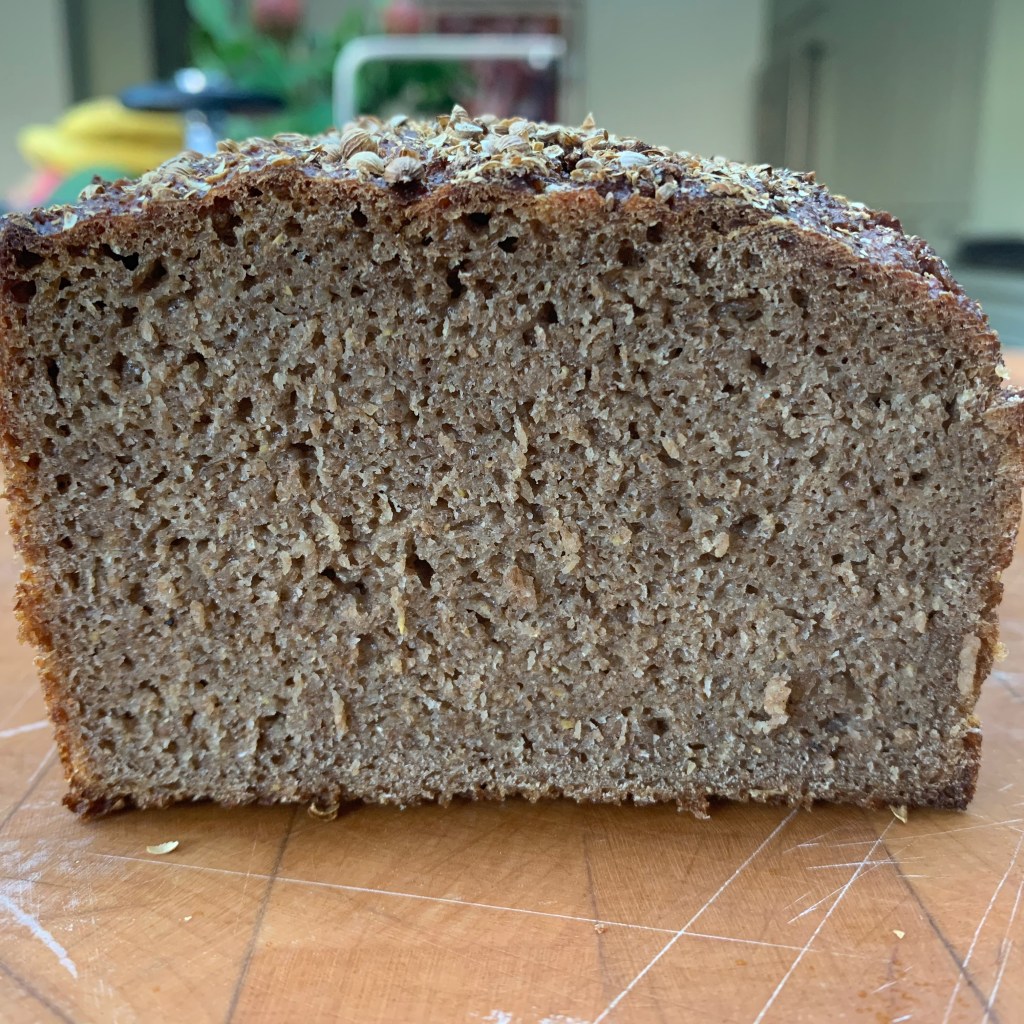
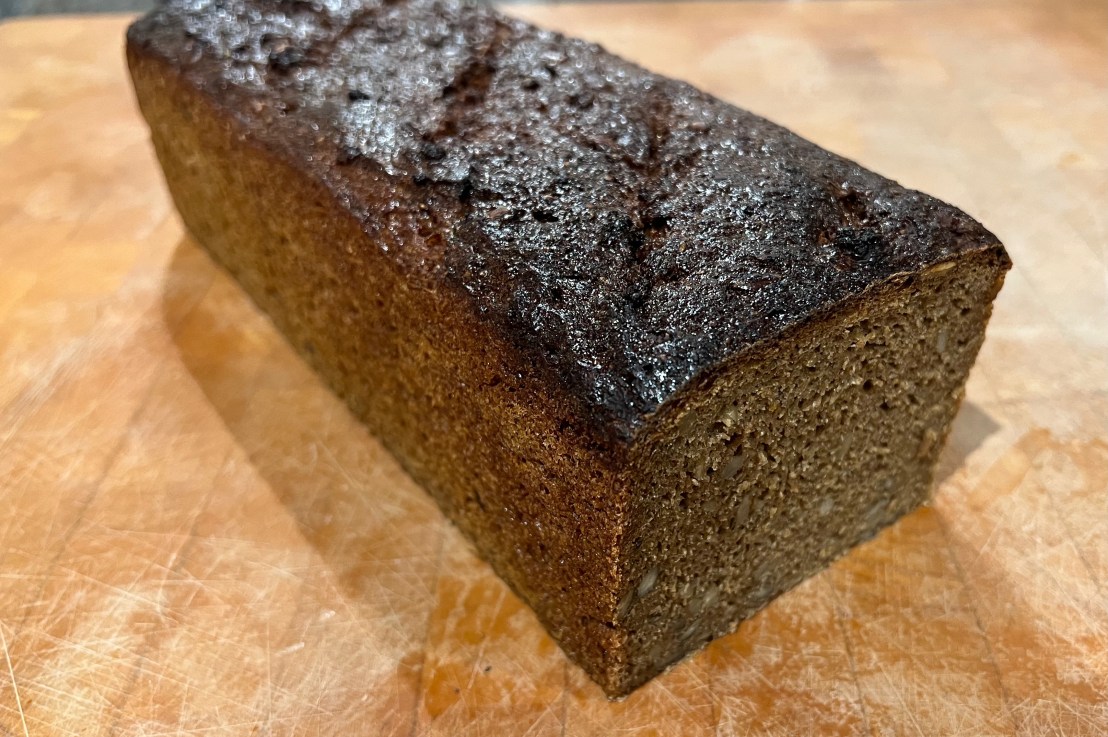
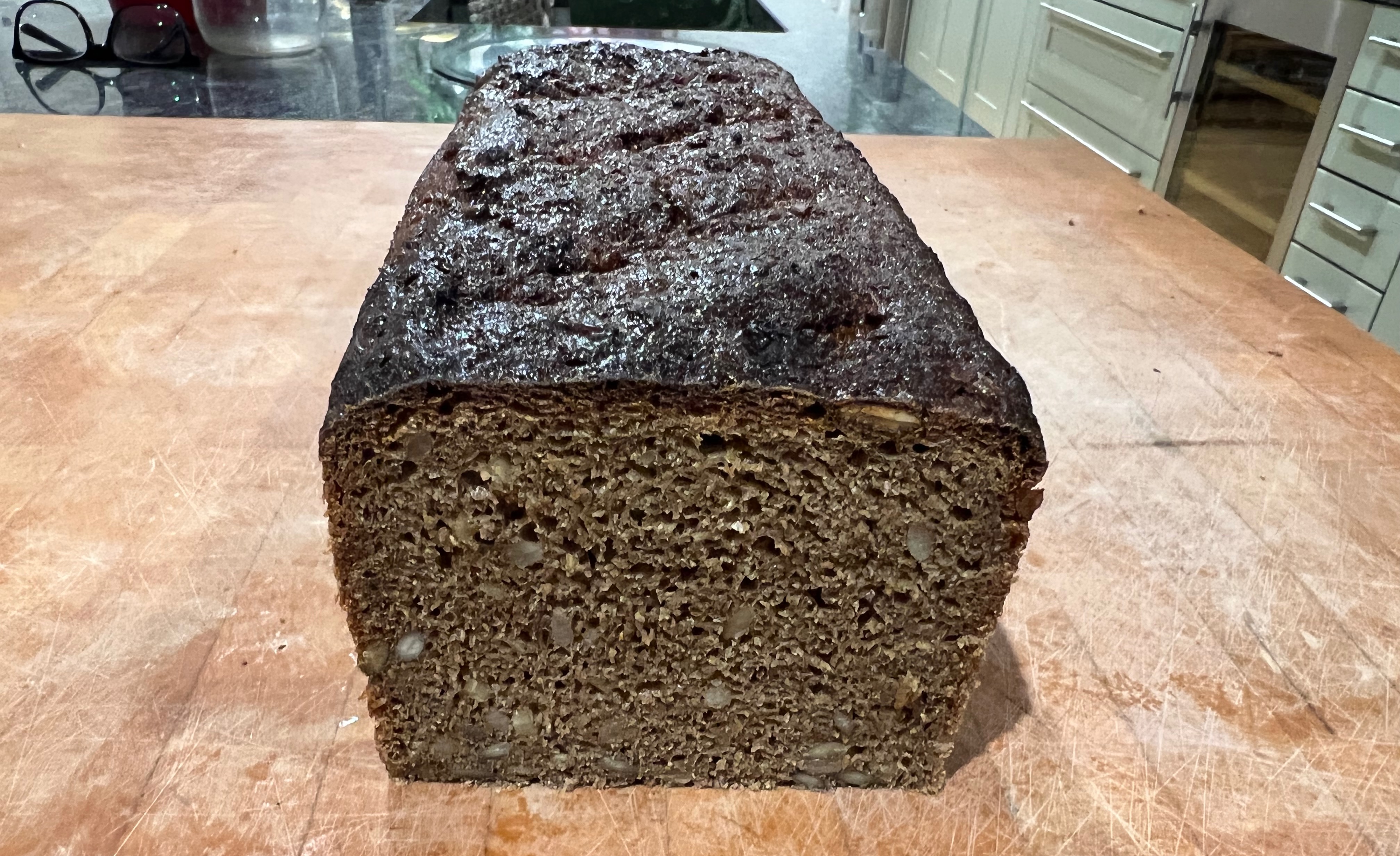
There have been several dark rye breads in this series, but after a recent visit to Estonia, I felt compelled to make the Estonian version, known simply as “Leib” (bread) or, if you’re feeling loquacious, “Must Leib” (black bread). It’s a soft, earthy and aromatic loaf that immediately hit the top of family favourites of any bread that I’ve made, displacing its Russian cousin Borodinsky bread; it also seems to keep particularly well. You need a couple of days elapsed time and it’s fairly hard work compared to many breads, not least because the dough is very sticky so you spend masses of time on washing up, but it was well worth the trouble and it’s definitely going to become a regular.

As ever, recipes vary: the common theme is the use of dark rye, caraway seeds and various other seeds (pumpkin and sunflower here; I’m sure others are possible), as well as the use of a fairly long fermentation time. I’ve started with a post on Deutsche Welle from their EU correspondent Georg Matthes, taking down the quantities around 20% to suit the size of my bread tin and changing a couple of ingredients to the ones readily available to me. By the way, my bread tin measures around 29cm x 11cm x 10cm, so around 3 litres, probably not far off an American 10 x 5 inch loaf pan.

Georg is surprisingly precise about fermentation time and temperature – 17 hours at 24℃ – which is fine if you are a professional baker with access to a temperature controlled environment but sounds scary to us amateurs. I have the choice of room temperature (around 20℃ in winter) or the cupboard containing my boiler (more like 30℃), so I ended up doing a kind of mix and match. It worked fine, so I suspect that things really aren’t all that sensitive.

I’ve given you the timings and sizes that I used successfully. Obviously, adapt as needed to your schedule, kitchen and available equipment. 

Day 1 – around noon

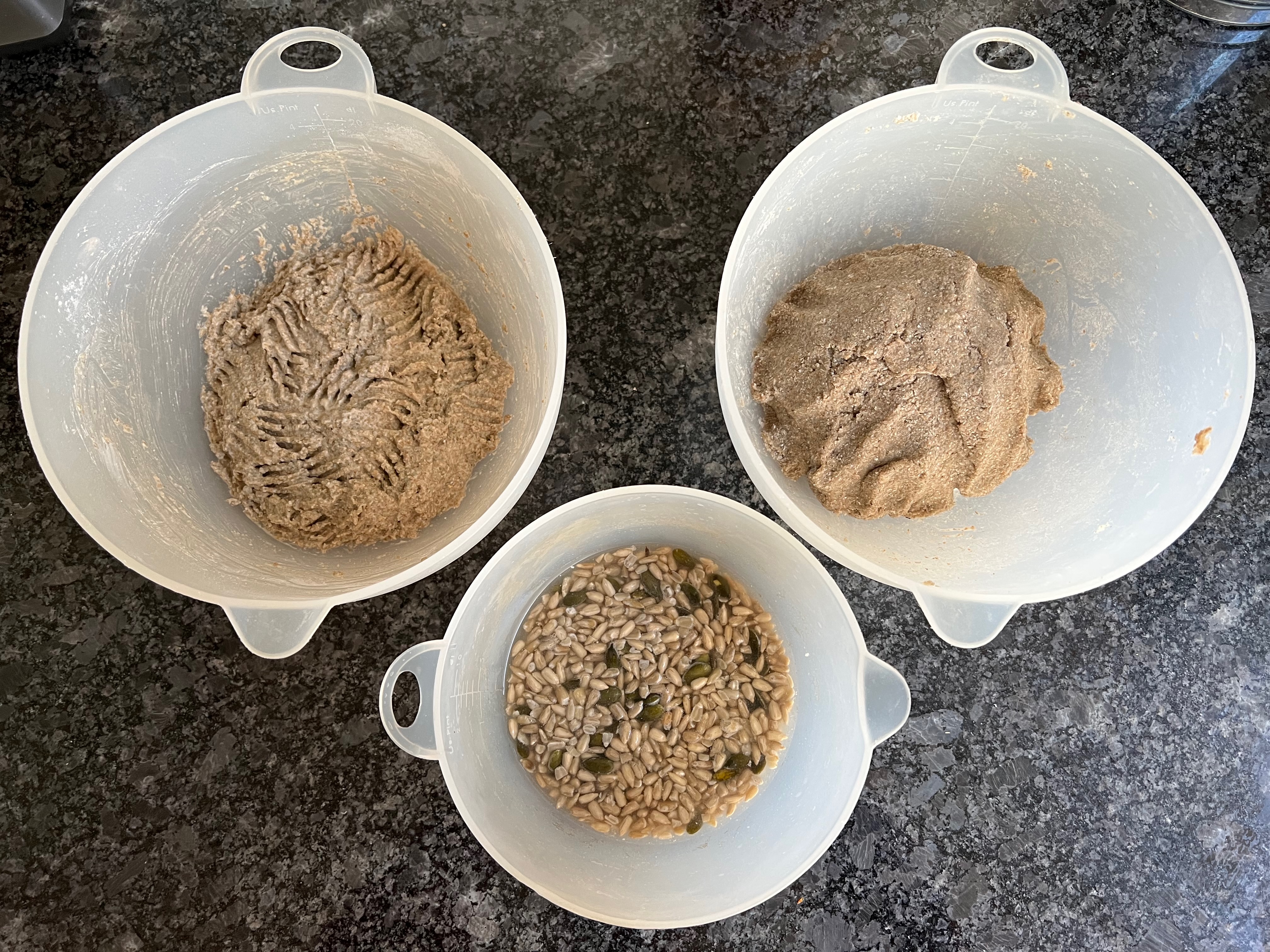
You’ll start by making three separate mixtures and leaving them to ferment. In each case, combine all the ingredients in a bowl, mix thoroughly, cover and leave.

Sourdough

  • 50g sourdough starter (mine is dark rye)
  • 200g dark rye flour
  • 200ml water

Plain dough

  • 280g dark rye flour
  • 300 ml water

Seed mix

  • 50g pumpkin seeds
  • 75g sunflower seeds
  • 8g salt
  • 120ml boiling water

Day 2 – around 9am – mix and first rise

  • 200g wholemeal wheat flour
  • 10g dried yeast
  • 35g malt extract
  • 50g molasses
  • 7g caraway seeds
  1. Put all ingredients into the bowl of your stand mixer. 
  2. Add all three doughs from the previous day.
  3. Mix thoroughly at medium speed for around 10 minutes using the normal paddle (the dough hook won’t work). You may need to stop and scrape the sides a few times to make sure that you incorporate any flour at the bottom that hasn’t blended in, as well as ensuring that the sticky malt extract and molasses are evenly distributed.
  4. Cover the bowl with cling film and leave to rise until doubled in size (in my relatively cold kitchen, this took close to two hours).

Day 2 – around 11am – shape and second rise

  • 15g butter
  1. Melt the butter and brush your baking tin with it.
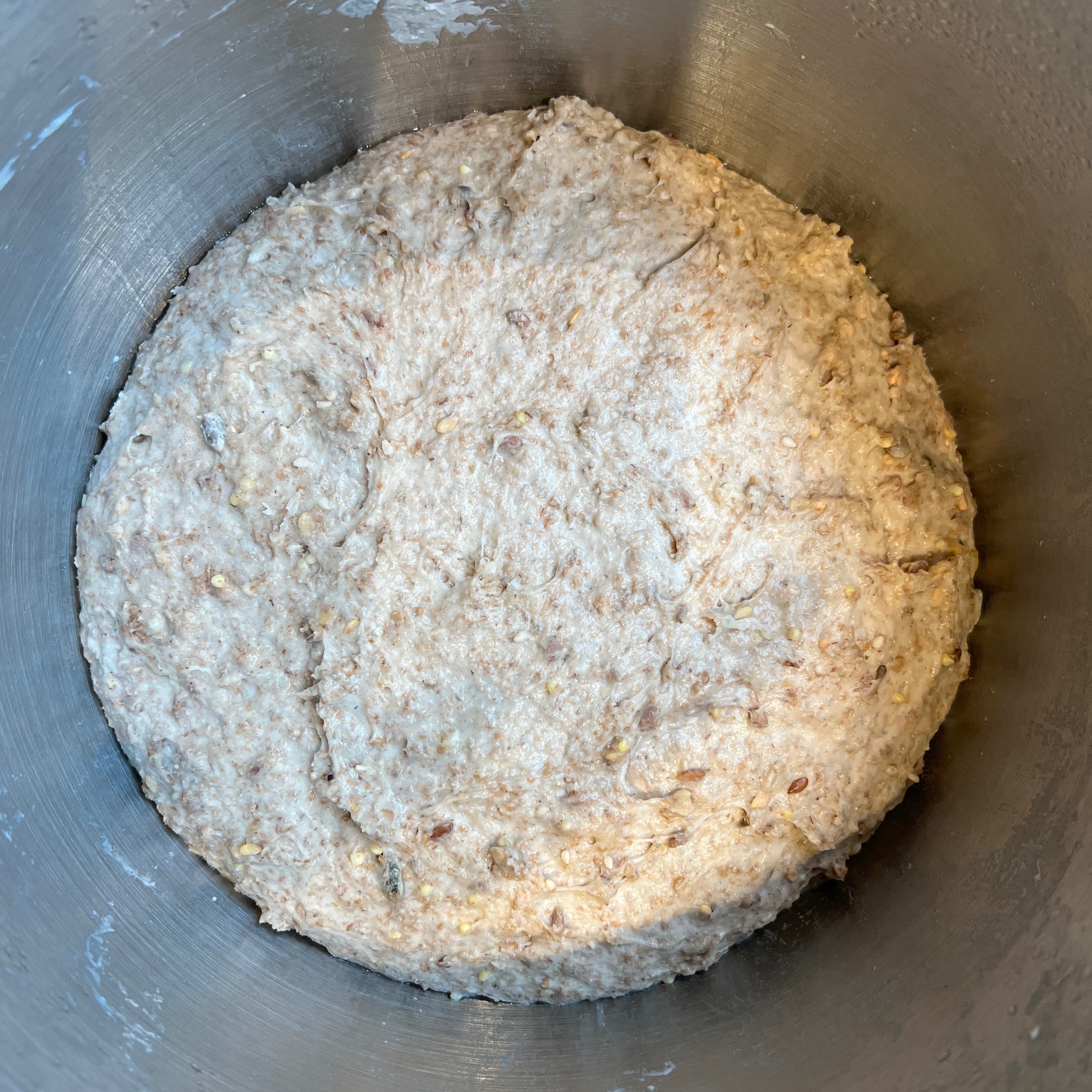
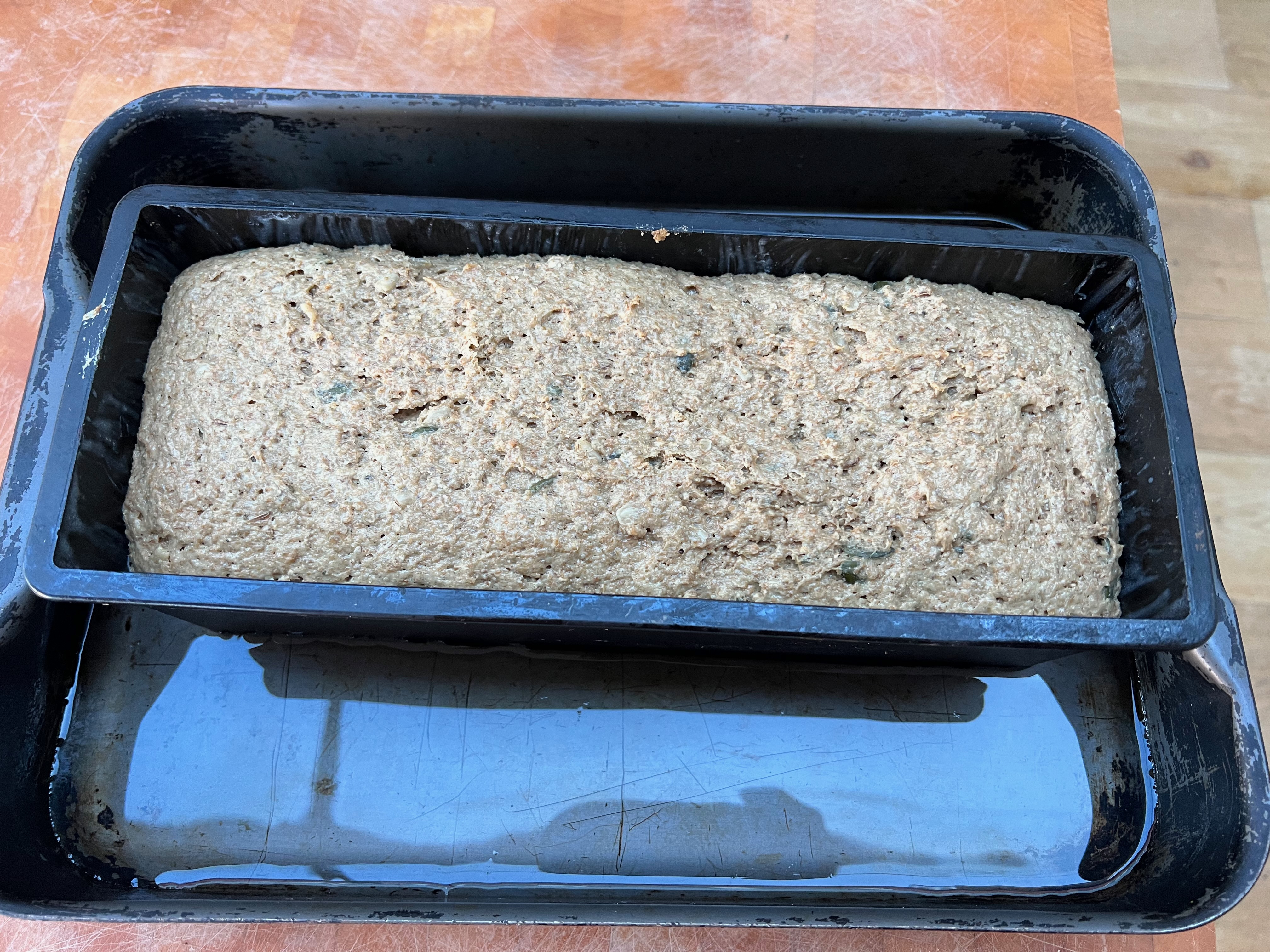
  2. Press the dough into the pan, getting it fully into the corners and making as even a shape as you can. Don’t worry about maintaining gluten structure: the preponderance of dark rye flour means there won’t be much.
  3. Leave to rise until the bread is nearly level with the top of the tin. This took another two hours, but in all honesty, the time is completely variable (disclaimer: I should have left mine about half an hour longer than I did for the loaf photographed here). You just have to be patient and keep watching the bread at regular intervals.

Day 2 – around 2pm – bake and glaze

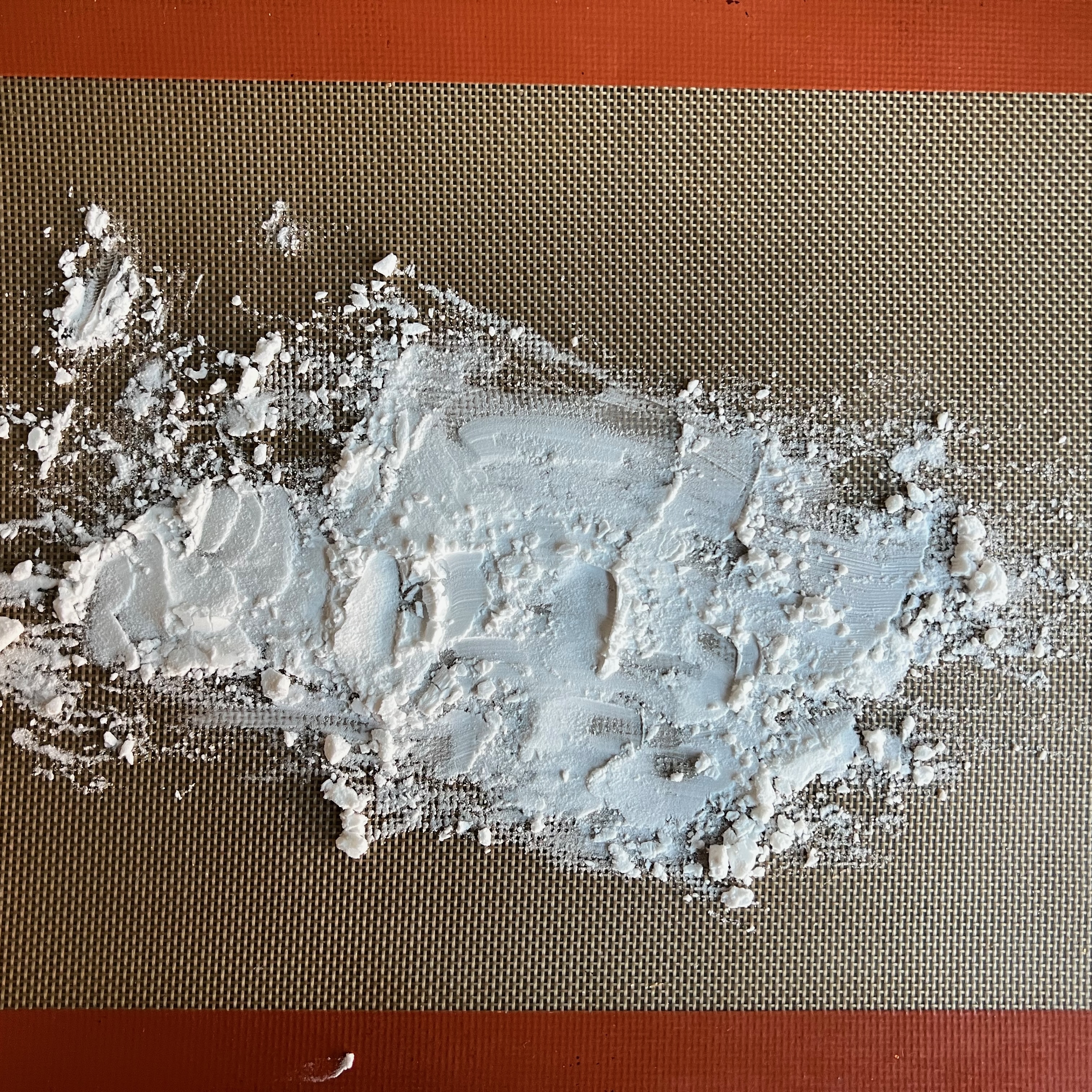
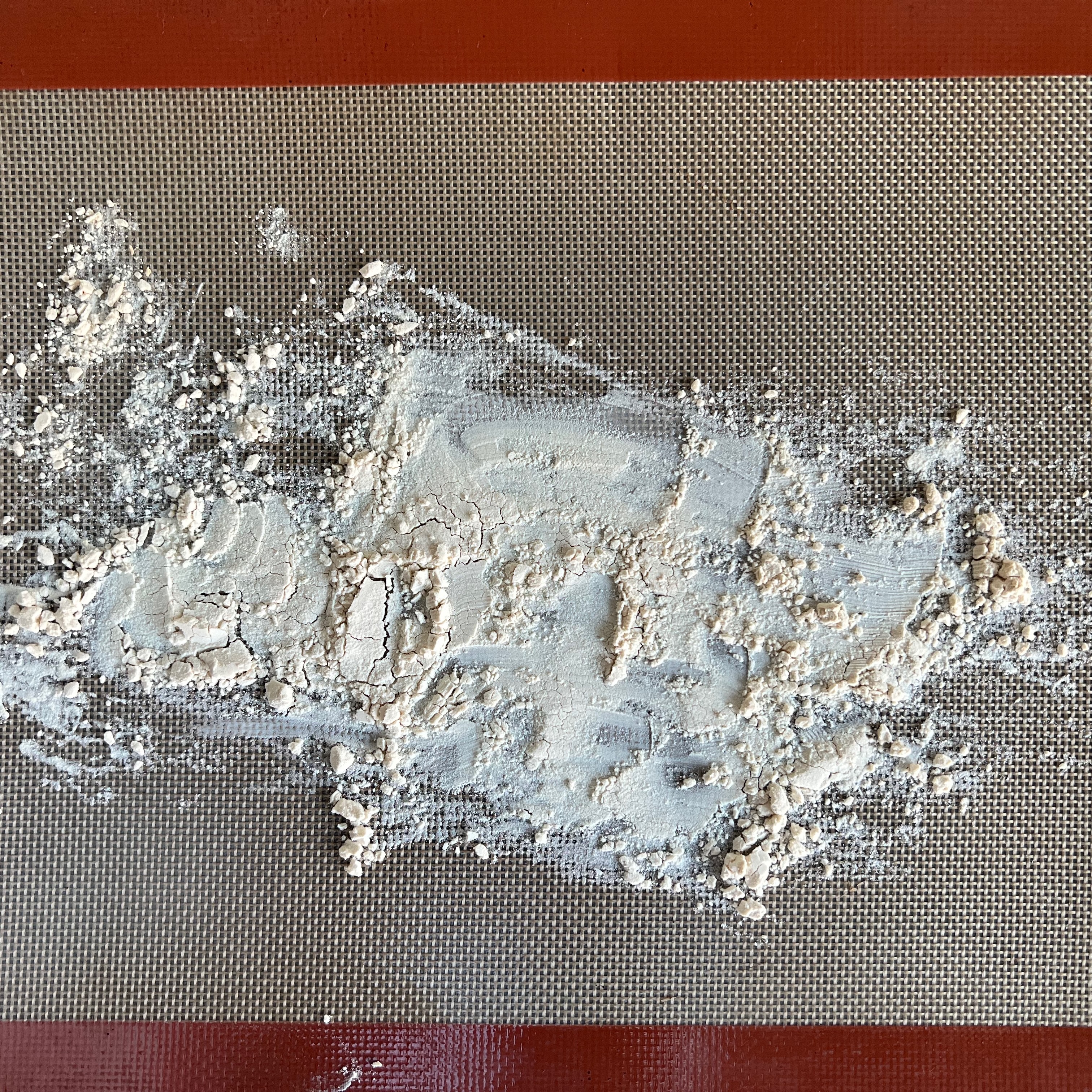
  • 8g potato starch
  • 30ml water (this is a guess – Georg doesn’t specify)
  1. Around half an hour before you think your loaf will be fully risen, preheat your oven to 250℃ fan.
  2. Spread the potato starch thinly over a Silpat sheet or sheet of baking paper over a baking tray. When the oven is up to temperature, put it in the oven and roast until golden (this took me around 15 minutes). Remove from the oven and leave to cool.
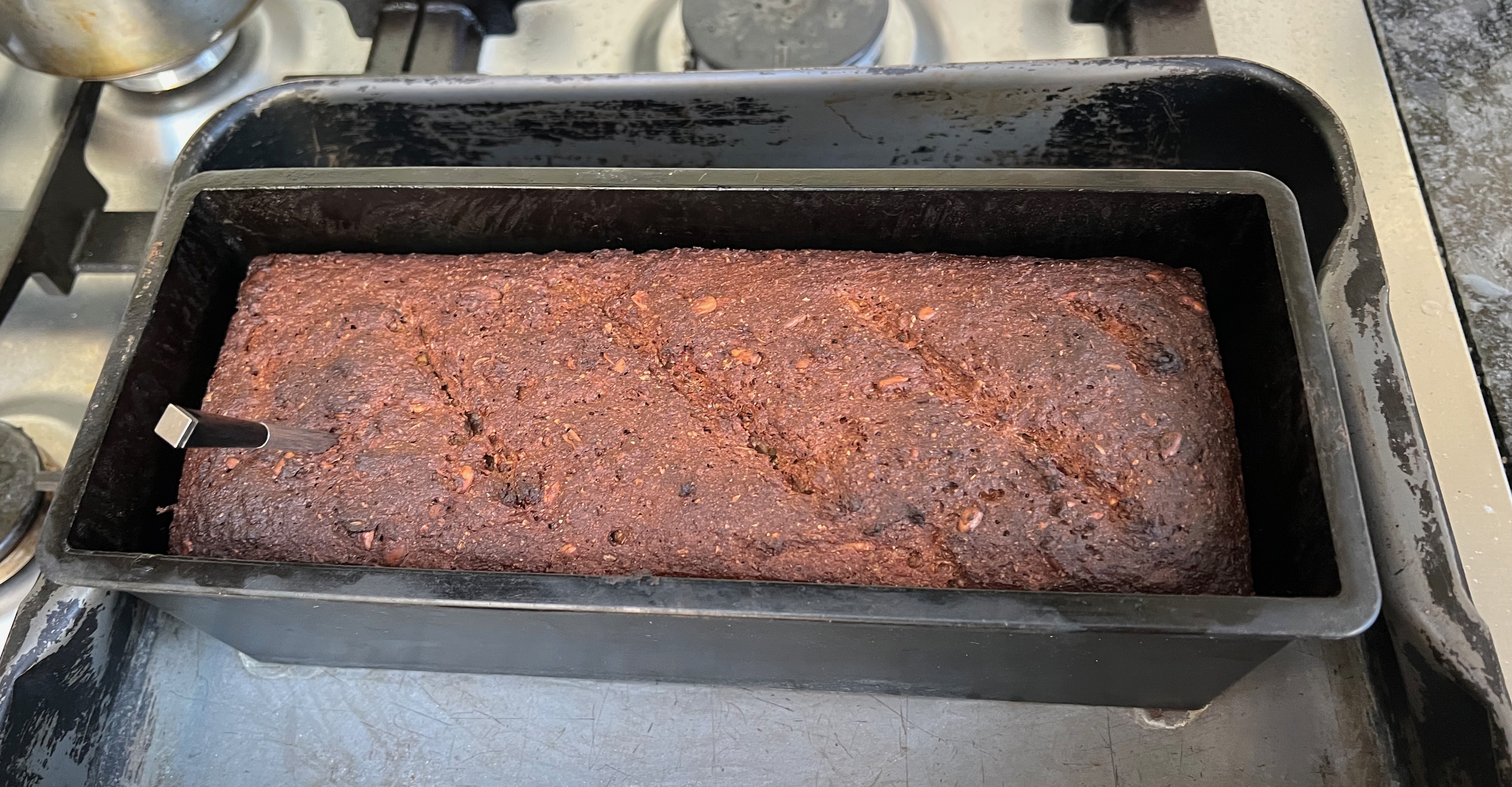
  3. When your loaf is risen to your satisfaction, score the top and brush it with a little water.  If you have a thermometer probe that you can use in the oven, stick it into the loaf.
  4. Put the tin into a larger roasting pan with some water and put the whole assembly into the oven.
  5. After 10 minutes, turn the oven temperature down to 180℃ fan and open the oven briefly to let off the steam.
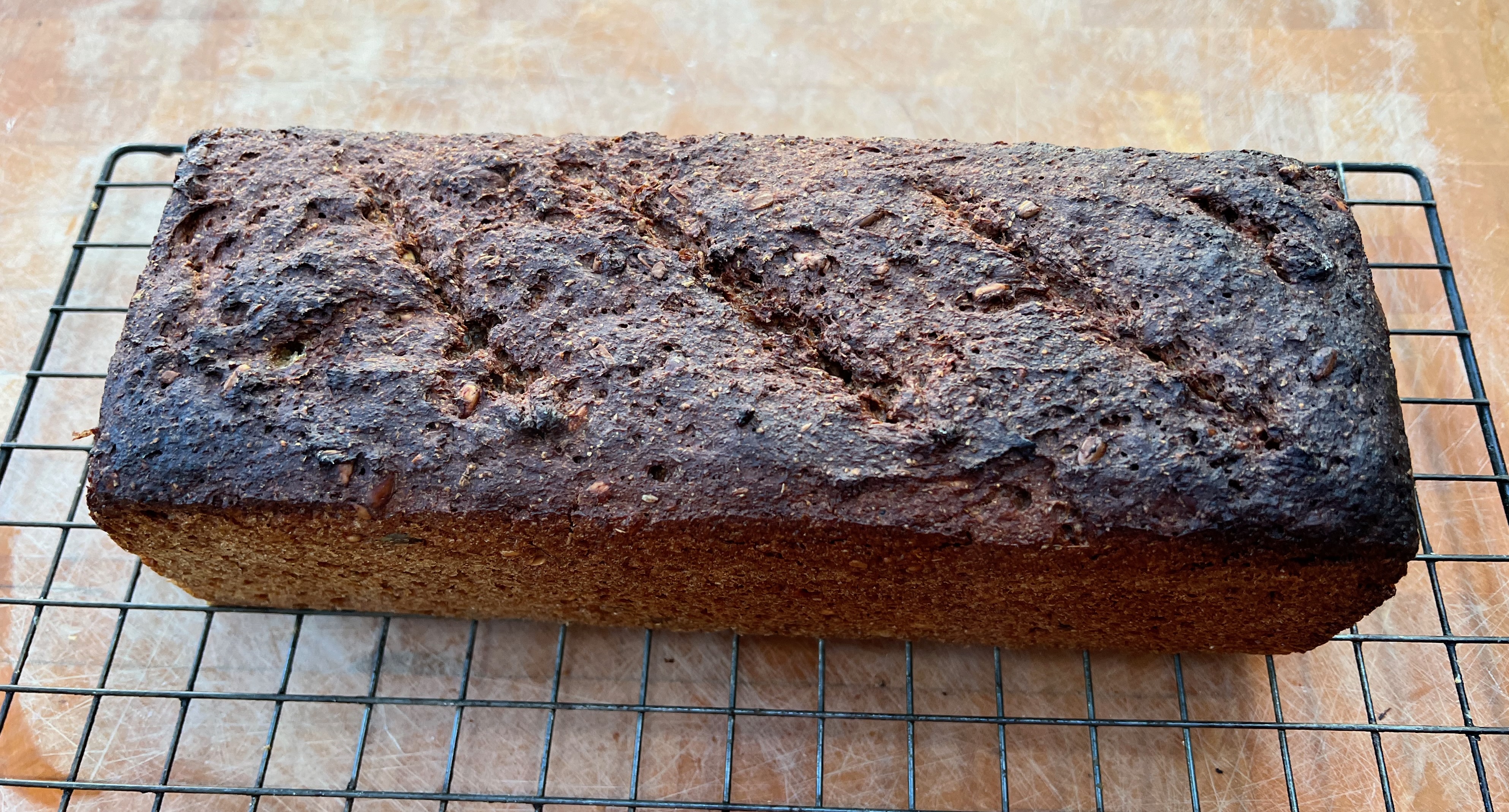
  6. Bake until the internal temperature reaches 98℃ (this took me around 50 minutes).
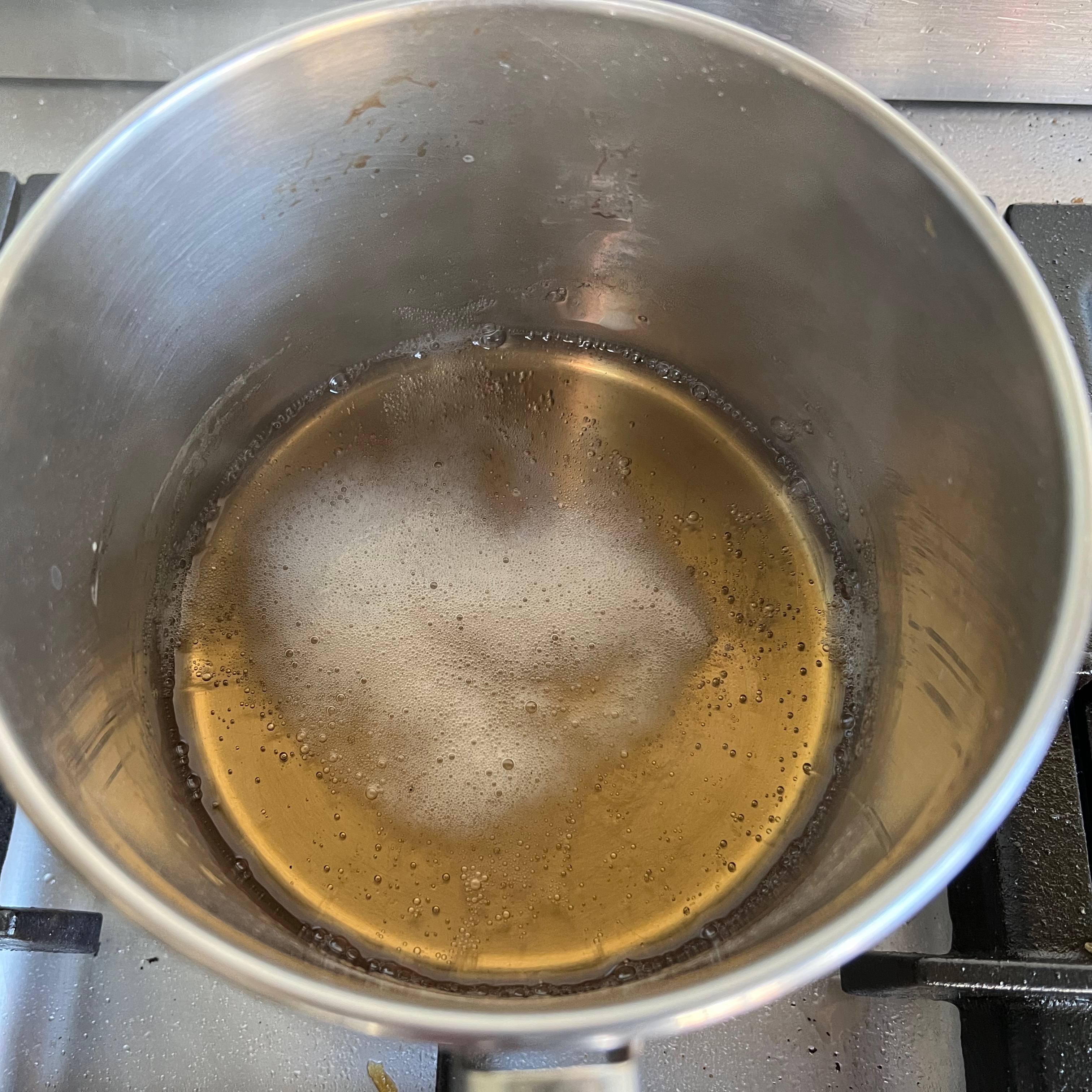
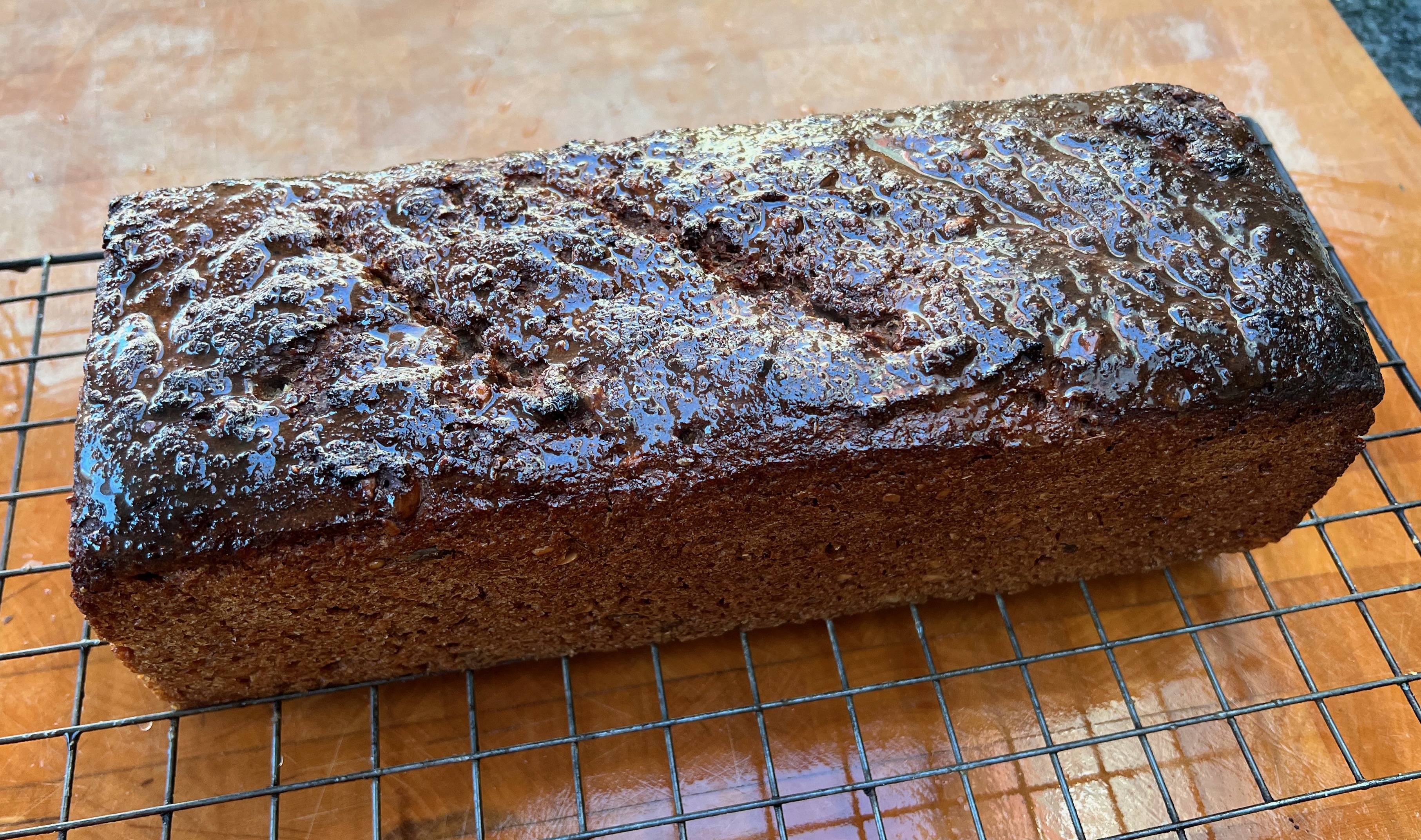
  7. Around 10 minutes before the end of the baking time, put the roasted potato starch and the water into a saucepan, bring to the boil and simmer for five minutes or so. Take off the heat.
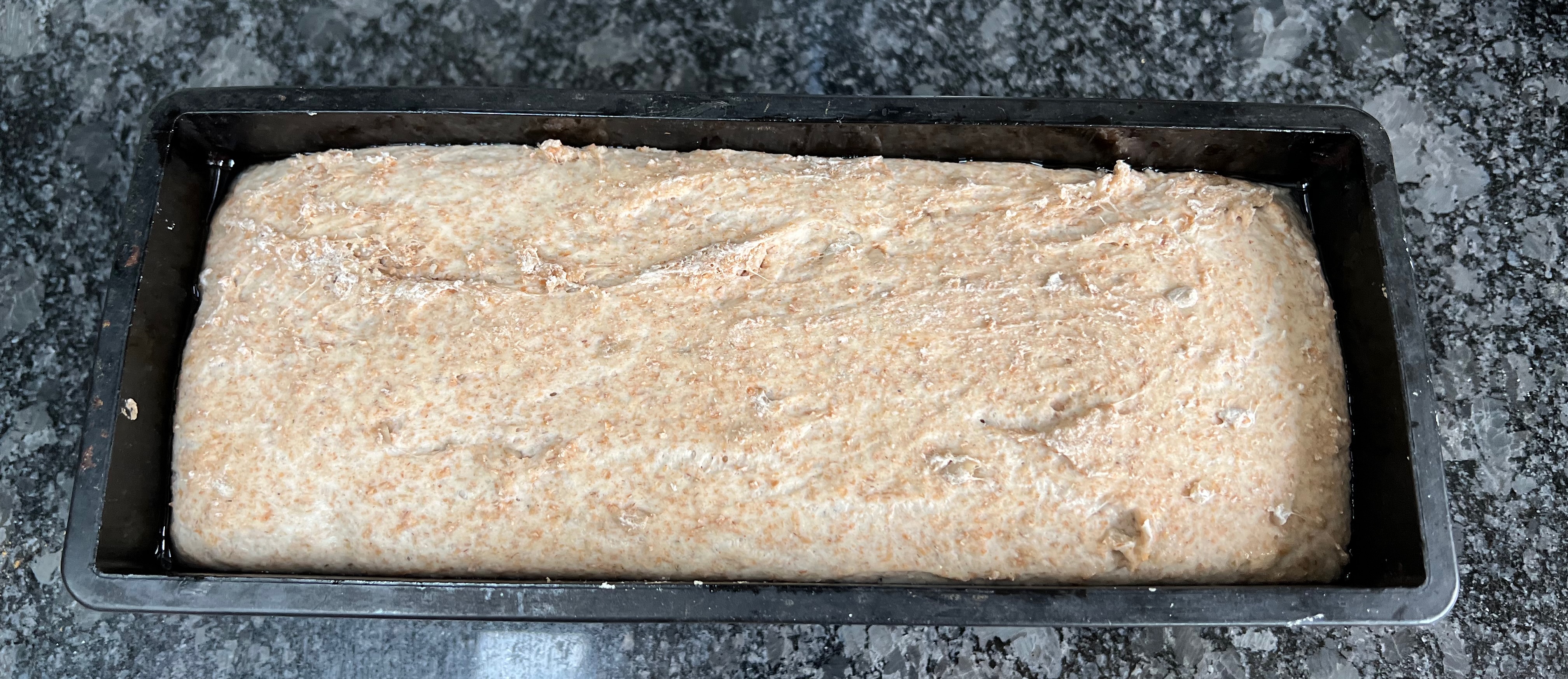
  8. Remove from the oven and place on a wire rack. Brush it all over with the potato starch and water mixture.
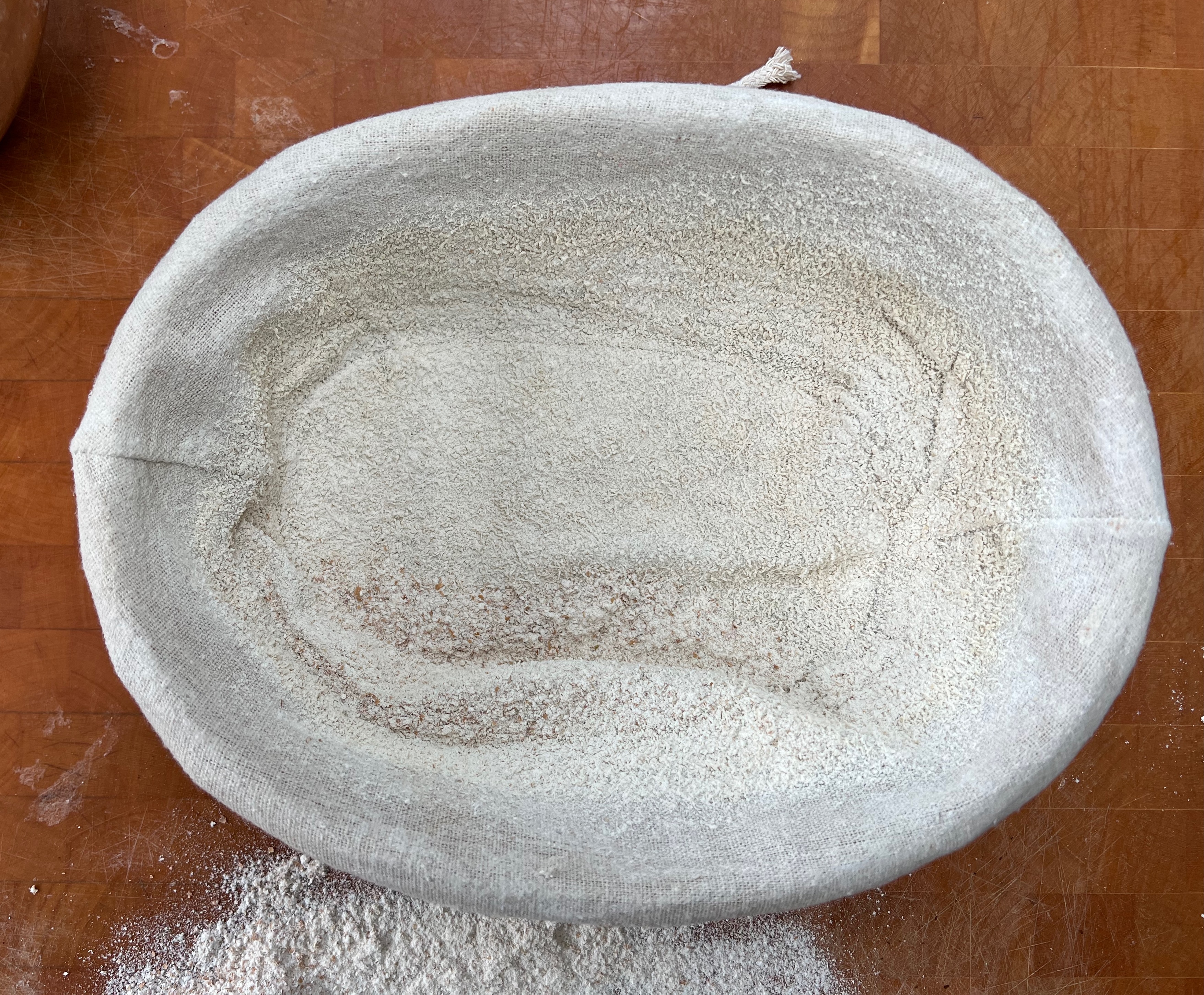
  9. And here’s the hard part: leave the bread to rest for 24 hours before eating!