Tag: Palestine

Palestinian freedom, seen from Paris at Passover

Palestinian freedom, seen from Paris at Passover

Our Seder night this year was a small affair, with just close family. I’m not very religious, so for the last few times we’ve been hosting Seder, we’ve used a Haggadah I’ve put together that focuses on telling the full story from the Bible. Within that, there is a space entitled “Other stories” for discussing tales of enslavement from other peoples – last year, this was the African slave trade and the oppression of the Uighurs.

This year, it hit us like a thunderbolt: the people suffering the most severe oppression are the Palestinians, and the oppressors are the Israelis. Every day, we are hearing stories of atrocities perpetrated by Israeli forces in Gaza; every day, more Palestinians are forced from their homes. The difference between their plight and that of the Jews in Egypt is that we were able to flee from our oppressors and find some vacant territory to which we could migrate. The Palestinians are unable to do so.

Just War theory includes a doctrine called proportionality: even if a war is just in all other ways, it cannot be just if the degree of force used is so massive as to be utterly out of proportion to the initial events that triggered the war. If a terrorist commits a single murder, it’s unjust to annihilate a whole village in reprisal. The October 7th attacks were heinous – but it cannot be right to use them to justify the devastation of the entirety of Gaza.

It worries me greatly that several of my Jewish friends and family members seem unable to see this. Have they so absorbed the idea that the attack was so bad that any level of violence is justified in response – even tens of thousands of deaths? Do they consider Palestinians to be so subhuman that anything the Israeli government does to them is just fine? Do they really think that any criticism of Israel is anti-semitism, regardless of how it behaves?

The word genocide is an unhelpful distraction in this context. Clearly, Israel is not attempting to exterminate all Muslims or all Arabs in the way that Hitler attempted to exterminate all Jews. As a result, when faced with accusations of genocide, it’s all too easy for Israelis to let themselves off the hook by denying them. What cannot be denied, however, is that Israel is engaged in major league ethnic cleansing: they’re turning Gaza into such a hell-hole that no person could reasonably expect to live there. I assume that they hope that at some point, other countries will open up their doors to a flood of Palestinan refugees, willingly or not, but that’s guesswork on my part. In any case, it presupposes that Israel has a single coherent strategy, which may well not be the case.

But regardless of this, I don’t believe that Israel’s real priority is the return of the hostages. And since the arrival of Benjamin Netanyahu, I don’t believe that Israel has shown any intention of making a just and lasting peace with the Palestinans – their overwhelming strategy for many years has been one of oppression and landgrab, dressed in the name of needing to maintain security.

I’m not denying that there is a great deal of anti-semitism in the world, much of it founded on a tissue of ancestral lies and hatreds. But right now, the actions of the Israeli government are the biggest thing feeding the anti-semitic fires. It’s time to tell them to stop. To tell them that the Jewish nation is not a barbaric people in this way, that they do not represent us and that we do not support them.

Yesterday, from the window of the Paris apartment where I am currently staying, I saw a large and powerfully crafted demonstration demanding the freedom of Palestinian prisoners. As a Jew, I felt frightened, but I also felt like I was on their side.
Thoughts on the Israel-Hamas war, two months in

At its heart, as Amos Oz put it, the Israeli-Palestinian conflict is fundamentally a matter of real estate: there is only one Palestine and there are two peoples who want it. The reason that both sides want the land so badly is that they have nowhere else to go. Jews have been forcibly expelled from so many countries over so many centuries that they see Israel as the only place where they can be safe. In the time that has passed since the creation of the state of Israel, the situation of the Palestinians has been shown to be little better: they might not be persecuted for their religion, but neighbouring Arab countries have shown no appetite for a mass influx of Palestinian refugees.

We can argue until the cows come home as to who has the stronger ancestral claim on the land and whose human rights have been violated by whom. But it boils down to this: in the long term, there are only three possible outcomes: ethnic cleansing whereby one side or the other is “driven into the sea” (a phrase often heard on both sides), a peace deal whereby both sides share the land and feel equitably treated (whether the “two state solution” or one of the various alternatives to it) or a stasis whereby violence continues indefinitely, perhaps ebbing and flowing in severity.

The 1993 and 1995 Oslo accords stated the objective of a peace deal. It’s reasonable to suppose that at the time, both a majority of Jews and a majority of Palestinians hoped that a listing peace could be created that would be accepted by both sides. But even then, there were contingents on both sides who had no interest in this and preferred to push for ethnic cleansing of the other side. For these contingents, it was better  to accept a violent stasis, however long it might last, if it meant avoiding capitulation. On the Palestinian side, Hamas exemplifies those who believe that the Jews should be expelled from Palestine. On the Jewish side, there are substantial numbers of people promote unlimited settler expansion and severe constraints on the liberties of Palestinians: they may not be terrorists in the way that Hamas are, but they are equivalent in their desire to subvert the peace process. In November 1995, with the ink scarcely dry on the Oslo accords, one of these Jewish equivalents murdered Yitzhak Rabin, the Israeli Prime Minister who signed them.

Both of these camps are in profound agreement: they don’t want a peace deal on terms that could conceivably be palatable to the other side: you could call it an anti-peace alliance. And while both sides get very angry if you accuse them of intending genocide, they both use genocidal language and they both have the same goal: ethnic cleansing or complete subjugation of the other side. Right now, the alliance is the ascendancy, in control of the governments of both Israel and Gaza. In the early days after the Oslo accords, you might have considered these two camps as extremists. By now, in the aftermath of the October 7th attack,  they are mainstream – perhaps even in the majority in their respective peoples.

Both halves of the alliance must think that everything is going swimmingly well right now. Hamas is achieving the dream of every terrorist organisation, to provoke its opponents into acts of revenge and repression so horrible that anybody neutral considers them to be monstrous (for a clear analysis of this kind of mindset, read Louise Richardson’s What Terrorists Want, written in 2007 but still spot on today). The Israeli far right are in equally good shape, able to demonstrate to their followers that Hamas are monsters who must be eradicated at all costs – even if those costs include taking a large chunk of the civilian Palestinian population with them.

So how do I – born in the UK of Israeli parents, Jewish by race and atheist by religion – feel about supporting Israel in all this? For a start, I accept the fundamental Jewish argument of “we need a safe haven, and Israel is it.” I don’t believe for a moment that antisemitism has been consigned to history: even in supposedly liberal countries like the UK, it’s easy to detect classic antisemite language and behaviour both in the far right and the far left, while in most Muslim countries, antisemitism is a majority viewpoint. (By the way, Islamophobia is even more present in the West, a fact which doesn’t affect the argument here but shouldn’t be ignored).

But the way Israel is waging its war against Hamas is a godsend to the antisemite cause: it’s daily proof for everyone who considers Jews to be bloodthirsty monsters, giving credence to centuries of slanders from Christ-killing to the blood libel. If we want to persuade the world to hate us because we’re Jews, there’s no better way to do it than to massacre thousands of Palestinian civilians. It doesn’t matter whether individual killings are deliberate, collateral damage from operations against armed enemy fighters, or starvation by destruction of infrastructure. A civilian death is a civilian death. If flushing out a terrorist organisation requires the killing of tens of thousands of civilians and the destruction of their entire country, that isn’t self-defence, it’s revenge.

Sadly, it was a predictable response. Writing in Le Monde just a week after the Hamas attacks, historian Vincent Lemire described what he called “the double trap” set by Hamas: the military trap of enticing Israel into warfare in difficult territory and the moral trap of provoking Israel into an excessive response. The Israelis may have been smart enough to avoid the worst of the military trap, but they have fallen headlong into the moral one.

Unless both sides commit to peace, the cycles of violence in Palestine are doomed to repeat themselves. This may be the worst of the cycles in recent times, but it will not be the last – however much the Israeli military might wish to believe it so. The “war to end wars” idea didn’t work in Europe and it won’t work in Palestine either.

What Hamas did on October 7th was monstrous, and their continued holding of Israeli hostages remains so. But before I can support Israel in their war against Hamas, Israel needs to do three things: stop the mass killing of civilians in Gaza, reverse the settling of Palestinian lands in the West Bank and display some genuine intent to make peace on fair terms. The present Israeli government might conceivably do the first of those things. It looks unlikely in the extreme that they will do all three. I can only hope that some political cataclysm happens in Israel that will bring in leadership of a very different kind.

The Israelis are my people. I hope that one day, I can once again be proud of this. But I fear that’s a day I won’t live to see.

More reading:

Louise Richardson, What Terrorists Want, Random House, 2007 https://www.randomhousebooks.com/books/153951/

Le Monde article by Vincent Lemire https://www.lemonde.fr/idees/article/2023/10/14/vincent-lemire-historien-depuis-l-attaque-du-hamas-contre-israel-nous-sommes-entres-dans-une-periode-obscure-qu-il-est-encore-impossible-de-nommer_6194355_3232.html (in French, paywalled)

Around the world in 80 bakes, no.23: Ka’ak Al Quds from Palestine (Jerusalem sesame bread)

Around the world in 80 bakes, no.23: Ka’ak Al Quds from Palestine (Jerusalem sesame bread)

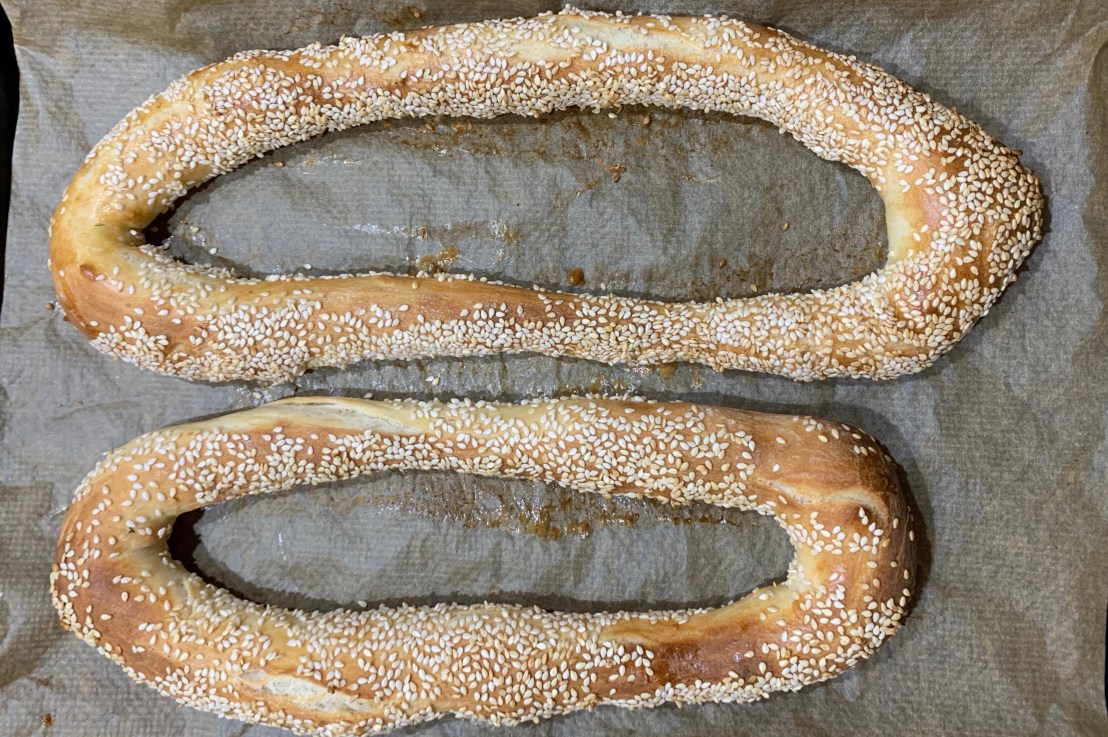
Almost every street corner in East Jerusalem has a vendor with a trolley piled high with hoops of sesame-encrusted white bread called Ka’ak Al Quds: the aroma of fresh baking and toasted sesame is overpowering and irresistible. London-based chef Sami Tamimi, originally from East Jerusalem, has published a glorious book on Palestinian cuisine entitled Falastin (the Arabic language, he explains, does not have a letter “P”, so it should perhaps be “Falastinian”). I cannot recommend the book highly enough and you really, really should go out and buy it, so I hope Sami will forgive me for reproducing my version of his recipe here.

  • 10g dried yeast
  • 20g sugar
  • 300ml lukewarm water (around 40℃)
  • 40g olive oil
  • 250g strong white flour
  • 250g plain white flour
  • 10g salt
  • 15g dried skimmed milk
  • 1 egg
  • 20ml milk (or water)
  • 60g sesame seeds

This will make six of the hoops-shaped loaves: you will be able to fit two at a time onto a typical baking tray (something like 35cm x 25cm). If you have three trays and a big enough oven, you can bake the whole batch at a time; otherwise, you’ll have to do them in two or three batches.

  1. In a bowl or jug, combine the yeast, sugar, lukewarm water and olive oil and stir well. Leave for 5-10 minutes until it’s frothing nicely
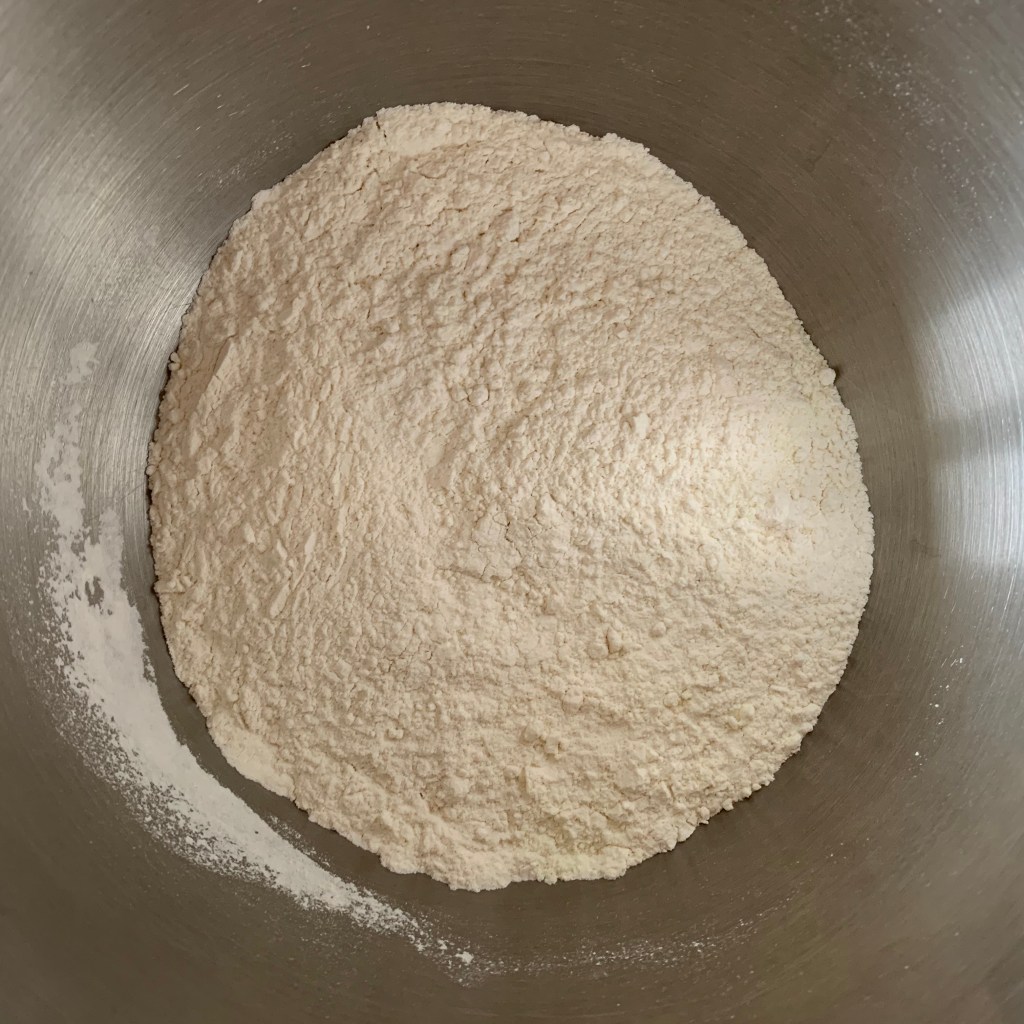
  2. In the bowl of your stand mixer, combine the flours, salt and dried skimmed milk and stir until evenly mixed
  3. Add the wet mix to your dry mix and knead with the dough hook until smooth (by the way, Sami’s recipe says 270ml, but I found I needed a bit more).
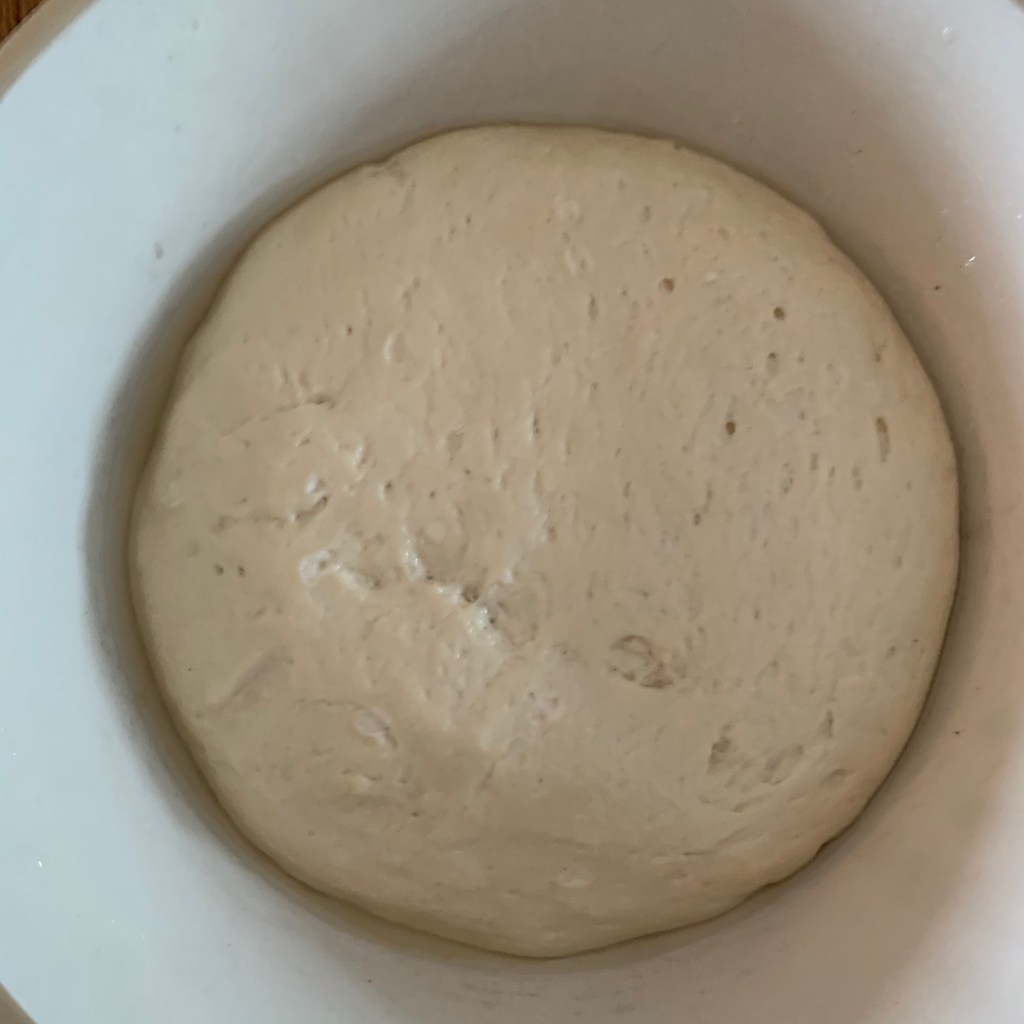
  4. Form into a ball and leave to rise in an oiled, covered bowl. Usual bread-making rules apply: the warmer the place you leave it, the quicker it will rise, so there’s no point in my giving you a numbers of hours it will take.
  5. Cut three rectangles of baking paper big enough to line your tray.
  6. Once your dough has risen, divide it evenly into six balls. Take the trouble to weigh them to make sure they’re about the same – expect around 150g each.
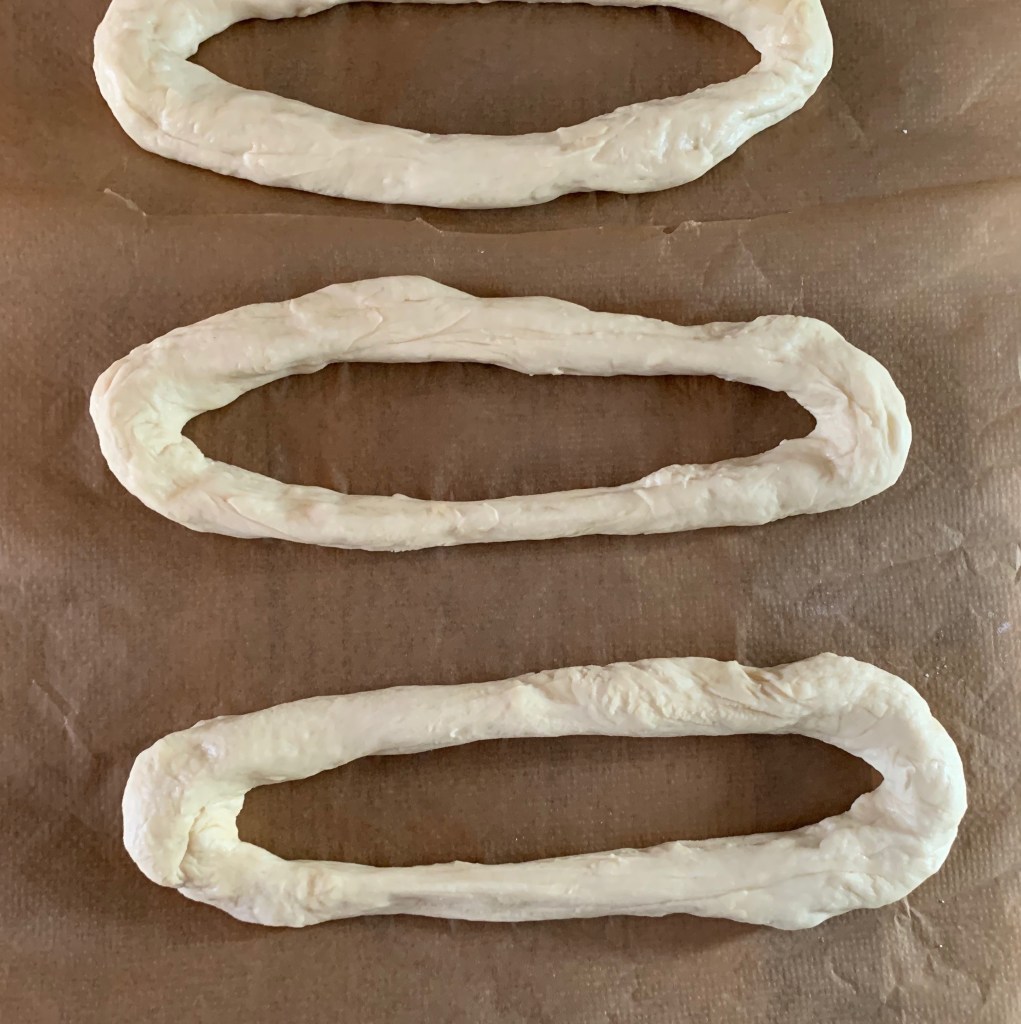
  7. Take a ball of dough, mould it to a flattened sphere, poke a hole through the middle of your sphere of dough and pull it apart to form an elongated doughnut shape. Pull it to most of the length of your tray, trying to keep the width as even as possible, which is tricky, and place it on one of your rectangles of baking paper; now repeat for the other five balls.
  8. Cover the loaves loosely with tea towels and leave for another half hour or so.
  9. Preheat your oven to 220℃ fan, with your baking tray(s) inside
  10. Lay out the sesame seeds in a dish longer than your loaves (or on a board if you don’t have one)
  11. Beat the egg together with the milk
  12. When you’re ready to bake, brush a loaf with the egg wash, dip it wash side down into the sesame seeds and ensure that it’s thoroughly coated.
  13. Put the loaf back onto the baking paper, sesame side up, and repeat for as many loaves as you’re going to do now.
  14. Take a baking tray out of the oven and transfer the baking paper rectangle with its two loaves onto it. To do this, you will probably either need two people or a tray of some sort.
  15. Bake for 10-15 minutes – you want the loaf to be a deep golden brown but not actually burning.

Leave to cool for a few minutes before eating: this bread is at its best straight out of the oven, but you don’t want to burn your tongue!