We arrived home from holiday last week to find campaign literature from both sides of the EU referendum campaign in the letterbox. I was dismayed by both: the arguments presented were dubious, to say the least, and it seemed to me that neither side dares to say what it really believes.
Humans are tribal creatures and the EU debate is ultimately about the size of the tribe. Do we want a tribe which is large and strong (if possibly fragmented and slightly fractious), or do we want our tribe to be small and cohesive (if possibly short of resources and clout)?
The Eurosceptic viewpoint seems to me to be driven by two fundamentals. The first is the image of Gulliver strapped down by the Lilliputians: Eurosceptics hark back to the days when the United Kingdom was a great power in its own right and feel that it could be so again if it were not enmeshed in a web of European bureaucracy and compromise. The second is a deep discomfort with immigrants, the idea that we are losing our country to invaders and not even putting up a fight over it.
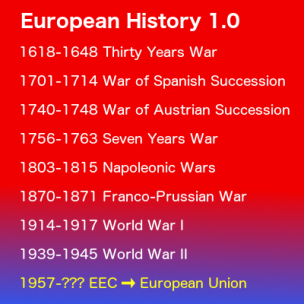 My own beliefs are the opposite. I was born in 1958, which makes me pretty much the first generation for as long as anyone can remember to live sixty years without a major European war, and I attribute this not merely to nuclear weapons but largely to the EU – not to its specific institutions, but to the change in mindset that makes European governments start with an assumption of co-operation.
I don’t buy the “UK can be great again” argument. The UK is great: I love my country for the creativity, humour and fundamental sense of decency of its people, not its empire – which was lost not because of the EU but because the UK bankrupted itself over two world wars and because the prevailing ethical climate made it impossible to continue with the colonialist principles on which that empire was built. I’m only too pleased that historical episodes such as slavery, the opium wars and the salt tax are well behind us, and if a Brit ever feels the need to preach to the world about genocide, they would do well first to consider the question “why are there no aborigines in Tasmania.” (Answer: because we killed them all). And I fundamentally believe in government by compromise – at the European or the UK level. To get technical for a moment, I actually believe in stuff like pooled sovereignty and subsidiarity.
Turning from those who hark to the olden days to those who merely say that Britain is the world’s fifth largest economy and can stand perfectly well on its own, I would reply “yes, but for how long?” As education globalises, can a heavily populated small country with depleted natural resources really maintain the productivity lead that we have had in the past?
These are huge issues, and I’m more than happy to debate them with an open mind – and I believe we should be debating them. In my view, it is neither evil nor racist to feel uncomfortable at living in a city where you often can’t understand the language of the majority of the people in your street, or to be concerned at democratic deficit. But that’s not the debate we’re having.
Rather, on both sides, the debate so far has been about nickels and dimes, with statements being made that are deeply misleading. Consider this one, from the “Leave EU” side:
“We can remove our politicians who are answerable to us. Unlike unelected European commissioners”.
European commissioners are the equivalent of our senior civil servants, who are every bit as unelected. The laws in the UK are written by civil servants and voted on by politicians, just as EU laws are written by commissioners (and their staff) and voted on by the Council of Ministers and/or the European Parliament, who are people we elect. At heart, it’s not the existence of appointed officials that Eurosceptics dislike – otherwise, they should be trying to get rid of the whole of Whitehall – it’s the idea of appointments being made by what they consider to be the wrong people.
The Stay camp hardly fares better. “AA warns of pain at the pump with possible 19p rise if Britain leaves EU,” trumpets the leaflet, quoting the authoritative source of The Sun. Really? Even if it’s true, which sounds highly dubious, is the future of our country’s international relations really to be decided on the basis of motorists’ worries about their next petrol bill?
Or “Good for women, with the EU protecting women’s rights in the workplace, including vital anti-discrimination and equal pay laws”. I’m sorry, I may be an ardent supporter of the staying in campaign, but I can’t accept the idea that the UK Parliament is in some way incapable of enacting wise gender equality laws without having to rely on the EU to police it.
So please, let’s debate the real issues. Will a Brexit do irreparable damage to our relationship with European countries? Can an independent UK continue indefinitely to punch above its weight economically? Is it real or illusory that ordinary people will gain more control over the decisions that affect them? Should we wean ourselves off immigration, which we have relied on to cope with the economics of an ageing population? And if the answer is yes, is it feasible for an independent UK go about doing so?
For me, the answer is simple and emotional. It lies in a clip from the unashamedly anti-Brexit Great European Disaster Movie, in which a German lady lays out on her table a series of Iron Crosses, each representing a parent / grandparent / great-grandparent who died in a European war. She is of the first generation not to add to that list, and is unspeakably proud of it. Long may that trend continue. Being part of a whole, peaceful Europe enhances my life.
 Speaking of toilets, a couple of weeks before getting here, I was sent a Japanese class item about washlets – the toilets which have a sort of built in electronic bidet and spray water over your nether regions. But nothing prepares you for the reality of a toilet with a heated seat which, as soon as you sit down, starts making gurgling and squelching noises to mask anything you might be producing yourself. I’m told that birdsong is a popular alternative.
 when they’re not.
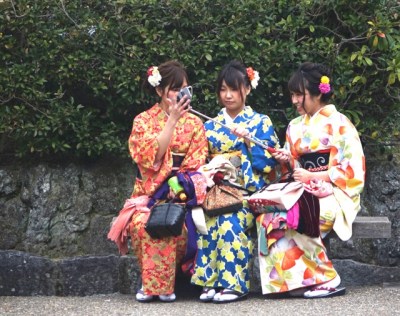 Several of the main Kyoto shrines are awash with girls wearing full kimono regalia, who have come there in groups, not least to Kiyomizu-dera, the temple with the “walk of love” where you have to go blindfolded from one stone to another – if you succeed in reaching the target (and you’re allowed help from onlooking friends), you will gain fortune in matters of the heart. Somehow, the combination of these beautiful traditional outfits with a cellphone on the end of a selfie stick struck me as particularly bizarre.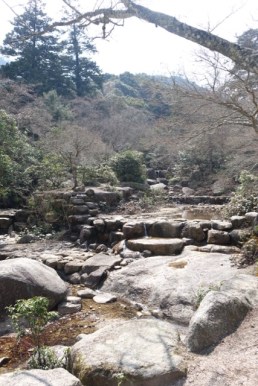
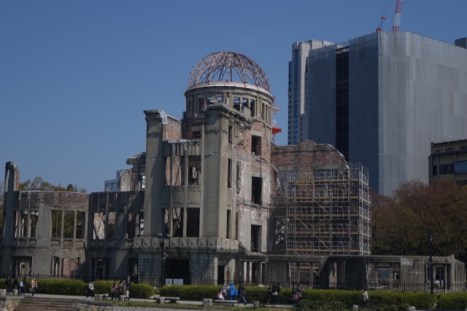
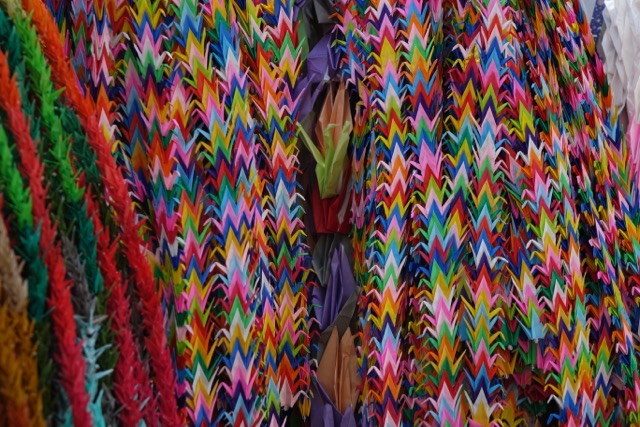
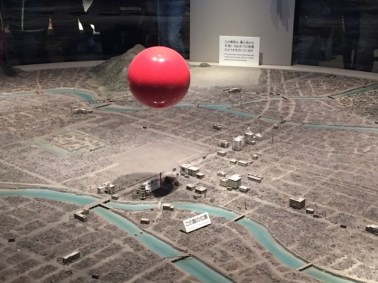 Messages of peace and goodwill from a plethora of world leaders provide a thimbleful of soothing balm, while just down the road, the Children’s Peace Monument tells the story of the girl who hoped that if she could make a thousand origami cranes, she might survive her A-bomb related leukaemia. She did not.
 The Japanese love of their cameras is famous, to the point where the cluster of Japanese tourists snapping away is a hardy old cultural stereotype. My assumption has always been that this is because of the Japanese love of gadgets and the associated fact that they make the world’s best cameras. But having been to Kyoto, I’m not so sure.
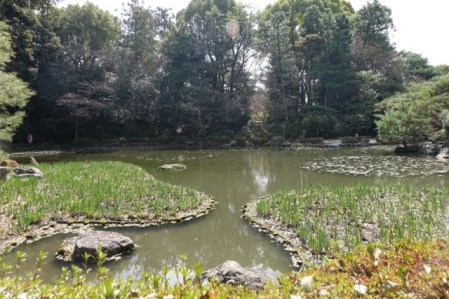
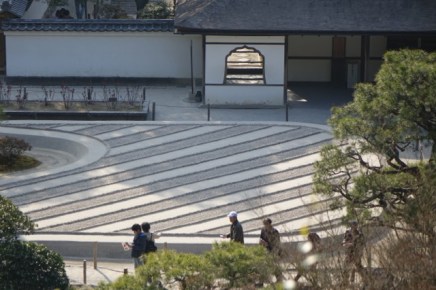 The fact that this isn’t accidental is something you realise when you’ve been through some of the city’s many gardens: whether it’s a zen sand garden (who, I wonder, first thought of simply raking sand or gravel into harmonious patterns), the formal gardens set around water with their pavilions, stepping stones, bridges and ornamental trees, or the enormous park-like gardens that surround the imperial palaces, you feel that every square metre has been laid out by someone who knew exactly what he wanted the space to look like from every angle and was quite clear about the emotional responses he hoped to induce: calm, harmony, a sense of rightness about the world.
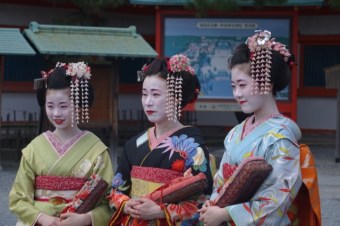
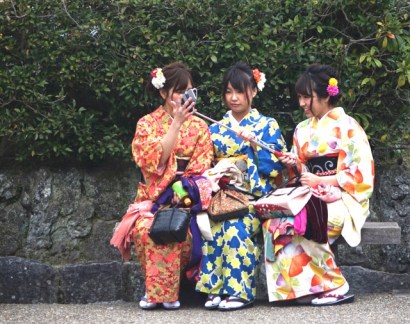 It seems to me that the Japanese don’t just love their cameras because they’re into gadgetry. It’s that the idea of the perfect composition of an image is hard baked into their culture. You see it in the prints they revere from Hokusai, Utamaro et al, and in the spectacular Kano school scrolls in Kyoto’s Jukoin temple. And it’s part of everyday life – or at least special occasion life. In Kyoto, a cool thing to do is for groups of young girls to come here for a trip in which they rent kimonos and go and photograph themselves (or get friends to do it) in full traditional regalia near the various temples and beauty spots. The combination of kimono and selfie stick is a common sight. More spectacular still is when you see geishas in full, white-faced splendour (usually, to be precise, the “maiko” or trainee geishas).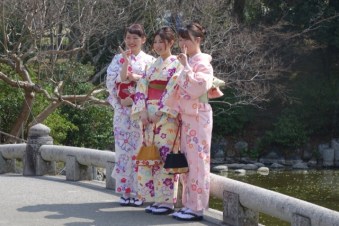
 For most of the world’s major tourist cities, if you do a modest amount of reading up before your visit, you get a decent idea of what it’s going to be like to be there. It’s not just that you read the list of attractions and formulate a mental tick list: travel writers generally do a good enough job that you get some sort of feel for the nature of the destination.
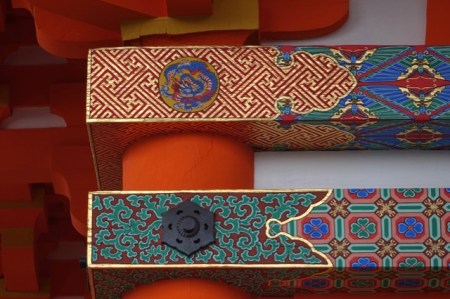 Not Kyoto.
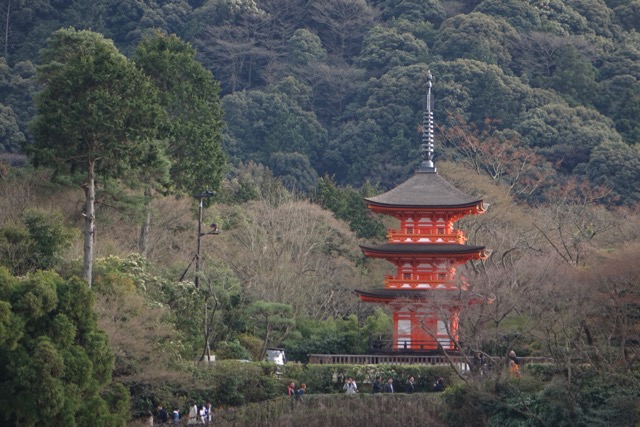 Back in the 8th century, Kyoto was chosen as the location to which the Emperor should move his capital in order to move away from religious influences. The Imperial geomancers loved the protection and natural beauty of a site bounded on three sides by mountains and split by a broad river: snow-melt from the mountains means that there is water all over the city, with countless canals and storm drains meaning that (at least in spring) water is running wherever you go. Today’s density of temples says that the move away from religion wasn’t stable. But I reckon the Imperial geomancers hit the bull’s eye.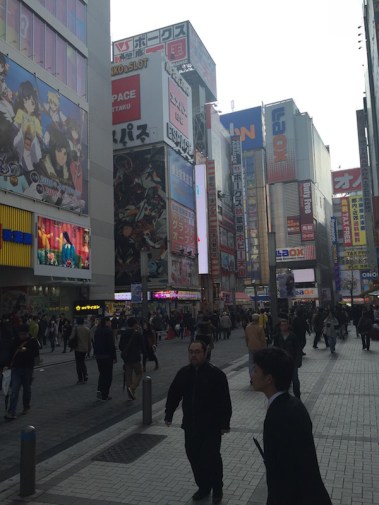
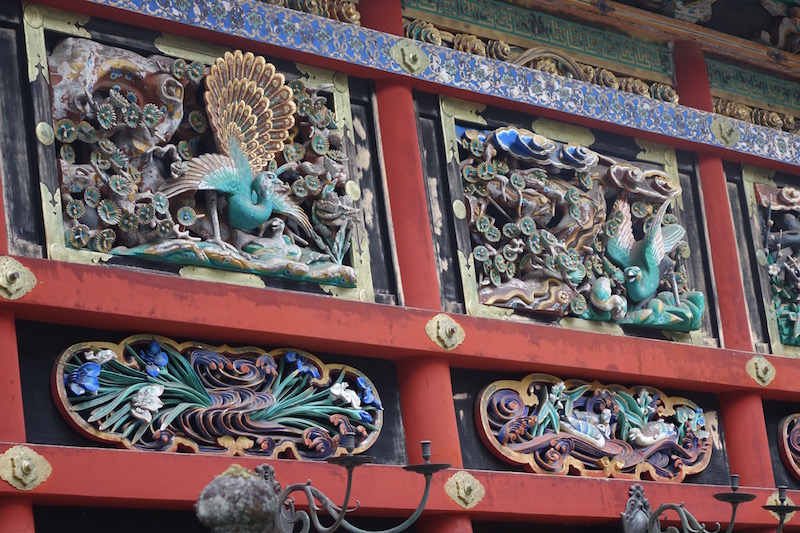 Nikko epitomises some of the contrasts in the country. The town is famous for its major shrines of the Tokugawa shoguns (the first of whom, Ieyasu, was the single most important figure in making Japan into the single country that it remains today). The Tokugawa shrines and temples are in a sort of Japanese baroque – gigantically ornamented to the point where it’s quite hard to get your head round the sensory overload of different themes and motifs. And – on a holiday week end, at least – they are packed rigid with visitors. It’s all very well organised, but Buddhist calm and Ieyasu’s own rather austere-sounding personality are very much submerged in the throng.
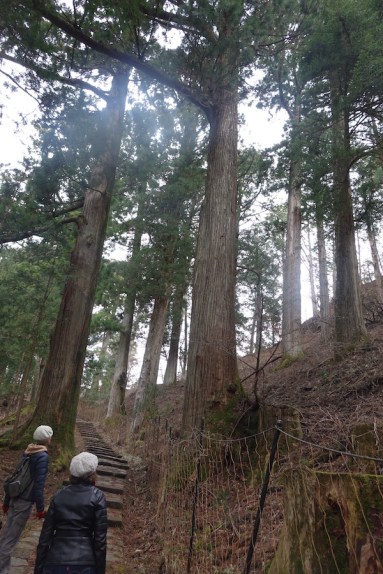 But step just a few yards off the beaten track and the world changes. In the blink of an eye, you find yourself in the utter serenity and clear air of the mountain cedar forests; as you tread the well tended path through giant, ancient trees, you pass ancient shrines which don’t attract the big restoration funds: there might be a single brazier of incense burning, but the tiny stone buddhas with fractured limbs have not been tended. Yet amazing carvings can await you, and these are places of deep spiritual calm.
 Polything