Author: davidkarlin

Gaijin view 4: top 10 things I didn’t expect in Japan

Lots of what we saw in Japan was exciting and great to see, but pretty much consistent with what I’ve read and with my memories of a short visit thirty years ago. To close our trip, in no particular order, here’s my pick of the rest…
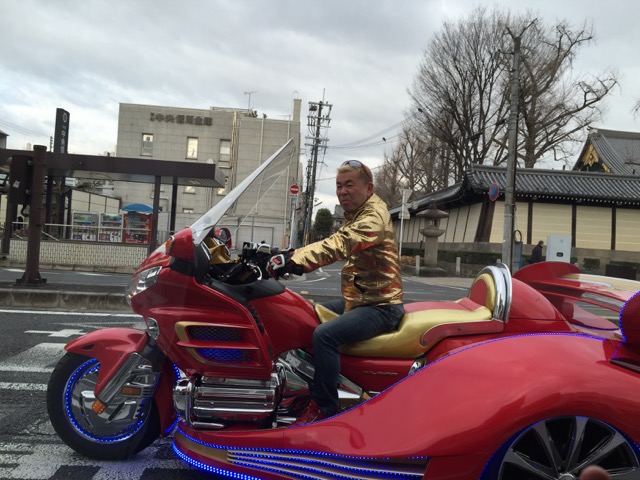
Gold lame biker in Kyoto

Japanese Kitsch

The Japanese love their minimalist aesthetic of clean lines and elegant shapes. But when they drop all that and go for kitsch, they do it in a big way. Here’s the guy in Kyoto with close cropped dyed-blonde hair in a gold lame suit on a red Honda Goldwing-based tricycle trimmed with blue neon lighting. And while we’re on the subject of blue neon, here is the hall-of-mirrors corridor to the toilets in the otherwise relatively modest Café Grace in the suburbs of Hiroshima. The toilet itself, by the way, uses mirrors instead of wallpaper. Floor to ceiling, on all four walls. Really.
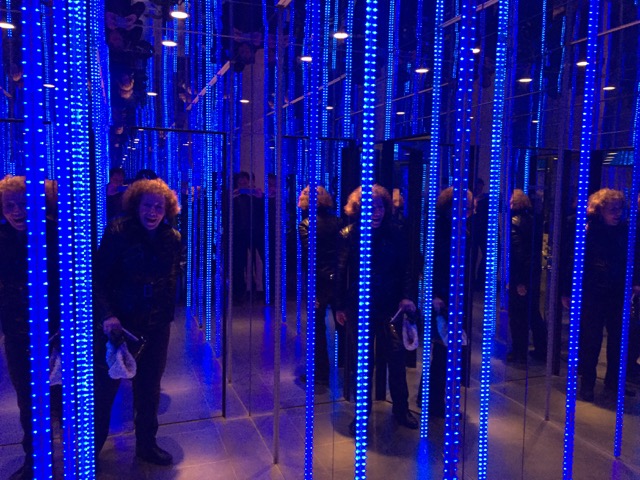
Toilet at Cafe Grace, Hiroshima

Washlets

Cistern with integral washbasinSpeaking of toilets, a couple of weeks before getting here, I was sent a Japanese class item about washlets – the toilets which have a sort of built in electronic bidet and spray water over your nether regions. But nothing prepares you for the reality of a toilet with a heated seat which, as soon as you sit down, starts making gurgling and squelching noises to mask anything you might be producing yourself. I’m told that birdsong is a popular alternative.

Less weird but strangely impressive is the cistern with integral wash basin. It saves the space of a separate floor standing unit (always a consideration in space-constrained Japan) and means that your hand-washing water is re-used to flush the toilet.


Shinkansen trips are short. Even Shinkansen 253 to NIkkowhen they’re not.
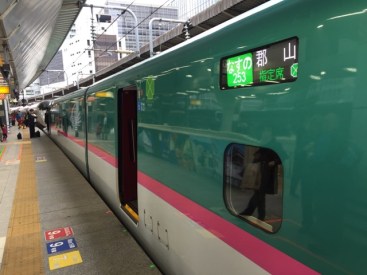
Eurostar and TGV, eat your heart out. The original and best high speed railway line is the Shinkansen “bullet train”. I don’t understand how it’s possible to do a five and a half hour ride from Hiroshima to Tokyo and have been so relaxed and comfortable along the way that you feel you could happily have gone double the distance.

Japanese directions. Or not.

If you ask someone Japanese the way to go somewhere, they don’t seem to accept the concept of telling you where to go (or pointing, as you might expect if their English is as non-existent as my Japanese). Rather, they simply accompany you to wherever you are trying to go, even if it appears to be considerably out of their way. We had one shopkeeper virtually shut up shop when we asked for some wrapping paper. He didn’t have any in his shop, but he duly accompanied us to a shop a short way down the road that did.

Hideki the teppan-yaki guy

I expected Japanese food to be relatively expensive by the standards of most cities I visit, an expectation that turned out to be largely correct. Then we fetched up at the Teppan Tavern Tenamonya: a tiny hole-in-the-wall teppan-yaki place in Kyoto, just by the Torii of the Yasaka shrine. The owner, Hideki, more or less bullied us into ordering the right things, and proceeded to serve up course after course of totally delicious, perfectly cooked food. The whole thing cost us ¥7,000 for four (around £11 a head), including a couple of rounds of beer and sake.

Hideki keeps a nice Takamine acoustic guitar in the joint, which he will lend out if asked nicely. And if he’s not busy and you ask really nicely, you’ll discover that he spent years in a Beatles tribute band and plays mean versions of Blackbird and I saw her standing (and, presumably, others). An amazing evening out.
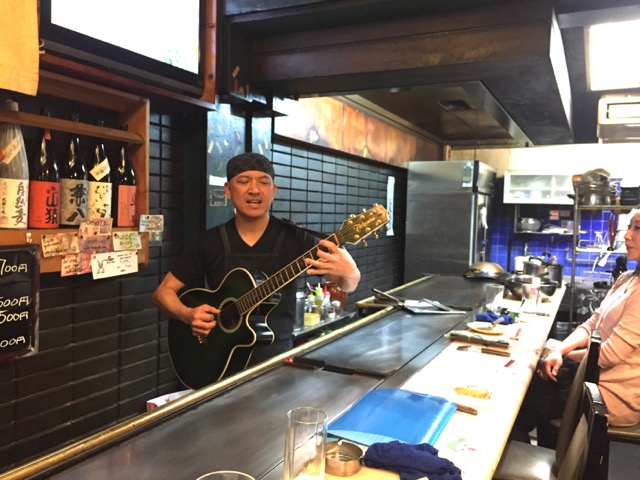
HIdeki playing Blackbird at Teppan Tavern Tenamonya

The Kimono-and-selfie-stick combo

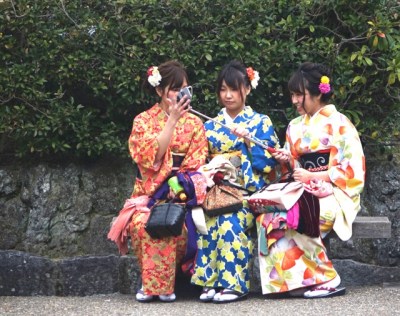
Kimono selfiesSeveral of the main Kyoto shrines are awash with girls wearing full kimono regalia, who have come there in groups, not least to Kiyomizu-dera, the temple with the “walk of love” where you have to go blindfolded from one stone to another – if you succeed in reaching the target (and you’re allowed help from onlooking friends), you will gain fortune in matters of the heart. Somehow, the combination of these beautiful traditional outfits with a cellphone on the end of a selfie stick struck me as particularly bizarre.

Japanese banks don’t take foreign cards

The vast majority of Japanese banks – even the big international ones – have ATMs that only take Japanese cards. And by the way, there are far fewer high-street branches and cash machines than we’re used to in the UK, so it takes longer than you expect to find this out: visitors come back with tales of “The Great ATM Hunt”. If you want to get money out with your European debit card, it turns out, improbably, that the place to go and do this is a Seven-Eleven convenience store, many of which are suitably equipped.
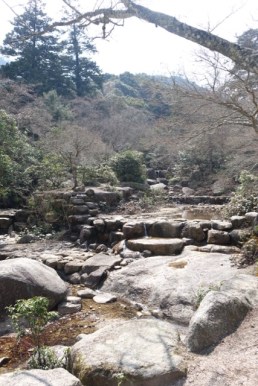
Trail to Misen peak, Miyajima

Hill walking

We did two lots of hill walking while we were here, at opposite ends of the country. Nikko, in the mountains outside Tokyo is a sea of cedar forests, a place of bewitching calm. Miyajima, an island just off Hiroshima, is at the latitude of the northern edge of Africa; it’s volcanic geology gives it steep forested slopes whose vegetation reminds one of the jungles of further south – although in March, it’s chilly out of the sunshine, so the trees and undergrowth are far less dense than in real tropical regions. Both longish hikes were utterly magical, each in its own way.

The Onsen is a marvellous thing

OK, so we were spoilt. As well as a public onsen (hot-springs type bath with continually circulating hot water) our ryokan (Japanese-style inn) in Nikko gave us a private onsen for our own personal use. There’s a ritual – rinse first with hot water, then soak in the tub, then get out, wash with whatever soap or washing products you’re using, rinse and then soak in the tub again – and you have to get used to soaking in seriously hot water. But particularly with the help Nikko’s clear mountain water, I have never felt so relaxed and totally clean in my entire life.

The obsession with Sakura picnics

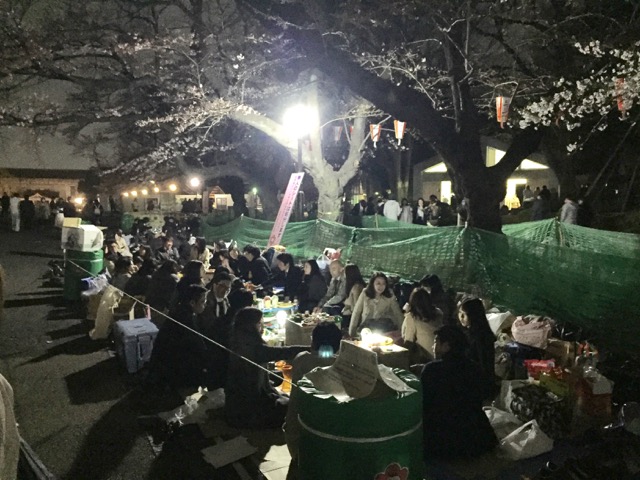
The moment the cherry blossom comes out in spring, Japanese people feel an irresistible urge to eat under it. The most junior person in the office is dispatched to the nearby park of choice to lay down their mat (usually in a rather lurid blue which isn’t necessarily the best match for the sakura itself) and spend the day on it awaiting the party that will happen at sundown. The picnics themselves appear to be quite cheerful affairs, if this one in Tokyo’s Ueno Park is anything to go by: there are drinking games, performances of music on a variety of instruments, magic tricks and, of course, large quantities of eating. Since it’s actually quite chilly at sakura time, the ramen stalls (hot noodle soup) do a roaring trade. The trait is odd, really, since the Japanese are normally incredibly reticent about eating in public. Maybe this is just a time to throw off the shackles…
IMG_1795

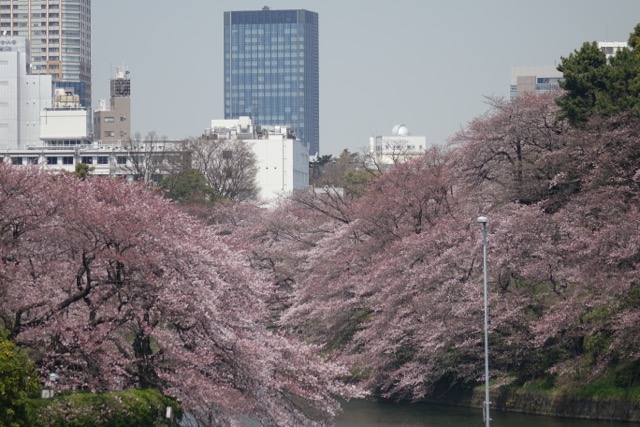
And just for a bit of eye candy, I’ll close with a picture of the cherry blossom in full glory at Chidorigafuchi. Actually, I can kind of see what they get so worked up about…
DSC02299

Gaijin view 3: Hiroshima


Atomic Dome
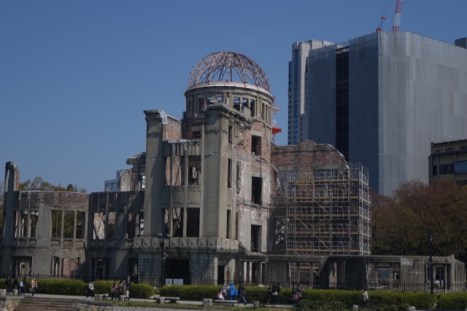
Hiroshima Atomic Dome

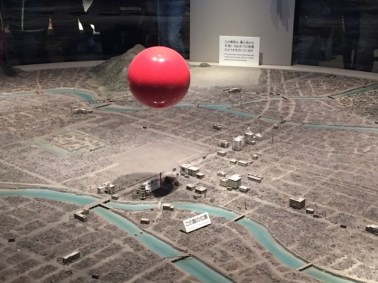
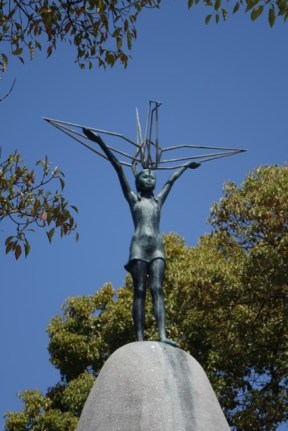
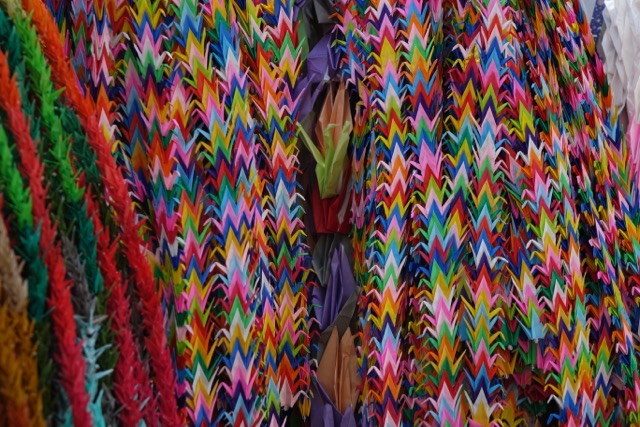
As one would hope, visiting the Peace Museum in Hiroshima is a deeply moving experience. The horrors of the atomic bomb are told with an icy clarity. The sheer magnitude of a single blast is shown by a scale model of the flattened city and the fireball that caused the damage. Real portions of damaged building attest to the unnatural power of the weapon. Most tellingly of all, the human stories are told by charred fragments of clothing accompanied by the stories of the people who wore them. A child’s much beloved tricycle, buried with the child by his grieving father, tells the tragedy as strongly as the recording of a mother who describes walking every day, for years, down the usual road to work of her daughter, whose body was never found. Model of Hiroshima destroyedMessages of peace and goodwill from a plethora of world leaders provide a thimbleful of soothing balm, while just down the road, the Children’s Peace Monument tells the story of the girl who hoped that if she could make a thousand origami cranes, she might survive her A-bomb related leukaemia. She did not.
 

And yet.

Once I’ve choked back the tears and got rid of the lump in my throat, I’m more disturbed by what’s missing from the Peace Museum than by what’s in it. The problem is this: at the end of my visit, my emotions have been stirred and I’ve dutifully  signed the petition to call upon the world’s leaders to discuss nuclear weapons reductions, but I haven’t actually learned much that matters – merely a bunch of details about an event of whose horrific nature I was already utterly aware.

Children's Peace Memorial
Children’s Peace Memorial

What I wanted to learn was some insight into how the A bomb dropping came about, from the Japanese point of view: what is their view of the causes of World War II and what made things escalate to the point where the US even considered such desperate measures. And perhaps even from the American point of view: I’d have loved to see the briefing papers given to Truman on the day the decision to drop the bomb was made, or to Roosevelt when authorising the Manhattan Project.

Rather, in this museum, the start of the war was glossed over by a single sentence in a single panel, saying that “tensions arose” after the Manchurian Incident in 1931. Later events – until the bomb itself and its aftermath – get little or no attention.

I can’t help but compare this with Berlin’s Museum of German History, which devotes considerably more space to the question of how Hitler could have risen to power in the first place as it does to, say, the plight of the Germans ethnically cleansed from Pomerania after the war. I came out of the Berlin museum with a clear feeling that the Germans have taken a good, hard look in the mirror and understood the place of Hitler and World War II in their history. I did not get the equivalent impression in Hiroshima.

Saying that “this must never happen again” is, of course, the best possible starting point. But it’s not enough. The burning question is the one of how these wars happen and how the chance of them can be mitigated.

The museum is being renovated, with the new facilities due to open in 2018. Among what is promised is an exhibition floor devoted to the dangers of nuclear weapons, which may well address some of these concerns. I hope it does so. As I gaze at a clear blue sky – just like the one on 6th August 1945 from which such horrors emerged – I can hardly contain my gratitude for having been born into what is now seventy years of peace for my country. Hiroshima should be an ideal site for focusing minds on maintaining peace as best we can.

Origami cranes at Children's Peace Memorial
Origami cranes

Gaijin view 2: postcard from Kyoto

Heian ShrineThe Japanese love of their cameras is famous, to the point where the cluster of Japanese tourists snapping away is a hardy old cultural stereotype. My assumption has always been that this is because of the Japanese love of gadgets and the associated fact that they make the world’s best cameras. But having been to Kyoto, I’m not so sure.
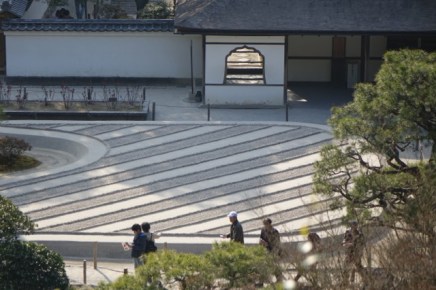
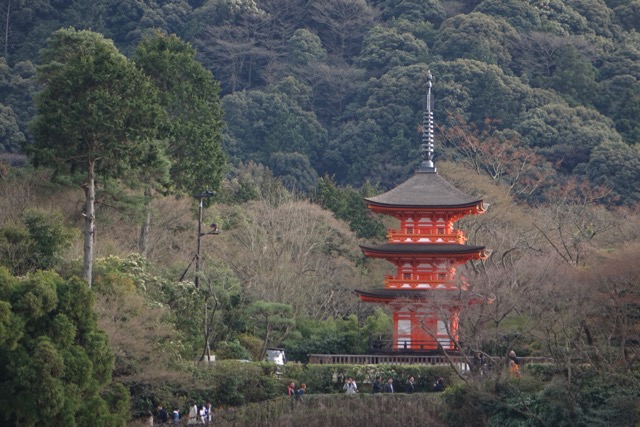
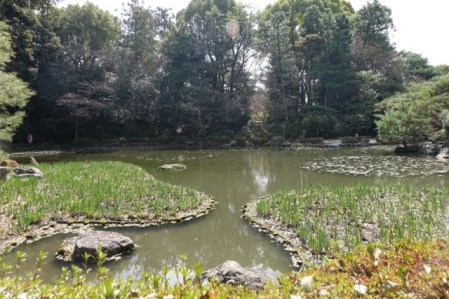
Kyoto is like a normal city onto which some gigantic god has sprinkled fistfuls of shrines and temples: you can’t walk for more than a hundred metres or so without running into one. The size varies from modest individual shrine to massive temple complex, but they all share the characteristic of having clean lines and interesting shapes. When taking photos here, you have to pay more attention to composition than anywhere I’ve ever been, because there’s always some interesting piece of framing that is possible.

Zen garden at Nanzen jiThe fact that this isn’t accidental is something you realise when you’ve been through some of the city’s many gardens: whether it’s a zen sand garden (who, I wonder, first thought of simply raking sand or gravel into harmonious patterns), the formal gardens set around water with their pavilions, stepping stones, bridges and ornamental trees, or the enormous park-like gardens that surround the imperial palaces, you feel that every square metre has been laid out by someone who knew exactly what he wanted the space to look like from every angle and was quite clear about the emotional responses he hoped to induce: calm, harmony, a sense of rightness about the world.
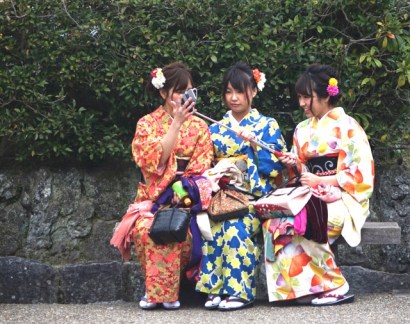
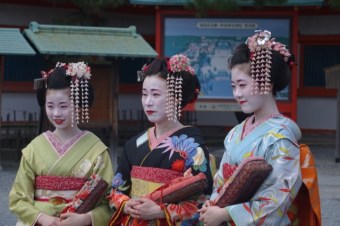
Kimono selfiesIt seems to me that the Japanese don’t just love their cameras because they’re into gadgetry. It’s that the idea of the perfect composition of an image is hard baked into their culture. You see it in the prints they revere from Hokusai, Utamaro et al, and in the spectacular Kano school scrolls in Kyoto’s Jukoin temple. And it’s part of everyday life – or at least special occasion life. In Kyoto, a cool thing to do is for groups of young girls to come here for a trip in which they rent kimonos and go and photograph themselves (or get friends to do it) in full traditional regalia near the various temples and beauty spots. The combination of kimono and selfie stick is a common sight. More spectacular still is when you see geishas in full, white-faced splendour (usually, to be precise, the “maiko” or trainee geishas).
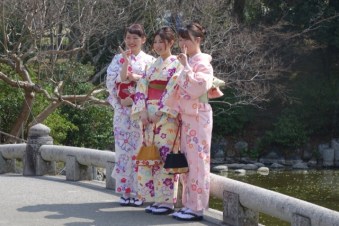
Kimonos on the bridgeMaiko close-upFor most of the world’s major tourist cities, if you do a modest amount of reading up before your visit, you get a decent idea of what it’s going to be like to be there. It’s not just that you read the list of attractions and formulate a mental tick list: travel writers generally do a good enough job that you get some sort of feel for the nature of the destination.
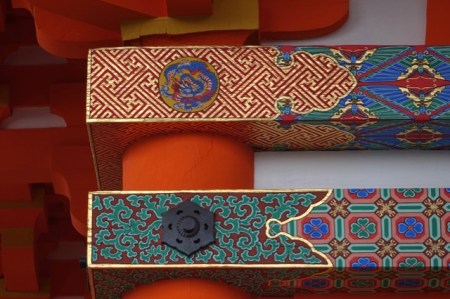
Kiyomizu-dera workmanshipNot Kyoto.

I knew lots of things about Kyoto before coming here: Japan’s pre-Shogunate Imperial capital, still a major working city and a centre for arts and crafts, the highest density of temples and shrines on the planet, many famous gardens, a beautiful setting, etc. But what I read didn’t prepare me for the reality. The inner calm of those miraculous garden spaces, the sense of cultural importance imparted by the exquisite workmanship on every temple, the understated joie de vivre of the girls giggling under the spectacular flowers of their kimonos (we’re just at the beginning of the blossom season, so everything is floral) give a sense of balance and well being of which I had no real expectation.

DSC01786Back in the 8th century, Kyoto was chosen as the location to which the Emperor should move his capital in order to move away from religious influences. The Imperial geomancers loved the protection and natural beauty of a site bounded on three sides by mountains and split by a broad river: snow-melt from the mountains means that there is water all over the city, with countless canals and storm drains meaning that (at least in spring) water is running wherever you go. Today’s density of temples says that the move away from religion wasn’t stable. But I reckon the Imperial geomancers hit the bull’s eye.
Gai-jin view 1: bureaucracy, shrines and cedars

As soon as you hit the immigration queue, you realise that things are different in Japan: the people managing the queue are brisk, friendly and efficient: guys are moving the tapes around so that you don’t have an interminable zig-zag through empty lanes, a single girl dispatches each traveller to one of ten kiosks, checking paperwork for gross errors as she does it. The briskness and efficiency continues with the lady at the JR (Japan Rail) desk at Haneda Airport, who, in spite of limited English, sorts out our rail cards and various reservations, including getting us seated in the right places, telling us which side of the train we need to be on for Mt Fuji (not something I’d realised was an issue) and so on.


IMG_1575
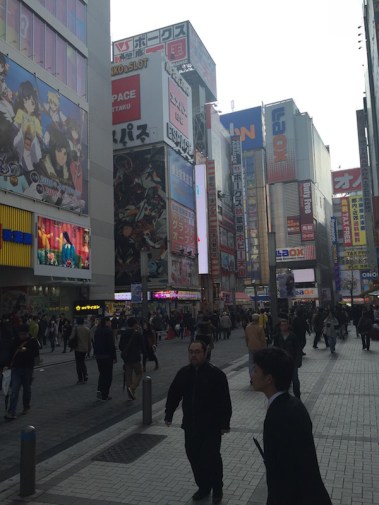
Akihabara, Tokyo’s electronics district

Having said which, they need to be: this country still does bureaucracy – on real paper – in a big way. Every train reservation took several pieces of paper, innumerable stamps and a bewildering number of different screens. The railway network isn’t integrated, so reservations outside the JR East region require the use of a whole different set of processes, including timetabling printed out on an ancient tractor-fed impact printer (anyone remember those?). The banking IT isn’t exactly integrated to global standards, either: lots of places don’t take credit cards, there are fewer ATMs than any city I’ve been to for years. In Nikko, a couple of hours outside Tokyo but still a major tourist site, there appears to be only three ATMs, none of which take foreign credit cards.

But the brisk, friendly, get-things-done kind of attitude seems to pervade everyday life: the everyday virtues of politeness and kindness to strangers are continually apparent. When we asked the way to the correct platform at Tokyo’s large and confusing Shimbashi station, perish the thought that the thirty-something man we asked should merely tell us the answer: in spite of having looked in the tearing hurry that characterises most users of the Tokyo subway, he turned round and accompanied us a goodly long way to the correct ticket gate for our line change.

We were expecting the high population density in Tokyo – it’s pretty well charted knowledge, after all, and we all know that the subway at rush hour is a serious crush. But it’s other things that bring it home to you: the amazing network of canals as you arrive from Haneda are a tell-tale of land reclamation from Tokyo Bay on a large scale, and when you’re at the Edo-Tokyo museum, well out of the centre of town, you’re still on the kind of density of high-rise building that you would normally expect only in downtown city centres. And when you finally take a Shinkansen train out of the capital, the dense urbanisation continues, only slightly abated, for just about the whole of the hour or so trip to Utsonomiya.

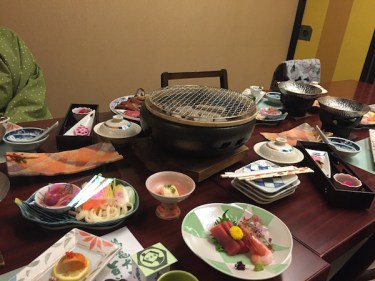
IMG_1610We all know that Japan’s cuisine is very separate from those of the rest of the world – different flavours, super-high quality fish, etc. The striking thing we weren’t expecting was the attention to how food looks. At the kaiseki (Japanese haute cuisine) restaurant in our ryokan in Nikko, we must have used some 20-30 items of crockery each, every one carefully chosen – sometimes to match some particular seasonal theme such as, in our case, plum blossom.

This is also the country of food packaging. The sweets/biscuits/general goodies shops pack everything in individual portions (down to a single biscuit or piece of crystallised fruit) before arraying it neatly in a box so beautifully that you could hardly conceive of gift-wrapping it: special see through model boxes are provided so that you can see what you’re buying. And it’s not the factories that go for multiple packaging. When the rice course at one of our dinners had utterly defeated us (rice is typically eaten at the end of a Japanese meal, which in this case meant about the tenth course), our leftover rice dish was given to us to take away in four individual portions, each in its own tray and lovingly wrapped in four layers of cling film. (We didn’t ask, by the way, it just appeared in a bag when we paid the bill).

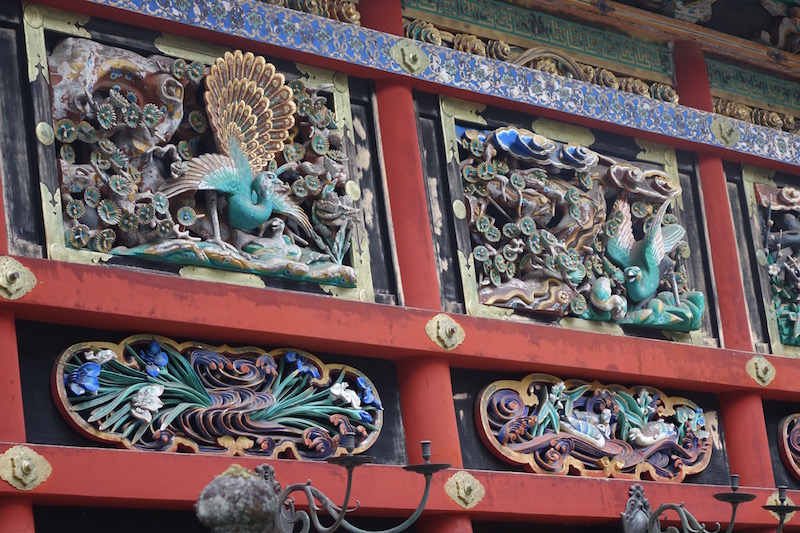
DSC01375Nikko epitomises some of the contrasts in the country. The town is famous for its major shrines of the Tokugawa shoguns (the first of whom, Ieyasu, was the single most important figure in making Japan into the single country that it remains today). The Tokugawa shrines and temples are in a sort of Japanese baroque – gigantically ornamented to the point where it’s quite hard to get your head round the sensory overload of different themes and motifs. And – on a holiday week end, at least – they are packed rigid with visitors. It’s all very well organised, but Buddhist calm and Ieyasu’s own rather austere-sounding personality are very much submerged in the throng.
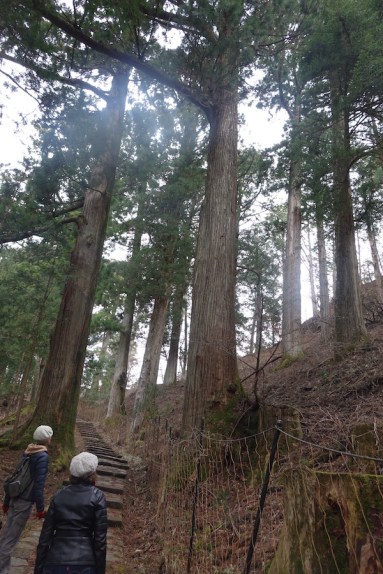
DSC01389But step just a few yards off the beaten track and the world changes. In the blink of an eye, you find yourself in the utter serenity and clear air of the mountain cedar forests; as you tread the well tended path through giant, ancient trees, you pass ancient shrines which don’t attract the big restoration funds: there might be a single brazier of incense burning, but the tiny stone buddhas with fractured limbs have not been tended. Yet amazing carvings can await you, and these are places of deep spiritual calm.

Back at the ryokan, the onsen bath is utterly seductive: a tub with continually circulating hot water, the perfect way to soothe limbs aching from a day’s hiking on mountain paths. There’s plenty of ritual attached – as in all Japanese things, there’s a precise schema of what order you’re supposed to do everything in – but the ritual works. In one of the busiest, most crowded countries on the planet, we finish the day more relaxed than I can remember.

Three questions you should ask your cloud-based software provider

Back in the day, if you were a software company pitching to investors, the first questions they asked you were much the ones you might expect: your turnover, margins, how many customers you have and so on. Smarter investors asked about things like retention rates and cost of customer acquisition. Around 2005 or so, all that changed: the question at the top of the list became “What’s your SaaS strategy?” A couple of years later, that morphed into “What’s your Cloud strategy?”

A few years later, I run a business which is small (9 employees) but complex (multi-currency, multi-lingual, multi-country). And indeed, pretty much everything that isn’t on our own server is run in the cloud: I finally moved our accounting system from Intuit’s Quickbooks desktop to Quickbooks Online eighteen months ago.

The move to Online has resulted in some small wins. The main one is that I don’t have to run a Windows Virtual Machine any more (I run Macs because I develop software and the tools require a Unix-family operating system). And it’s occasionally but infrequently useful to be able to get some of the accounts done at home in the evening. But the truth is that most of the product works very similarly and, broadly speaking, going cloud hasn’t affected things much either way.

Except that I’m now terrified. For three reasons.

What happens, it’s fair to ask,  if I do something really stupid with a transaction – of the sort that can’t be reversed. I’m accident-prone, after all, like anyone else. On the desktop product, it was easy to deal with: I would simply have reverted to the previous night’s or previous month’s backup and re-input a bunch of transactions. On the online product, backup and restore isn’t an option that’s provided. This isn’t unique to Intuit, by the way – the norm seems to be that most cloud vendors simply don’t offer this.

Lest you think this is unlikely to happen, I can tell you that when you advance payroll a month, there’s a large warning saying “This cannot be undone”: any mistakes and you’re toast. And when I have needed to work around bugs or omissions in Quickbooks, their technical support people have recommended with gay abandon that I do things that affect transactions in now-closed periods (i.e. would potentially make my VAT return illegal).

The next question for your vendor concerns their attitude to bugs. Not “technical support issues,” not “stray transactions that can be corrected,” but bugs – the real thing, where the system isn’t working. Perhaps intermittently, and perhaps just on your database. In desktop days, you had the option to simply not upgrade. Or to roll back an upgrade if it all went pear-shaped. In cloud days, you don’t. You really, really want your vendor to be completely committed to doing whatever it takes to bring you back on-line and running. And the truth is, these vendors are not. A missing feature deep in the multi-currency handling of Quickbooks Online kept my ledgers out of balance for most of a year until someone clever in Intuit figured out a workaround. Problems with my online banking interface are approaching their second birthday: the software worked fine when I evaluated it; two months in, Intuit deployed a rewrite which broke it. And there is no sign of them showing any commitment to getting it fixed: they work on it for a bit, and then give up. Fortunately, it’s only a time waster rather than a complete showstopper: because remember, I don’t have data portability of any viable sort. I have no easy way of exporting my data such that I could rapidly start again with another vendor.

The scariest problem (albeit the least frequent) is what happens if you or a vendor messes up your login credentials. You can all imagine the situation: you try to log in one morning and you get told that one of your passwords is wrong, or the software asks you to re-authenticate using one of your “memorable phrases,” and your phrase turns out to be less memorable than you thought.

With one of my cloud service vendors, that’s just what happened: I got locked out of certain areas of my account, and the vendor refused point blank to take the required steps to re-authenticate me. I was unable to satisfy them with the data they required in their online form, most probably because I couldn’t remember the month and year in which I originally joined the service, around a decade earlier, or which of my many email addresses I used at the time – but I can’t be sure.

And no, this wasn’t a small, fly-by-night operator: this was Microsoft. I actually had to stop using my old account (which still exists, by the way: they are unable/unwilling to delete it) and open a new one. Now losing a Skype account wasn’t the end of the world. I shudder to think how I would deal with the situation if this happened to my accounting system, or web host, or Gmail.

And that, by the way, is without considering the possibility of criminal malice: although, thank goodness, I’ve never personally had my identity stolen, I’ve watched it happen to one of my employees (who had a common first name and whose surname was Smith, which didn’t help) and I can assure you that it was a truly horrific experience.

So before you dive into the Cloud, here are three questions you should ask:

  1. What strategy do you support for me to back up and restore my data? (And while we’re on the subject, if I wish to move my data to another provider, how is that supported).
  2. If I hit a bug in my installation, what guarantees and timescales can you provide me that you will (a) provide a fix to get me up and running, and (b) fix the problem permanently?
  3. What, if any, data do you require me to hold to guarantee that, in the event of my being denied access to the system (whether because of identity theft or just my own forgetfulness), you will accept or replace my user credentials ?

The chances are that the answers to these will be something along the lines of (1) you don’t need to back up your data because we guarantee you 99.999% uptime; (2) our technical support team is available to help you 24/7 but we don’t provide specific guarantees and (3) we don’t publish security-sensitive information of this sort.  If they are and you’re a large organisation, you will need to write a set of large, ugly items into your corporate risk register.

Or, if you’re a small business, just lose some sleep.

Semi-ethics and blowback

It was in my business software days that I first came across the concept of a “semi-ethical” policy. We were looking at companies who wrote software for lawyers, and I remember with complete clarity one of their product managers explaining to me that you could have a “fully ethical” timesheet system (where the system printed precisely the time recorded on each job), a “non-ethical” system (where the lawyer could write in whatever time they wanted) or a “semi-ethical” system, which defaulted to the actual time recorded but then allowed the lawyer to modify the results before sending them on to the client. My younger and more naive self was shocked, not so much by the fact that the systems (or indeed the lawyers) behaved in this way, but by the brazenness of the nomenclature.

The late Robin Cook caused some seriously raised eyebrows in diplomatic circles when, upon becoming foreign secretary in 1997, he appeared to suggest that our future foreign policy should be an ethical one. But Cook’s exact wording was more nuanced: he said that our foreign policy should “have an ethical dimension” – in a speech that explicitly placed security as the first goal of foreign policy and included a commitment to “resolutely defend British interests”. A semi-ethical policy, in other words.

A couple of decades later, it strikes me that a semi-ethical policy is precisely what we are pursuing in the Middle East, and that this is a major cause of our present levels of confusion and muddle. The problem is that we’re prepared to be ethical, but only in isolated compartments (and, one suspects, when it suits us for other reasons). For example:

  1. Saddam Hussein is an evil tyrant, so something must be done. For the sake of his people, we must overthrow him at all costs.
  2. Bashar al-Assad is an evil tyrant, so something must….(repeat above)
  3. The Soviet Union was an evil empire, so when we had an opportunity to damage it at little risk to ourselves (such as in Afghanistan), it had to be seized at all costs.

The point here is that regardless of the ethical choice that you’re making (if, by the way, you accept the principle of self-determination, you have to be pretty doubtful about both 1 and 2), such choices made in isolation have a nasty habit of leading to results that are at best unpredictable and at worst seriously counterproductive.

The term “blowback” was originally coined to refer to the effect of battlefield poison gas when the wind changed and brought the gas back onto one’s own soldiers. Semi-ethical policies – or, to be more precise, policies in which one’s reliance on one’s ethics are limited to a particular, narrowly drawn issue, are particularly vulnerable to blowback. Our support for the Mujahideen in Afghanistan created the conditions in which Osama bin-Laden founded Al Qaeda. It turned out that the undoubtedly evil Saddam Hussein had been effectively keeping the lid on an explosive sectarian conflict, and it’s easy to trace the rise of IS directly to his removal. Our insistence on the deposition of Assad as a primary policy goal has led to the current crisis in Syrian refugees.

The difficulty faced by policy-makers is that most fully ethical policies look just as unappealing as ever, whereas in 21st century democracies, policies which disregard ethics altogether are becoming almost as unviable.

A fully ethical policy with the ability to prevent the Syrian crisis would have required the prevention of the global warming that caused or at least exacerbated the multi-year drought that triggered the crisis in the first place (see this graphic); our direct involvement could probably have been avoided only by getting rid of our dependence on Middle East oil, enabling us to be genuinely disinterested brokers. Both of the these things required sacrifices in lifestyle that Western electorates have found and continue to find unacceptable.

In the 19th century, ethics would have played little part in anyone’s thinking: a British or US government would have achieved its ends by a combination of overwhelming military force and diplomatic deviousness (there’s a reason for the name “Perfidious Albion”), without batting an eyelid. But times are different: as Robin Cook pointed out in that 1997 speech, “We are instant witness in our sitting rooms through the medium of television to human tragedy in distant lands.” The results of total ruthlessness in foreign policy are visible with considerable ease both to other nations and to our own electorates. Tony Blair’s prime ministership was very much a success until the Iraq invasion: for many, the results of the invasion and particularly the shenanigans surrounding the “dodgy dossier” that was used to justify it have turned Blair into a figure of hate.

So the chances are that semi-ethics will win, and that the processes of media spin and intensive muddling through will continue. At any given crisis, the cries of “something must be done” will be heeded and something will be done – even in the Middle East. But there’s little indication that the something will be the foundation of fair and lasting peace: that’s going to take a lot of luck, a commodity that’s been in short supply in the region.


Hello, from Polything

I’m lucky enough that writing is part of my job description. But on Bachtrack, I get to write strictly about opera and classical music. This blog is for all the other stuff: politics, software, business, cooking, the general randomness of living in London and anything else that I presume to think someone might want to bother reading.

The title was as close as I could get to “other stuff”, which someone else has already registered. I hope you enjoy it.

For tech and design heads, this is my first go with WordPress. Bear with me.

David