Author: davidkarlin

Protect your digital life: phone theft strategies

Protect your digital life: phone theft strategies

Every year, more of our life goes online. Whether it’s checking a bank account, paying taxes, buying insurance or getting a doctor’s appointment, the first thing we do is to reach for our phone. And as for money: I’ve barely touched a coin or banknote – or even a plastic credit card – in months.

But think for a moment: if all that personal IT were to suddenly break down, how would you cope? These days, all it takes for that to happen is to get your phone stolen. With every service you use yelling at you to set up “two-factor authentication” (sometimes called two-step verification, 2FA or 2SV for short),  your phone is now your access key to a high proportion of the services in your life. If it goes, you’re in trouble.

That possibility is turning into a nightmarish reality with increasing frequency. The 2024 Crime Survey for England and Wales estimated that 78,000 people had phones or handbags snatched in a year – 200 per day – with the figure rising steeply year on year. It’s not just petty criminals selling your phone down the local pub any more: the majority of these thefts are by organised gangs who make high profits by selling them in bulk into countries where legitimate phones are expensive and controls on stolen ones are lax (Algeria and China are prime candidates, according to the New York Times).

Although this type of theft is the most numerous, the type you need to worry about most is different: theft by tech-skilled people who are going to use your phone to siphon off your money. The son of a friend of mine had his phone robbed late at night, and by the time he got to somewhere he could report this, large sums of money had been cleared out of his bank accounts. Even after he reported the theft to his bank, the thieves continued to drain money, putting him under severe stress and causing an uphill struggle with the bank concerned to get restitution.

Big organisations assess risk and have “disaster recovery” plans to deal with major IT failures. They often fall woefully short – just ask the British Library, whose systems still aren’t fully operational two years after they were shredded by a ransomware attack. But the basic idea is sound: be prepared for what to do if things go wrong. And that holds just as true for you as an individual as it does for the biggest worldwide corporation.

The rest of this post is to give you some ideas for what to do and why. Lots more detail is available if needed, but the post was too long already… Here are some headings:

  • Make a contingency plan for phone theft
  • What to do in advance of an attack
  • What to do immediately after an attack
  • Setting and keeping track of strong, unique passwords
  • Laptop theft and other threats
  • Stop the whole thing happening in the first place

Make a contingency plan for phone theft

Ask yourself this: if your phone gets snatched, what do you do next? Do you know how to get your number blocked, how to stop your bank handing out money? How to stop the bad guys getting into your email? And what about all those precious family photos that you have stored on the phone?

From the moment the thieves have your phone, you’re in a race against time. They have to crack any passwords or PINs to get into your precious phone apps, which will take them a certain amount of time – which you can lengthen (see the section on passwords below). During that time interval, however long it may be, you need to prevent them hurting you by doing as many as you can of three things: remotely erase the phone’s contents (ideal but not always possible), get your mobile provider to block phone use (quick, but only part of the solution) and change the passwords on your most important applications.

We’ll talk about the detail of those measures – both in advance of and after an attack – but first, consider this: did you really need the convenience of being able to do your banking on a phone app? If you can keep at least some of your money in an account where you haven’t installed an app on your phone, but access only from your computer at home with one of those plastic keypads your banks provide, that money is 100% safe from phone theft. (An alternative is to use an account which needs a phone app, but only install it on an old phone that you keep safely locked up at home).

What to do in advance of an attack

The first essential measure is to identify all the services that are really critical to your continued well-being, the ones that will cause you a significant problem if you can’t get into them because you no longer have your phone to allow you in. Your primary email service should be at the top of the list, because if it gets hacked, the thieves can use it to do a “forgot password” against most of the others. Your bank account(s) are next. For Apple users, the Apple ID is next, since it lets you manage your devices as well as cloud storage. You may have others – a lot of people run their lives on WhatsApp.

For each of these critical services, you’ll be way faster at saving yourself if you have learned in advance how to get back into them so that you can change your security credentials. Many will let you set a backup phone (most probably a family member or close friend). Others will let you print out a set of recovery codes: do this and keep them in a “Safe Place” – a fire safe is ideal, or a locked cupboard in the house of the said family member or close friend. Others give you a phone number to call, most probably with a set of security questions. Whatever the methods are, make sure that you will know what to do in the wake of an attack.

Look up your phone provider and bank’s mechanisms for blocking use of your phone. For a phone with a physical SIM, it’s a good idea to convert it to an eSIM, which the thief can’t simply take out and plug into another phone. You can do it on the phone and it’s quick (albeit at the cost of making changing handsets more time-consuming).

Another obvious step is to know how to call your phone provider to get them to block your phone. There’s generally a number to call and/or a web page on your mobile account. For any bank apps on the phone, you will want to know the drill for contacting the bank. These things can be looked up online, but even then, it’s helpful to know in advance what security questions they’re likely to ask you.

You want your data to be backed up regularly. On an iPhone, the most convenient way to do this is to subscribe to some cloud storage with Apple (£2.99 per month will get you enough for most usage). Tick the relevant boxes in iOS Settings and you’re done. This also means that you can get your electronic life back to normal with a new phone.

What to do immediately after an attack

The first thing you will want to do after a theft is to erase the data on the phone remotely, preventing the thieves from doing you any harm whatsoever beyond the need to buy a new phone. Both Apple and Android have “Find my” apps, which you can access from any web browser. The big caveat is that if you have 2FA set up, which Apple pretty much force you to do, these days, you have to be able to use whichever 2FA backup mechanism you have set up, as mentioned earlier.

Next, you will want to instruct your phone provider to disable the phone. Potentially, there are two lots of this: the SIM card and the IMEI number (which identifies the phone hardware itself). IMEI blocking isn’t perfect, but it’s still worth doing.

Next comes your bank. I wish I could say that banks were perfect at blocking your app use as soon as you’ve instructed them to. They’re not, but at least making that call gives you a better chance when demanding compensation because they didn’t deal with your request promptly.

Setting and keeping track of strong, unique passwords

Let’s talk about the meaty subject of passwords and PINs – which is the thing that will probably involve you in the most work to change what you’re currently doing. It helps if you understand the most important ways in which the bad guys can break your password security:

  1. You left the password lying round somewhere, either on a piece of paper or in an unencrypted file – post-it notes are frequent culprits, as are laptops left open on a café table.
  2. They guessed a password that was too obvious (you’d be at amazed at the number of passwords that are set to “password” or “123”), or they used “brute force” computing methods to go through thousands or millions of password guesses – so-called “dictionary attacks” are popular, as is use of researchable data like your address, birthday or children’s names.
  3. They found the password in a data leak from one of your websites (or by snooping your connections on public WiFi), and then tried it on all the others.

My preferred scheme for protecting your passwords (there are others) works like this:

  • Identify a few of your (no more than half a dozen) that are so critical that you’re never going to write them down at all (e.g. your email address and your bank account), except perhaps in your Safe Place. Choose passwords that are long (20 characters or more), diverse (include numbers and punctuation) and memorable to you but no-one else. Examples might be “George – Albufeira Beach – 2022” if your best holiday ever was with George in the Algarve, or “Greased Lightning – GL 03 XKZ” for the nickname and licence plate of your first car (don’t use the current one).
  • For the others, go to the other extreme and use a password which is long and random (for example “PlnoplxM#mtazo@!50xFm&UXoSydxx3” and use a password manager to create and remember them all for you (I use LastPass, which costs £2.60 per month, but there are plenty to choose from, including the free ones provided by Google or Apple). These kind of passwords are near-impossible to guess, even by brute force, unless you’re the CIA or Mossad.
  • Change any passwords required to avoid using the same one for more than one website. This is time consuming, but a good password manager will run you through a list of the ones you need to change, either because you’ve re-used them or because they are known to have appeared in a data leak. That way, if a password leaks or is guessed, the damage is contained to just one service and doesn’t spread to others.

Laptop theft and other threats

Other than the replacement cost, losing your laptop isn’t nearly as serious as losing your phone, because all your 2FA still works, so you can still use your phone to access your services. You should still plan on changing all of your critical passwords, and doing a remote erase if you can.

The real killer is if you lose both the phone and laptop at the same time (which is why it’s a really good idea never to put them in the same handbag or backpack). At that point, you’re really thrown back on whatever you can remember in your head or have stored in the “Safe Place” described above.

The preparation and response to most other threats is surprisingly similar to the steps shown everywhere else above. The one most worth mentioning is a ransomware attack: if you get the kind of screen that says “we have encrypted all your data, please pay us xxx bitcoin to get it back again”. The advice here goes like this:

  1. Don’t pay the ransom. There’s a strong chance that the attackers will just pocket the money and won’t actually restore your data.
  2. As soon as you see the ransomware screen, do not touch anything on your device. Rather, take a photo of the screen (if it’s on your own phone, borrow someone else’s to do it). Keep it for later diagnosis, if needed.
  3. Now switch power off to your device, by whatever means the manufacturer gives you (usually a long press-and-hold on a button somewhere).
  4. After a few seconds, switch it on again. If the ransomware demand is still there, you know you have to take the device for repair. If it’s gone, you can breathe a little bit more easily, but you’d probably better get the device scanned for malware (or do it yourself if you’re sufficiently confident).
  5. If you want, report the attack – but in the UK, at least, the chances of the police actually doing anything are pretty remote.
  6. Once you have your device back and cleaned, it’s time to restore from backup.

Stop the whole thing happening in the first place

Obviously, your starting point should be to avoid thefts happening in the first place. Don’t  leave a phone or a computer lying around on a café table while you go to the loo (along with your house or car keys, it’s possibly the single most stupid item to use to mark a table as being yours). Don’t put your phone in an easy-to-access back pocket or an easily snatched handbag. Don’t walk around with your face buried in Google Maps – look up your itinerary before you start and only refer back to the phone when you need to. If you really can’t avoid walking around staring at your phone, stay away from the edge of the pavement where the classic grab-and-run-from-motorbike is easiest. The list goes on…

That’s it, folks. You might well ask the question of how we all got into such a vulnerable state, and what our institutions might think of doing about it. But that’s a subject for another day…

P.S. Some places where I don’t necessarily agree with the conventional wisdom

Various people will tell you to change passwords often, and it’s true that this helps defeat a particular sort of attack where someone is intercepting your traffic (perhaps by snooping on public Wi Fi, or by plugging a key logger into your desktop computer at work). The trouble is that if you have followed the good advice to use unique, strong passwords, it’s pretty much impossible to do that when you have different passwords for several hundred different websites.

People also say that you should have 2FA everywhere. I’m not so sure. 2FA does indeed protect you in a specific case: when your password has leaked but your device has not been stolen. If you use different passwords everywhere, the impact of this is pretty limited, and it comes at the expense of turning your phone into a giant single point of failure for your whole electronic life. I’m enabling 2FA for most things, but reluctantly.

Finally, I’m not yet a fan for the current trend of asking you to create “pass keys”. I happen to do most of my work on a closed laptop plugged into a docking station (so I don’t have touch id or face id). Therefore, “use a pass key” turns into “type in your main computer password”. This is far less convenient and I remain to be convinced that it’s massively more secure.

That’s really it now, folks.
Discovering and observing Skopje, North Macedonia

Discovering and observing Skopje, North Macedonia

It’s been a constant feature of my travelling life that whenever I visit a small country for the first time, the kind of country that I and most of my friends know very little about, I always find far more of interest than I could possibly have imagined beforehand. And so it has proved in my first visit to Skopje, capital of the Republic of North Macedonia.

Skopje Fortress

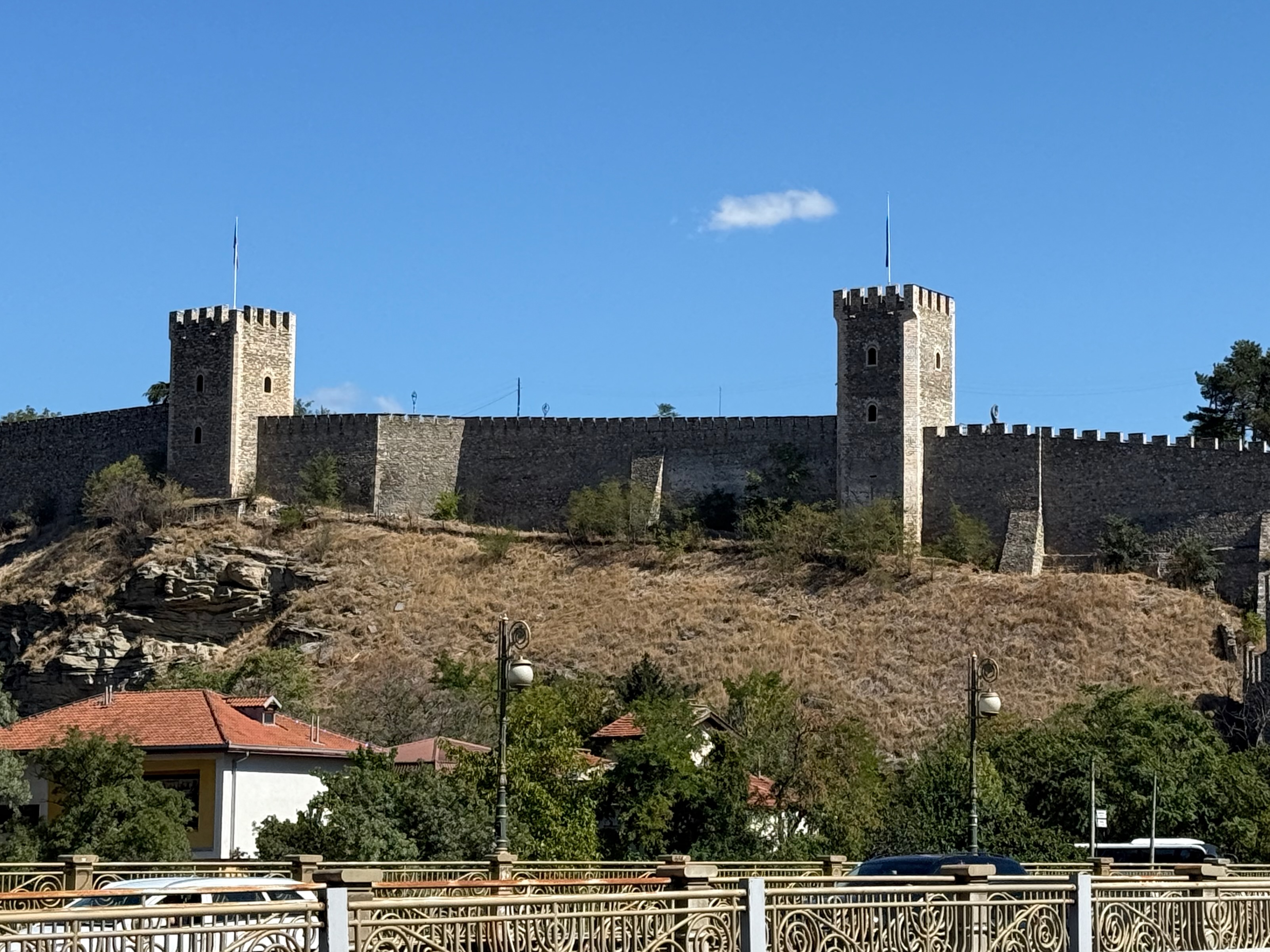
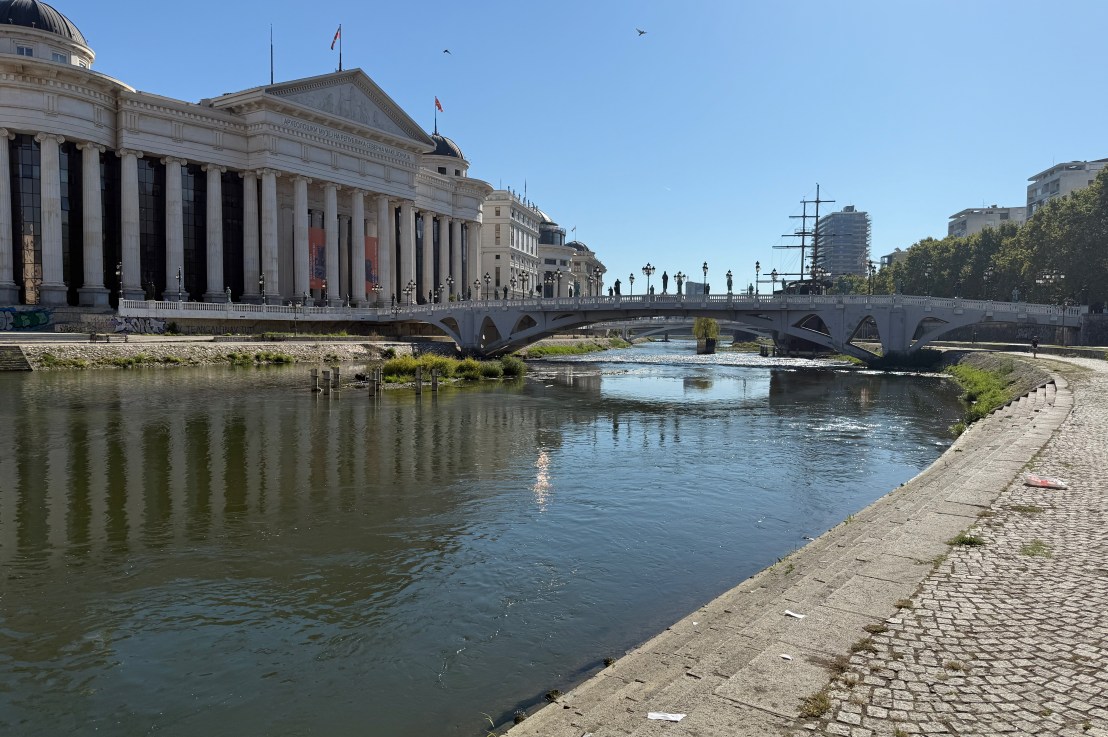
Skopje has the unusual geometry of being long and thin – over 30 km long but mostly less than 5 km wide. That’s because it’s built along the length of the Vardar river, snaking gently from East to West along the river’s course and surrounded by mountains. The imposing Skopje Fortress  is situated atop a substantial bluff immediately north of the Goce Delčev Bridge, the main river crossing point for car traffic. The Kale (the Macedonian word for fortress) has been there, in various forms and various levels of repair, since the sixth century CE, which makes it one of the oldest castles in Europe.

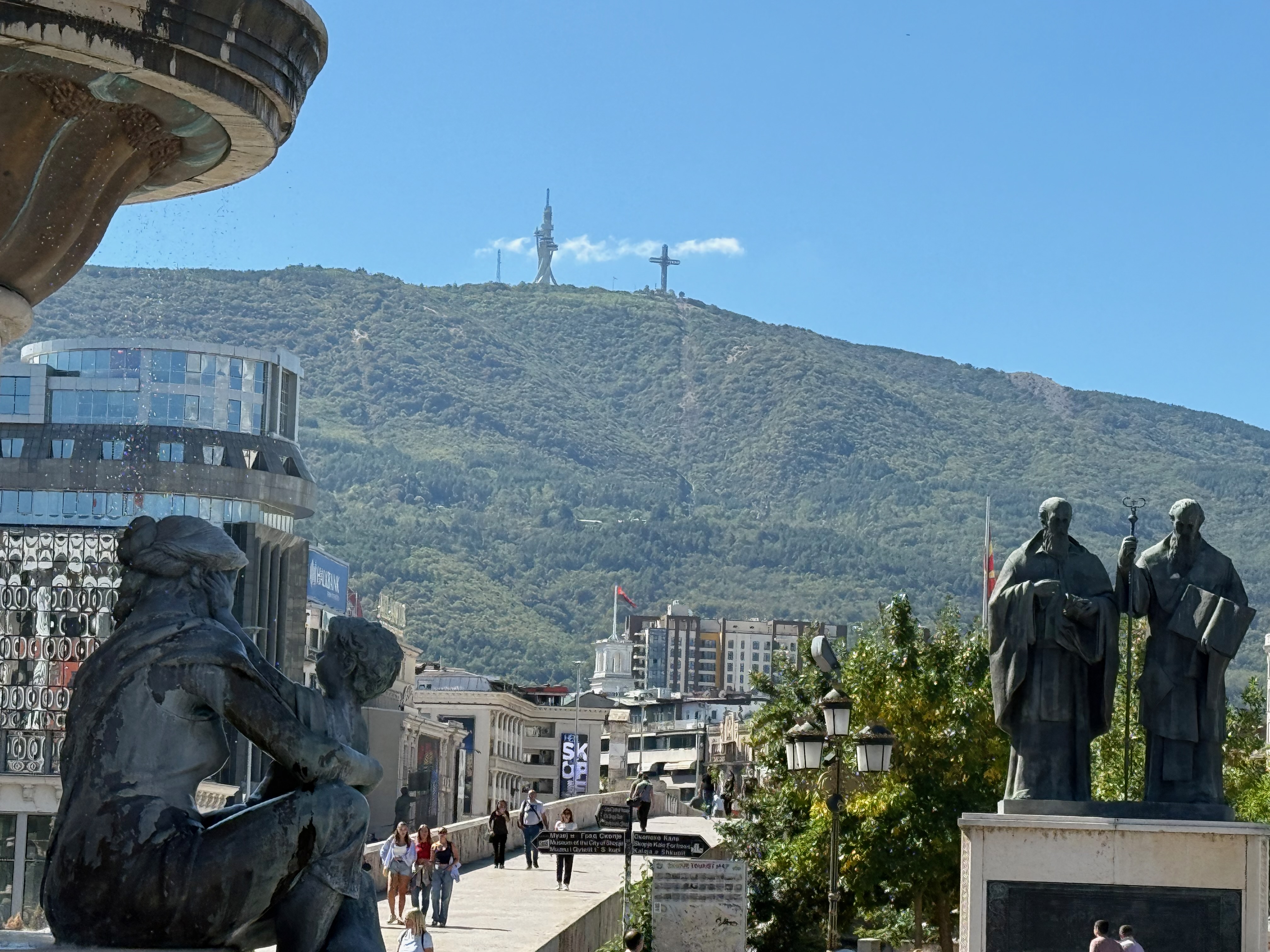
The Stone Bridge with Mount Vodna in the background

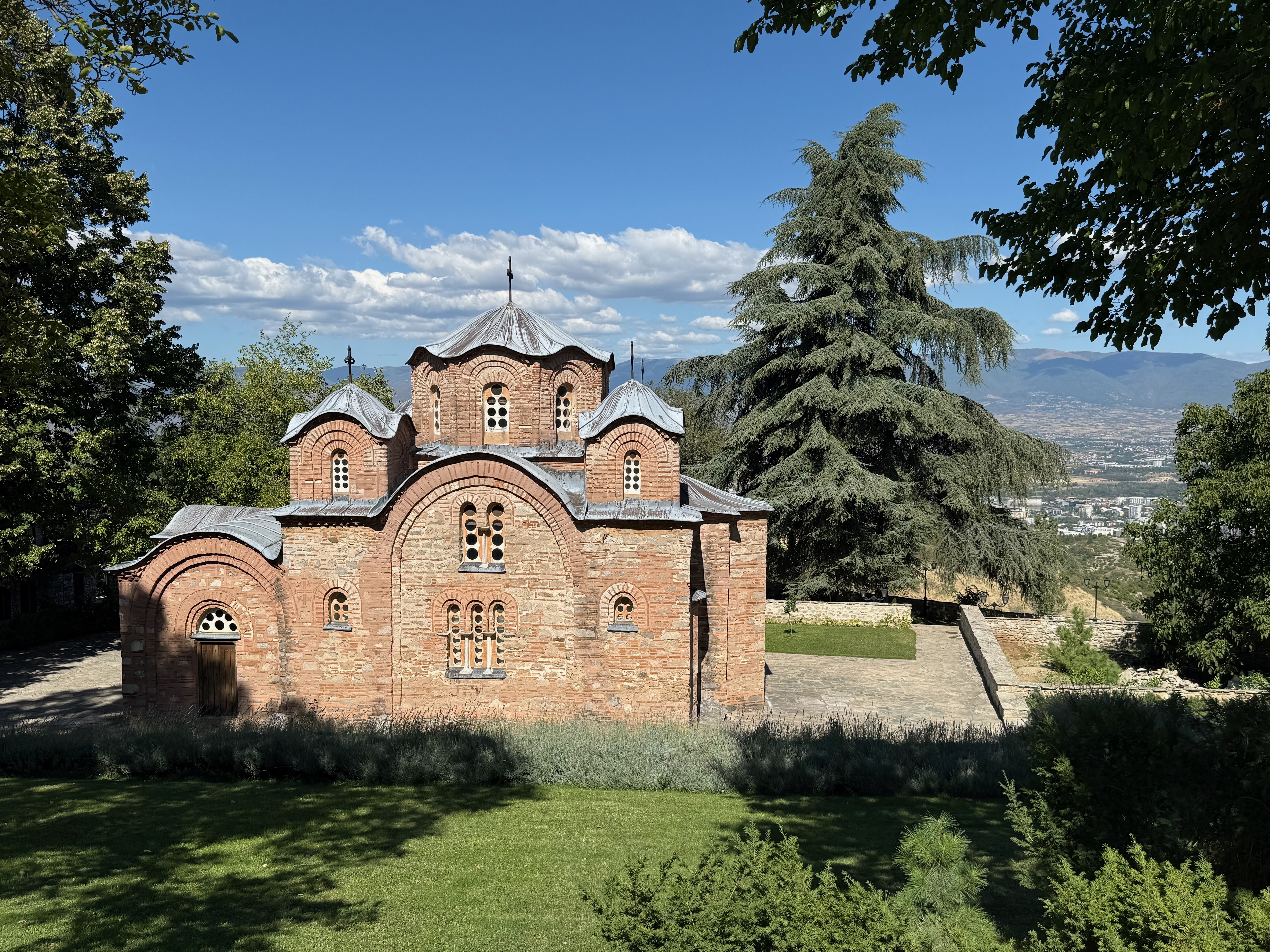
From the city’s river valley position, mountains are visible from most sides (which makes orientation straightforward). Kossovo and its capital Pristina are behind the Skopska Crna to the north. Closer and to the west the, Šar Mountains separate Macedonia from Albania. In the south, within the official city limits, is Mount Vodno, whose summit, named Krstovar peak, has been dominated since 2002 by the enormous Millennium Cross, a landmark that’s unmissable from just about anywhere in the city. Below the summit is a most extraordinary place to visit: the Byzantine Church of Saint Panteleimon, founded in 1164.

Skopje: St Panteleimon Church

The church building, which has been lovingly restored, is of great elegance and beauty, with graceful symmetric proportions, domed towers and a combination of brick, stone and rendering, glowing pink in the autumn sunshine when we visited. Inside is an even more exciting sight: the many original frescoes which have been cleaned up to shine brightly even in the subdued light. The Pietà is an eye-opener with its clear depiction of Christ and the Virgin Mary as flesh-and-blood human beings, making a nonsense of the western Art History idea that Giotto was the first artist to do so – it would be 150 years before the world would see the Italian master’s frescoes in the Scrovegni Chapel in Padua.

Skopje: St Panteleimon Church - Fresco of Pietà

We were shown around by the man in charge of the church and of the monastery of which it forms part, who calls himself simply Father Panteleimon. He is a phenomenon in himself: a deeply devout man, but one who has clearly had a life before taking holy orders. He spared no effort in probing us to find points of connection with his world and his experience: in our case, this turned out to be an improbable combination of beekeeping, mountain herbs, the music of Arvo Pärt and a church in Kent with windows by Marc Chagall (we were less enthusiastic about his love of Depeche Mode, whose lead singer Dave Gahan, it turns out, is also an Orthodox Christian).

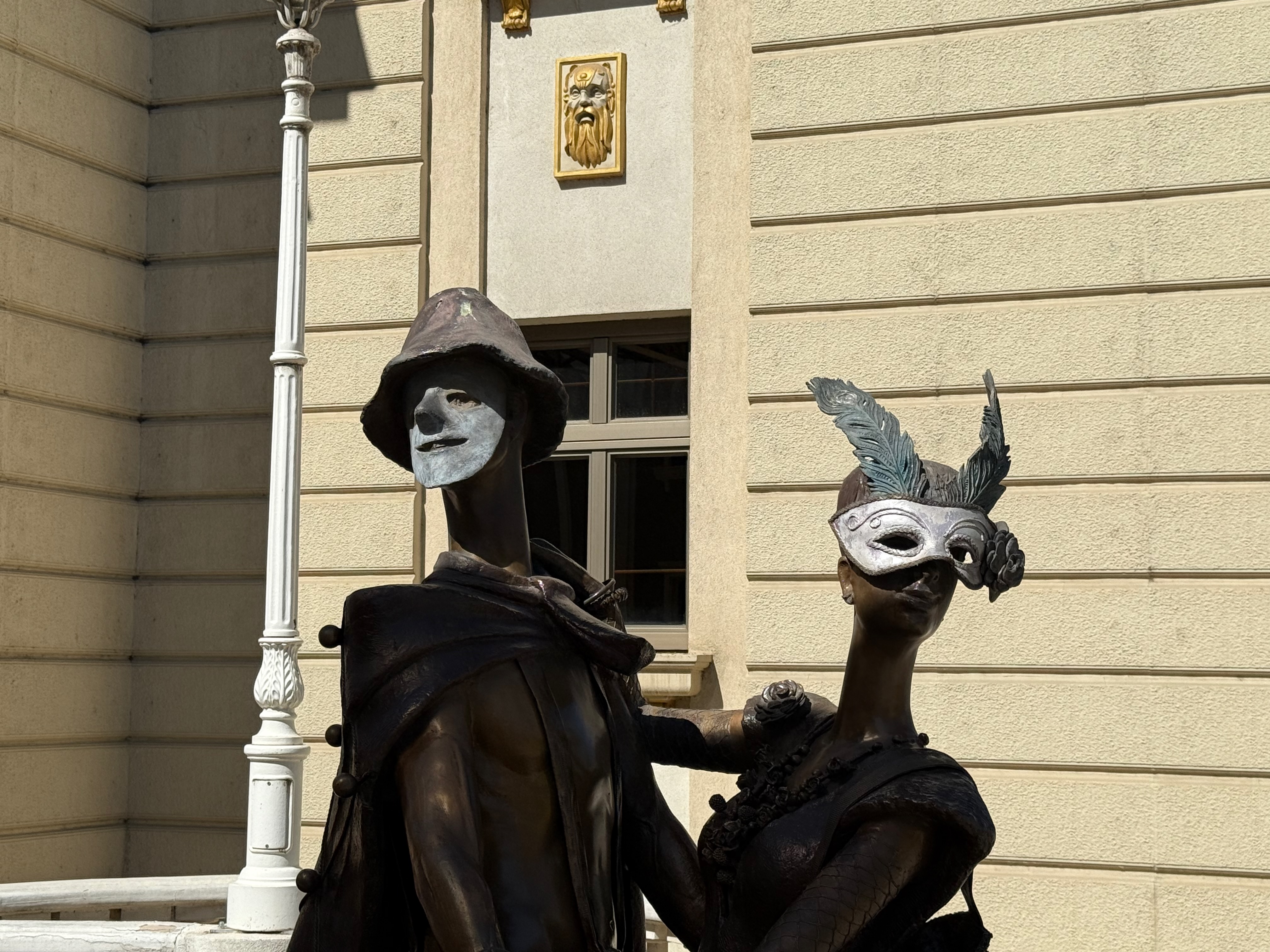
While Skopje is a very old city, it is also – in a sense – a brand new one: that’s because a massive earthquake in 1963 flattened the place almost completely. The ensuing international appeal enabled the city to be completely rebuilt, which was done in a consistently modernist style. This was not necessarily to everyone’s taste, and in 2014, a massive project was launched to rebuild or re-facade buildings into a neo-classical style, with much white plasterwork and many classical-looking columns. It’s been divisive, to say the least: cheap frippery to the modernists, welcome relief to the traditionalists. Since I didn’t see what it looked like before 2014 and since I’m not as commited to modernism as the architect friend who showed us around the city, I won’t pass judgement except to say that I found it perfectly pleasant to walk round, with the National Theatre particularly appealing – although I have to confess that the rows of statues which lined the “Bridge of Civilizations in Macedonia” and the “Art Bridge” next to it were grim.

Skopje: Figures outside National Theatre

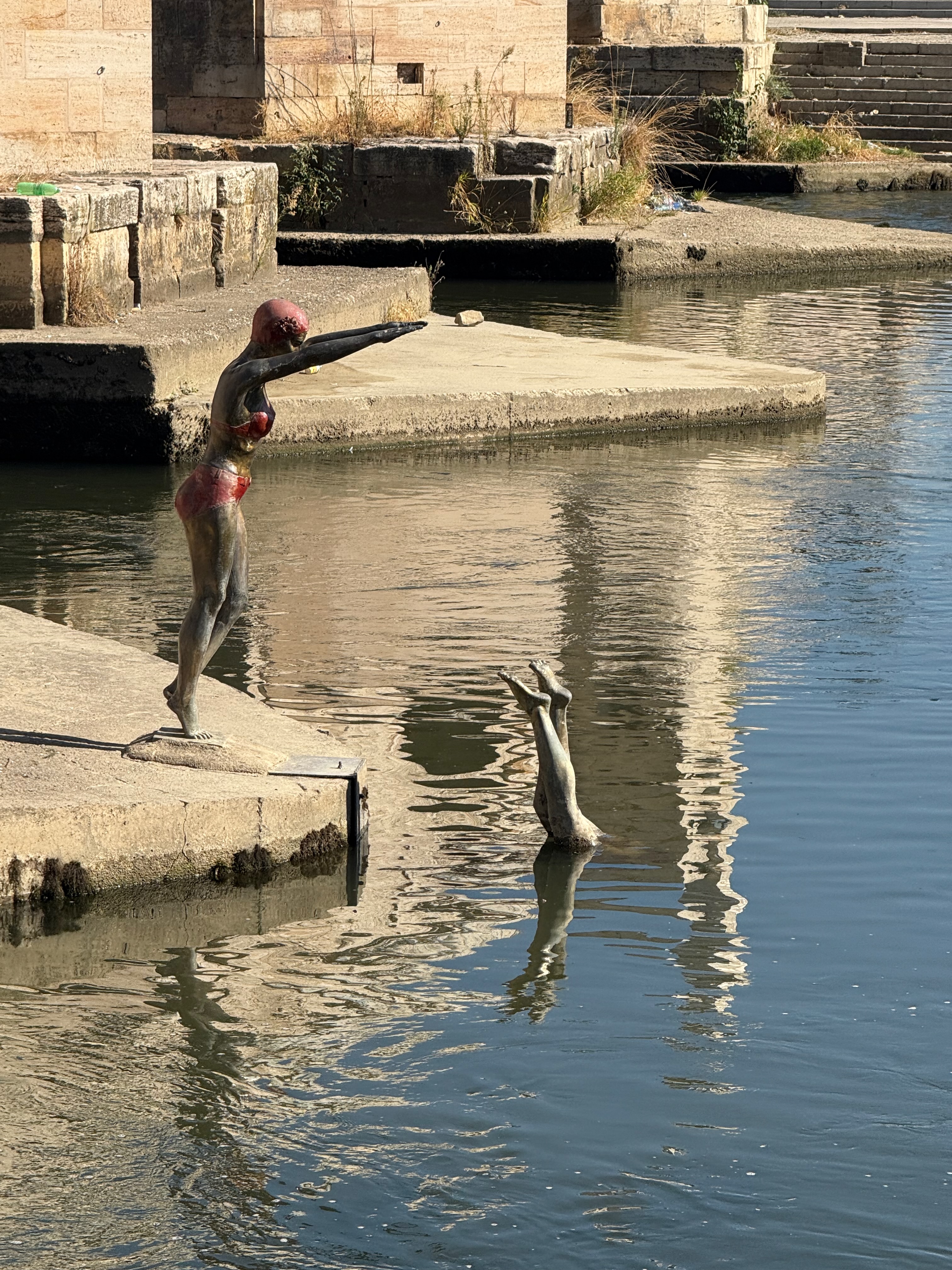
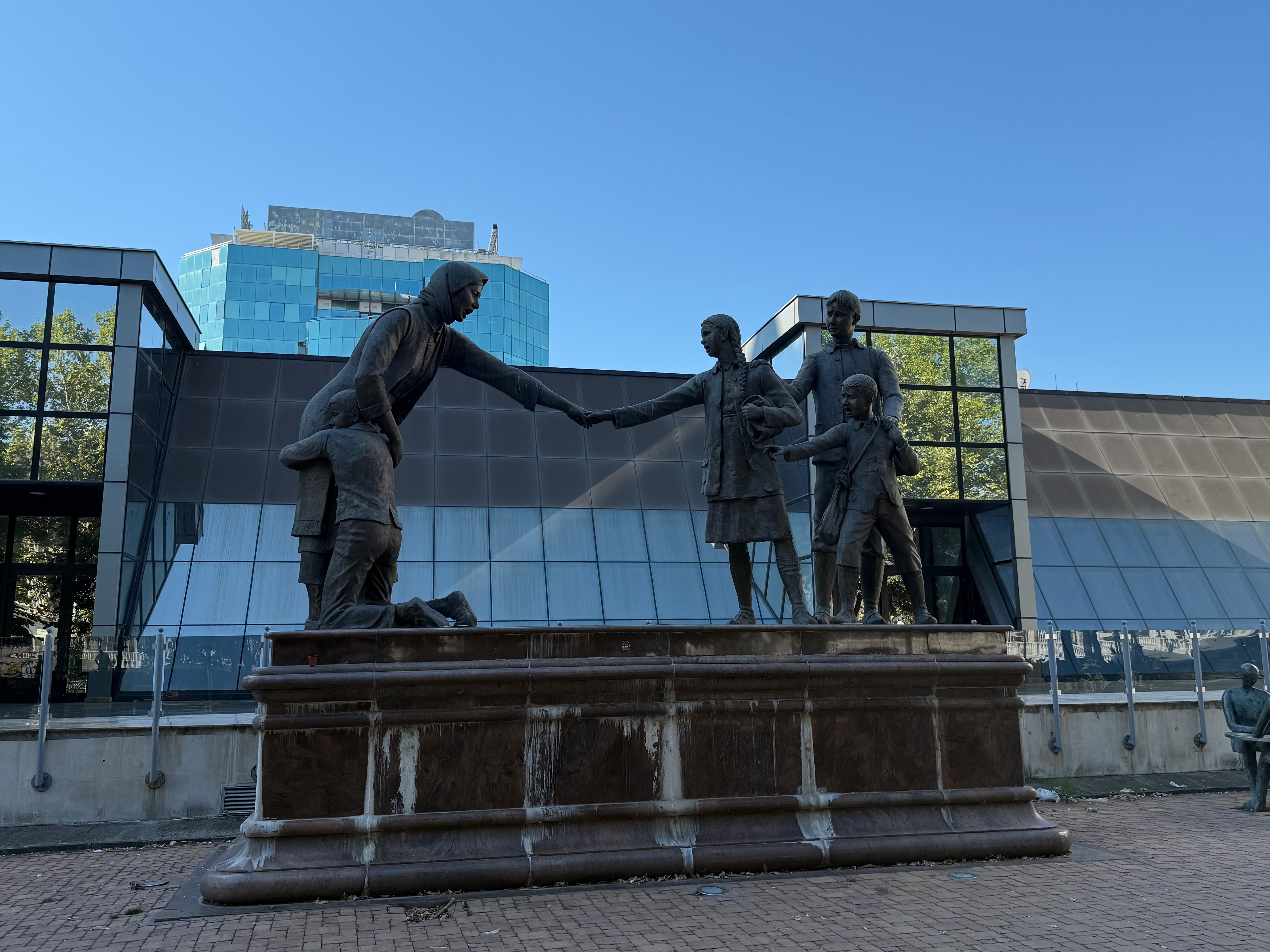
There’s a lot of street sculpture in Skopje, much of which I really enjoyed. I loved some of the statues outside the National Theatre, as well as a pair of women diving into the Vardar just by the Stone Bridge and a group of figures on its south bank near the Holiday Inn. The two pairs of lions which guard the Goce Delčev Bridge – one pair classically figurative, the other more abstracted – are controversial, not because of their quality, which is rather good, but because the lion is the symbol of the ruling party at the time they were erected, so this was a blatant piece of grandstanding.

Divers by the pillars of the Stone Bridge

And you can’t miss the two truly blatant examples of grandstanding that are the giant statues of Alexander the Great, on horseback in Macedonia Square, and his father Philip, on foot across the river. The pair were clearly intended as a two-fingered salute to the Greeks in the long-running dispute over Macedonia’s name: the problem is that both nations are desperate to claim Alexander the Great as being their own. The Macedonian claim is territorially correct, given that Alexander’s birthplace is inside the country’s borders; the Greek one is culturally valid in that he was clearly a product of the Hellene civilisation and clearly predated the Slavic and Ottoman civilisations that form the Macedonian people today. The dispute was eventually settled in 2018 by the solution (which I personally find rather childish) of changing the country’s name from “Former Yugoslav Republic of Macedonia” to “Republic of North Macedonia”). The statues, I’m sorry to say, are completely tasteless, although the nearby Fountain of the Mothers of Macedonia, which incarnates Philip’s mother Olympia as four stages of motherhood, is an altogether better effort.

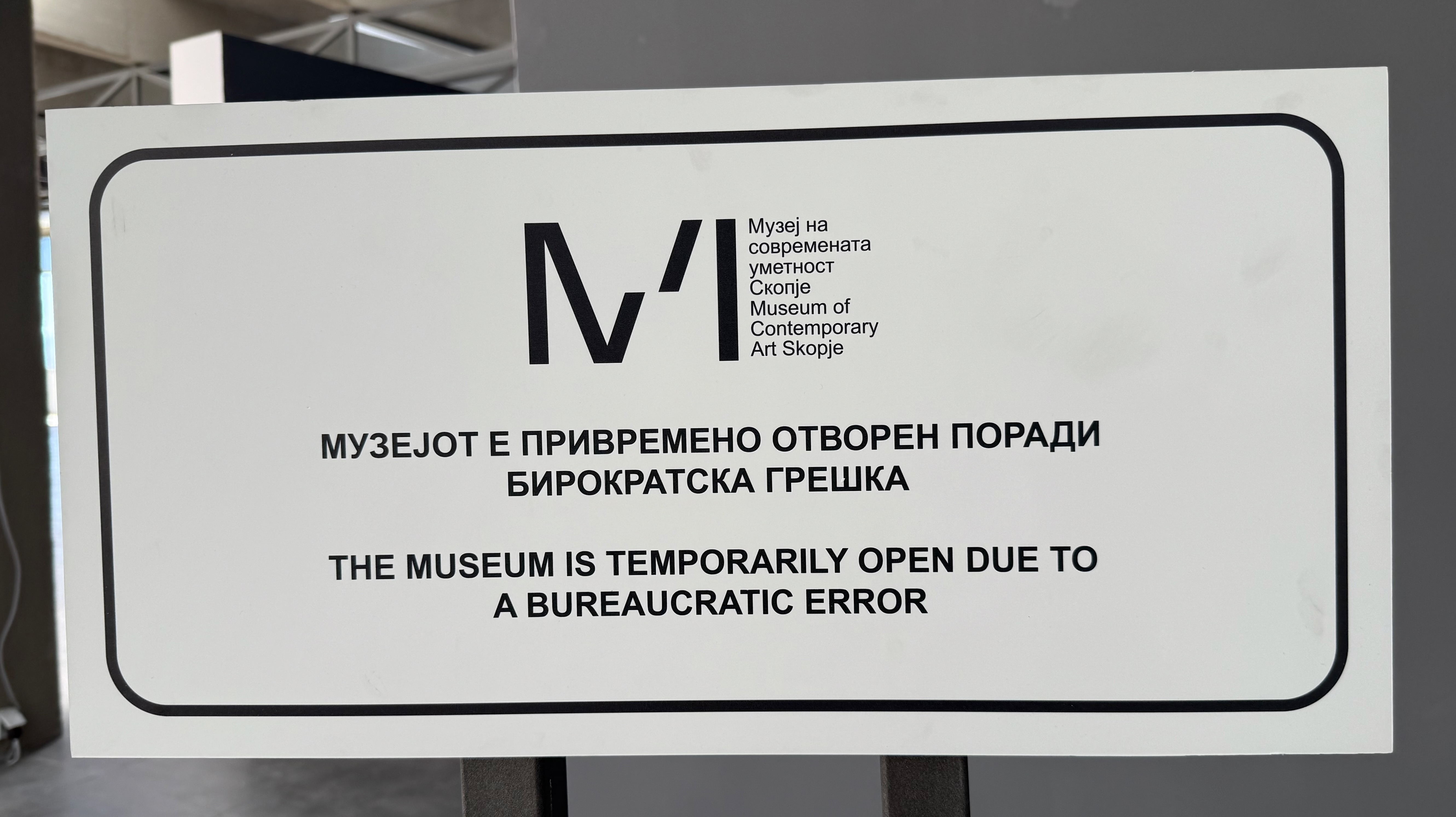
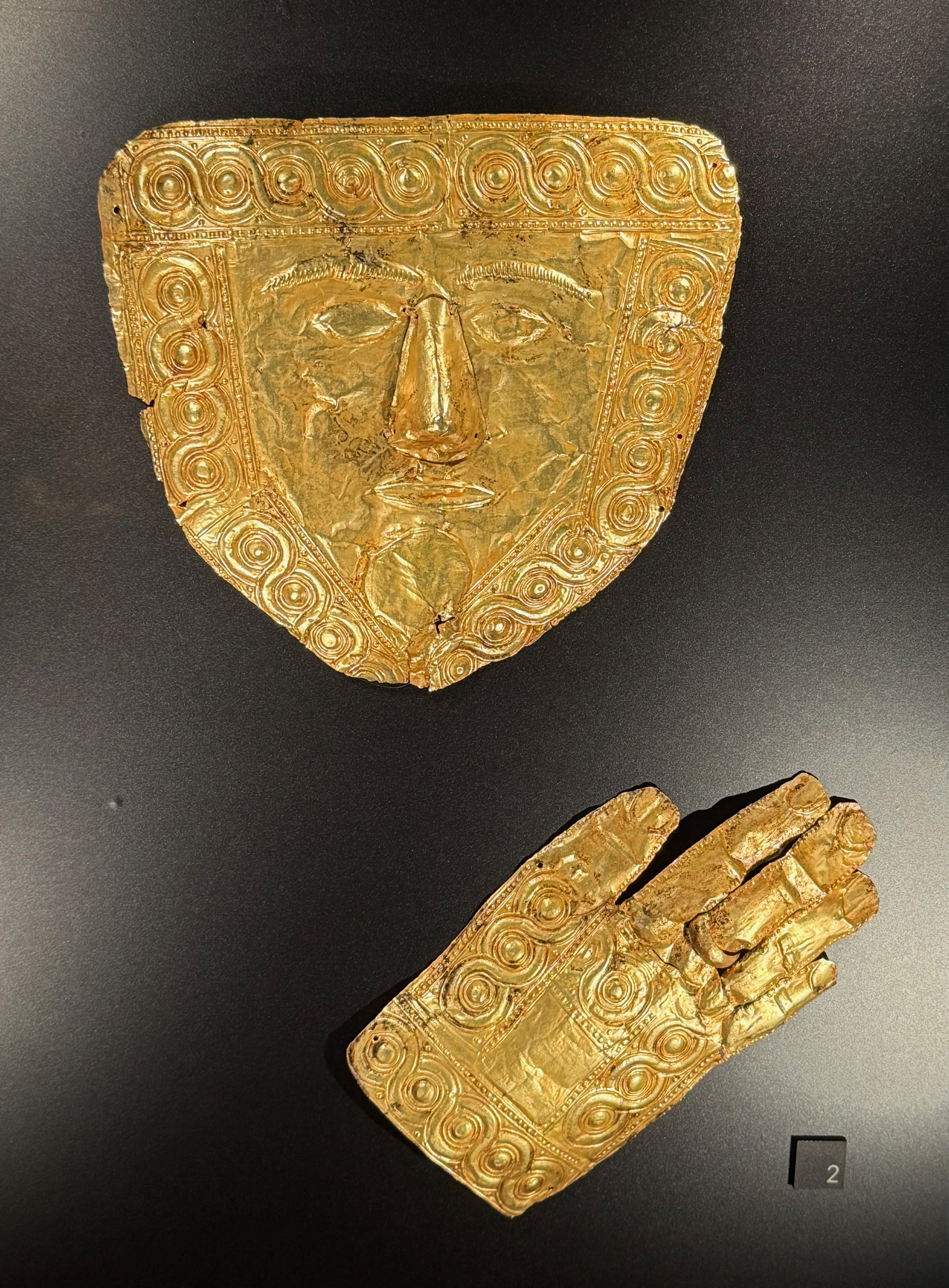
We just had time for two of the city’s many museums. The airy Museum of Contemporary Art, on the same bluff as Skopje Fortress, holds regularly changing temporary exhibitions and boasts panoramic views of the city from the terrace outside. Slightly spookily, they were preparing to host a conference of 250 FBI operatives when we arrived: I’m not sure what the Feds would have made of “Museum open until further notice”, a collection of hilariously sarcastic anti-establishment memes by artist Cem A (with delicious irony, as I write this, the museum is actually closed to host a different conference). The second was the Archaeological Museum of Republic of North Macedonia, packed with artifacts through the ages, such as the superb funerary gold mask and glove pictured here, from the Trebenishte necropolis near Ohrid in the south of the country, probably from the 6th-5th century BCE. Lake Ohrid, we are told, is seriously worth visiting, but we didn’t have time for the two-and-a-half-hour drive each way.

In addition to all this public stuff, Skopje’s broad riverbank walks, extensive City Park (surprisingly green in September after a long, dry summer) and its lively old bazaar make it a pleasant place to visit. However, the city and the country have a dark secret: corruption. Transparency International’s Corruption Perceptions Index for 2024 ranks Macedonia as 88th out of the 180 countries it studies, and locals point to cronyism and siphoning of funds from government projects. The results are visible on the streets of the city: perfectly decent buildings are undermined by poor maintenance, while green spaces are marred by insufficiently frequent rubbish collection. What we didn’t experience (being there in September) was the winter pollution: apparently, too many people burn coal or wood, and the ensuing smog lingers because the spaces for wind to blow it away, as envisaged by the post-earthquake town planners, were filled in by buildings. Effects of corruption are also visible in net migration statistics, with far too many young Macedonians leaving the country to seek better opportunities elsewhere.

Skopje City Park

Which is sad, really. Skopje is an attractive city in a fertile country. The climate is broadly lovely. The food is great, within a fairly typical Balkan range of dishes, in which the stars are Macedonian tomatoes, which rival the best in Italy for utter deliciousness. Some of the local wines were really quite impressive. The vast majority of people we met were utterly charming. The ethnic tensions between Macedonians, Albanians, Turks and others, seem broadly contained, at least by comparison with the norm in this part of the world. Let’s hope that the gap between Macedonia’s potential and its current reality will be narrowed in years to come.

Travel notes from Indonesia above water

Travel notes from Indonesia above water

Our recent trip to Indonesia was mainly about diving (see the previous post). But as on all diving trips, there was also a day or two of seeing around, in fairly out of the way parts of the country. Our first day out was in the small port of Labuha (population 10,000, according to our guide), on Pulau Bacan in the Maluku Islands, aka the Moluccas, the famed Spice Islands which were of such great interest to European colonists. (“Pulau”, by the way, means “Island”, and the “c” in “Bacan” is pronounced “ch”). Our second was in the considerably larger city of Manado (population 458,582, according to Wikipedia, or 1.4m for its metropolitan area) at the Northern end of Sulawesi – the large island immediately recognisable on a map because of its spidery arms.

Here, in no particular order, are some impressions that we gathered about the country.

Firstly, there’s been a lot of development, most probably in relatively recent years. My memories of past visits to Malaysia or Indonesia are of a lot of simple wooden buildings in a fairly standard style that you would see anywhere in Asia, and not all that well maintained – the climate doesn’t really lend itself to the spick and span look to which Europeans aspire, and in any case, doesn’t need it in terms of perfect insulation. In both locations on this trip, there were plenty enough of these, but there were also large numbers of modern structures in concrete and steel. The bigger and fancier ones were either government buildings or places of worship (mosques in Labuha, churches in Manado), showing clear evidence of investment from sources outside the region. But even ordinary homes included some buildings that looked very solid and well made.

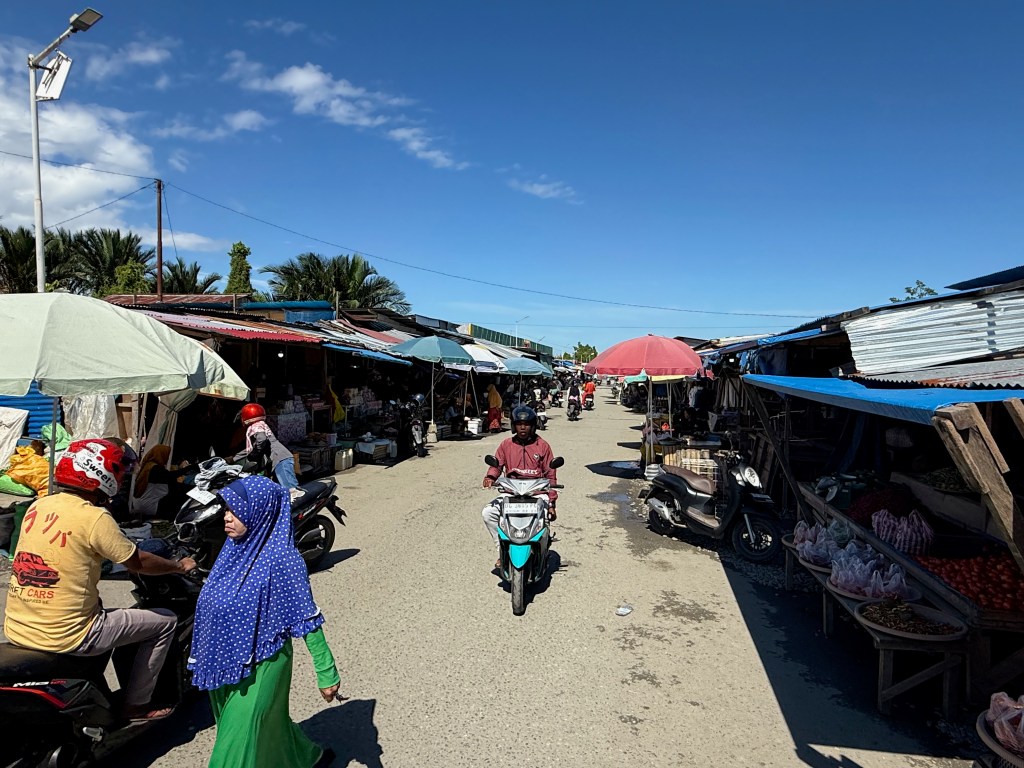
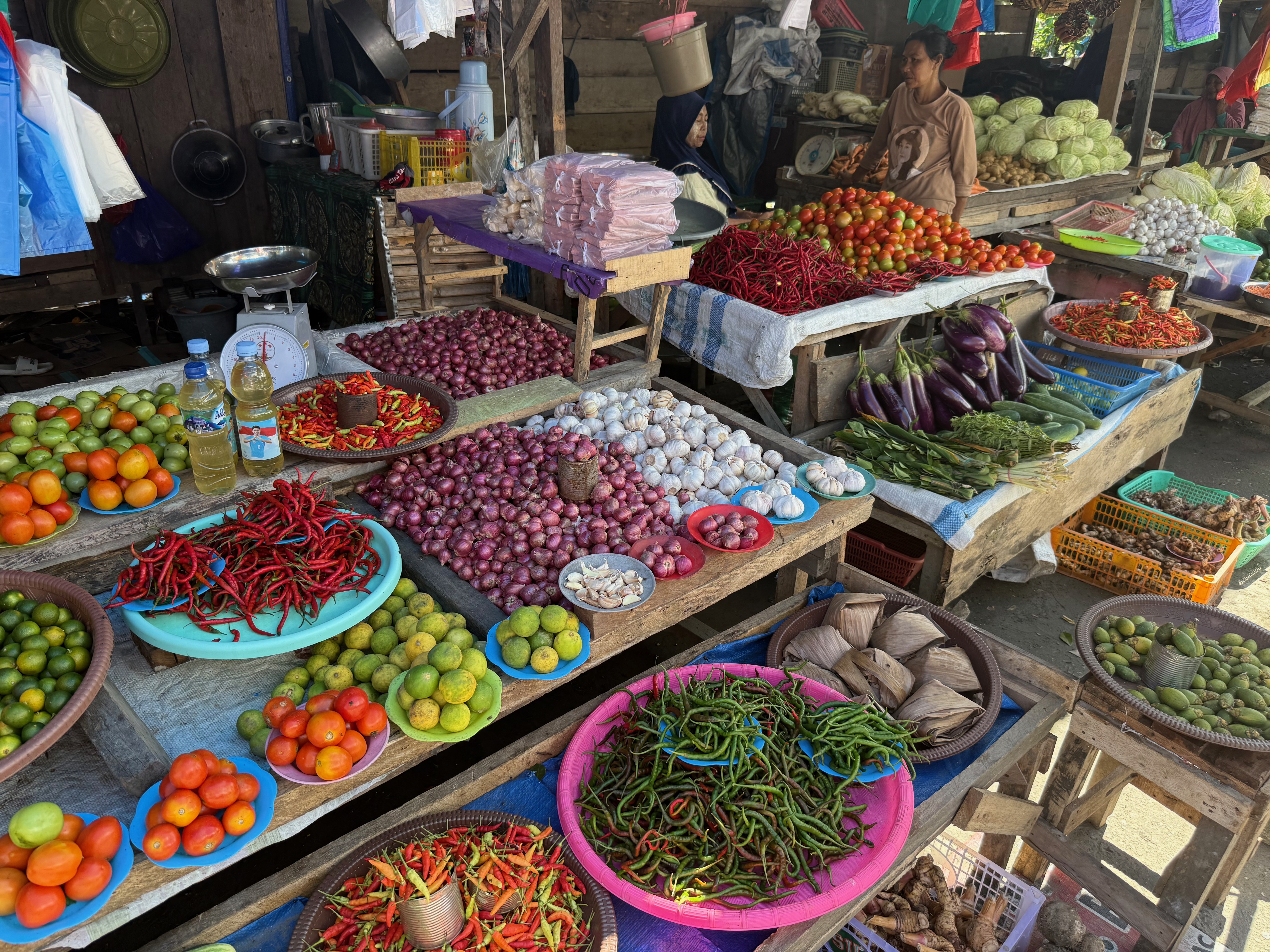
Labuha market

The growth very much follows a ribbon development model. On both routes from our boat mooring point to the city, there was hardly any open countryside bordering immediately onto the road – for almost the whole length of the road, there was a strip of buildings one deep (be they houses, shops or something larger). These were not major roads; the road quality seemed to be very good along most of the length, but with multiple places where the weather had wrecked a chunk of road. Particularly near Manado, there were a fair number of crews mending the worst damage – but for the most part, these were very small crews with very little equiment – a couple of men with shovels and a sack of cement.

Labuha market

Fundamentally, Indonesia has the potential to be a wealthy country. It was a major oil producer in the past and remains a major gas producer, with an annual production of around 60 billion cubic metres – which makes it the largest in the region after China and Australia. And it’s incredibly fertile: pretty much anything can grow here. I can’t really speak for the large populous cities in Java and Sumatra, but in Manado, our guide related how a US visitor had told him that whatever apocalypse happened in the world, “you’ll be fine here. You’ll always be able to feed yourselves”.

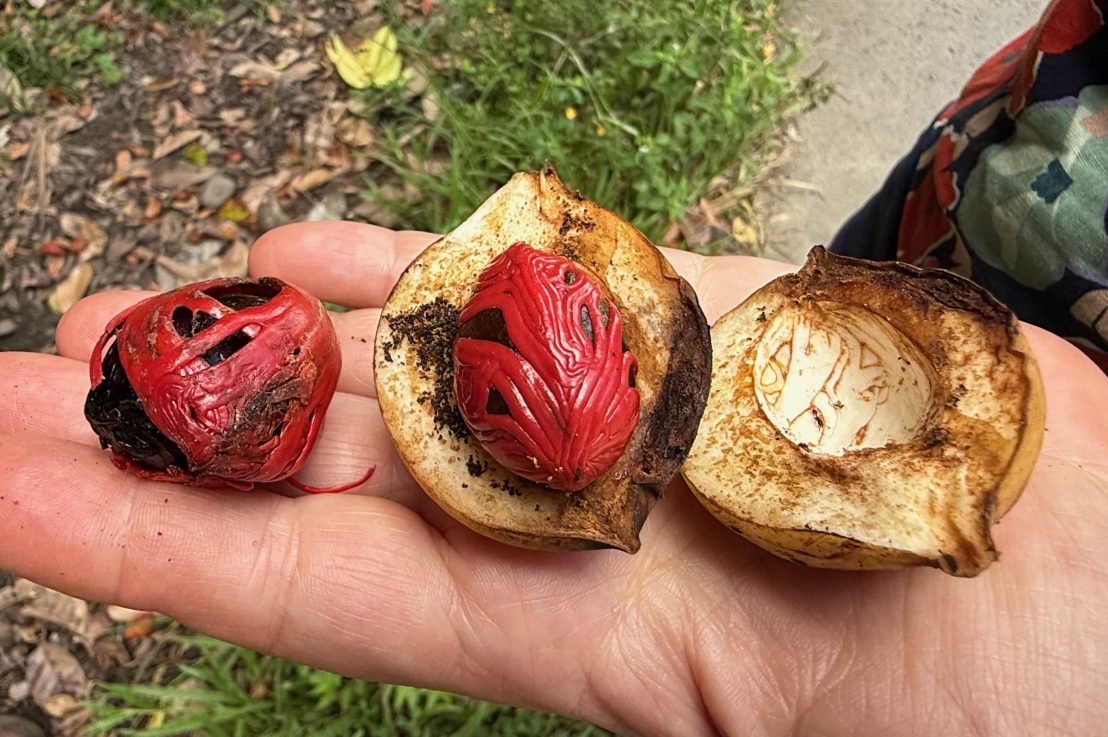
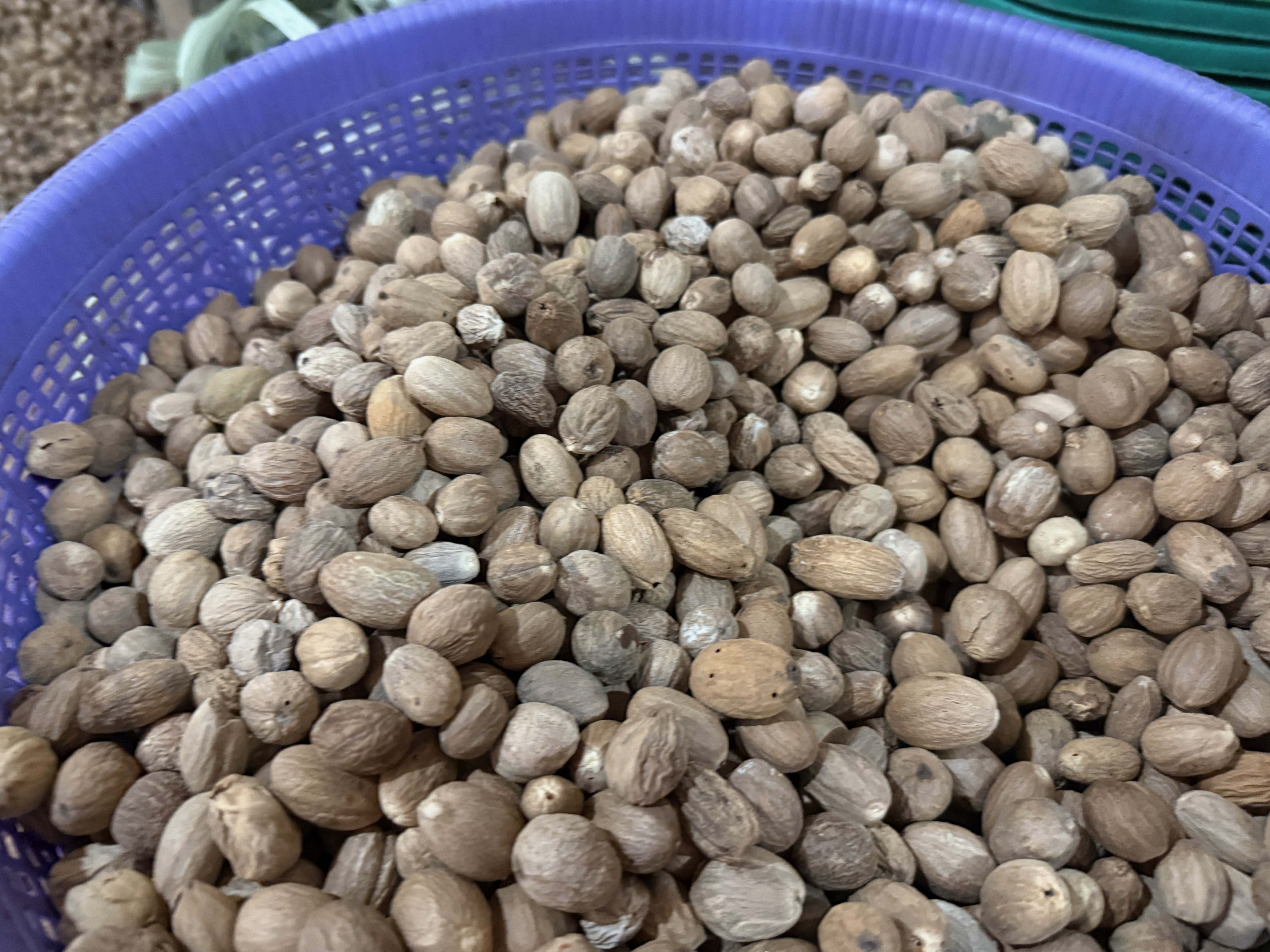
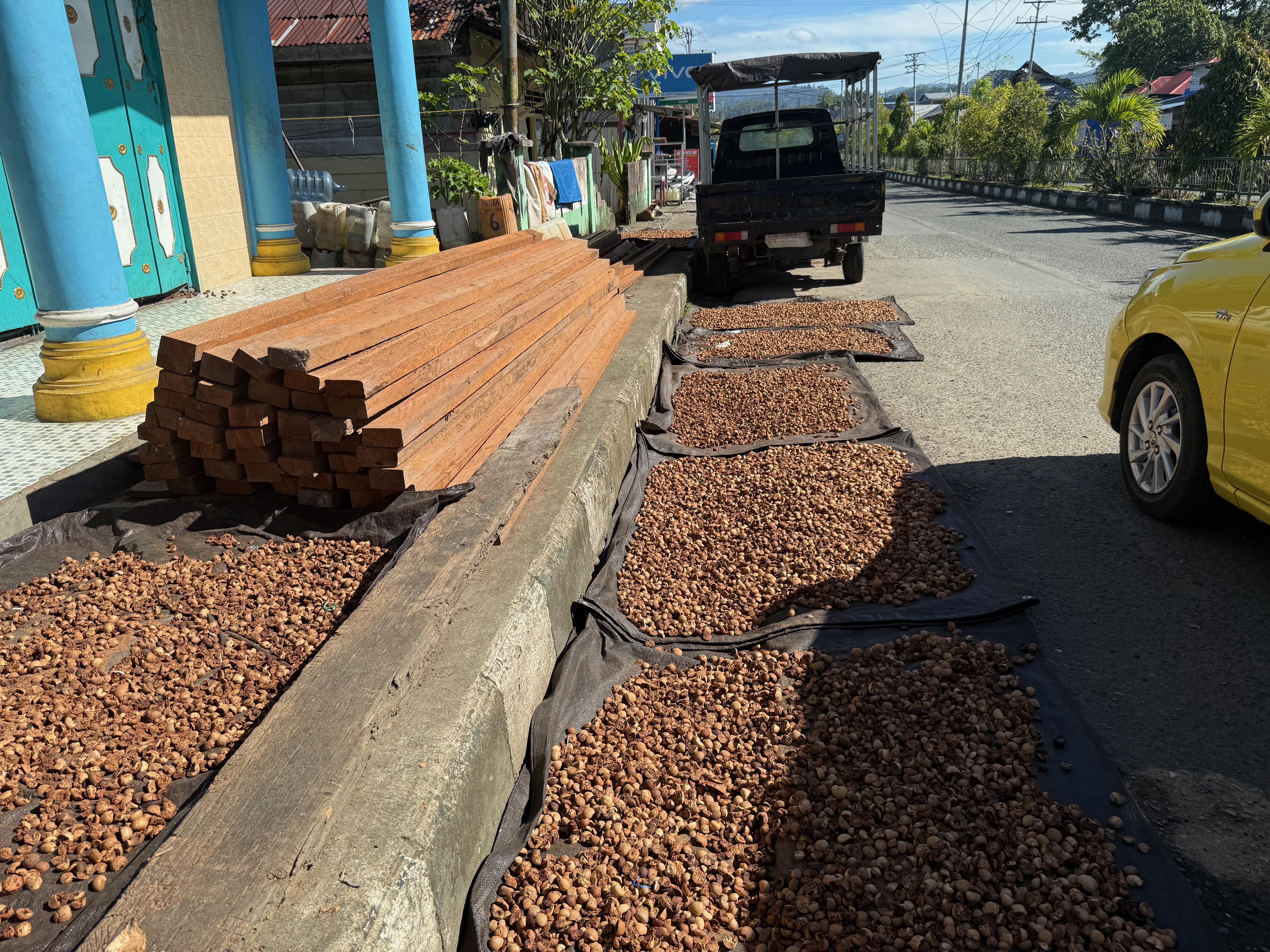
And, indeed, the country was an incredibly foody place. We were expecting the glorious spice traders in Labuha – after all, the place has been the epicentre of nutmeg, mace and cloves for centuries. What we weren’t expecting was the incredible food market, with dozens of stalls selling all manner of fruit and vegetables, bean curds, spices, palm tree products, raw and smoked fish, chickens. The quality and vareity of vegetables was the real eye opener: ranging from characteristically Asian items like long beans and pak choi through to recent imports like avocados, through to things we’d never heard of like papaya flowers (tasty, and allegedly good for diabetics). The two lunches we had on these trips were in pretty ordinary hole-in-the-wall type places, and the food on both was outstanding, doing full justice to these lovely ingredients.

Nutmegs

The other food and beverage surprise was a reminder that this is a coffee-growing country:  one of the best cappuccinos I’ve had in a long time was served to us in the improbable venue of the Hapa Kitchen and Bakery, a small café airside in Manado Airport.

We had several reminders of how religiously and ethnically diverse the country is. While most of it is Muslim, there are big Hindu areas (most notably Bali) and big Christian areas (of which Manado is one). In the past, different religions seem to have co-existed in relative harmony, but there was a bad conflict, “the Ambon Riots”, in the Maluku Islands at the turn of the millennium. The obvious visible effect of this was at the end of class time at a very large boarding school, with hundreds of girls spilling out of the school wearing hijabs. According to our guide, the wearing of hijabs started in the wake of the Ambon Riots. The other sign of diversity was seeing instructions in more than one language: while the vast majority of Indonesians speak the lingua franca Bahasa Indonesia, it’s the primary language of only 20% of the population, with over 800 languages recorded in 2010. (Having said which, both Manado and Labuha have a higher-than-average proportion of Bahasa-speakers).

The flora and fauna are also diverse. Like most British, I suspect, I was unaware of the name of the Victorian naturalist Alfred Russel Wallace, a contemporary of Darwin who gave his name to the “Wallace Line” which splits Indonesia down the middle, with mainly Asian species on one side and Australisian species on the other. That made it surprising to discover that Wallace is very much remembered in the Maluku Islands, where he did a substantial amount of field work. Our guide on Bacan island wore a T shirt emblazoned with the gorgeous butterfly Ornithoptera croesus, otherwise known as Wallace’s Golden Birdwing. There are also many species whose latin names have the suffix “wallacei”.

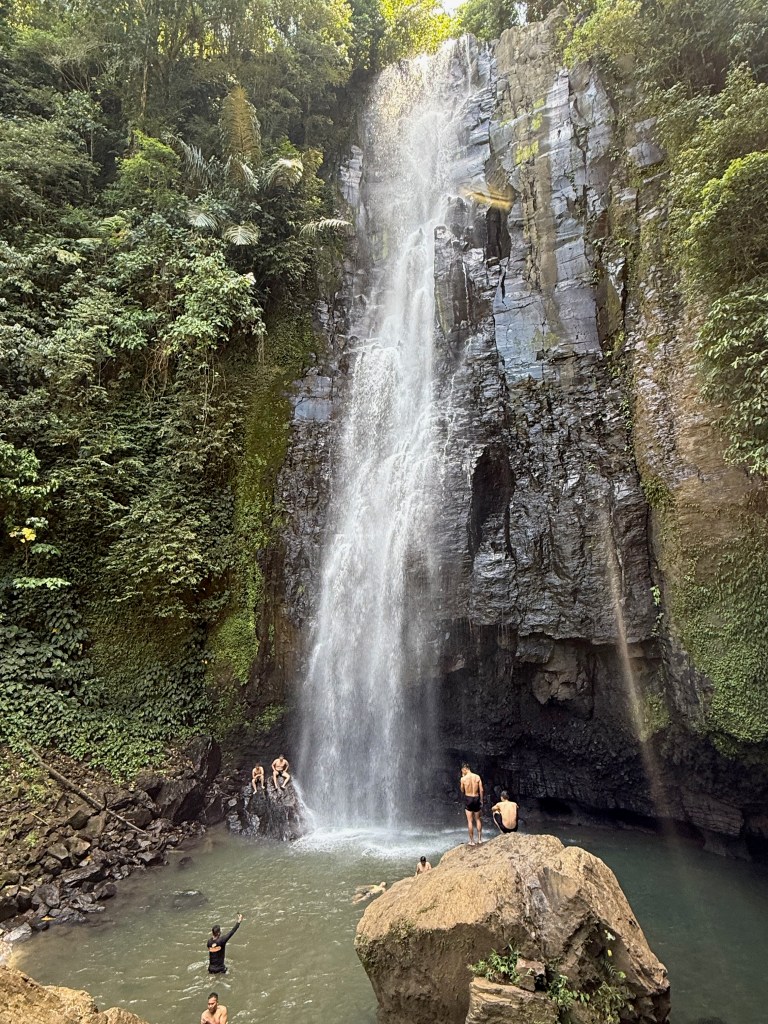
Tunan Telawaan waterfall near Manado

Having said all this good stuff, you can’t deny that Indonesia is still a developing country, and there are things that you’d hope they will improve – for example, our seat belts only worked on one car journey out of six. Generally, attitudes to safety seem on the lax side – we certainly saw that on our boats, with luggage piled up in front of the compartment with the life jackets, or with the boat handler cheerfully smoking a cigarette three feet away from a fuel tank whose cap had been replaced by a bit of rag. And I’ve already mentioned the most important of my worries in the diving post – plastic pollution. There are separated recycling bins in Manado airport, which I suppose is a start, but we did see an awful lot of food packaging littered on the streets.

Still, those are relatively modest cavils. The truth is, all we got was a little sampler of this fascinating country. I hope I’ll be back for more some day – and to other islands.

Indonesia underwater: Coral Eye and South Halmahera

Indonesia underwater: Coral Eye and South Halmahera

It’s been nearly three years since our last diving trip, to Wakatobi in Indonesia, at the southern end of the Coral Triangle. For this latest trip, we’ve decided to move further north in the triangle, starting at Coral Eye, a so-called “Marine Outpost” on Bangka Island, a short distance away from northern Sulawesi and its main city of Manado.

I’ll leave non-diving-related comments about Indonesia for another post, and I won’t repeat the “why we love coral reef diving” explanation of the post I did at the time. Suffice to say that most of the things I said about Wakatobi apply to Coral Eye, to a greater or lesser extent. On the other hand, I think it’s worth exploring the similarities and the differences between the two resorts, both in the diving and in the general ethos.

The primary intent for both Wakatobi and Coral Eye is the same: provide the guests with a luxurious experience and friction-free diving in waters rich in marine life, while at the same time making an effort to do good to the planet, or at least their particular corner of the planet. A veil is discreetly drawn over the carbon impact of actually getting there (both places are pretty remote from the overwhelming majority of their guests).

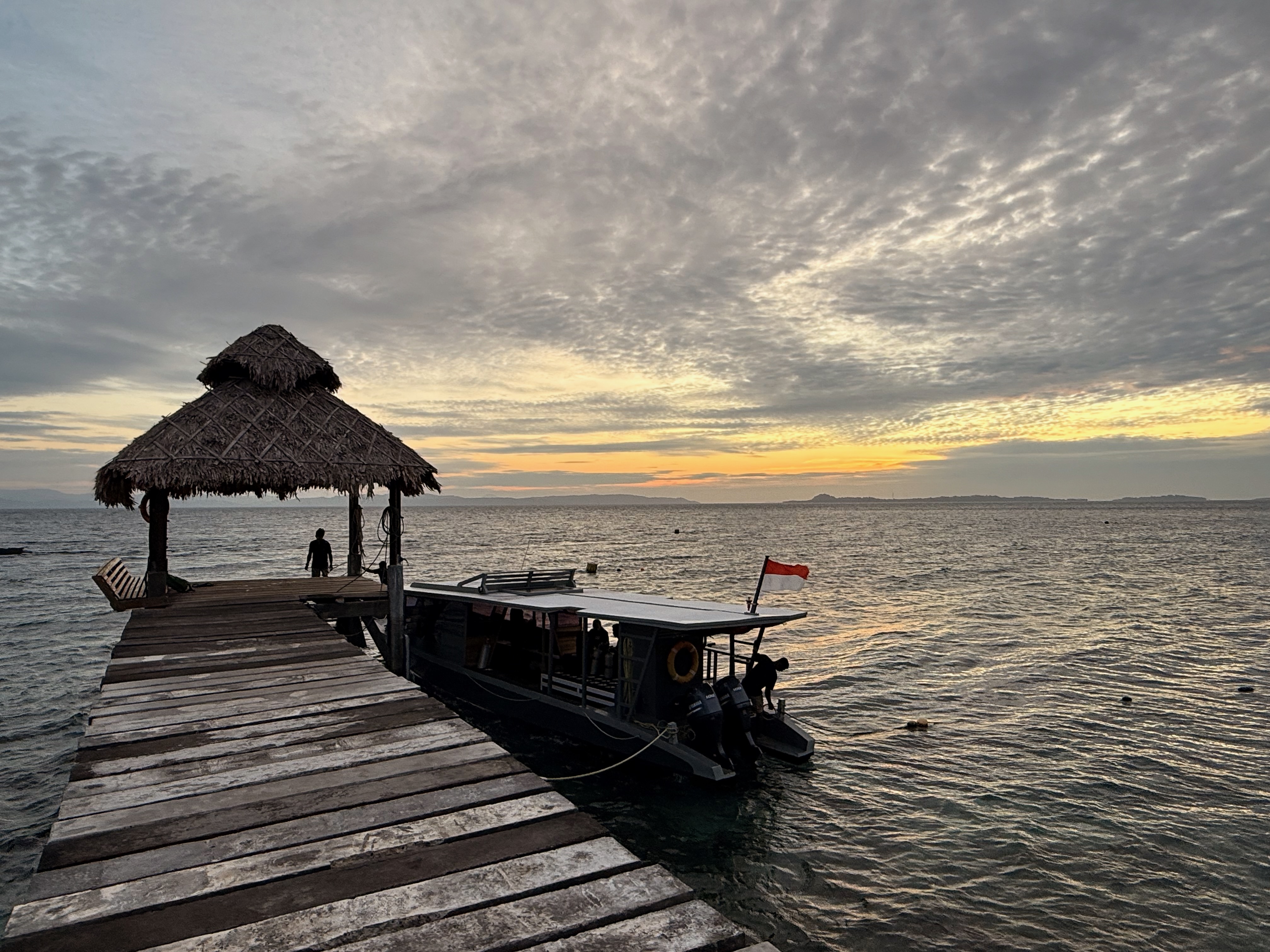
Jetty and dive boat at Coral Eye

For both, the “do good to the planet” agenda starts with the need to protect the reefs and the fish life. This requires a constant programme of engagement with the local communities to affect their behaviour, most notably in discouraging destructive forms of fishing: dynamite fishing has been common in the Philippines and Indonesia for years, and fishing by releasing poison is another activity that the planet would be better off without. The locals need to be persuaded (a) that both methods are disastrous to their long term well-being and (b) that the resorts can put in more money into the local economy – either by direct funding or indirectly via employment and purchases from local suppliers – than destructive fishing can possibly provide. Fortunately, the more intractable problem of dragnet fishing isn’t common in these kind of areas, coral reefs being really not the ideal venue for it. A more difficult struggle is the battle against plastic, which gets dumped into the sea at a depressingly high rate.

The differences between the two resorts are driven partly by the geography of the two sites and partly by their different histories. Wakatobi is bigger; it occupies the whole of a relatively small island but is close to communities on islands nearby. Their engagement is all about providing education and employment for the locals, with many “graduates” who have worked for the resort getting jobs in other parts of Indonesia.

Coral Eye, in contrast, started out not as a luxury resort but as a marine biology research station. Early in its history, it became clear that the owners could provide funding for the research (for example scholarships and grants) by letting rooms to the general public. It then emerged that the more luxurious the experience, the more money could be generated. Divers from faraway countries were thrilled to mix with researchers at the dinner table and learn more about the marine life they loved watching, and were prepared to pay good money for the experience.

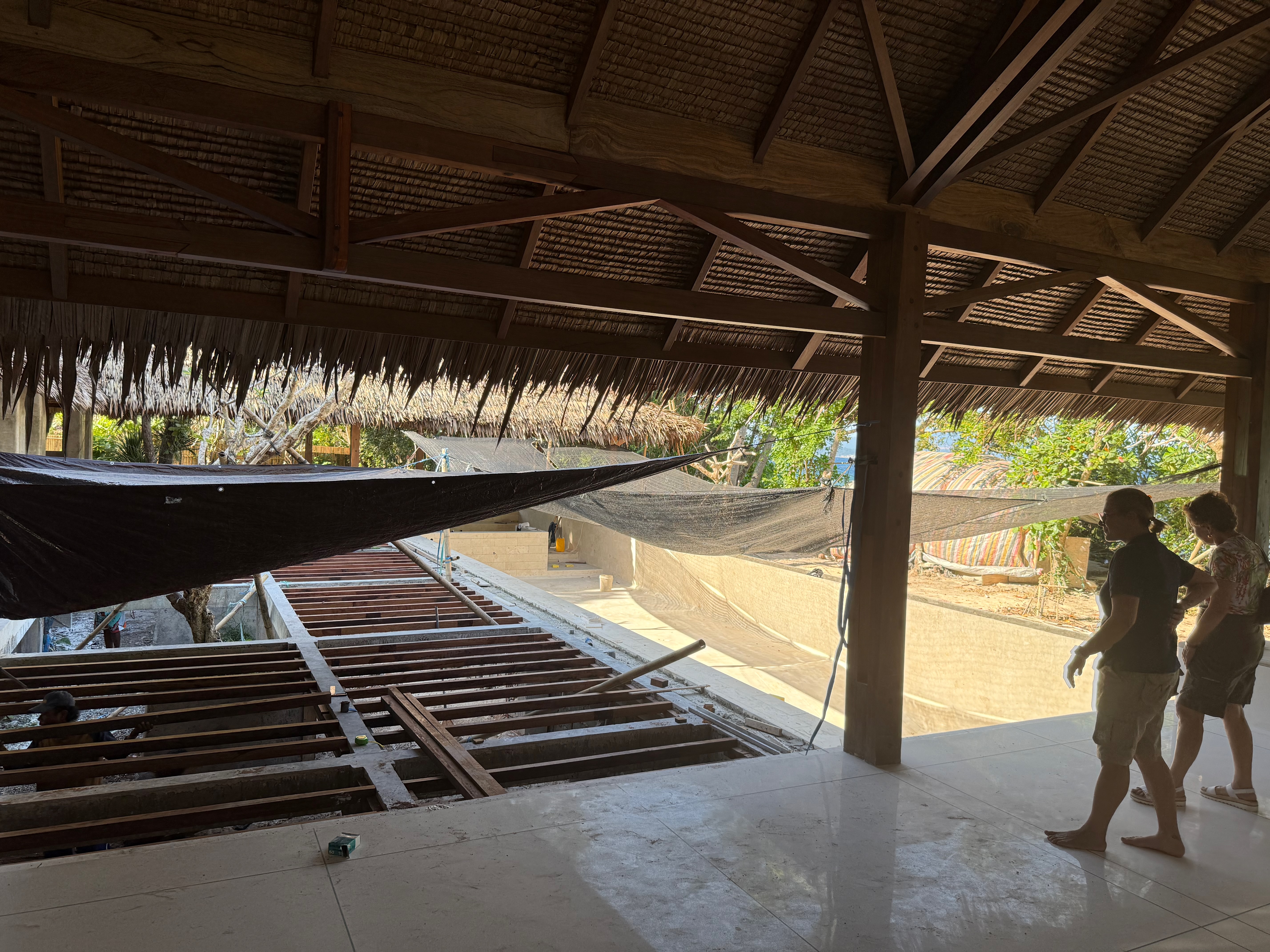
New building in progress at Coral Eye ©️ David Karlin
New building in progress at Coral Eye

Covid blew a hole in all that. Visits from the researchers became less frequent, so you currently have to be lucky for your trip to coincide with one – there were no biologists present in our trip, although we did see a bunch of the experiments they set up underwater at one of the dive sites. But plans to change all that are at an advanced stage. A new central guest area is almost complete (including a good sized swimming pool, both for general use and learning to free dive). When the new area opens, the existing guest area will be repurposed as a dedicated research centre, allowing Coral Eye to resume its research activities on a larger scale. If all goes well, when it’s complete, it will be possible for guests to gain a far deeper insight into marine life than a mere “look at all the pretty fish”.

In terms of the diving itself: we found the marine life to be very much comparable to what you see at Wakatobi in its profusion and diversity, with sightings of many fish and reef creatures we hadn’t come across before. Mostly, the coral isn’t as scenic – many of the dive sites are blocks or pinnacles of coral scattered over a sandy area (some of then quite large, to be fair) – but there were exceptions amongst the dozen sites we visited: Sahaung 1 was a glorious castle of coral with a blaze of gorgonians that I haven’t seen in many years, while Sahaung 2, next door, was more like the castle’s towers, with imposing pinnacles. For wall dives, you’re recommended to take the hour or so’s boat ride to Bunaken National Park, or to stay at Coral Eye’s sister resort Siladen, from which it’s more easily accessible.

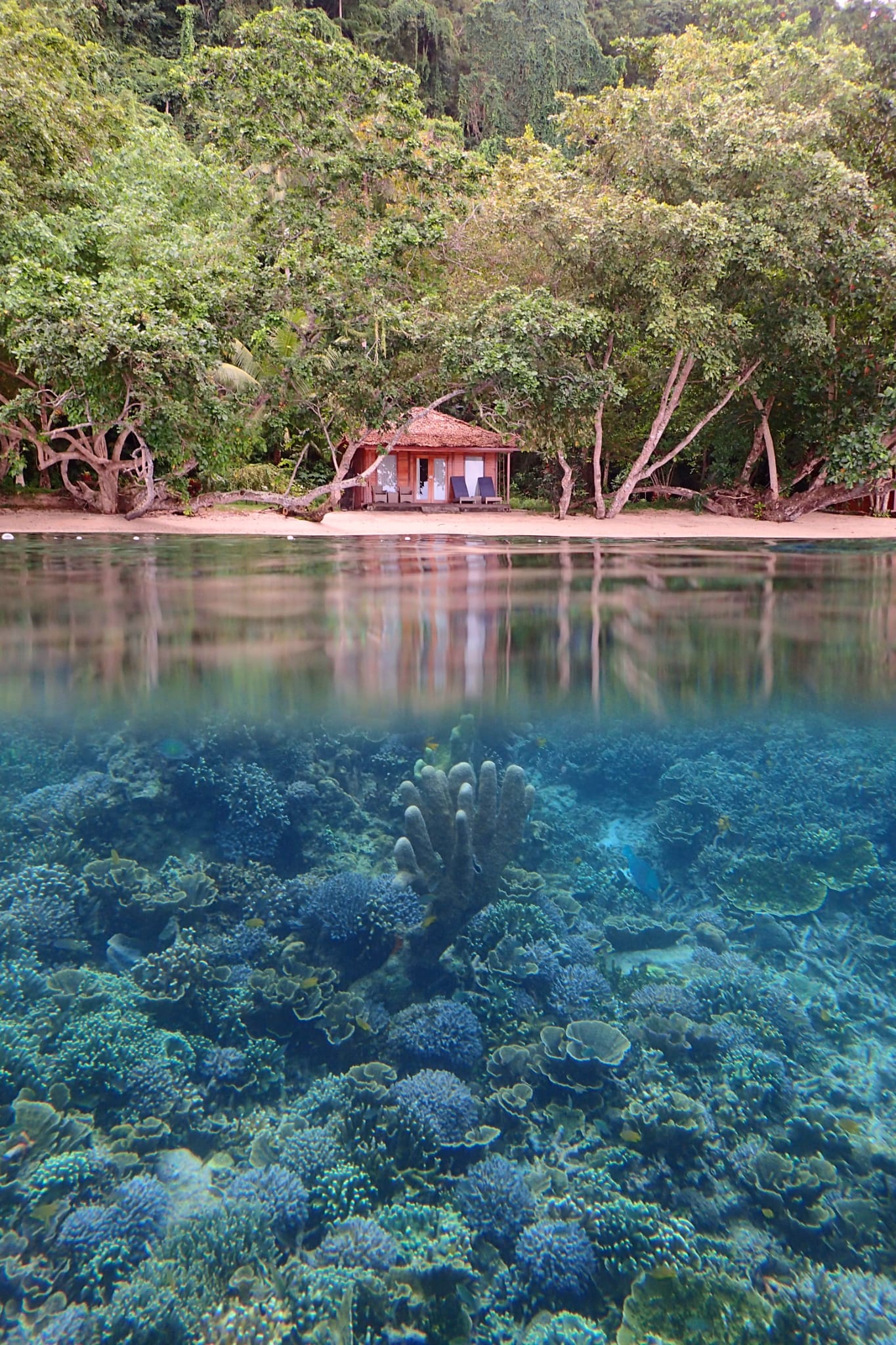
Underwater and on land at Sali Bay ©️ Frederico Navarro

For the second week of this year’s trip, we chose to continue eastward in the Coral Triangle to Sali Bay, on a small island off the coast of South Almahera, the southern chunk of Northern Maluku province, in the Moluccas (the famed Spice Islands). It’s well further off the beaten track than Coral Eye, and our travel agent promised that “Being the only resort in the region offers an unrivalled advantage of being able to explore new undiscovered dive sites.”

This turned out to be false. Although Sali Bay was the first resort in the area, it’s now been joined by at least three more within a fifteen minute boat ride (on a not particularly fast dive boat), and the area is served by various liveaboards. Still, it’s fair to say that in our time there, we only saw other divers on very few occasions. And undiscovered or not, there are two things to be said hugely in favour of the area.

Firstly, the fish life is more profuse than anywhere I’ve ever seen. In one dive, we spent more than twenty minutes accompanied by a shoal of blue triggerfish – they just kept on coming. And it’s not just the one species: both in the blue (with schooling snappers and jacks) and on the reef (with every patch of coral thriving with anthias and damselfish as well as a massive variety of other reef fish), this was an impressive place.

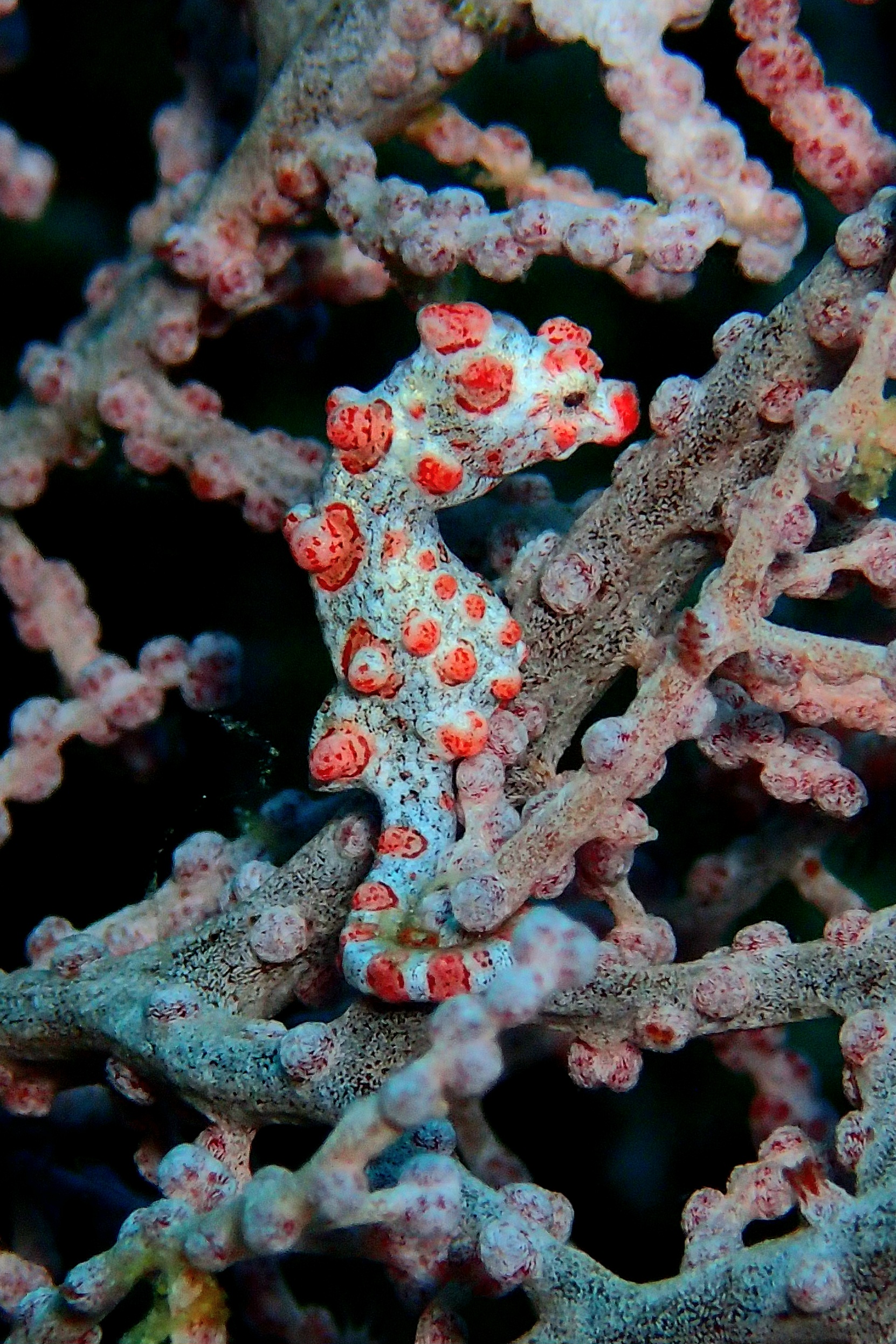
Pygmy seahorse ©️ Frederico Navarro
Pygmy Seahorse ©️ Frederico Navarro

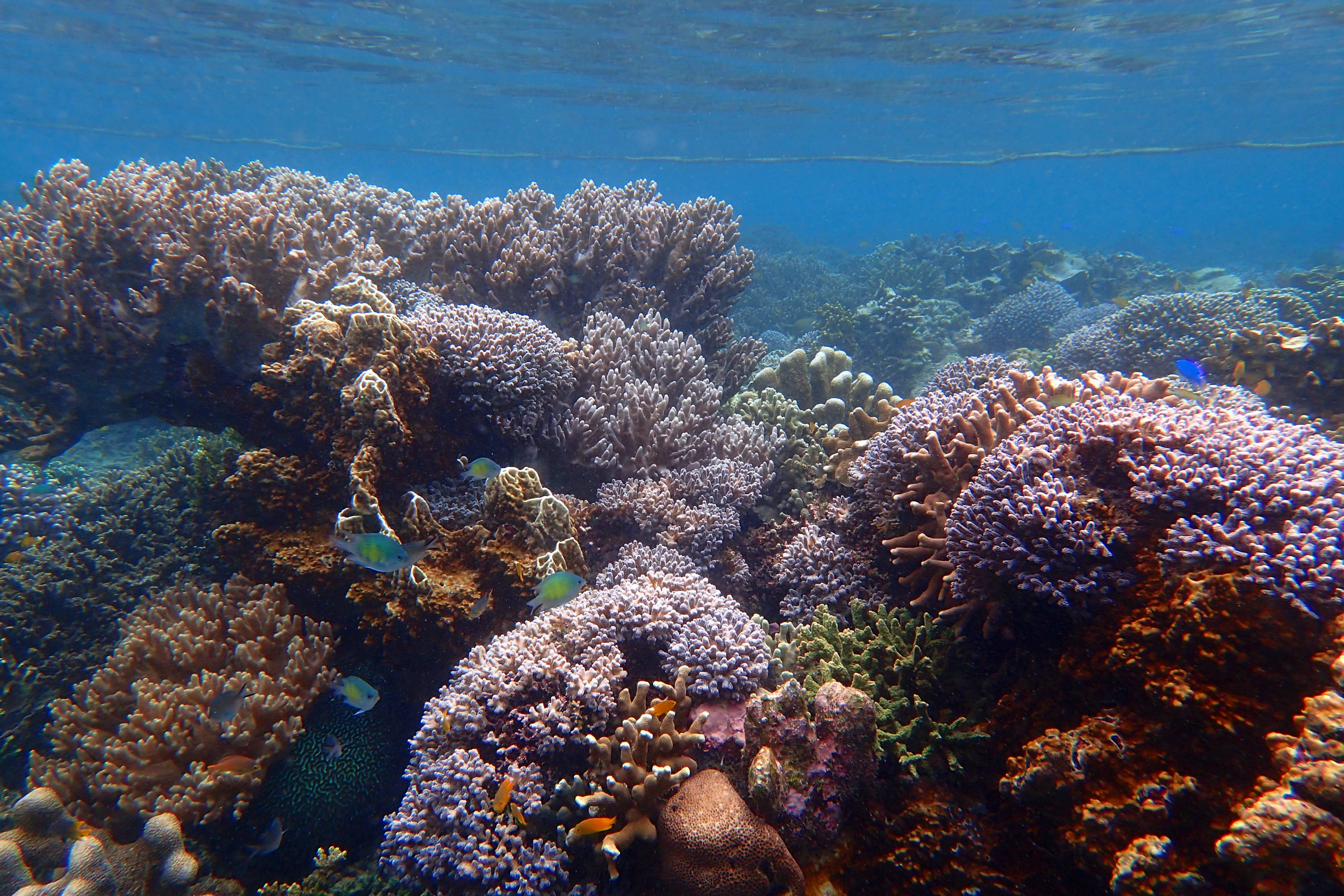
As to the coral: it might not be the most scenic (it’s a similar coral-block-on-sandy-slope landscape to Coral Eye, albeit the slopes are steeper), rather than the more spectacular vertical walls. However, it’s in rude health and it covers a very wide area. We often talk about the areas of branching corals at a depth of around 4-6m at the end of a dive as a “coral garden”: on that metaphor, one of our dives was a “coral Hyde Park”, stretching on far further than we could cover in our time available. In general, one could see multiple species of coral side by side, with exceptionally large colonies of each. So we may not have felt like intrepid dive explorers, but it was a heartening experience to see coral in such good shape.

Coral at Sali Bay ©️ Frederico Navarro

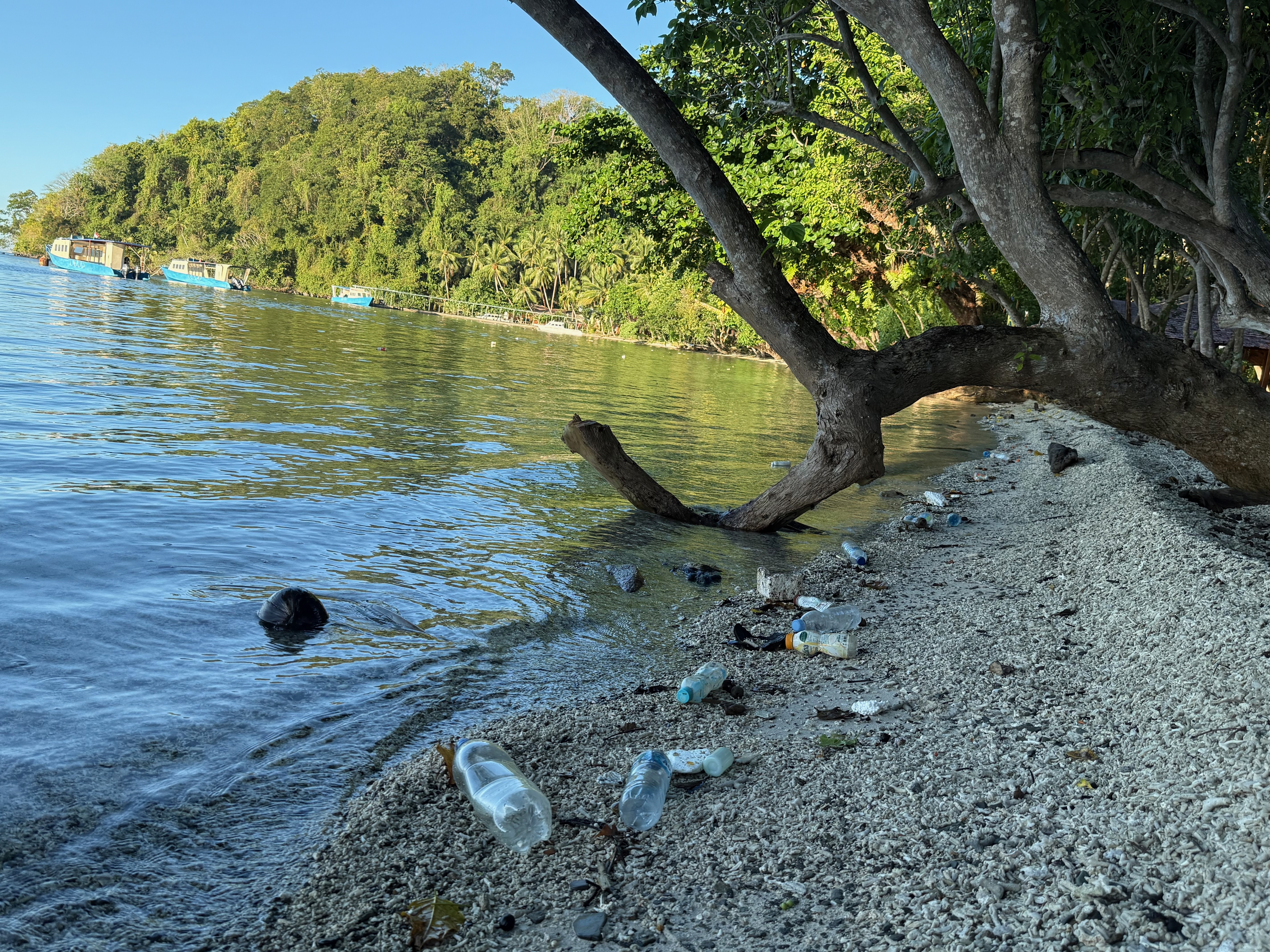
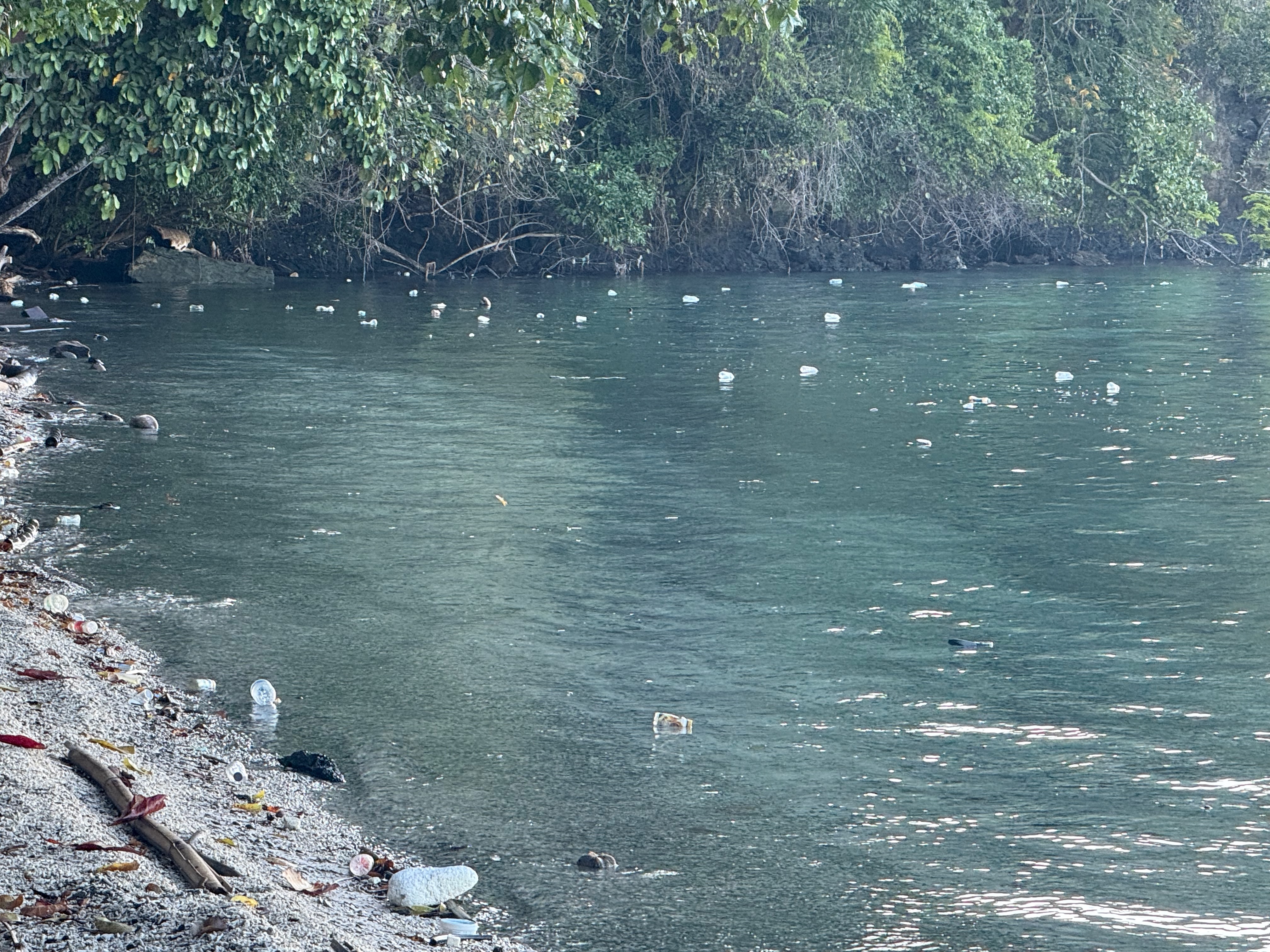
With one caveat. Some boat rides felt like ploughing through a sea of plastic, mostly food packaging and bottles. Most probably, this wasn’t local – at a population of 10,000, the nearest town of Labuha isn’t exactly a thriving metropolis, and other guests told us that the rubbish had only arrived recently, so I suppose it was probably carried in on currents in the wake of a typhoon in the Philippines whose tail end we caught. But local or not, concentrated or not, it was a sobering experience. The charities trying to deal with the issue of plastic in the oceans need our support.

Huge thanks to Frederico Navarro, a fellow guest at Sali Bay, for the wonderful underwater photos

What I learned about Paris

What I learned about Paris

We spent the months of April and May in Paris – a mixture of pleasure and business, giving us the chance to see many clients throughout France. It’s a city in which I spent several years as a child – but that was over half a century ago, so it was a chance to rediscover the city.

Some of what we found agreed with what our expectations from previous visits or from things we’ve read. But here are some things that surprised us. I should point out, of course, that anything in here is a result of our own experience – other people visiting other parts of the city might feel very differently.

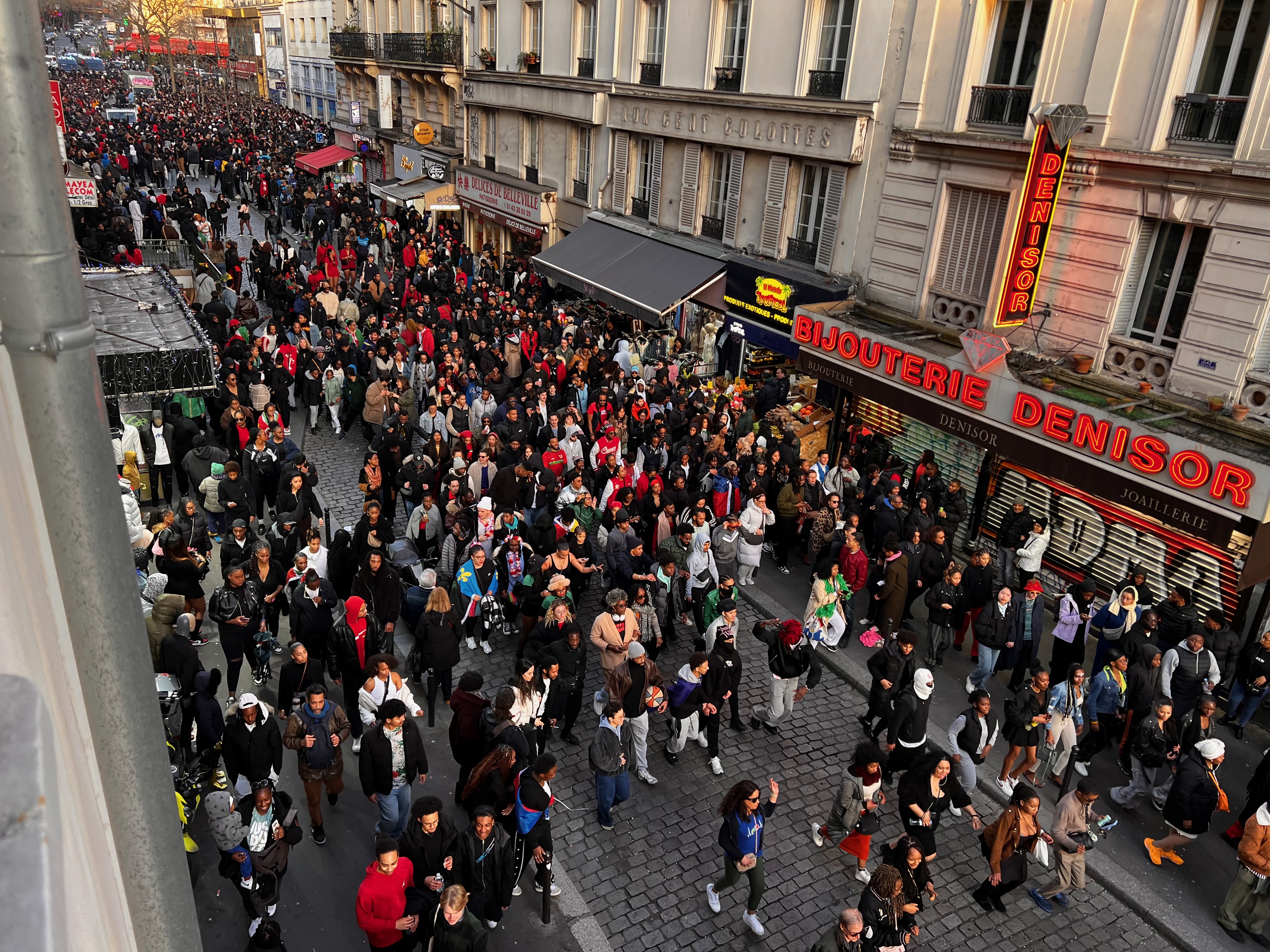
Belleville Carnival
Carnival at Belleville

Living in a residential area is an eye-opener

On previous visits, we’ve stayed in places where tourists go: the Marais, the area around the Opéra or the Champs-Élysées. My childhood was in the ritzy 16ème (yes, I know this signals heavy over-privilege).  This time, somewhat by accident, we ended up in an apartment in Belleville, of Rendezvous/Triplets fame. It’s a residential area that attracts few tourists and is very racially mixed – lots of Africans, lots of Chinese and Vietnamese, some South American, some indigenous French, a smattering of others. And we loved every minute.

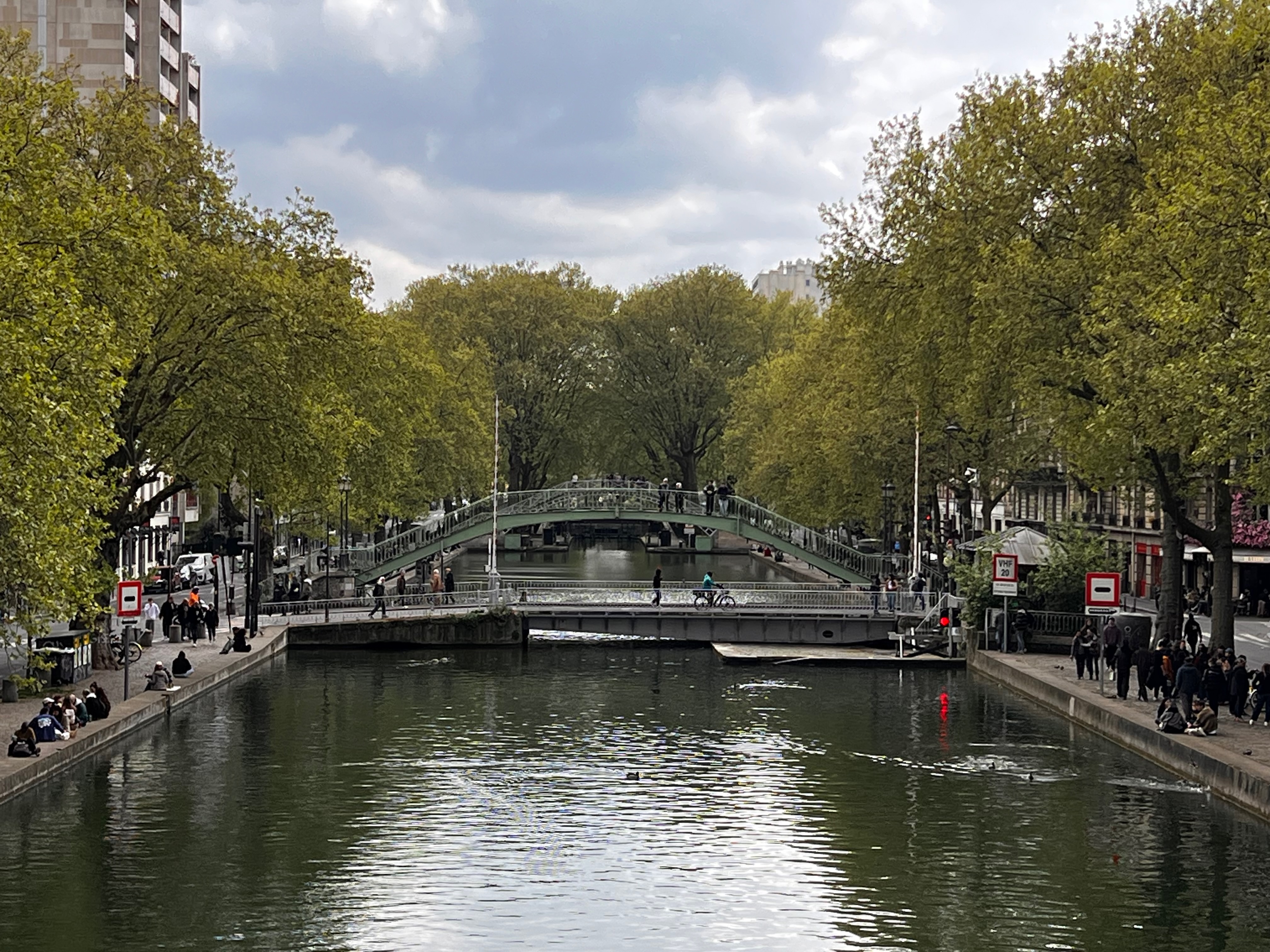
We could step out of our apartment, be swamped by a riot of colours and scents and be surrounded by the kind of shops where normal people go to buy everyday stuff (food, clothing, housewares, electronics). The whole place was unbelievably lively with the buzz of people going about their daily lives. The banks of the pretty Canal Saint-Martin were almost permanently rammed with young people hanging out, picnicking, drinking or just chatting.  You just don’t get that sense of really living in the city in an area where most of the people are tourists and most of the shops are oriented to them.

Canal Saint Martin
Canal Saint Martin

People are strong on minor courtesies

Parisians have a reputation for being brusque and surly, but with very few exceptions, that wasn’t our experience. People in shops varied from generally welcoming to seriously charming. The degree of pushing and shoving was far lower than in London, either on crowded pavements or in the Metro, where people readily gave up their seats, especially to women older than them (the same rule doesn’t seem to apply for men). This seemed particularly to be enforced by non-white mothers with their occasionally-reluctant children.

The major exceptions here are the cyclists and e-scooter riders, many of whom travel fast and ignore traffic lights. To cross a street, look them in the eye and walk predicatably so they know how to avoid you.

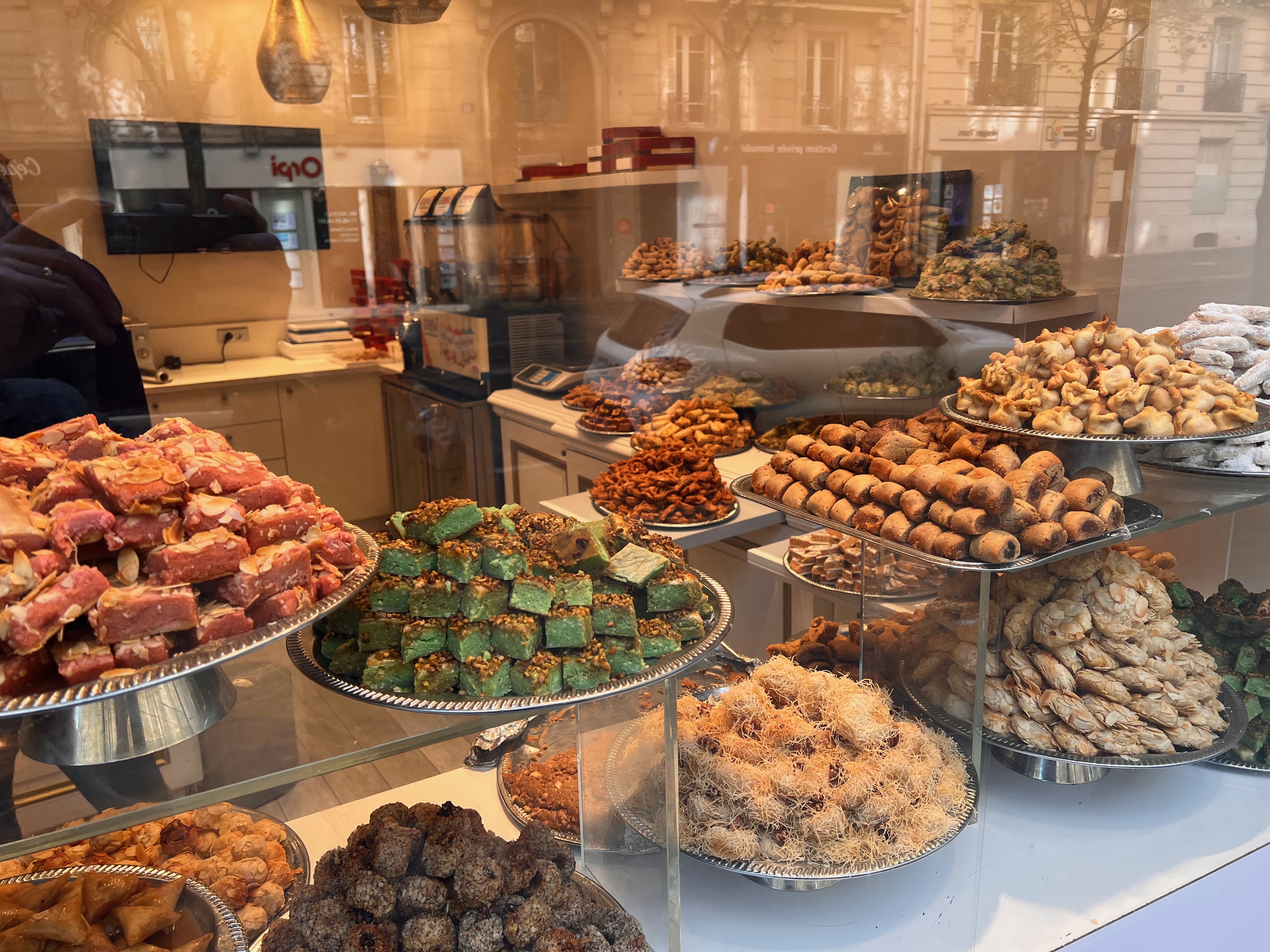
Middle Eastern pastries in 16e

Parisian street cleaning is awesome

Parisians are fond of a good whinge when it comes to their public services. But our experience of their street cleaning was uniformly excellent. We were on the Rue du Faubourg du Temple, a street choc-a-bloc with food shops and cafés. By 11pm every day, there was a quantity of rubbish on the streets. Overnight, however, an army of hose-equipped trucks and broom-equipped cleaning staff would roam the street. By 7am, the place was sparkling. 

The swimming pools are also awesome

We swim most mornings. The availability of public pools was extraordinary, with 41 across the city (the coverage is variable, but our apartment was within a 10 minute walk of two 25 metre pools in excellent shape). A short metro ride would have taken us to various 50 metre pools, including Piscine Suzanne Berlioux, improbably located underneath Les Halles, the giant shopping centre in the centre of town. And the prices are jaw-droppingly low: 44 € gets you a three month pass valid in all 41 pools – or 22 € if you’re over 65. 

The changing rooms are mixed, with cubicles for changing – which was perfectly fine and sidesteps what is currently a political hot potato in the UK. However, the showers only have individual cubicles for the disabled, so you have to shower with your swimming costume on. And during school periods, the early morning time slots available to the public are restricted. But we rapidly embraced our morning drill of “get up at 7am, swim, buy croissants on the way home”.

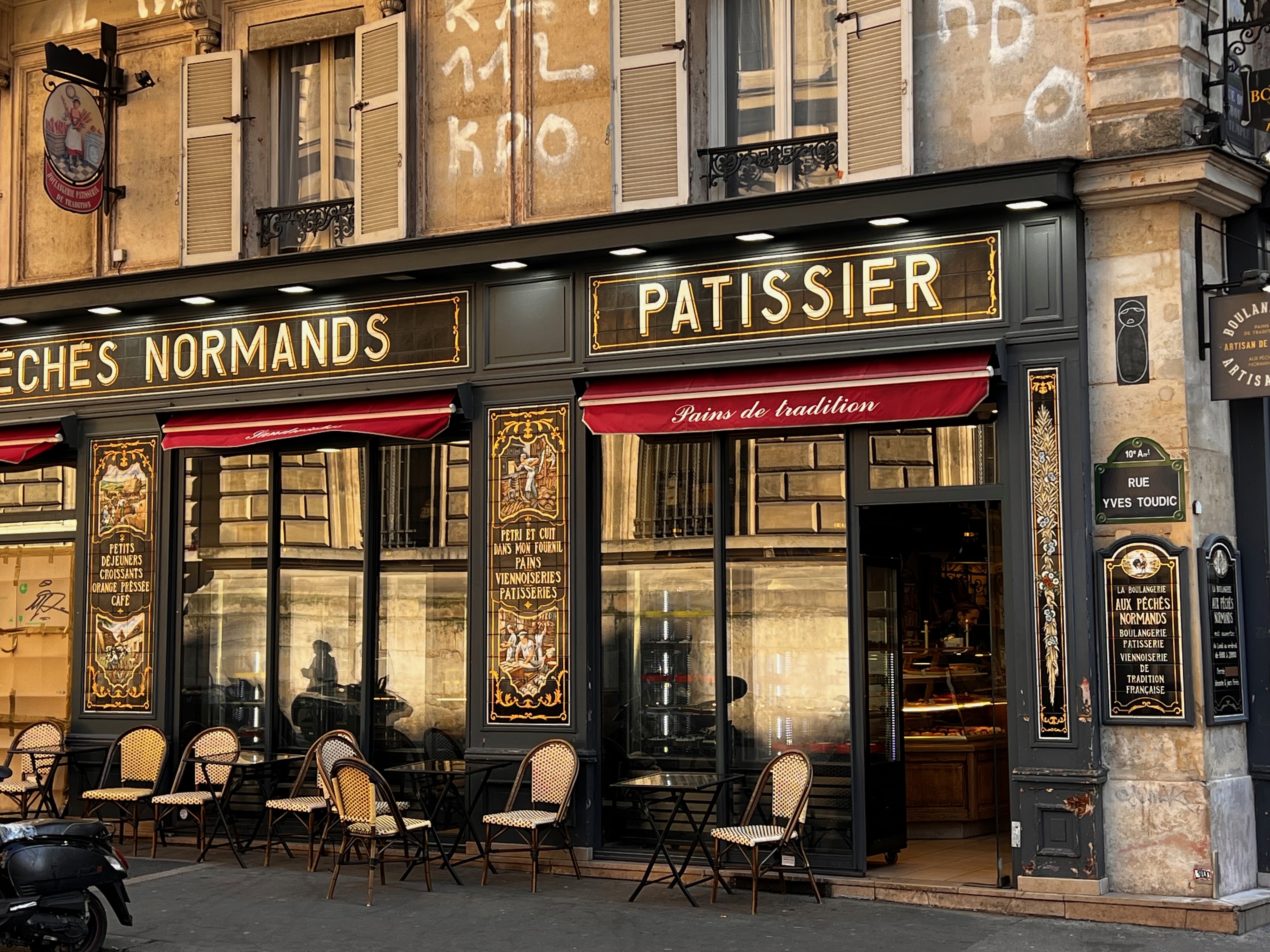
Aux Péchés Normands bakery

The dark side: there’s a lot of homelessness and begging

Sadly, we couldn’t walk too far without coming across someone sleeping rough, or someone asking for a few coins. The begging was usually pretty gentle and surprisingly polite, although there were instances of beggars who got aggressive. Several, we suspected, were mentally ill. And to judge by the number of ads and fundraisers for food banks, there are also a bunch of people who can’t feed themselves.

I don’t honestly know how this compares to other cities. My gut feel/memory says it’s worse than London and not as bad as San Francisco, but that’s a pretty unreliable guide.

The melting pot approach to multiculturalism is beginning to work

When a country has large a immigrant population, there are two main ways to approach multiculturalism. The approach promoted by many on the left of UK politics is the maintenance of identity, the idea that people have a right to their ancestral culture and heritage, which should not be “appropriated” from them. Faith schools and ethnically unmixed areas contribute to that.

The French do the opposite: what they call la mixité. It’s closer to the US idea of a “melting pot” but more extreme – religion and race are excluded from the public sphere. One is encouraged to be “colour-blind”, so that people of all races get the same upbringing and the same opportunities.

Or at least, that’s the theory. The reality has been very different, as expressed in the horrific treatment of immigrants from the Maghreb, by recruitment outcomes which varied wildly according to whether or not you had a Muslim-sounding name, and in Paris, by the concentration of immigrants in the impoverished parts of the banlieue (the suburbs outside the Périphérique ring road), leaving “Paris intramuros” to French whites.

But I saw and heard evidence that la mixité is beginning to become a reality. I saw many more mixed race couples than on previous visits to Paris. I saw black customer-facing staff in some very smart shops that wouldn’t have dreamed of having them in the past. And the “Grand Paris” project, the extension of the Metro into the suburbs, is beginning to break down the previously hard border between the city and the banlieue

It’s baby steps at this point, but the signs are promising.

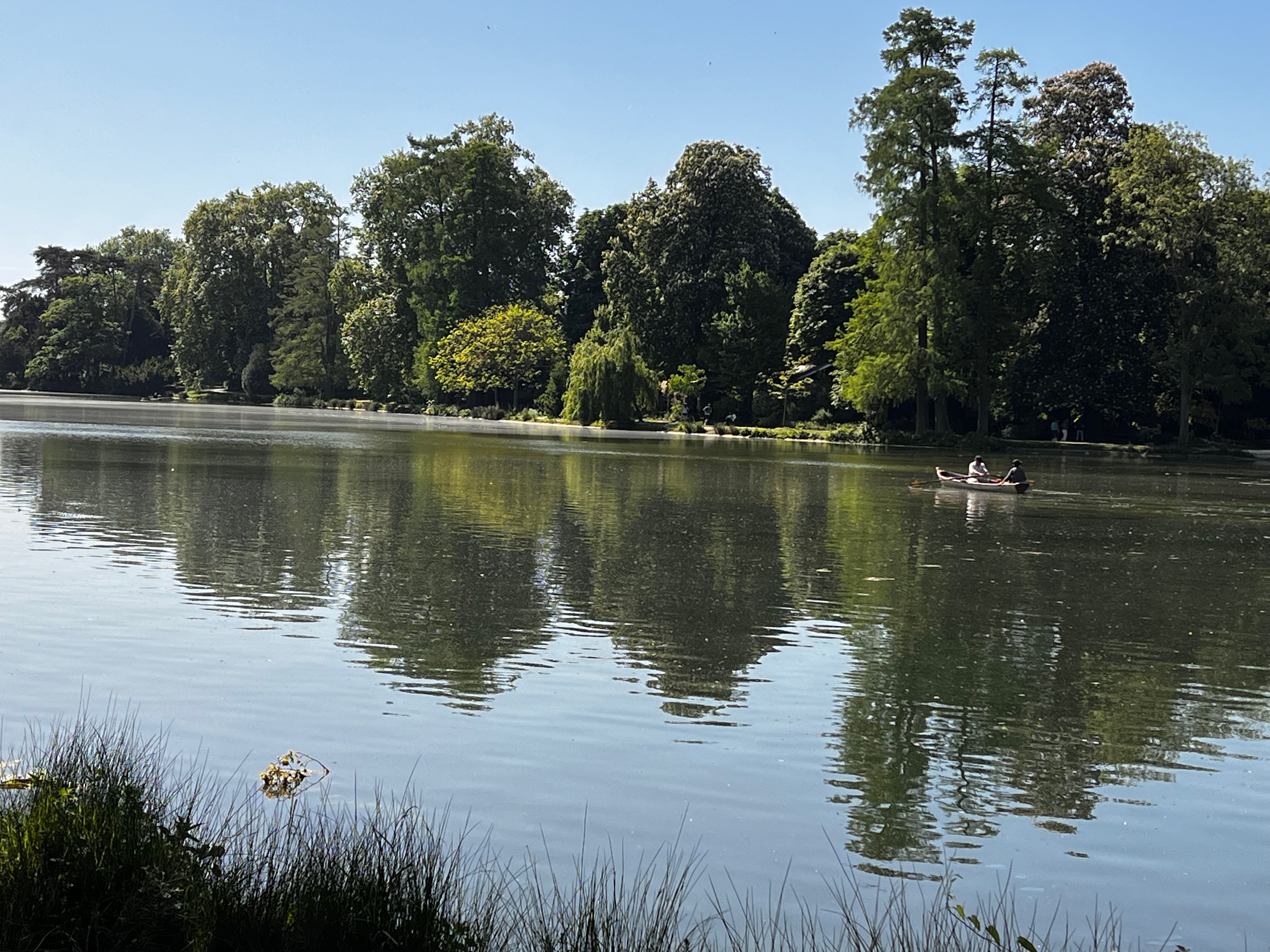
Bois de Vincennes
Bois de Vincennes

 The green side: we discovered the Coulée Verte and the Bois de Vincennes

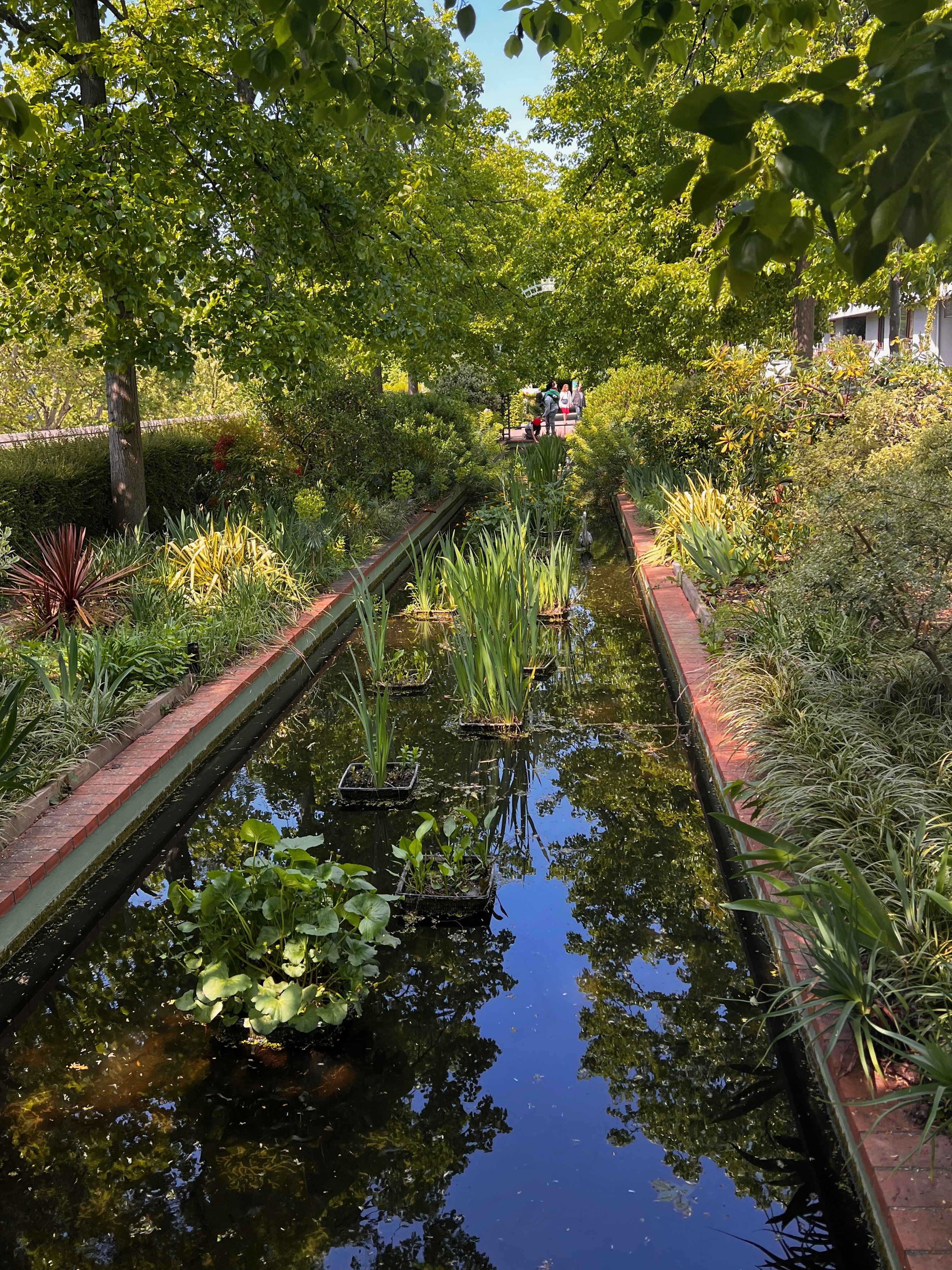
Paris isn’t celebrated for its green spaces, but there are a some real gems. The one we discovered on this trip was the Coulée Verte (formerly the Promenade Plantée), a narrow strip of land high above the streets that run from Bastille towards the Bois de Vincennes, the former royal hunting forest at the South-East of Paris. The Coulée Verte is about an hour’s walk end to end and is gorgeously landscaped: it’s like having a very long and thin botanical garden, interspersed with little nooks to chill out or gaze down at city outside. It’s blissful.

The Bois de Vincennes itself is huge and very beautiful. We didn’t make much of a dent in its overall size, but managed a long walk alongside the boating lake. I’ll be back.

Pond on the Coulée Verte

The city is ever shifting

The status of different areas of Paris isn’t fixed. On the Left Bank, back in the 70s, the Boulevard St Germain and the Boulevard St Michel were the hippest of the hip, celebrated both in popular culture and in literature and the home of cool new fashions from Yves Saint Laurent and others.

We found it rather sad, the streets mainly populated by guided parties of tourists there to relive its former glories. The fashion world has moved elsewhere: the Avenue Montaigne for brands favoured by the high rollers – Dior, Chanel, Prada and the like – and the Marais for a younger, more boho crowd (or bobo, as the French call it).

The Marais is changing, also. At one time, it was very much populated by younger professionals, with many foreign students or people early on their career. That’s been changing: the eclecticism is still there, but one senses that it’s catering to tourists far more than to locals, heading towards becoming a theme park of its former self. Personally, I suspect it’s a result of AirBnB and (to a lesser extent) Brexit, but I can’t be sure.

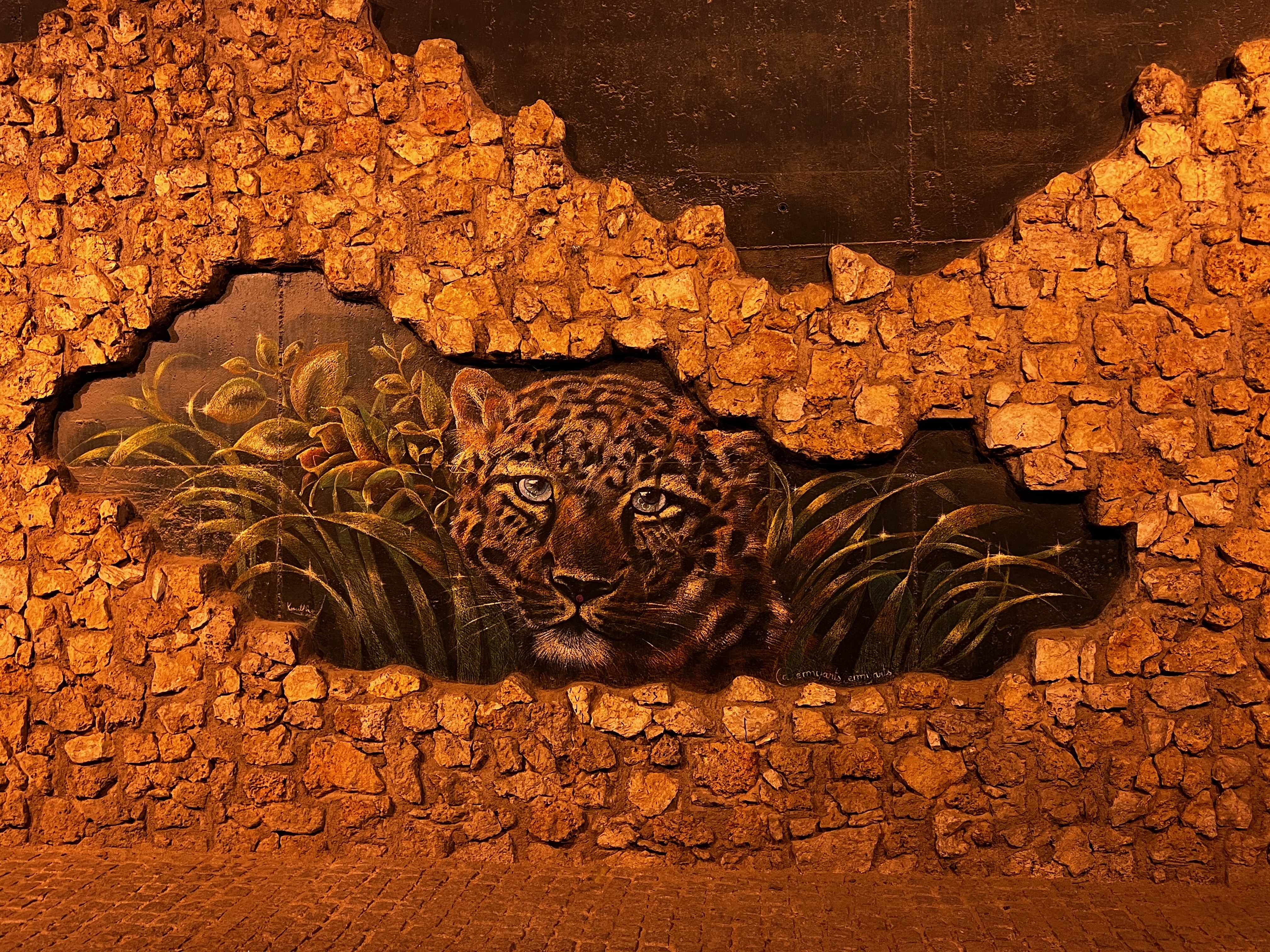
Mural in tunnel by the Coulee Verte

And the stuff you know…

I haven’t even mentioned the things you already know all about – the phenomenal food, both restaurant meals and produce for cooking at home, the breadth of the cultural offering in both visual and performing arts, the cityscape with its famous monuments and that incredible light. Suffice to say that I’ve fallen in love with the city all over again.

Palestinian freedom, seen from Paris at Passover

Palestinian freedom, seen from Paris at Passover

Our Seder night this year was a small affair, with just close family. I’m not very religious, so for the last few times we’ve been hosting Seder, we’ve used a Haggadah I’ve put together that focuses on telling the full story from the Bible. Within that, there is a space entitled “Other stories” for discussing tales of enslavement from other peoples – last year, this was the African slave trade and the oppression of the Uighurs.

This year, it hit us like a thunderbolt: the people suffering the most severe oppression are the Palestinians, and the oppressors are the Israelis. Every day, we are hearing stories of atrocities perpetrated by Israeli forces in Gaza; every day, more Palestinians are forced from their homes. The difference between their plight and that of the Jews in Egypt is that we were able to flee from our oppressors and find some vacant territory to which we could migrate. The Palestinians are unable to do so.

Just War theory includes a doctrine called proportionality: even if a war is just in all other ways, it cannot be just if the degree of force used is so massive as to be utterly out of proportion to the initial events that triggered the war. If a terrorist commits a single murder, it’s unjust to annihilate a whole village in reprisal. The October 7th attacks were heinous – but it cannot be right to use them to justify the devastation of the entirety of Gaza.

It worries me greatly that several of my Jewish friends and family members seem unable to see this. Have they so absorbed the idea that the attack was so bad that any level of violence is justified in response – even tens of thousands of deaths? Do they consider Palestinians to be so subhuman that anything the Israeli government does to them is just fine? Do they really think that any criticism of Israel is anti-semitism, regardless of how it behaves?

The word genocide is an unhelpful distraction in this context. Clearly, Israel is not attempting to exterminate all Muslims or all Arabs in the way that Hitler attempted to exterminate all Jews. As a result, when faced with accusations of genocide, it’s all too easy for Israelis to let themselves off the hook by denying them. What cannot be denied, however, is that Israel is engaged in major league ethnic cleansing: they’re turning Gaza into such a hell-hole that no person could reasonably expect to live there. I assume that they hope that at some point, other countries will open up their doors to a flood of Palestinan refugees, willingly or not, but that’s guesswork on my part. In any case, it presupposes that Israel has a single coherent strategy, which may well not be the case.

But regardless of this, I don’t believe that Israel’s real priority is the return of the hostages. And since the arrival of Benjamin Netanyahu, I don’t believe that Israel has shown any intention of making a just and lasting peace with the Palestinans – their overwhelming strategy for many years has been one of oppression and landgrab, dressed in the name of needing to maintain security.

I’m not denying that there is a great deal of anti-semitism in the world, much of it founded on a tissue of ancestral lies and hatreds. But right now, the actions of the Israeli government are the biggest thing feeding the anti-semitic fires. It’s time to tell them to stop. To tell them that the Jewish nation is not a barbaric people in this way, that they do not represent us and that we do not support them.

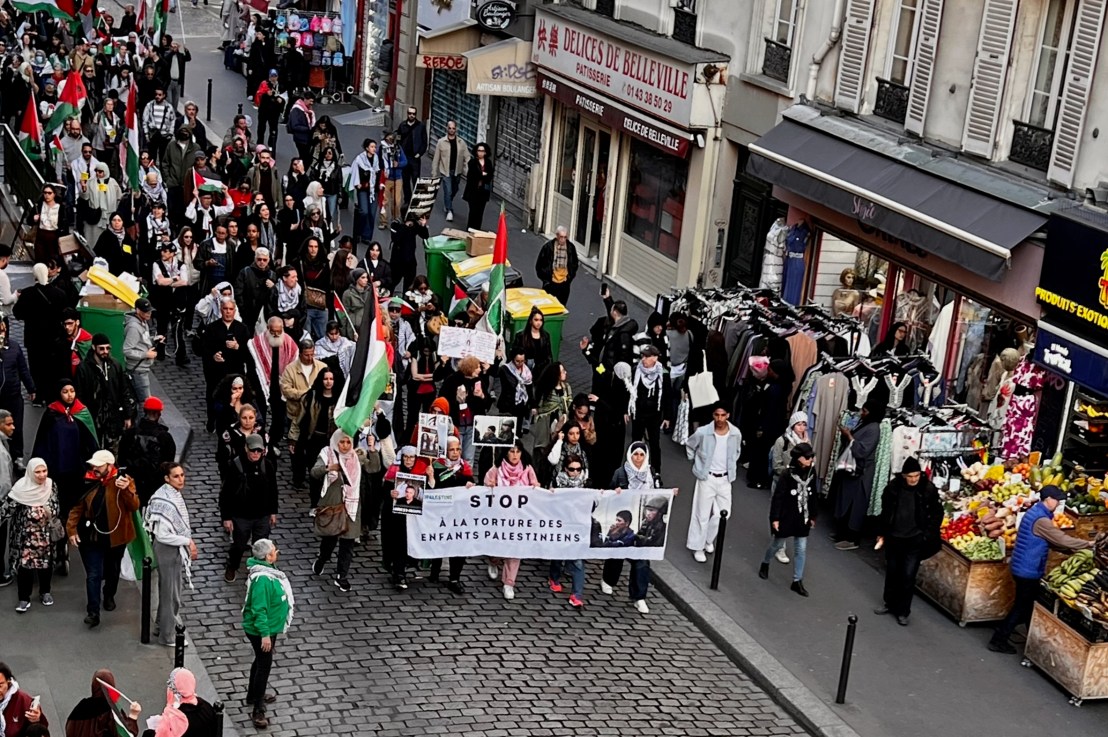
Yesterday, from the window of the Paris apartment where I am currently staying, I saw a large and powerfully crafted demonstration demanding the freedom of Palestinian prisoners. As a Jew, I felt frightened, but I also felt like I was on their side.

Discovering Haute Couture: Dolce&Gabbana’s Captivating Exhibition in Paris

Discovering Haute Couture: Dolce&Gabbana’s Captivating Exhibition in Paris

I’m not normally a follower of haute couture: the images of elaborate dresses that I can’t imagine anyone actually wearing leave me thinking of the Raymond Chandler tag “as elaborate a waste of human intelligence as you can find outside an advertising agency” (Chandler was referring to the game of chess, but we all have our own bugbears). So when someone told me that the one unmissable exhibition in Paris was the “Dolce&Gabbana: Du Cœur à la Main” show at the Grand Palais, I was dubious in the extreme.

Still, our informant was quite firm on the matter, so I took my heart in my hands and booked our tickets (which were rarer than hen’s teeth and only available for early mornings or very late nights). And thank goodness I did, because I left the exhibition with my mind completely blown, with a completely fresh understanding of what this kind of fashion can mean.

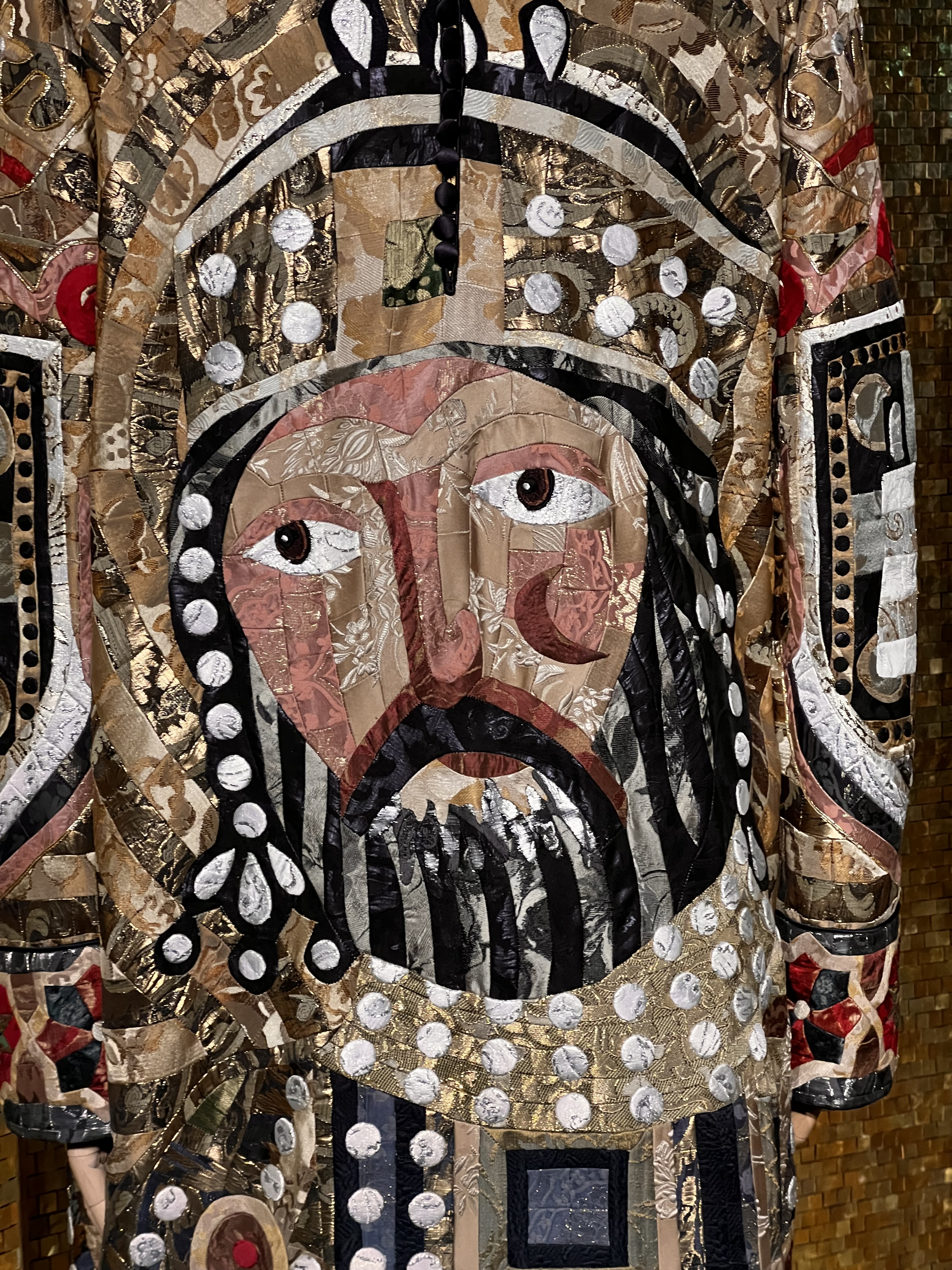
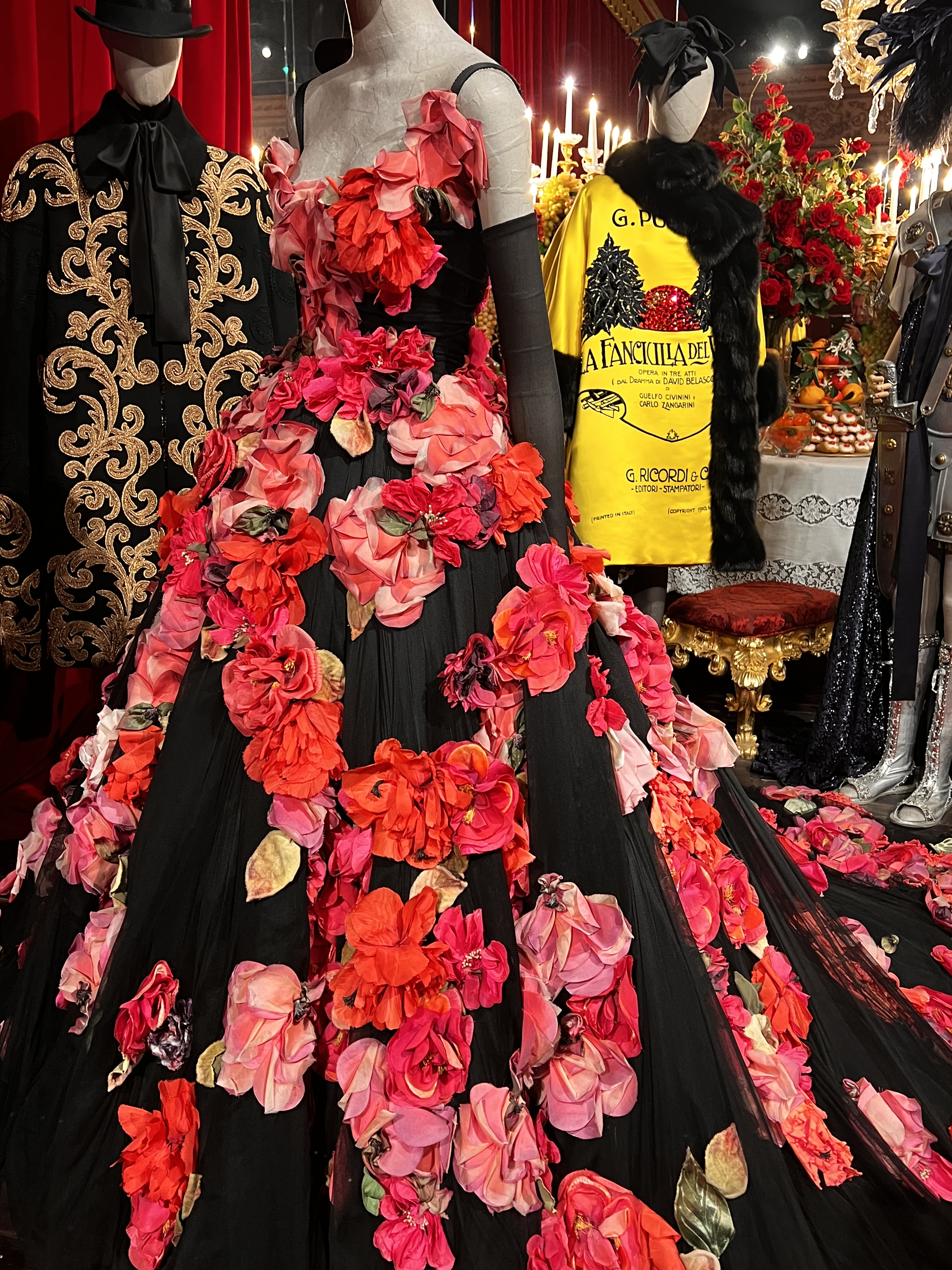
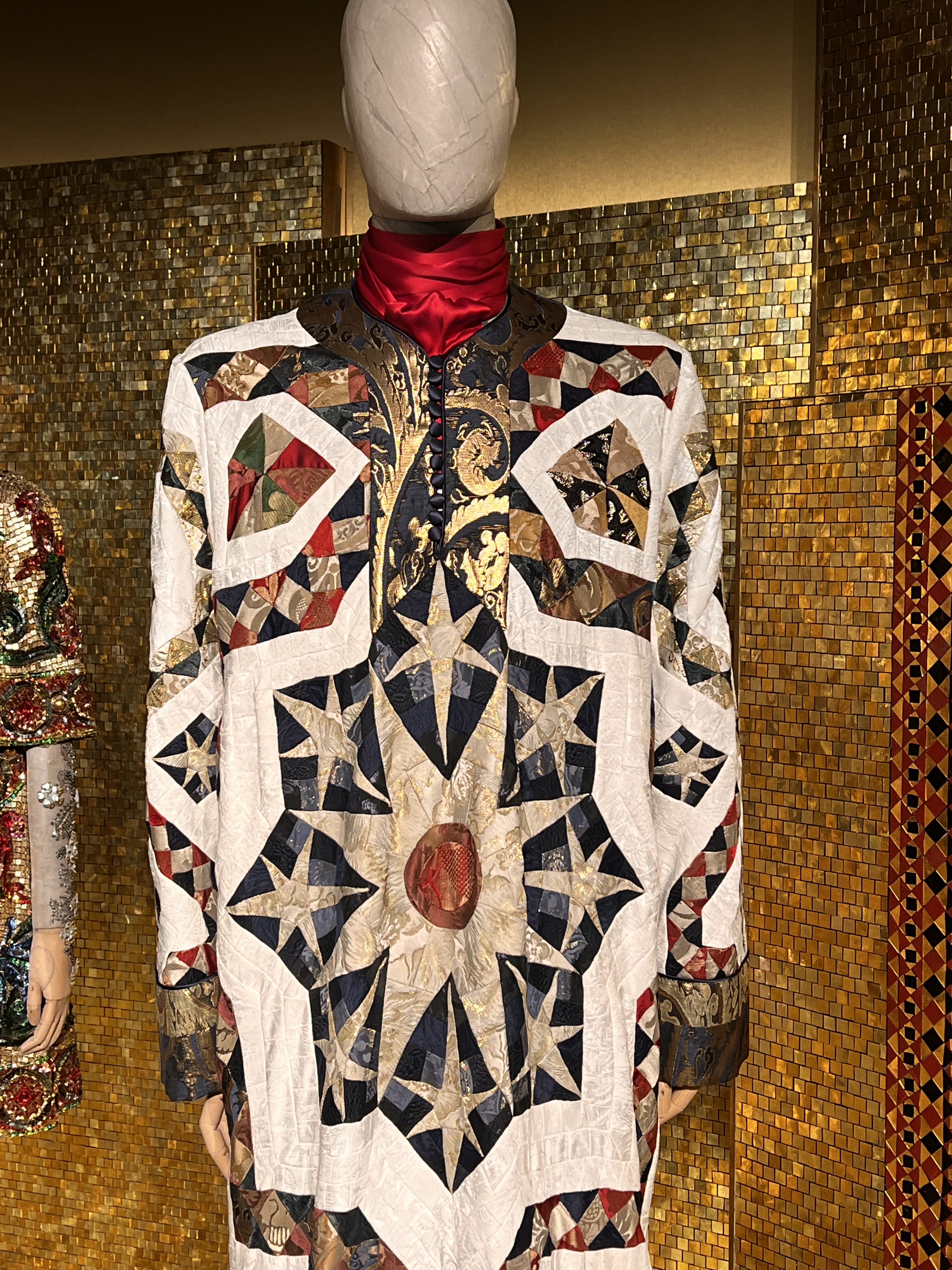
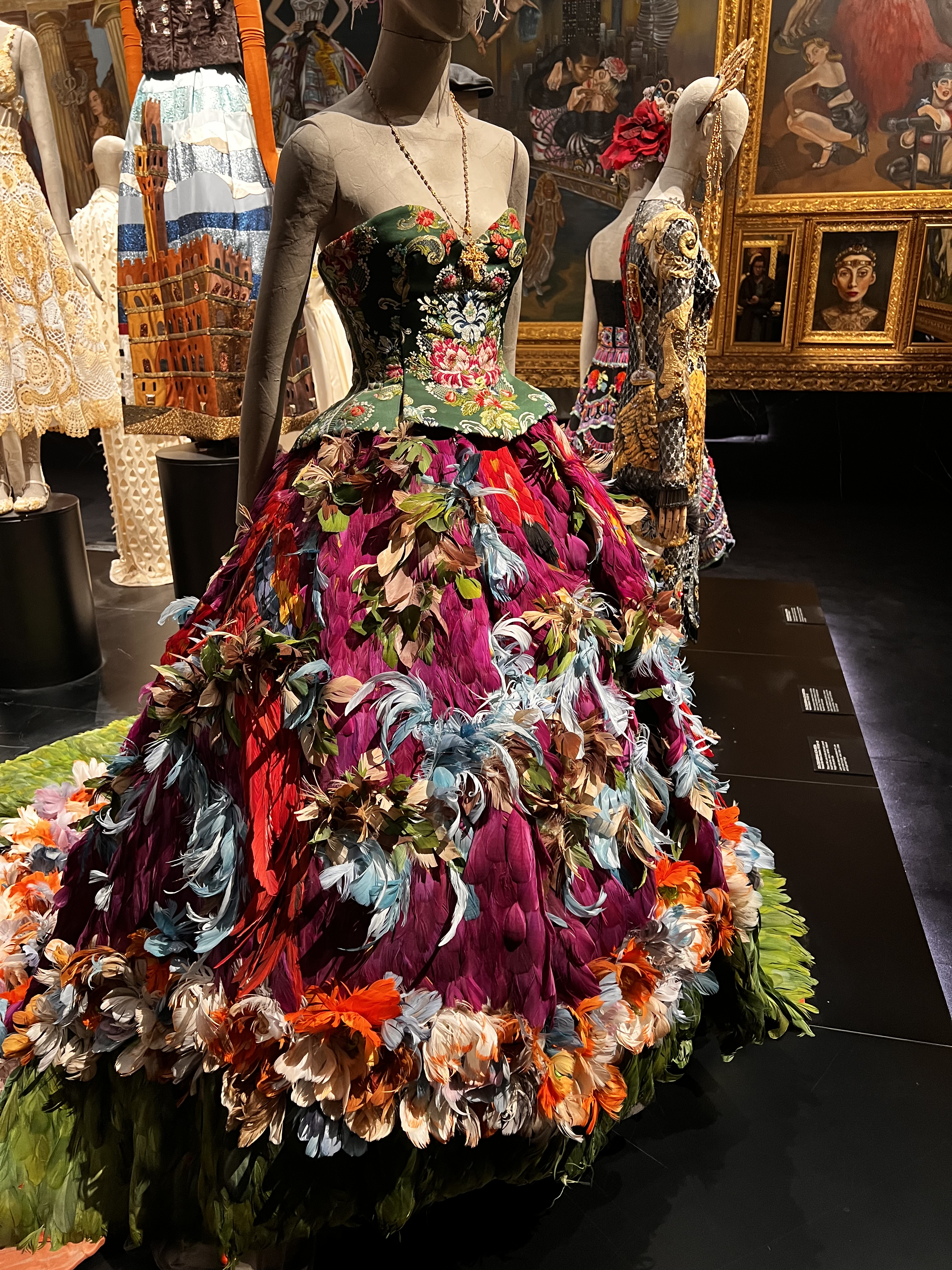
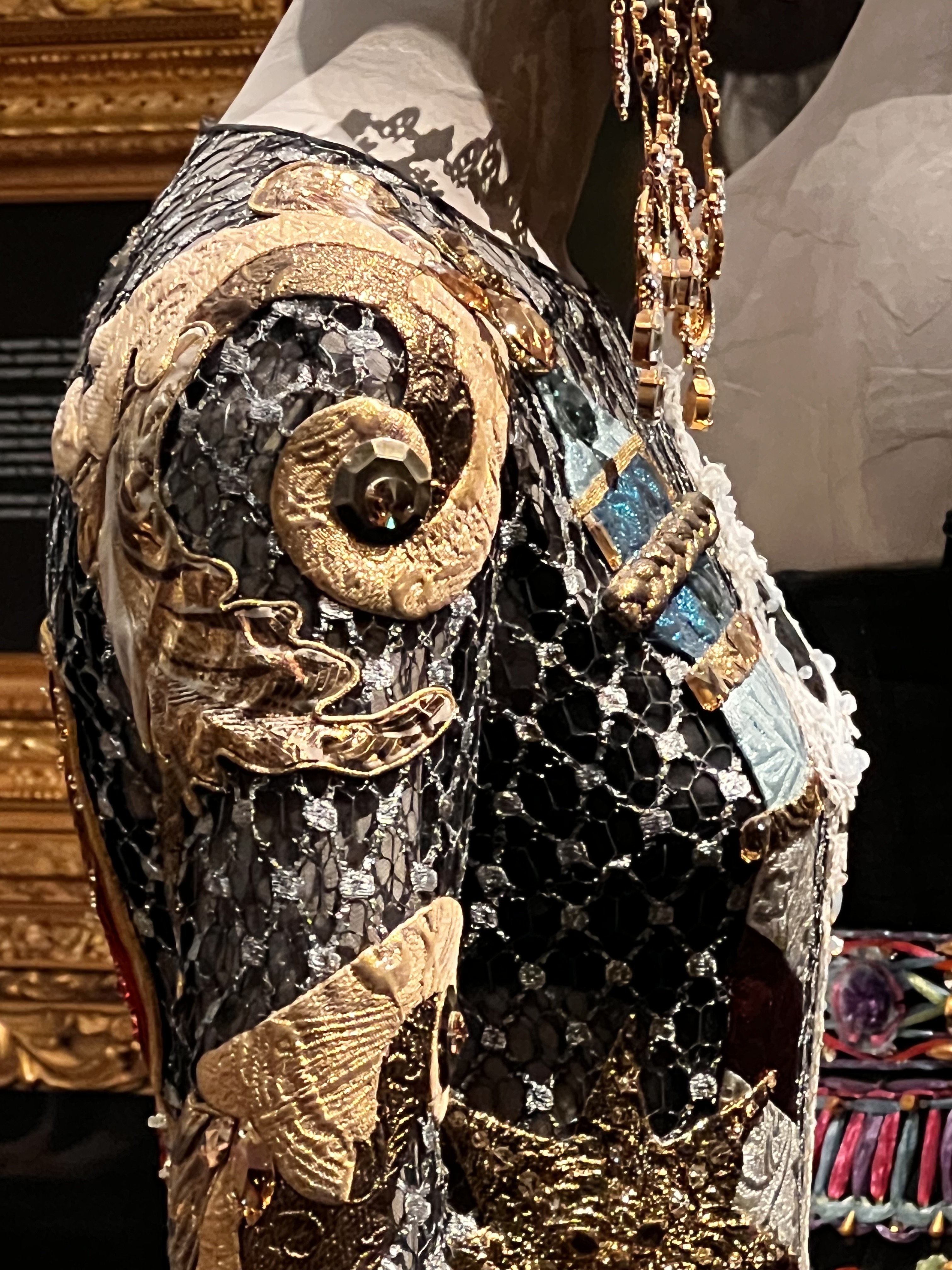
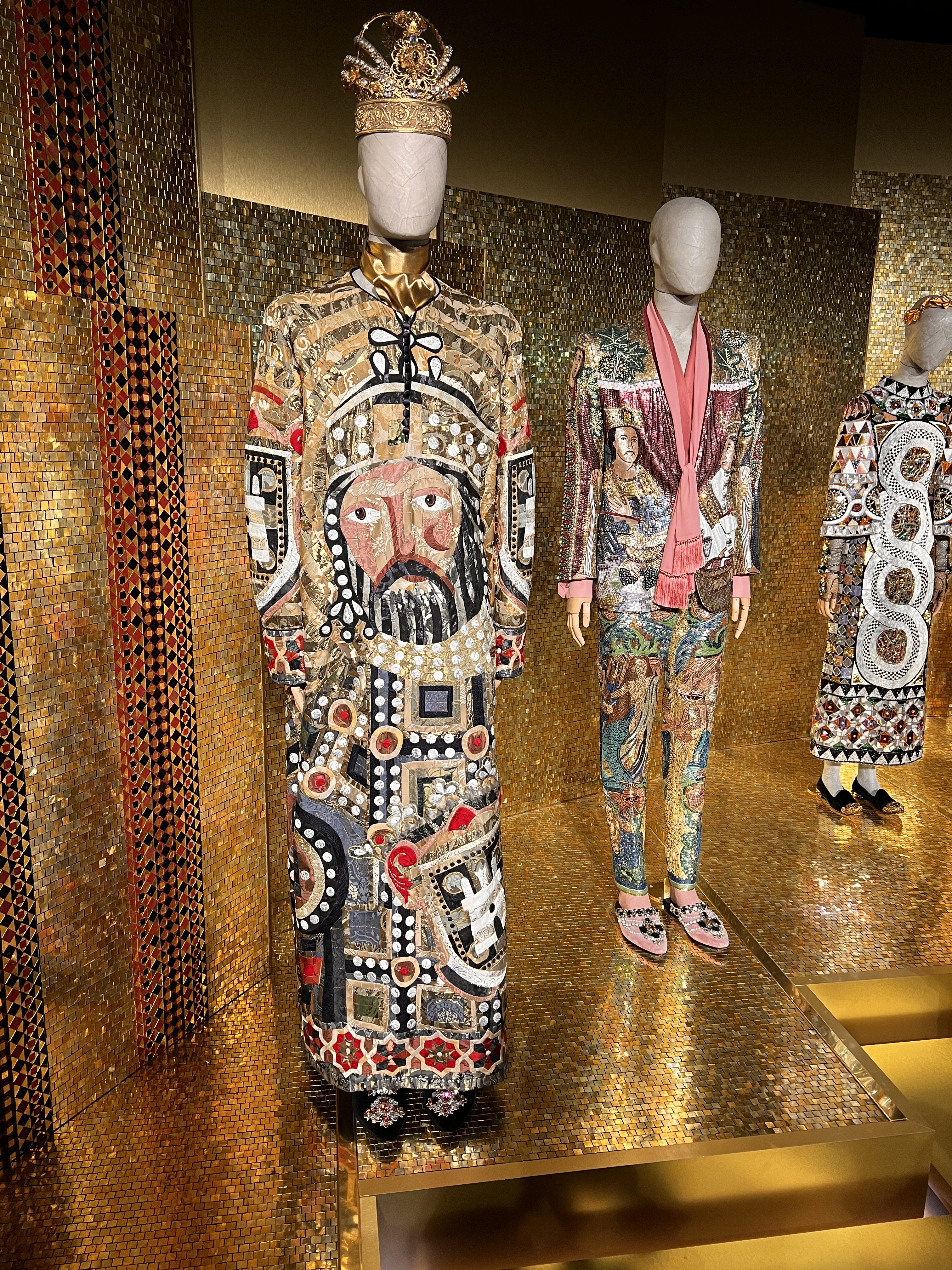
On the one hand, it’s true to say that the vast majority of what was on show was indeed clothing, in the sense that it’s in the form of sets of garments that people can wear. However, that turns out to be almost incidental: what Domenico Dolce et Stefano Gabbana are displaying in the “Alta Moda” in this exhibition is an array of works of art in different media, which happen to be in the shape that you can drape over a mannequin (or, presumably, the occasional supermodel or super-rich real person). And the beauty and craftsmanship embodied in those works of art is simply mind-boggling.

Apart from the obvious needlework and pleating, the art/craft forms in use include  tapestry (both woven and cross-stitch), printing, painting, metalwork and even glass-making. Dolce&Gabbana seem to be experts (or have experts on tap, anyway) on every one. The exhibition is mostly of the finished products, but it’s sprinkled with video of the artisans at work, so you can marvel at the skills on display as well as goggle at the garments that result.

It helps that Dolce and Gabbana evidently share two obsessions of mine: opera and Sicily. You’re assaulted by everyone’s favourite opera highlights (Pavarotti singing Nessun dorma, Callas singing Casta diva, you get the idea) as soon as you’re in the exhibition, and it largely continues that way – but what really blew me away was some of the wearable versions of the posters for various famous premières at La Scala.

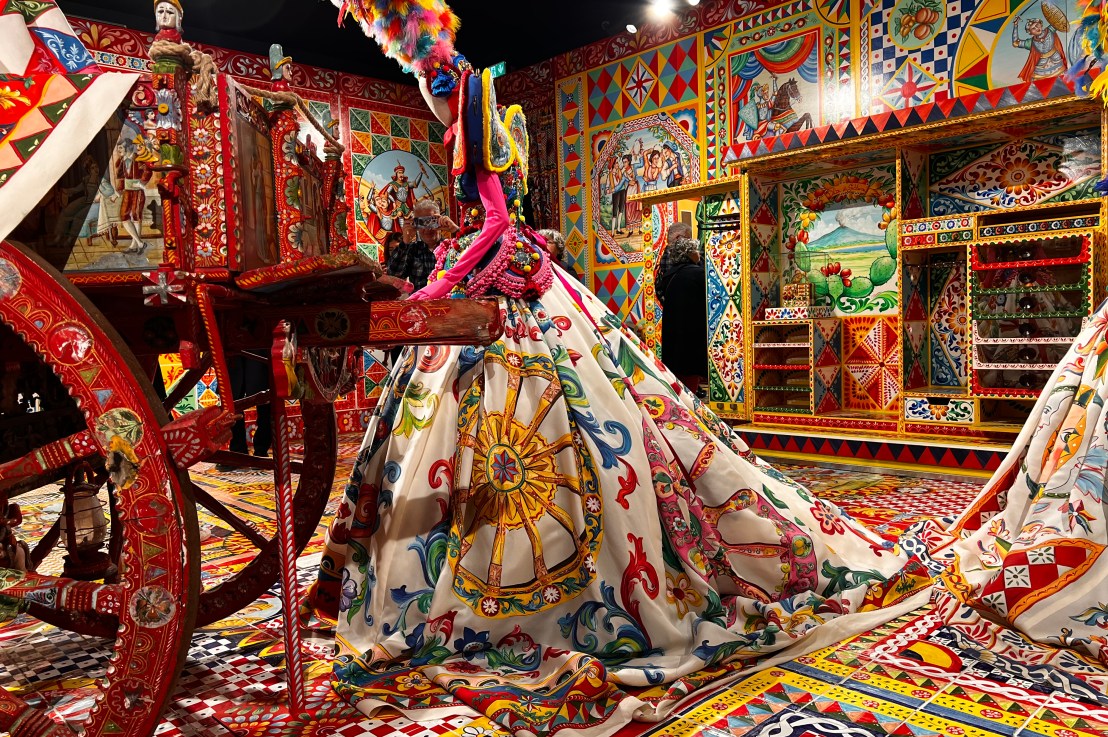
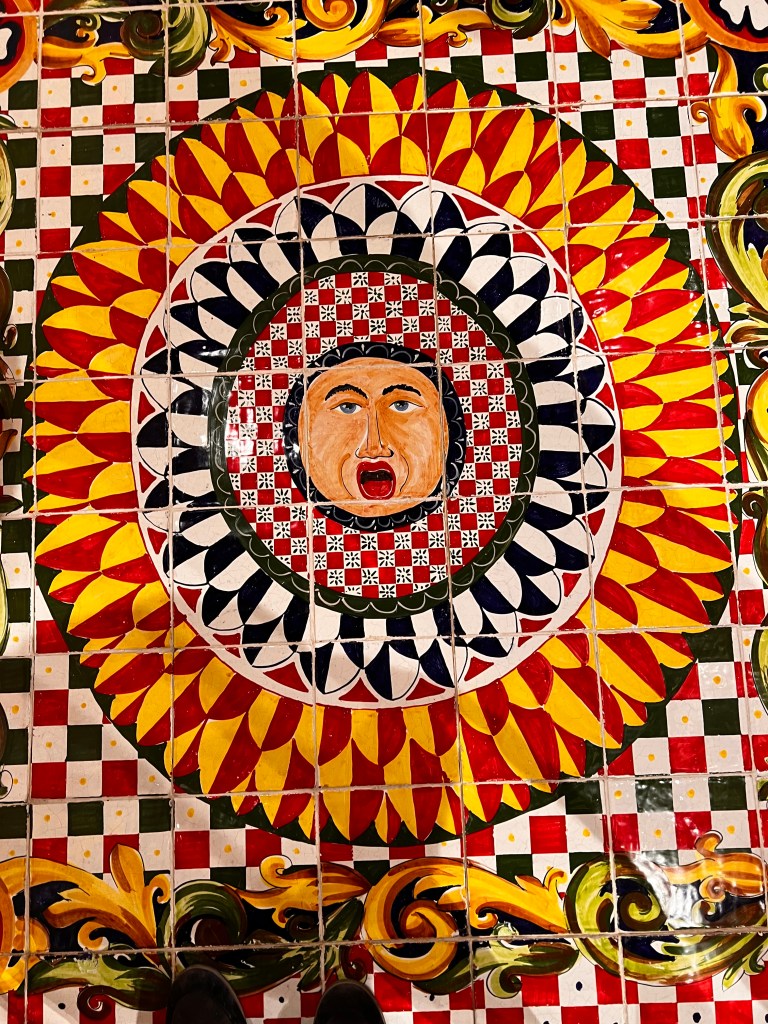
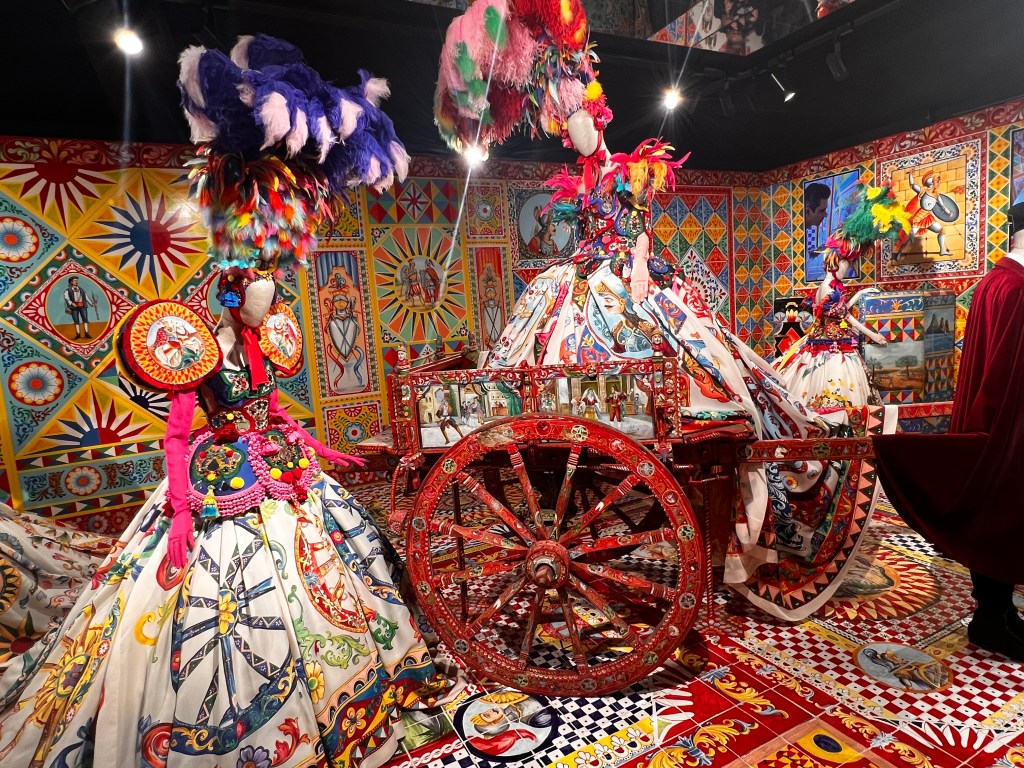
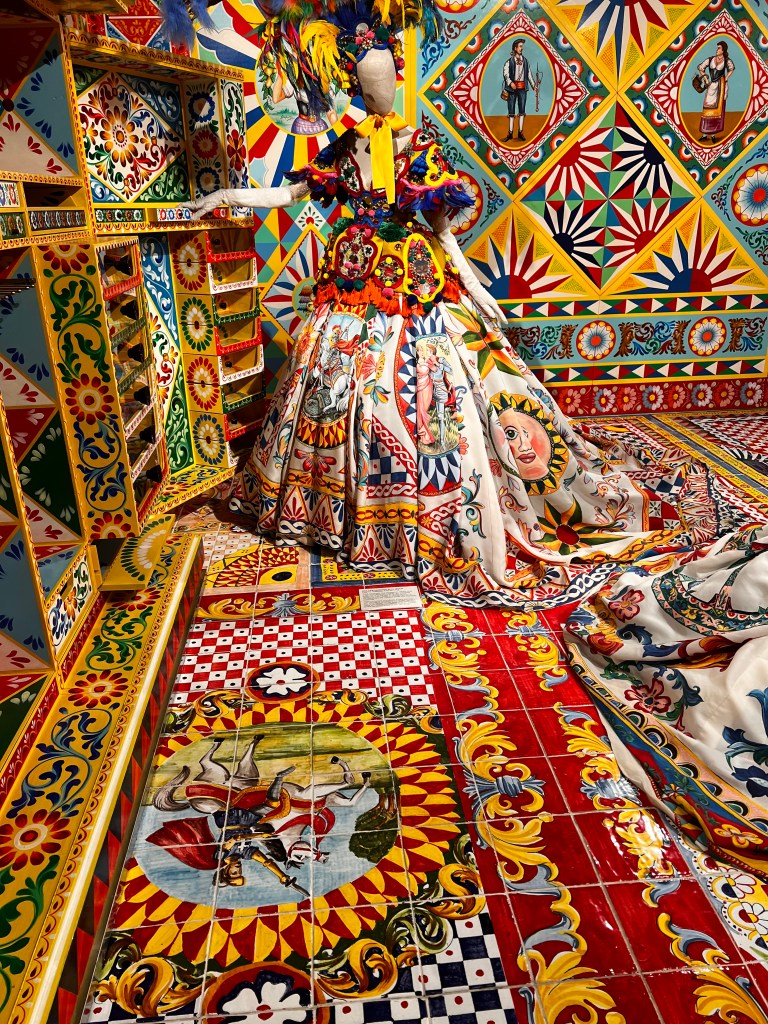
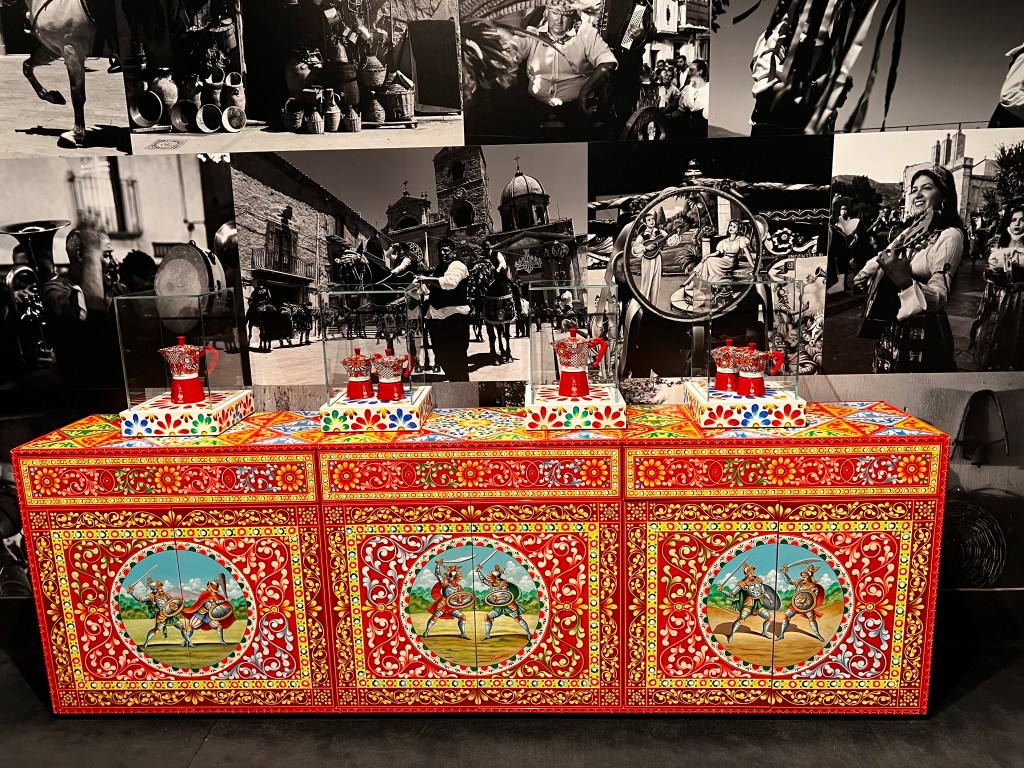
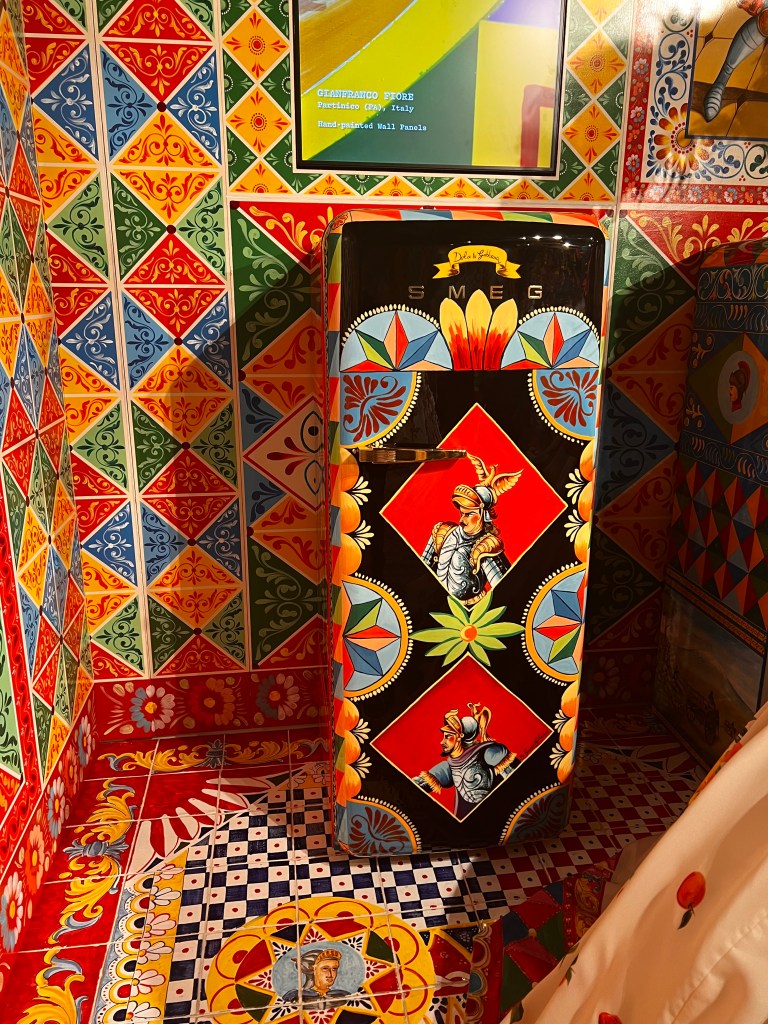
Two rooms were devoted to Sicily. The first was a modest antechamber with only a few garments but walls filled of black-and-white reportage photos of the island. That opened up into the brightest sunniest vista I’ve ever seen indoors: a blaze of Sicilian sunlight created by the boldest of colours. The themes I loved were the stories from Orlando Furioso – peerless knights, fair damsels, evil sorceresses and so on – that you’ll find in Sicilian puppet theatre, complete with a full size travelling cart that the puppeteers would have used to tour their show from village to village. And the brightness was applied to homewares as well as garments, with Smeg fridges as you’ve never seen them. (You could buy a gorgeously bedecked espresso pot if you wanted – not much else was on sale).

But back to that question that bothered me about coming to this show in the first place: would anyone really wear this stuff? And why? Are we just at a kind of massive craft fair where all the goods on show just happen to be people-shaped, or is this just providing a vehicle for oligarchs’ fantasies of what their wives and girlfriends should wear? I’ve rationalised a kinder answer – I don’t really know, of course – which is to consider professionals where the way you look really is a key part of the product (I’m thinking Lady Gaga or Margot Robbie, let alone models like Agel Akol or Bella Hadid). In that category, if you’re going out to a big occasion where you know the paparazzi will be out in force, then wearing something utterly individual and striking isn’t just a matter of vanity or self-indulgence, it’s simply good business. Even if you feel like you’re walking around in something that should really be in a museum. Like the Grand Palais.

By the time I get this posted, you’ll missed the Paris version of this show, but the exhibition will then be travelling to other cities “on a world tour”. Even for a non-fashion-lover like me, I think it’s worth the trip.

Springtime in Paris: the bakeries of Belleville

Springtime in Paris: the bakeries of Belleville

When people think about Paris, the top things they think about are the landmarks (the Eiffel Tower, the Arc de Triomphe and so on), the great public buildings (the Louvre, the Opera),  and the cafés and restaurants. But there’s one aspect of Paris that isn’t necessarily on everyone’s list: the place is a baker’s paradise.

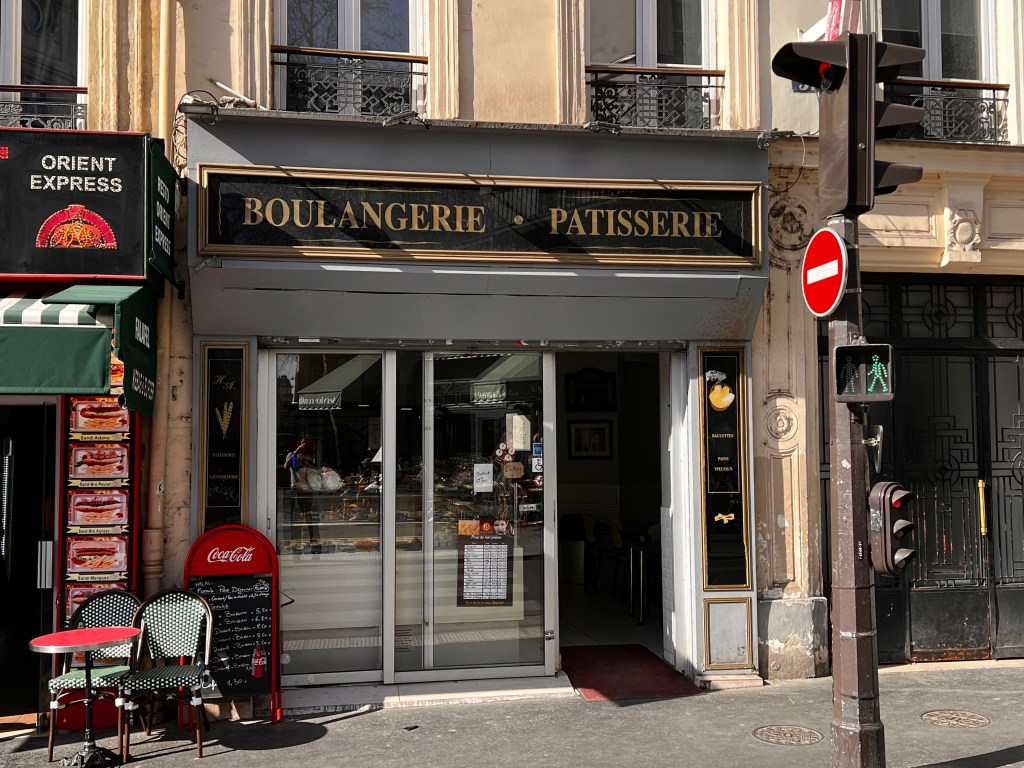
We’re currently on a two-month stay in Paris. Rather than being in a standard tourist area, the apartment we’ve rented is somewhat north-east of the city centre in Belleville, made famous by Sylvain Chaumet’s wonderful animated film Belleville Rendezvous (aka The Triplets of Belleville). It’s an ethnically mixed residential area, with a large population of North African origin as well as a lot of Chinese and Vietnamese mixing with the white population. Our apartment is on the Rue du Faubourg du Temple between Belleville and République metro stations. In the course of that one kilometre stretch, without going into the side streets, I counted fourteen bakeries of different kinds. Most of them are places I’d be more than happy to patronise near my home; the best are utterly outstanding.

Here’s a little guided tour – in no particular order (and not geographically).

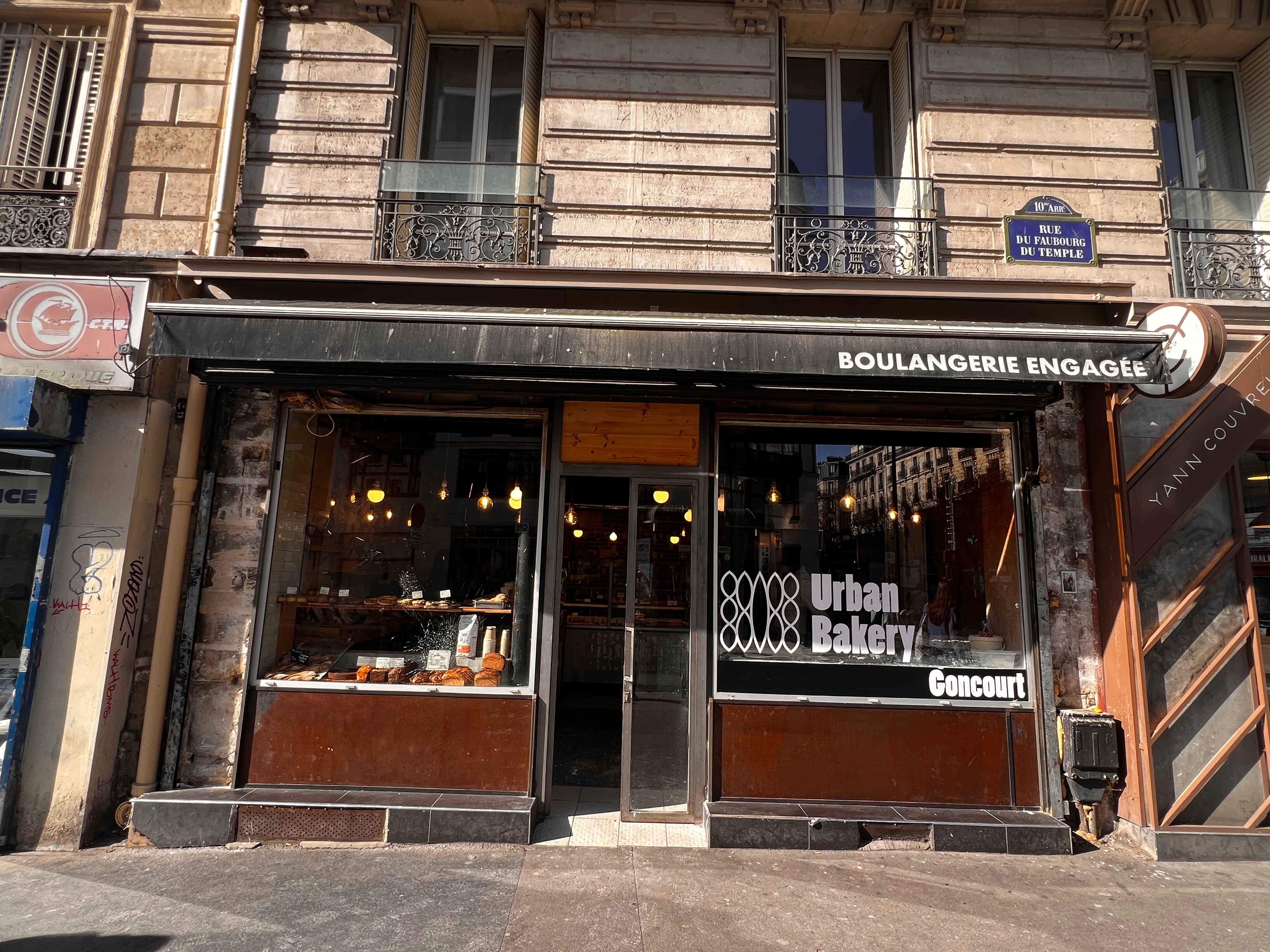
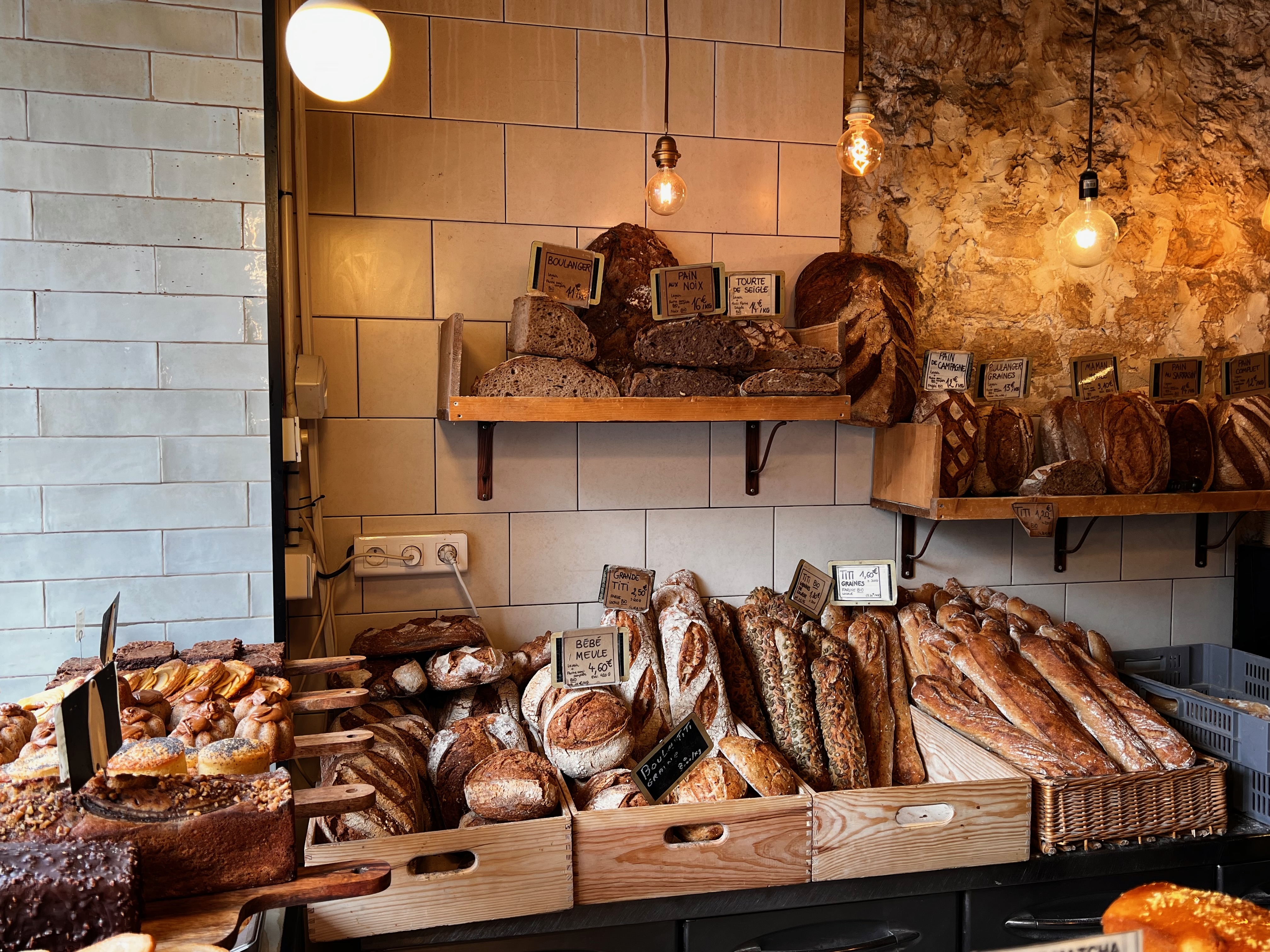
The most outstanding bread so far came from next to Goncourt metro: the Urban Bakery Goncourt, a branch of a small chain, with ten shops across Paris, which descibes itself as a “Boulangerie Engagée”. They do a wide selection of breads with different grains – rye and buckwheat as well as standard wheat – which  simply burst with flavour.

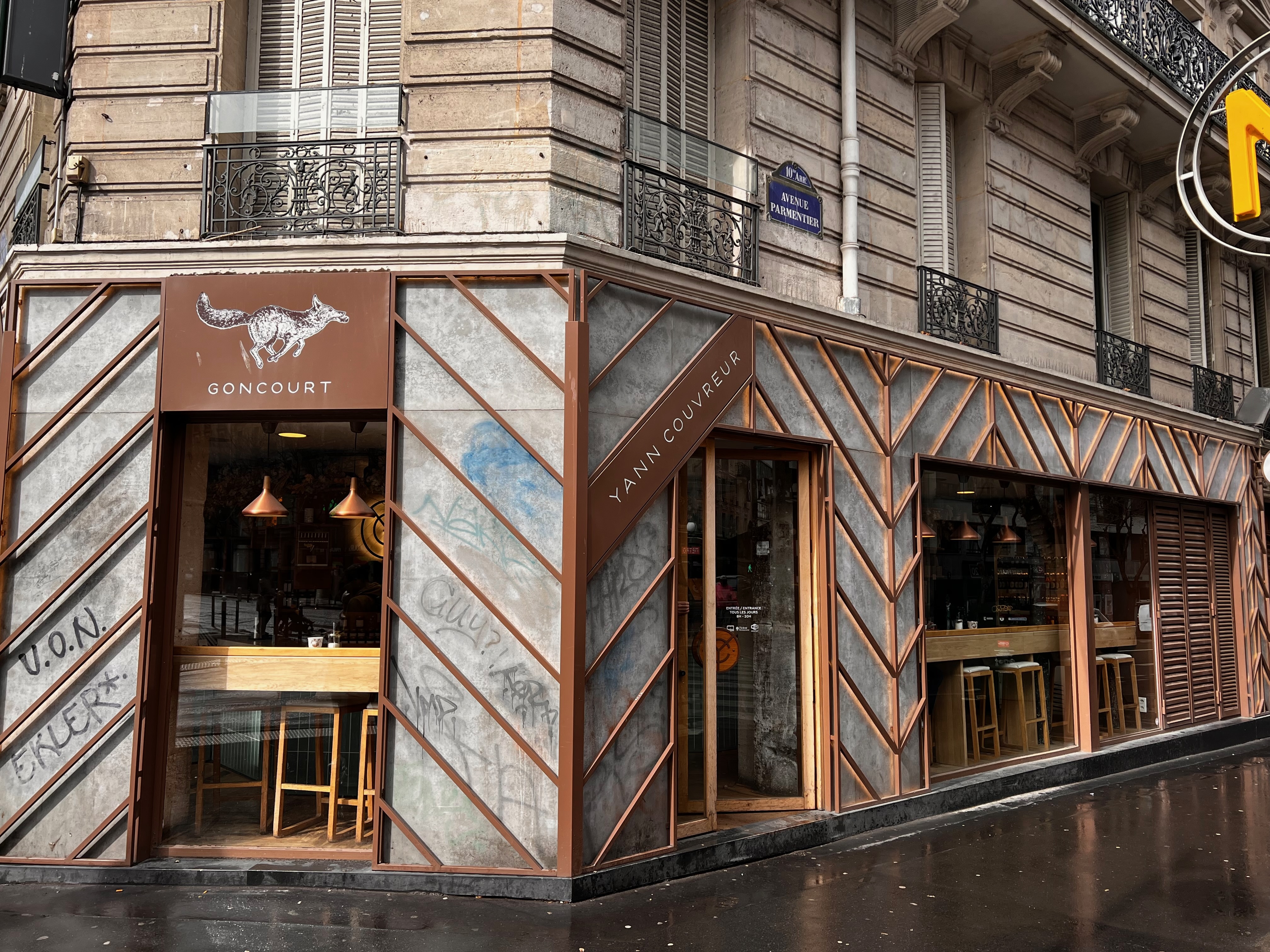
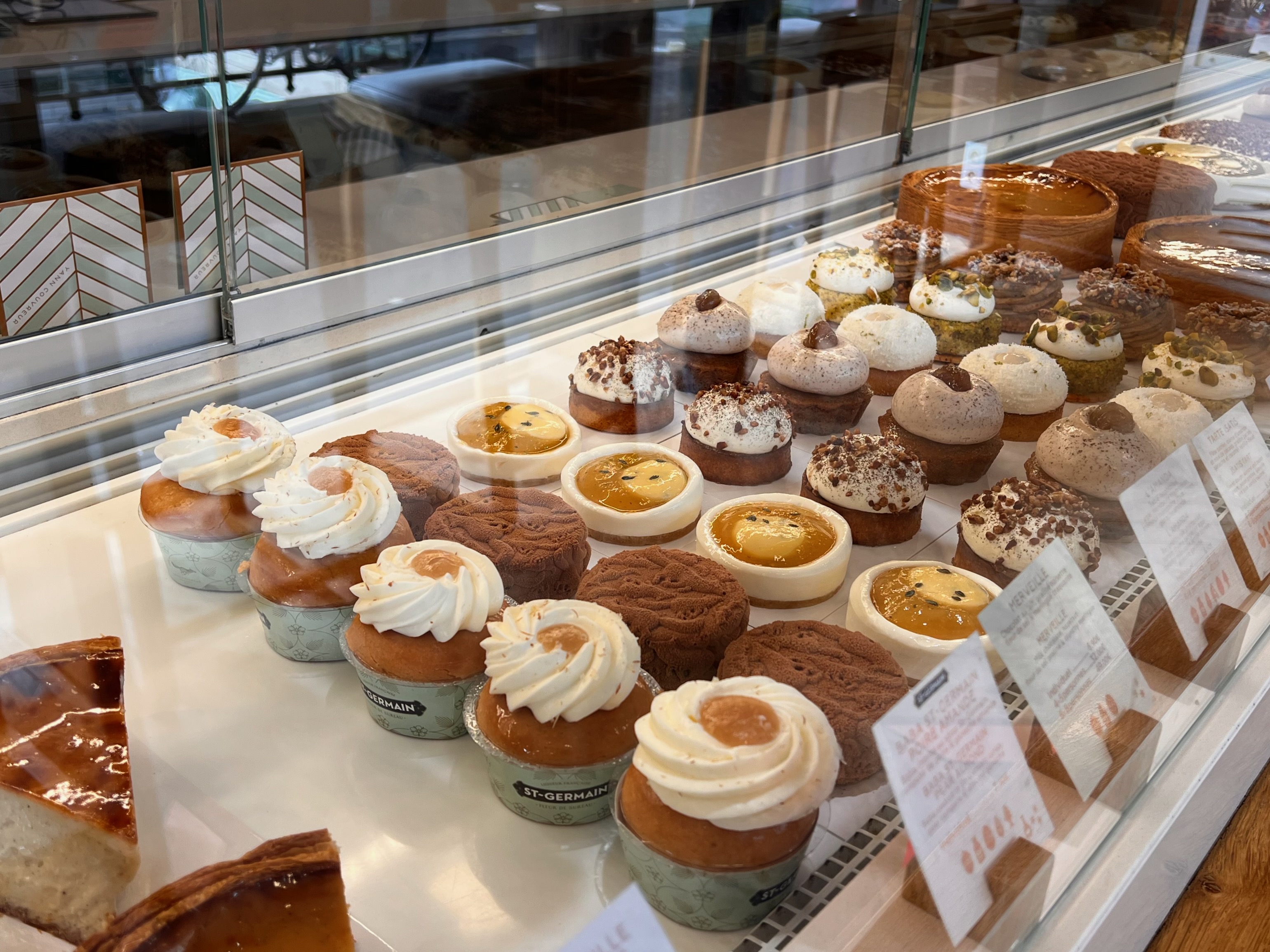
The Urban Bakery does some pâtisserie, though bread is clearly its main focus. However, it’s next door to Yann Couvreur, which doesn’t do bread but does uber-posh, innovative pâtisserie (at eye-watering prices, one has to admit). Couvreur is a famous pastry chef who also has branches in the Marais and in the main Galeries Lafayette, plus a café in town.

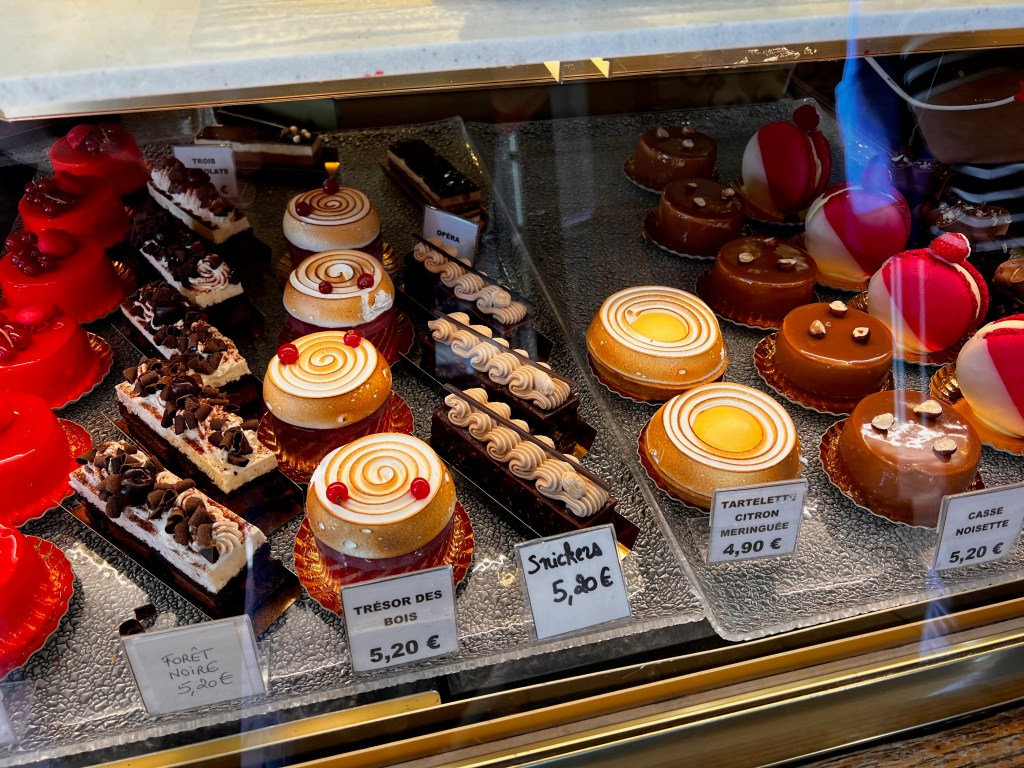
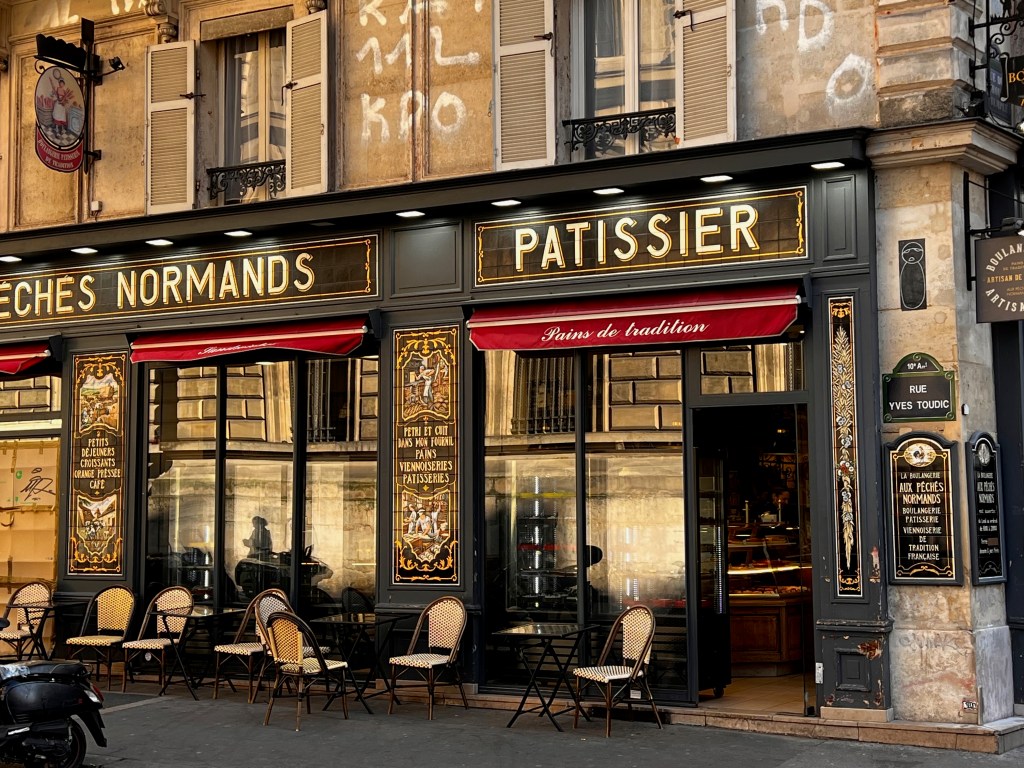
Nearer to République, Aux Péchés Normands does great bread and fabulous croissants and pastries, if perhaps not quite up to the refined levels above. But I can attest that their lemon meringue tartlets are a thing of beauty.

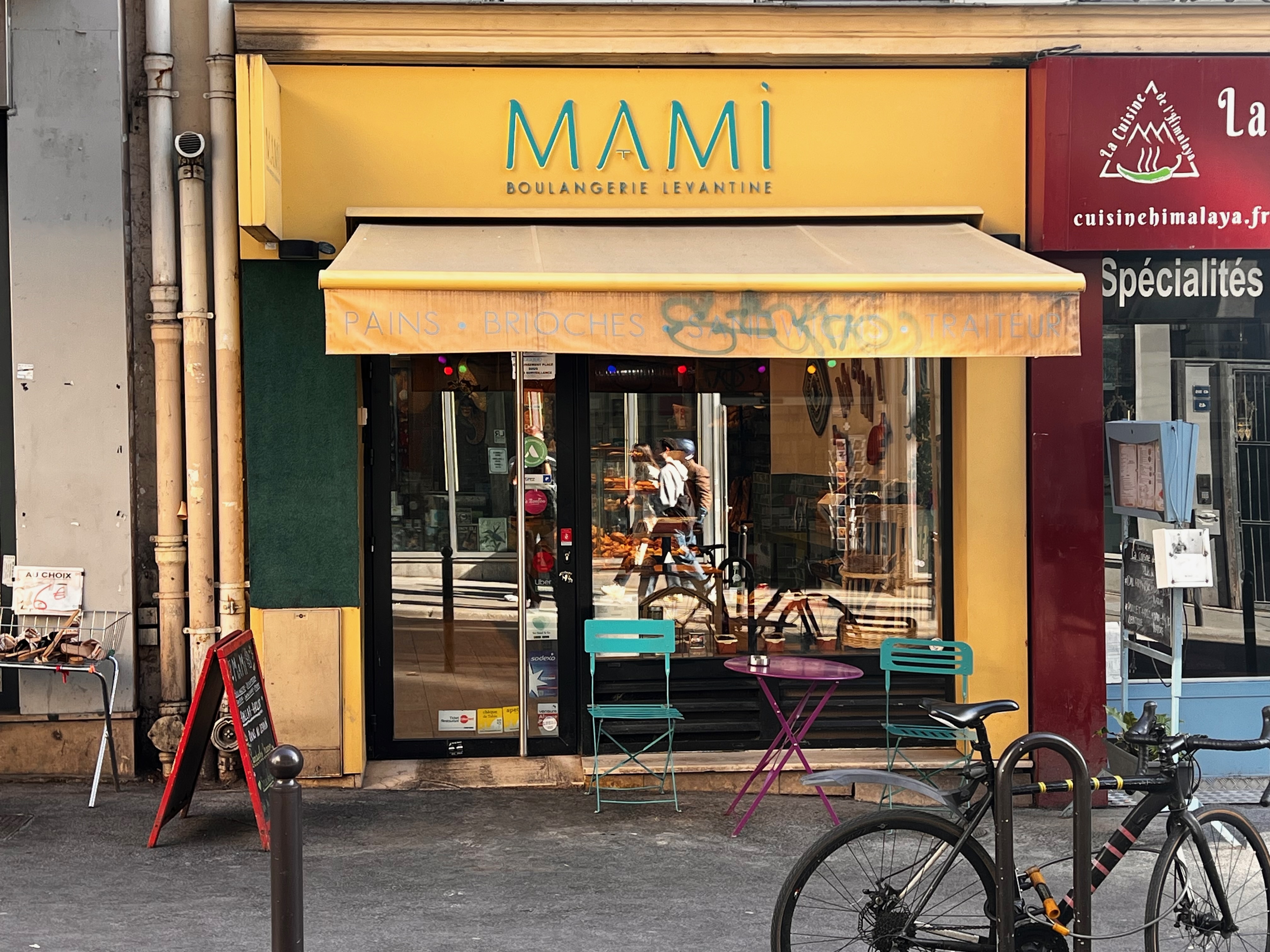
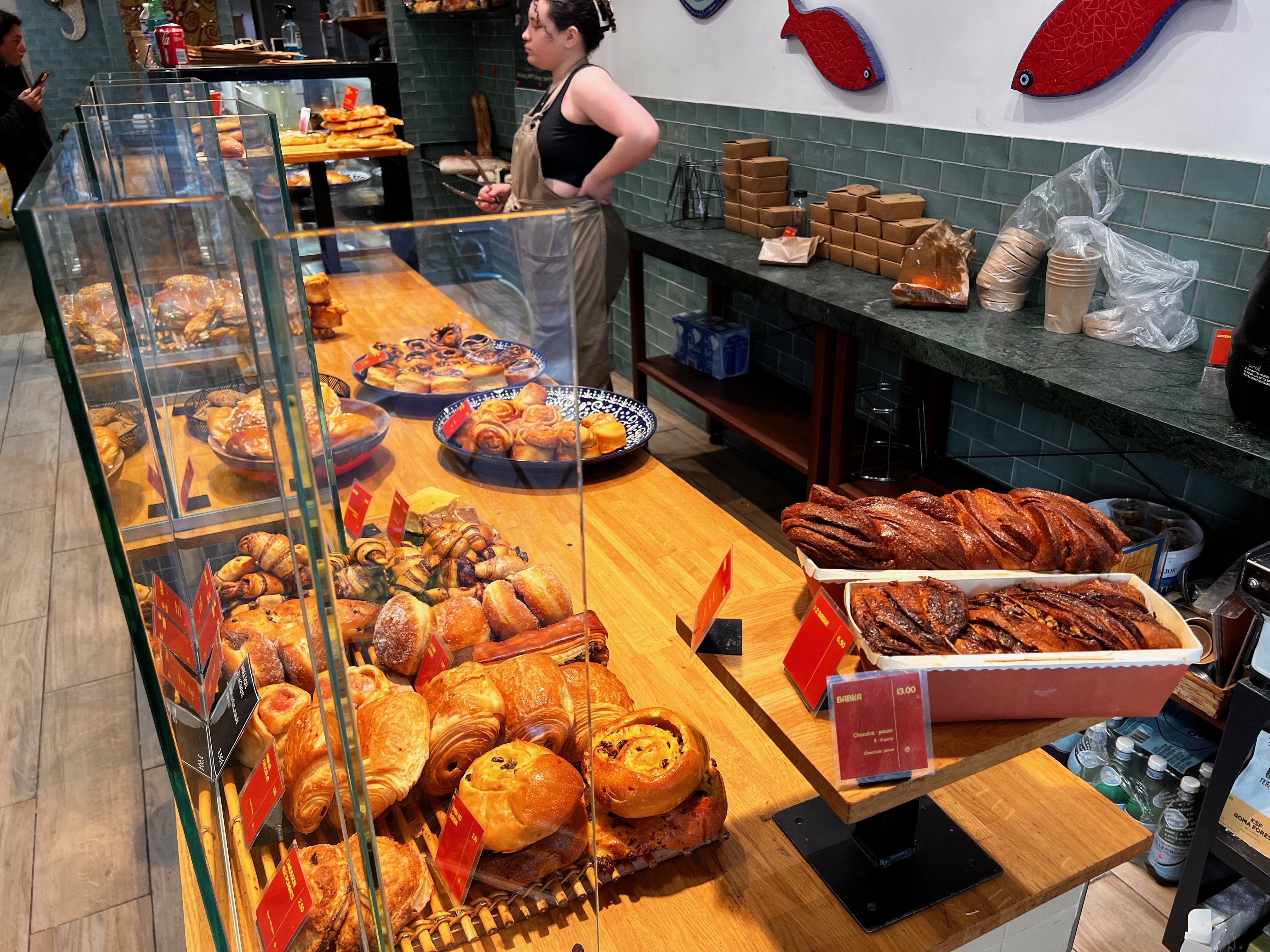
The really unexpected one was Mami, which describes itself as a “Boulangerie Levantine”. Taking its inspiration from all things Jewish and Middle Eastern, it has mouth-watering Babkas and a variety of Challahs, including a Za’atar-flavoured Challah, which is something I’ve never seen before but is quite delicious.

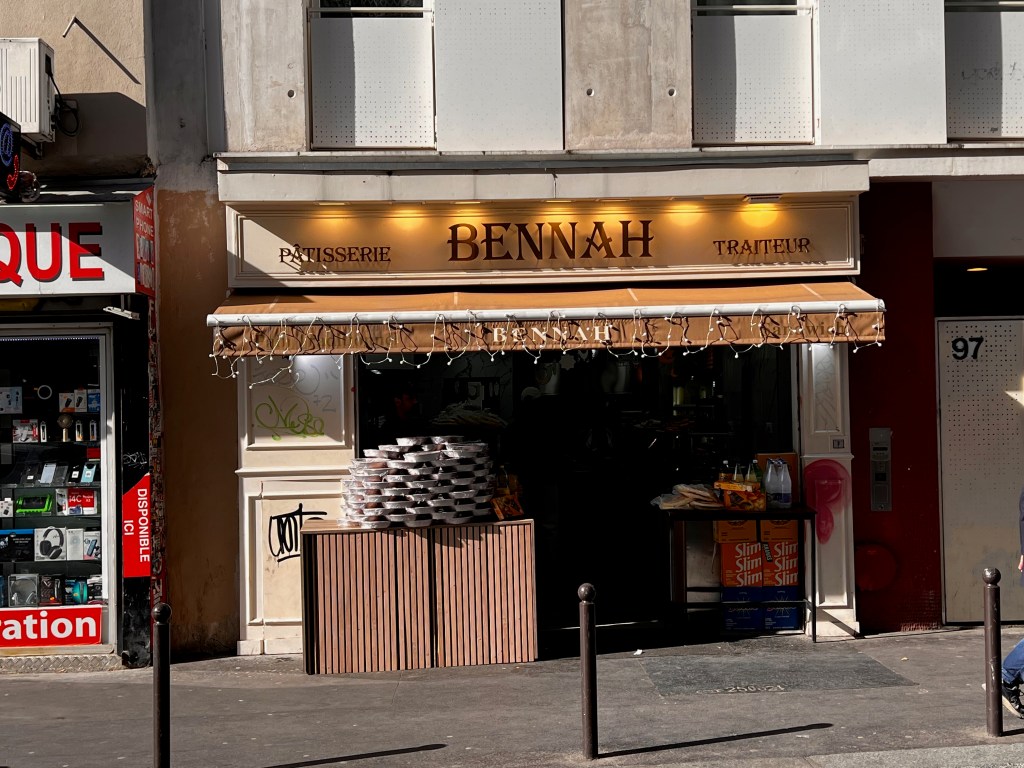
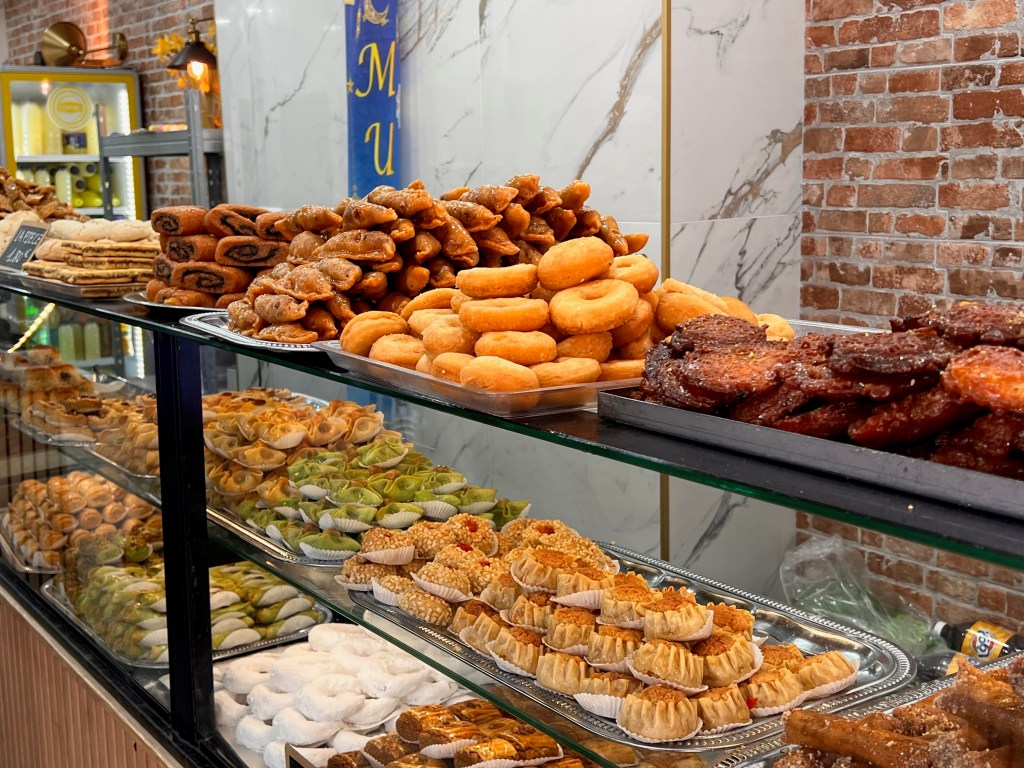
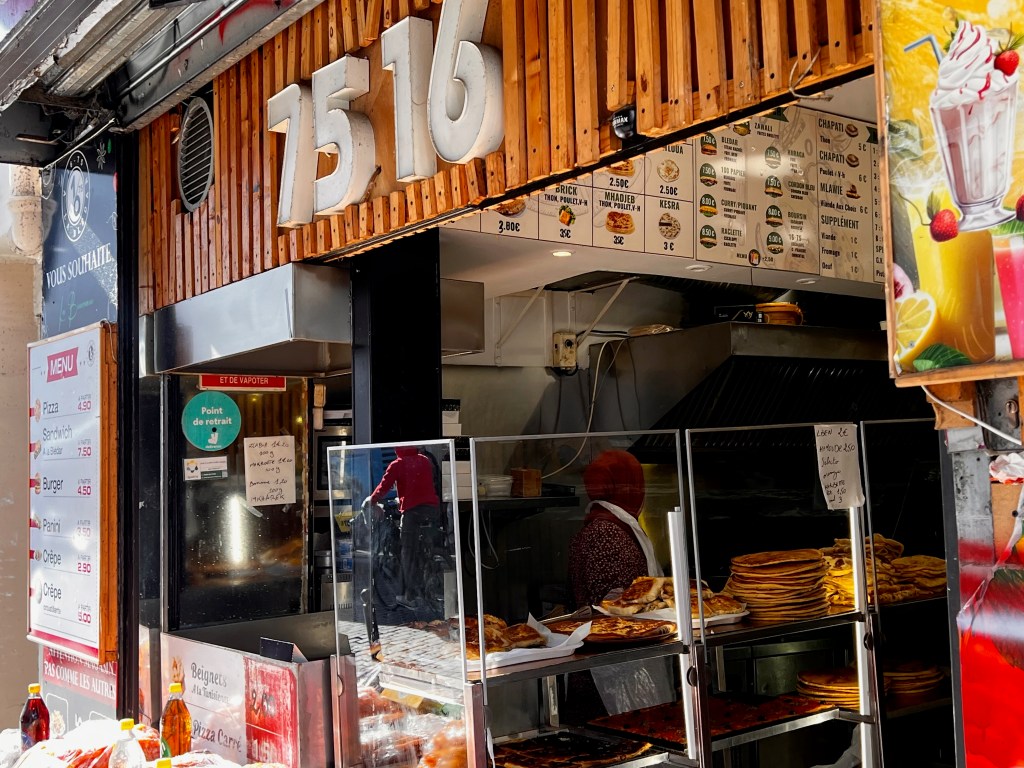
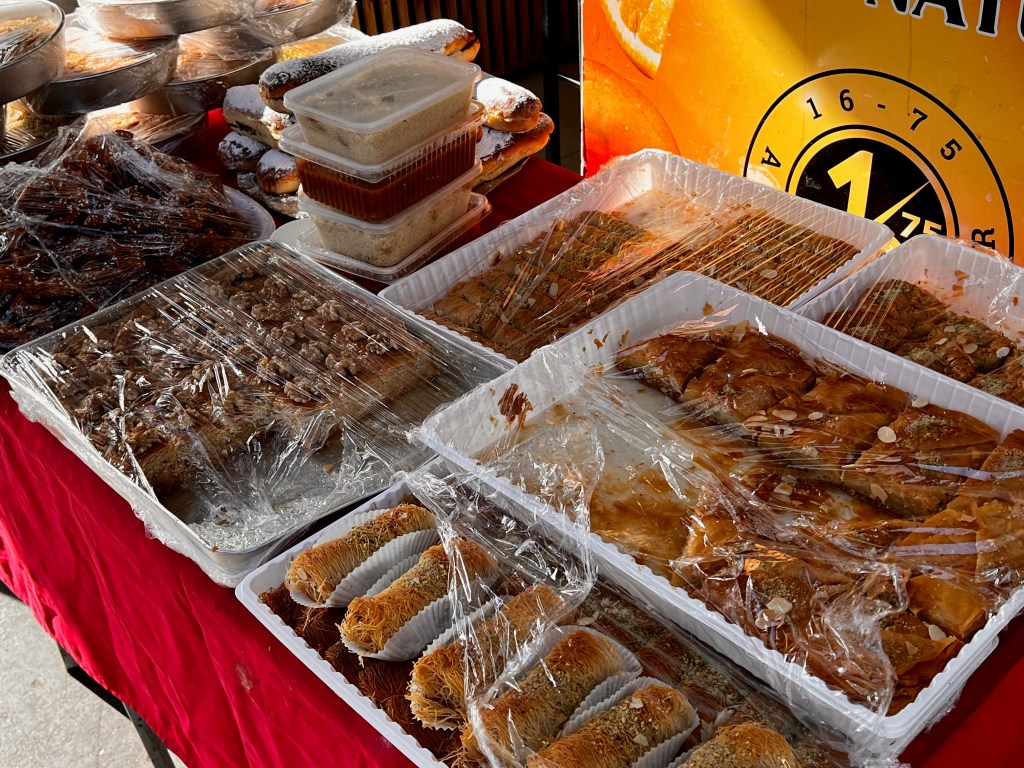
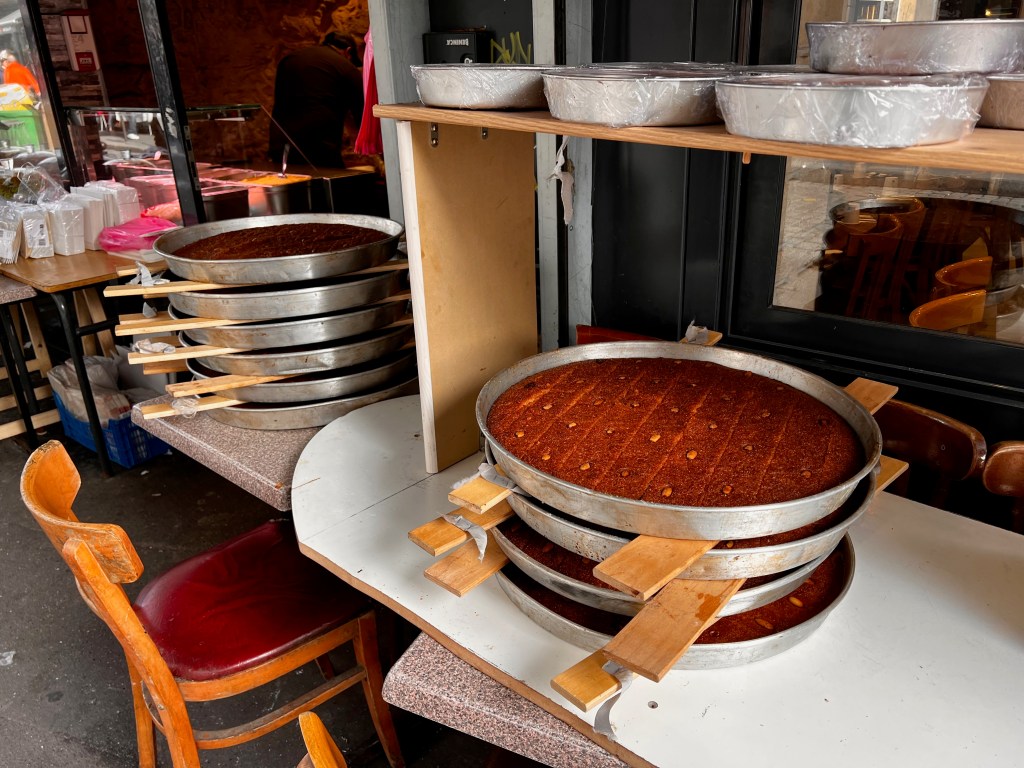
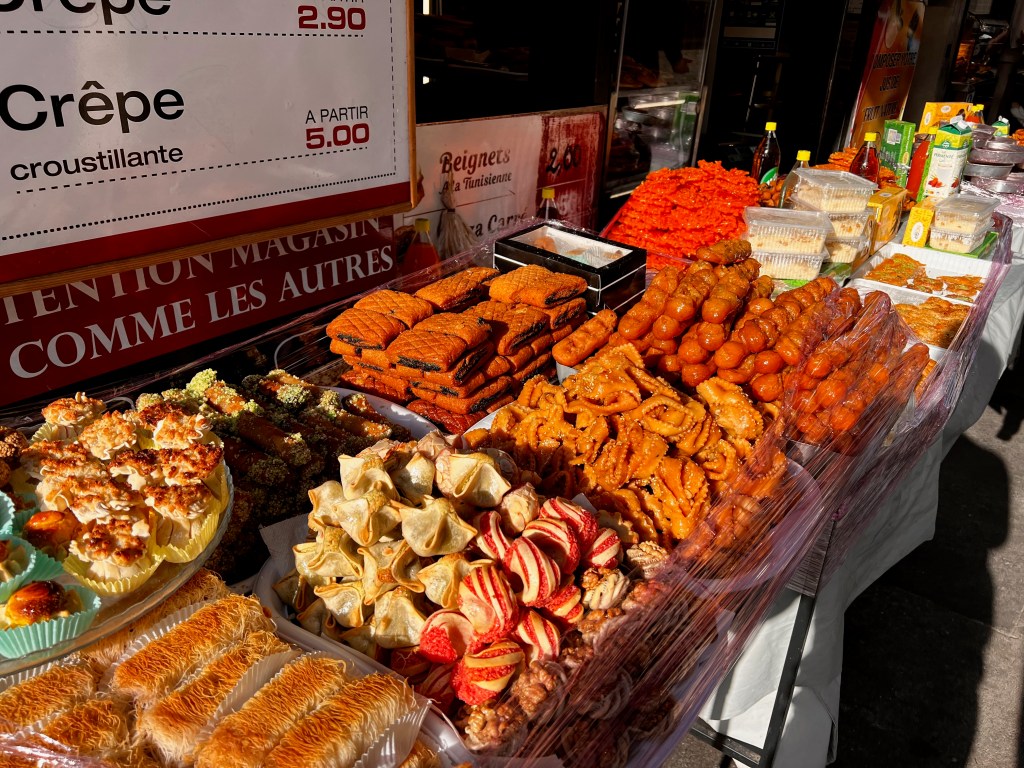
The area has many North African inhabitants (particularly Tunisians, it seems to me), resulting in the presence of many shops specialising in Arab and Maghrebi breads, sweets and pastries. It’s Ramadan at the moment, so every evening, there are vast arrays of goodies stacked on trestle tables outside the shops, which  wolfed down when the fast ends at sunset (to be fair, they also seem pretty busy through the day from both Muslim and non-Muslim shoppers). The one that seems permanently rammed is called Bennah – I took photos of three others and I probably missed a few.

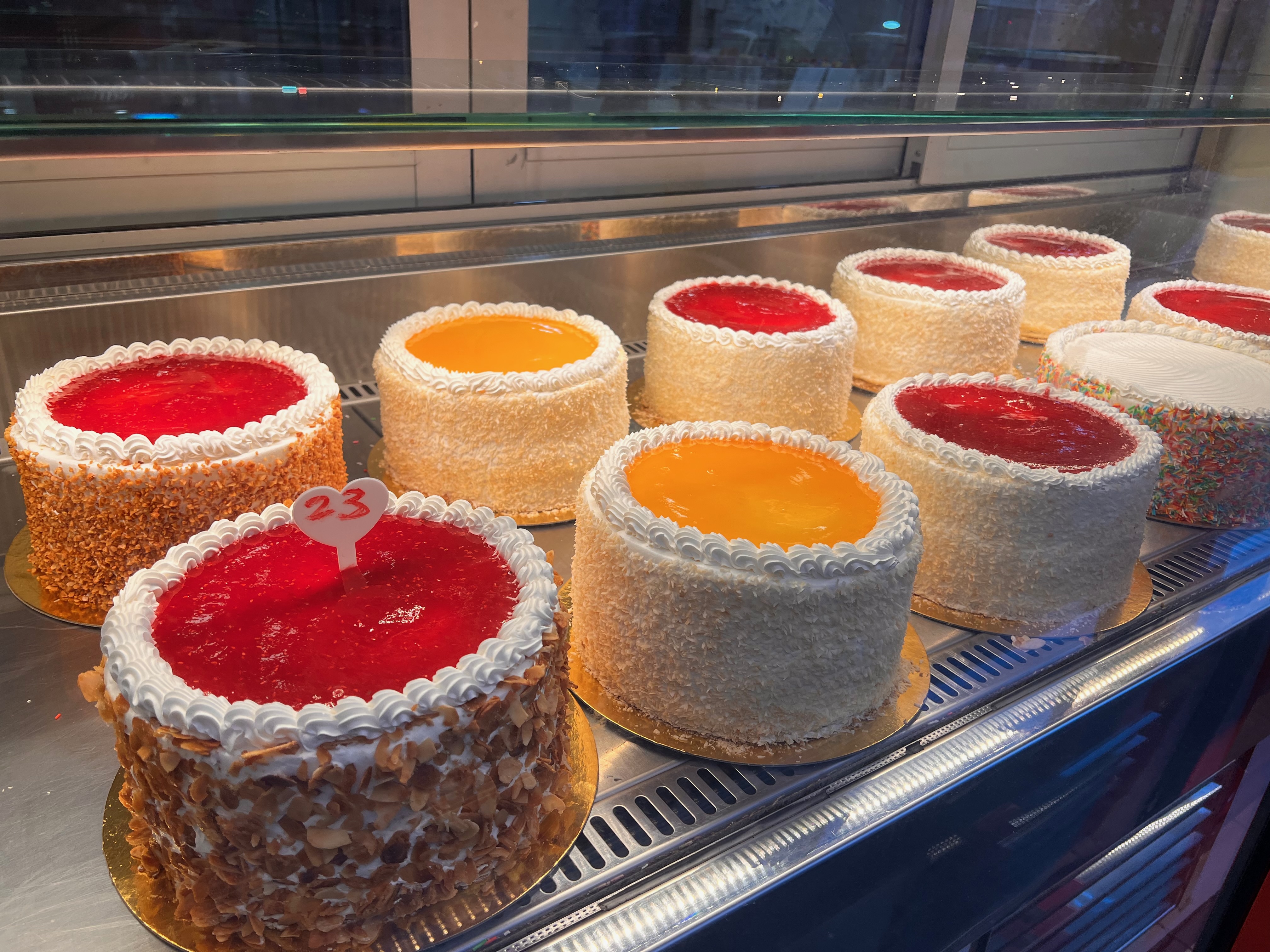
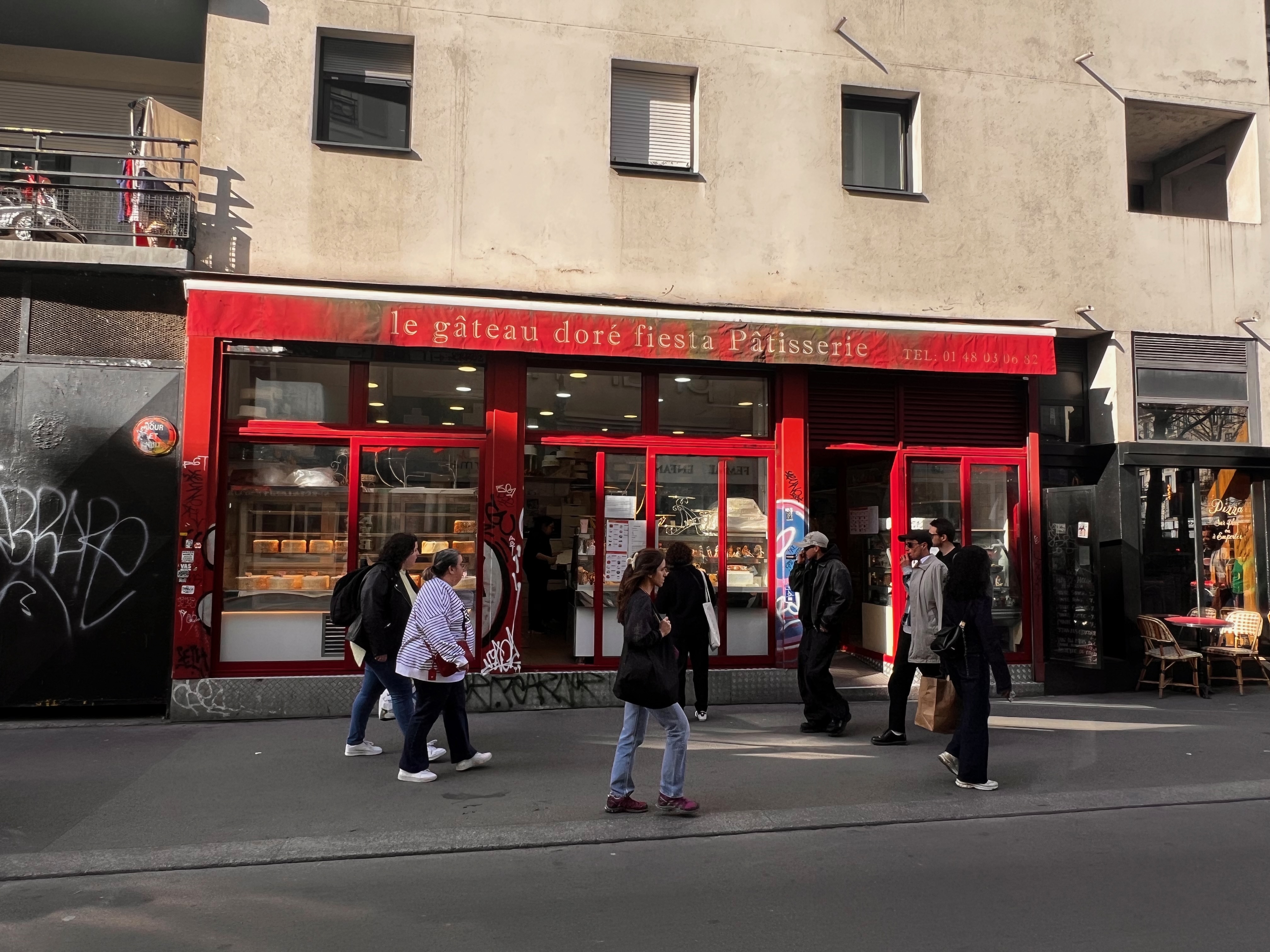
For something completely different, there’s Le gâteau doré fiesta Pâtisserie. It’s a cake shop which sells large cakes for birthdays and other events, apparently in large volumes. Its unusual feature, however, which has led me to dub it the “pornographic cake shop” is the array of scantily-clad plastic women in the window, waiting to adorn the birthday cake of your fantasies. (To be fair, there are also more conventional figures of brides and grooms, furry animals, national flags and so on).

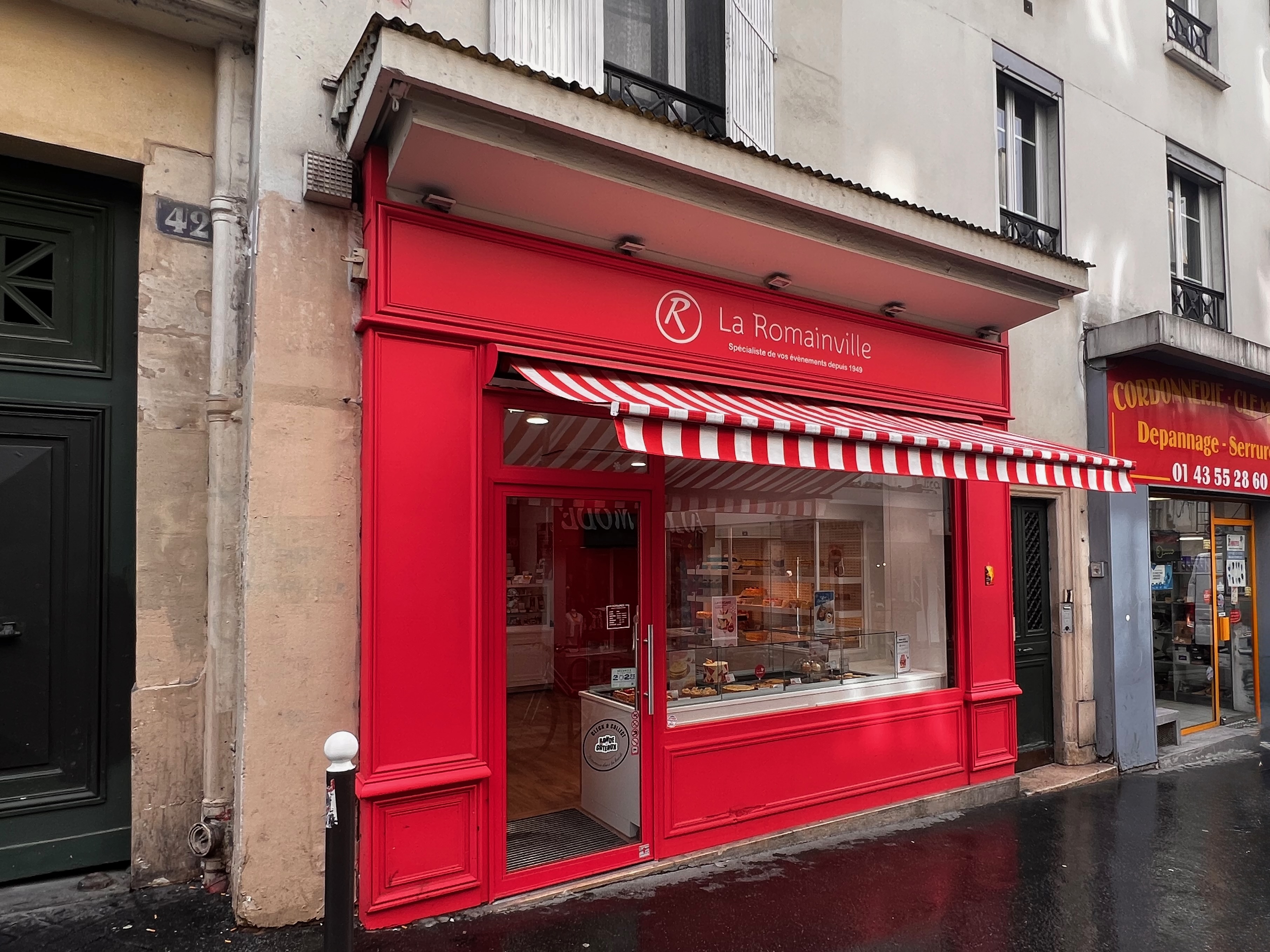
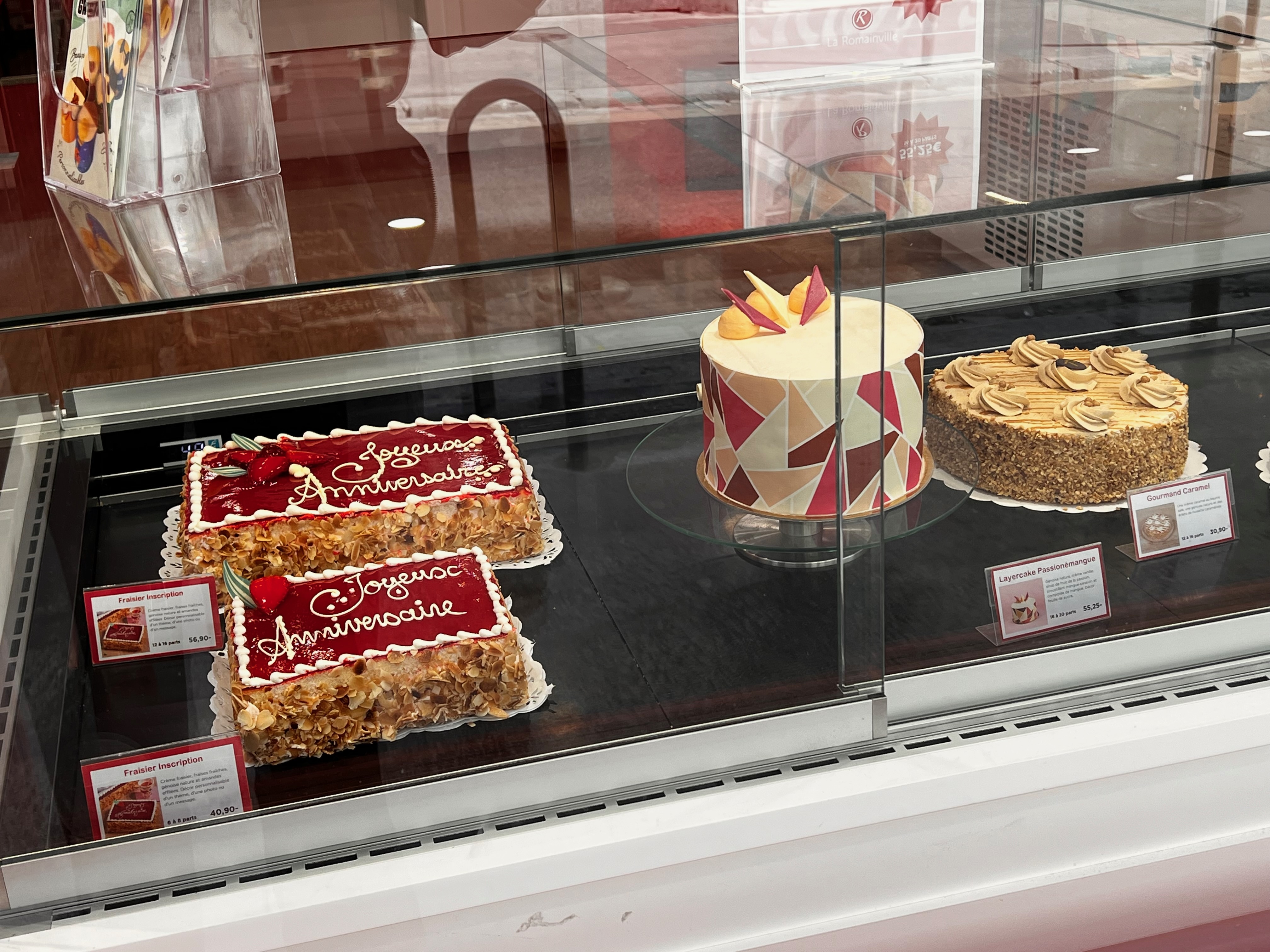
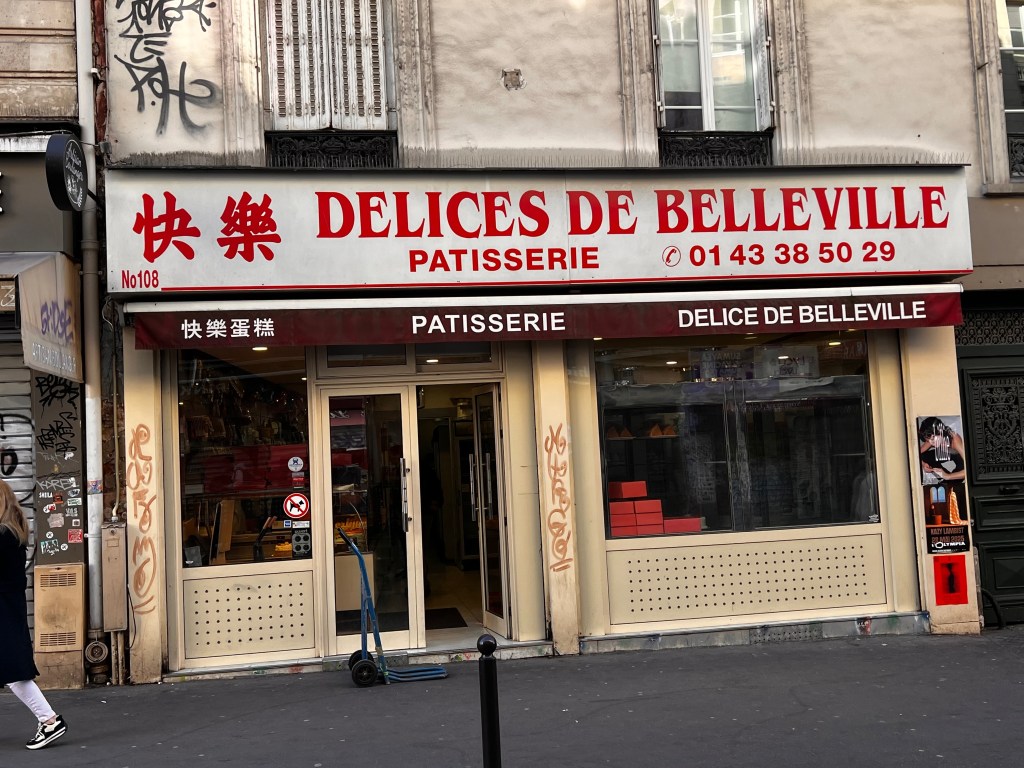
On the other side of the road from Le gáteau doré is a more demure looking (and possibly more upmarket) shop specialising in cakes for events, the Pâtisserie La Romainville. Another cake shop – the one nearest us, Délices de Belleville – is also labelled with the Chinese characters for “happy cake”.

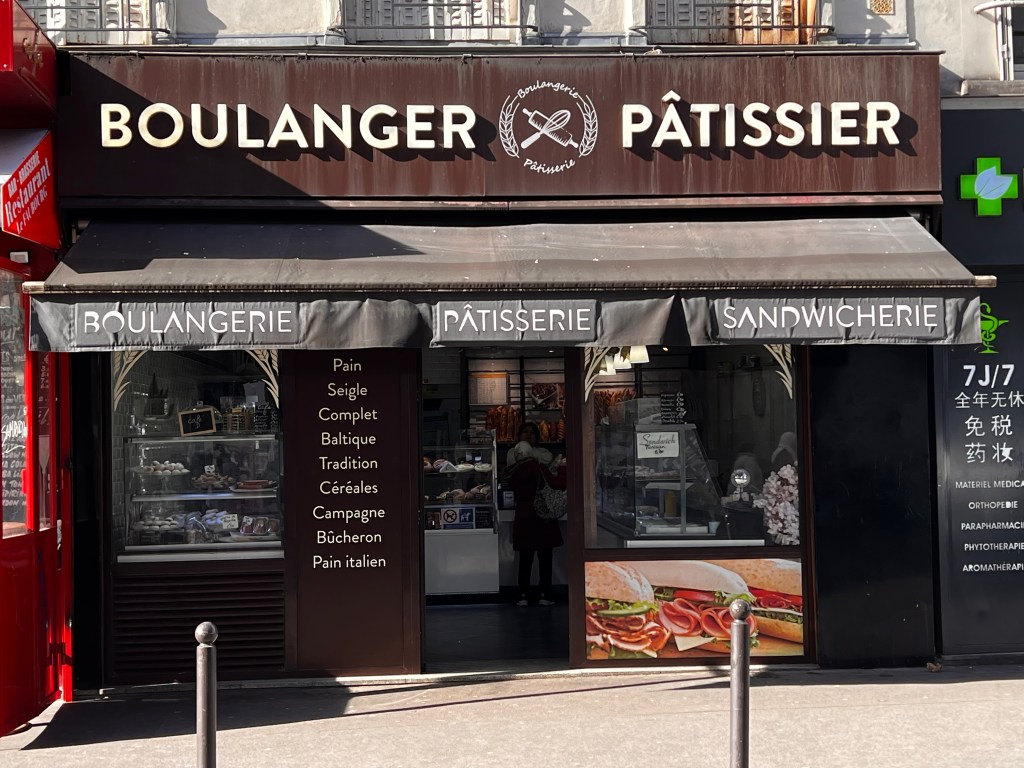
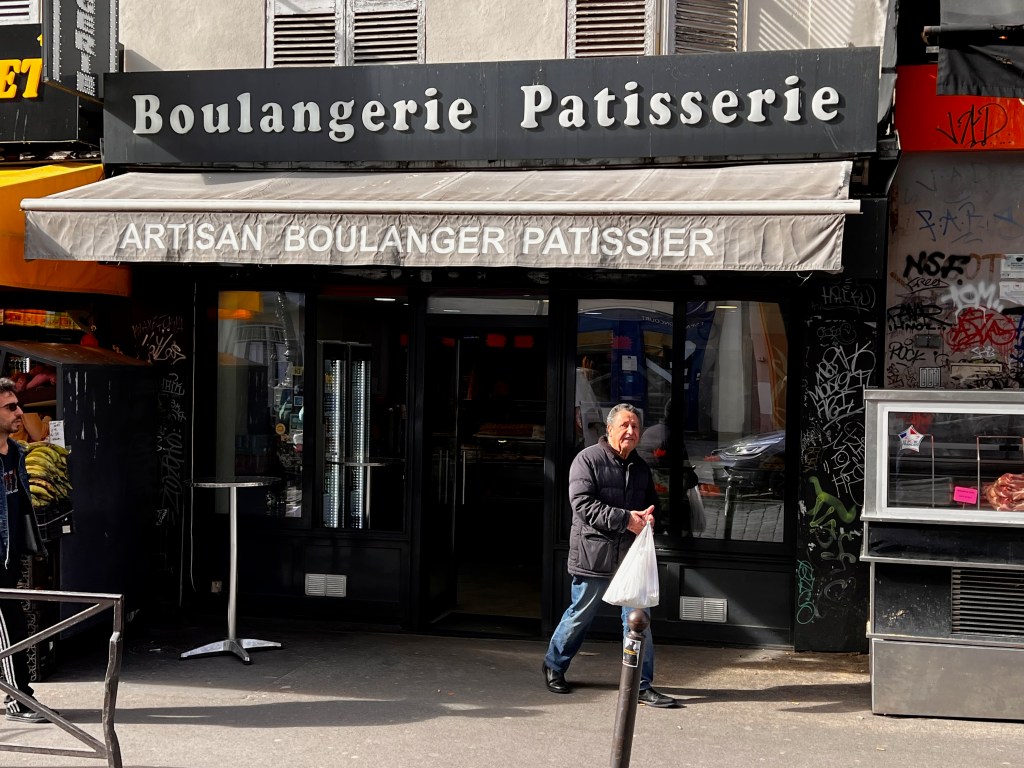
And there is no shortage of standard boulangerie-pâtisseries, the sort that will sell your morning baguettes and croissants as well as a variety of other stuff. Several of these don’t even have a brand name attached and are just labelled Boulangerie Pâtisserie or Artisan Boulanger Pâtissier or similar.

And that’s not counting the several supermarkets along the way that will sell you bread, croissants and cakes. I don’t think I’ve ever seen a place where you can’t walk for 50 metres without running into a bakery, and I’ve certainly never lived in one. And I love it.

Porto: a kaleidoscope of today’s Portugal

Porto: a kaleidoscope of today’s Portugal

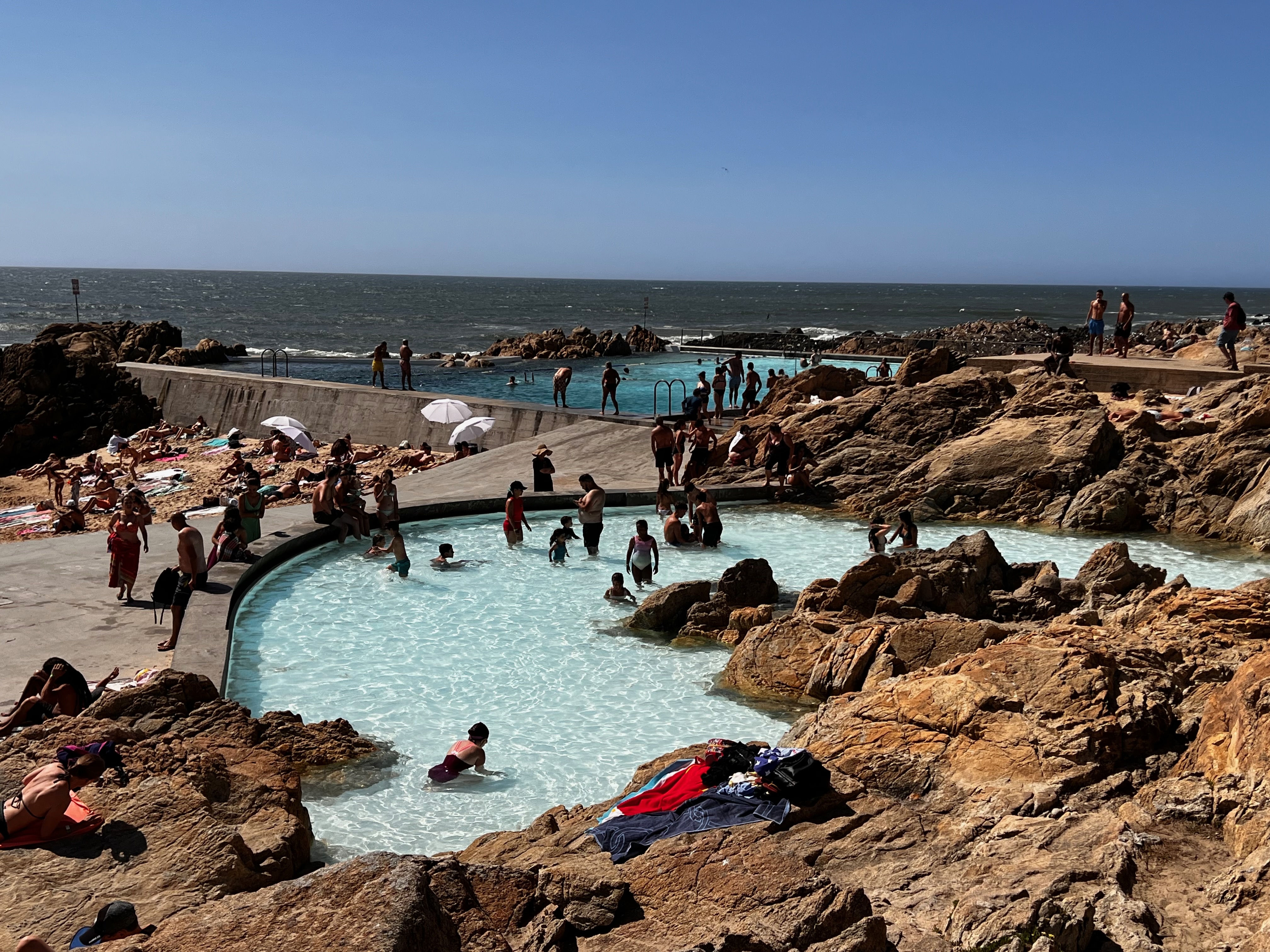
A visit to Porto is a kaleidoscope of different aspects of Portugal: the old and the new, the vibrant and the sleepy, the glitzy with the derelict – overlaid with the cultural flavours of the country, some of them authentic, some of them artificial. We spent three nights in Porto at the start of a road trip from north to south of the country: here are some things we saw and some impressions.

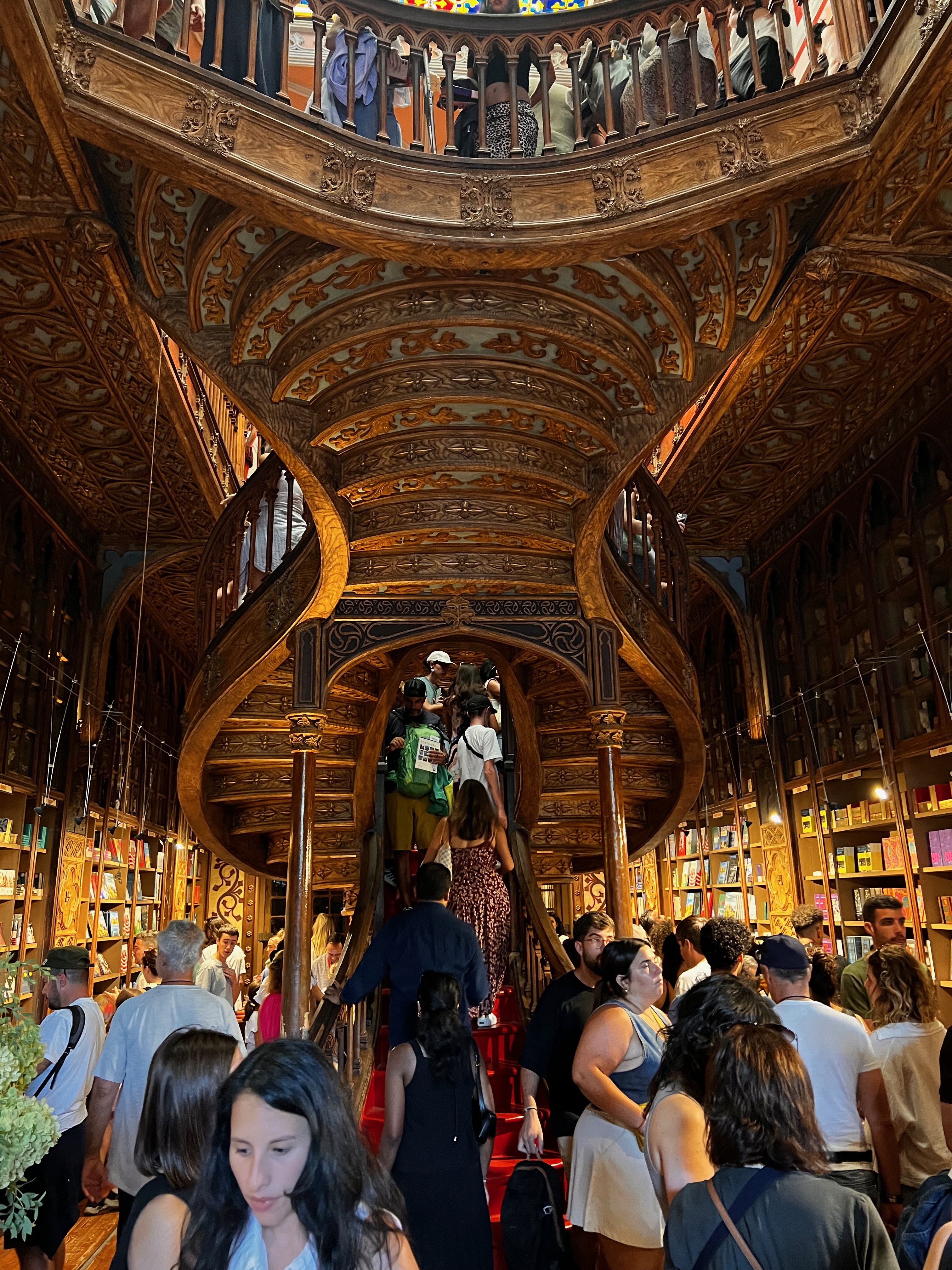
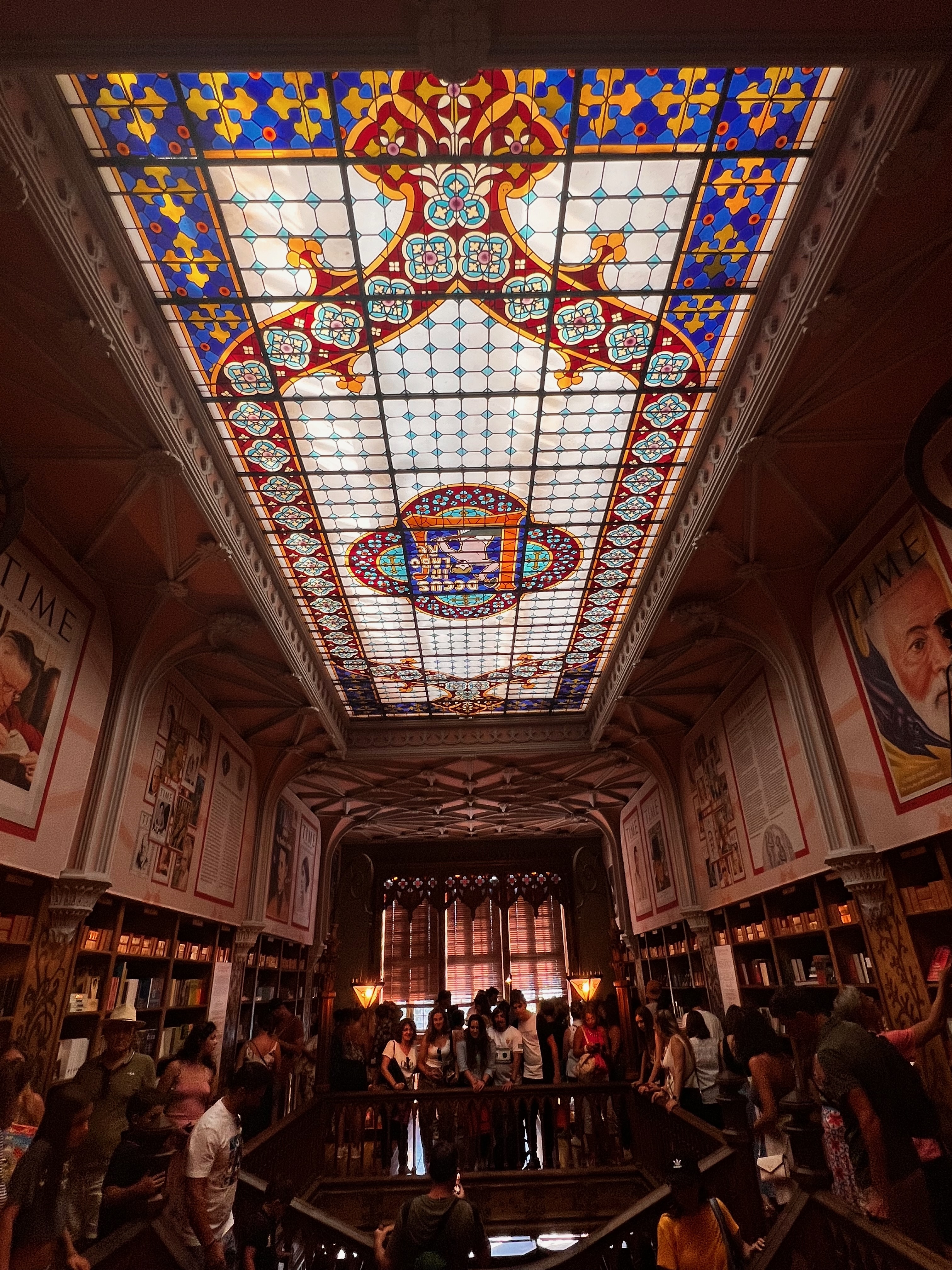
One place that sums up many different faces of the city is the Livraria Lello. Built in 1906, it boasts truly stunning Art Deco architecture with a central staircase, pretty enough to have been described as “the most beautiful bookshop in the world” by a 2006 article in El País. That strapline has been taken up enthusiastically by the owners (along with the probably apocryphal story that the shop inspired scenery in the Harry Potter books), and the Livraria Lello now attracts zillions of visitors at €8 a throw, refundable against purchases. It’s clearly a favourite with the Instagram community, so you have to book your time of entry in advance online and keep to it. Most time slots sell out, at least in summer.

The bookshop is full of treats for serious and infrequent readers alike (a large section of José Saramago for the serious, beautifully bound translations of famous works of literature into many languages for the souvenir hunters. This is the Portuguese taking their heritage and turning it into a tourist attraction – and by the way, the owners use the profits to fund other heritage activities: recent ones include restoring a theatre and acquiring a classic book publisher.

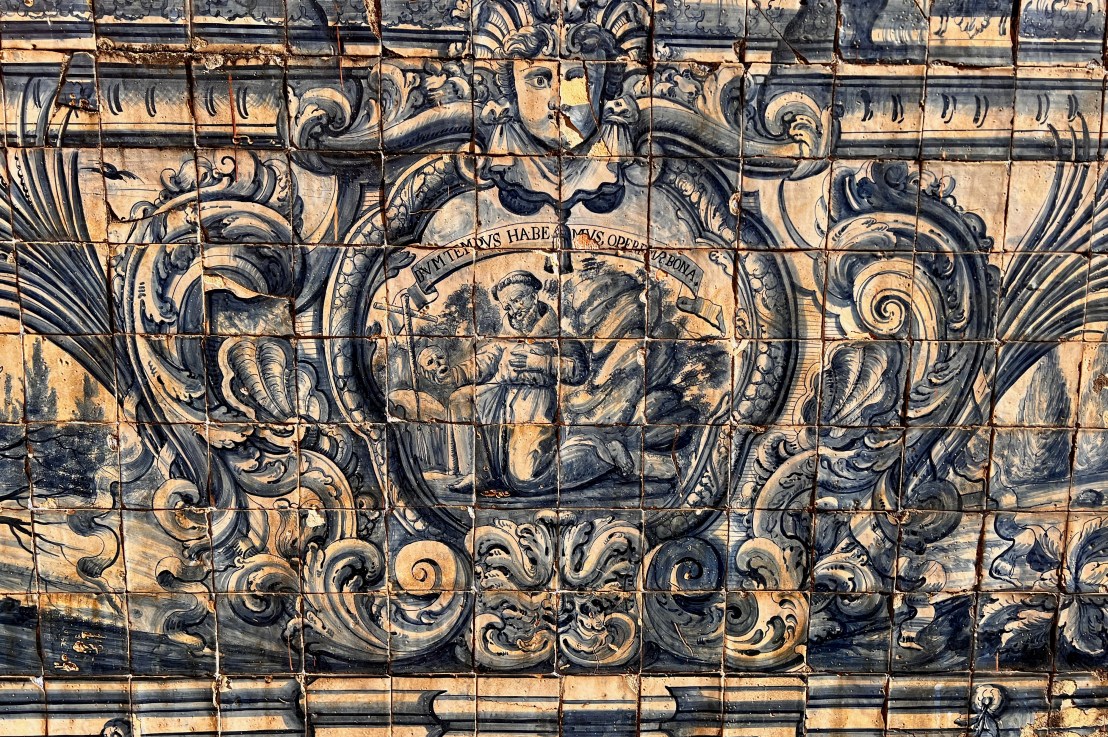
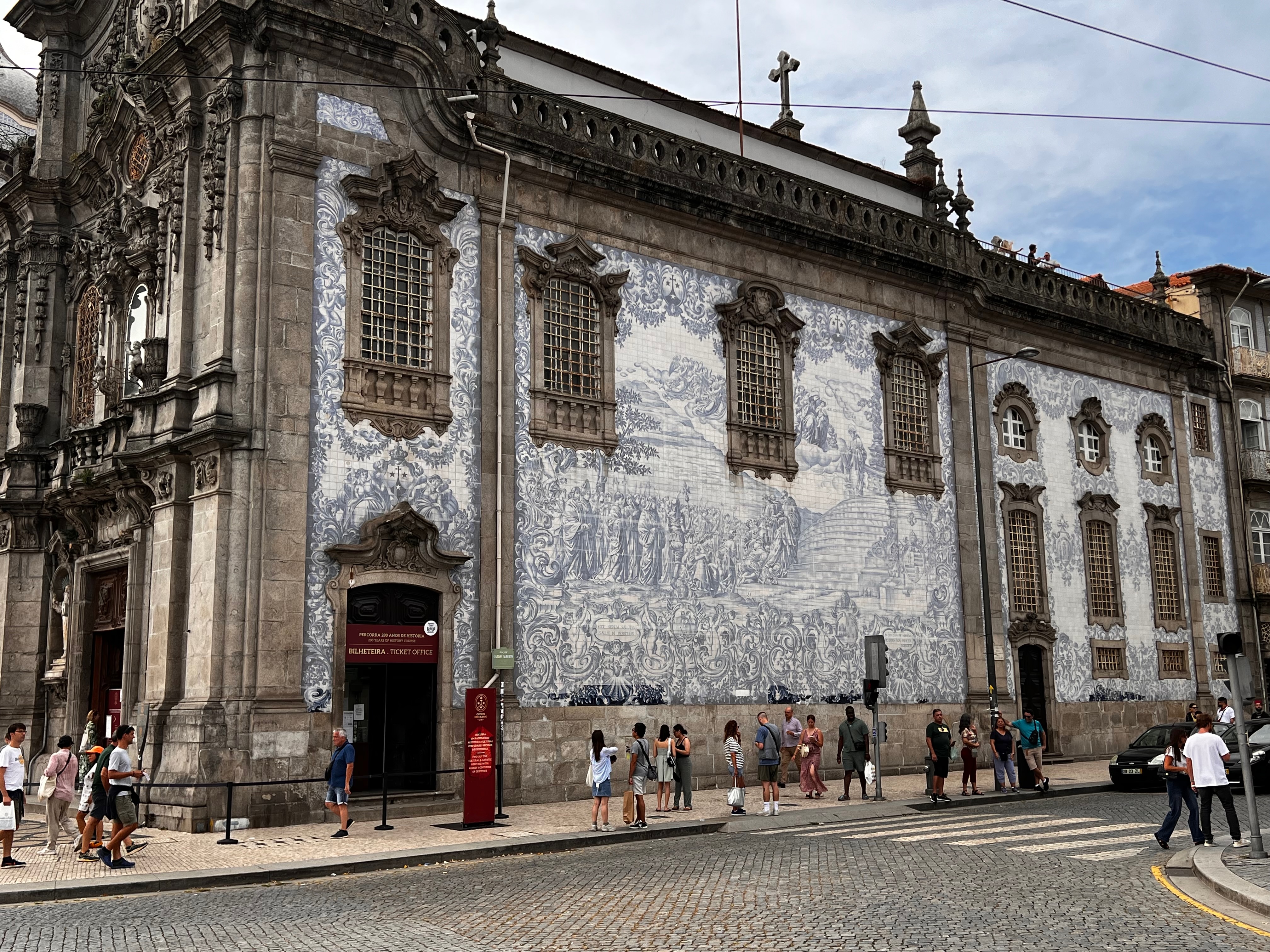
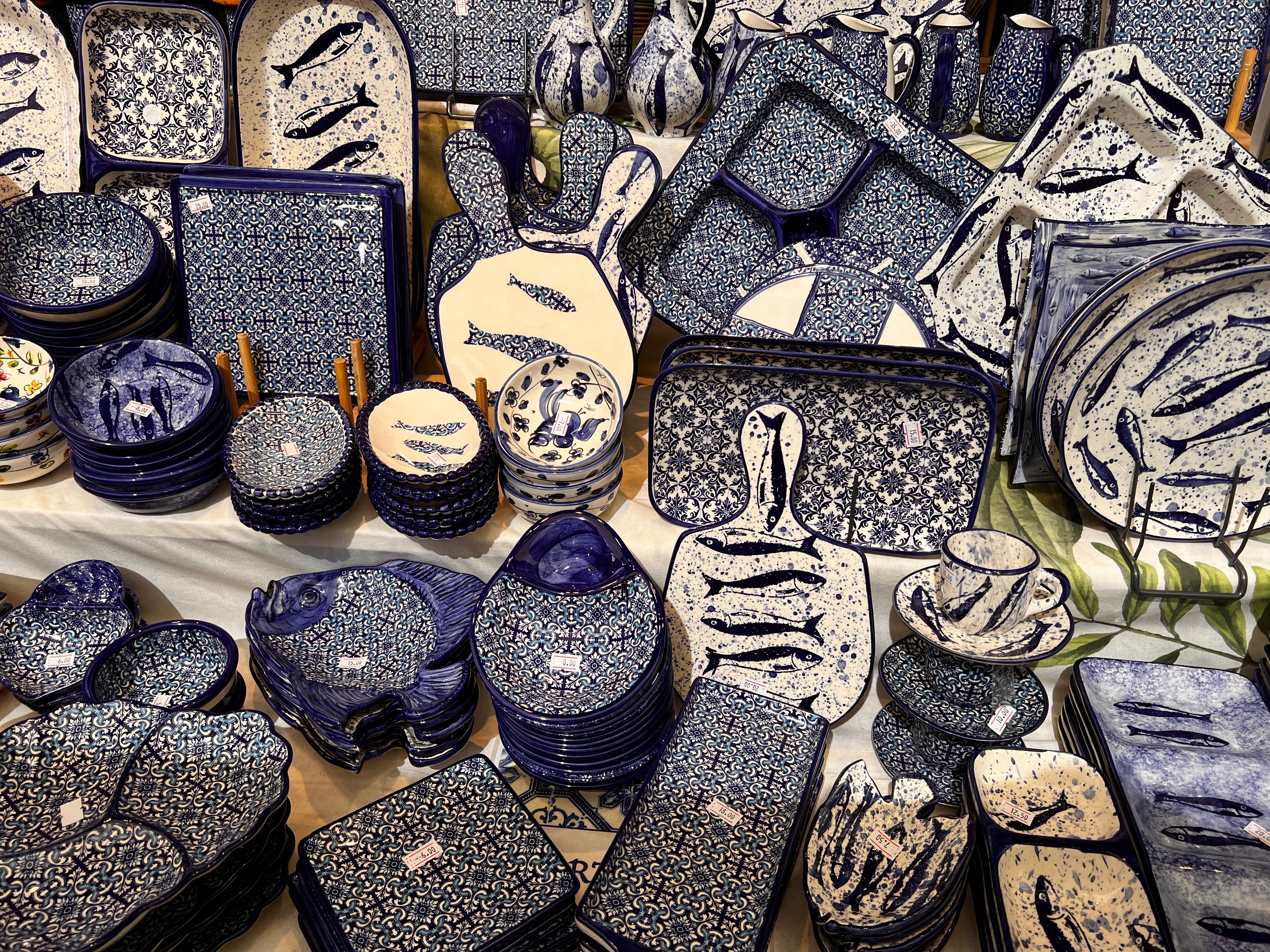
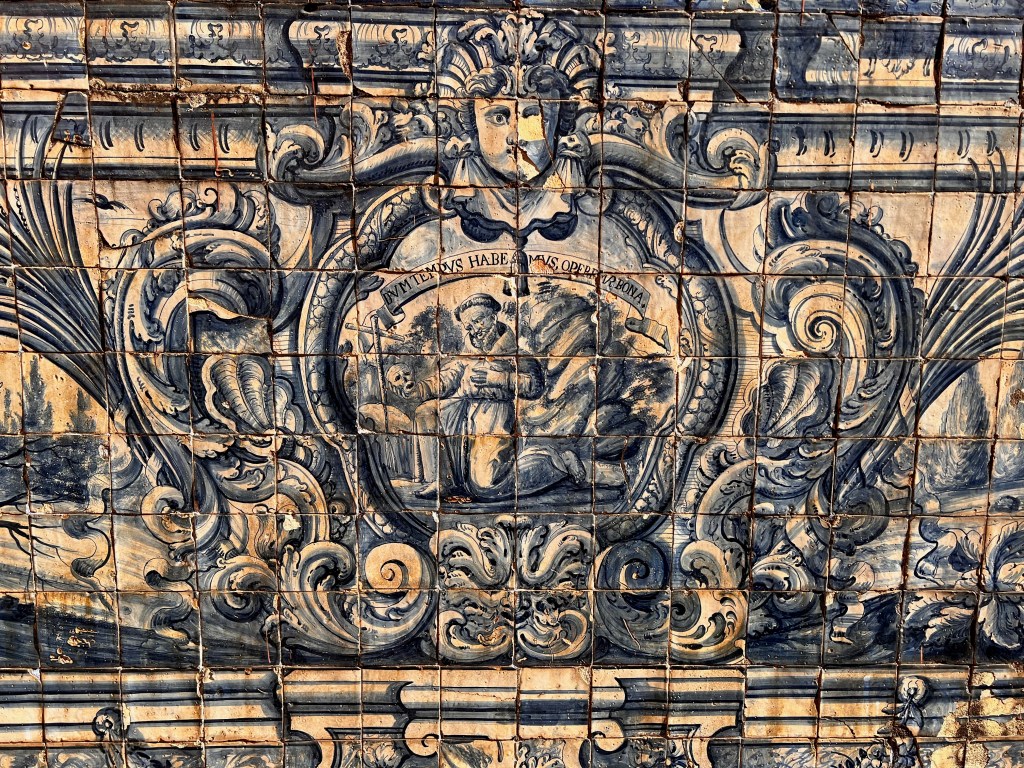
Turning right on exiting the Livraria Lello, a short walk up a steep hill gets you to the Igreja do Carmo (Carmo Church) and Carmelite Monastery, whose outside shows you another omnipresent feature of Porto (and Portugal in general): exquisite blue and white wall tiles (“azulejos” in Portuguese – although confusingly, the word is not derived from “azul”, meaning blue). The ancient tradition of tile-making is alive and well, so you’ll see tiles everywhere: on inside or outside walls of buildings of every kind, on graves, as tableware. We even saw a set of gorgeous tiles in the humble interior of a coin-op launderette.

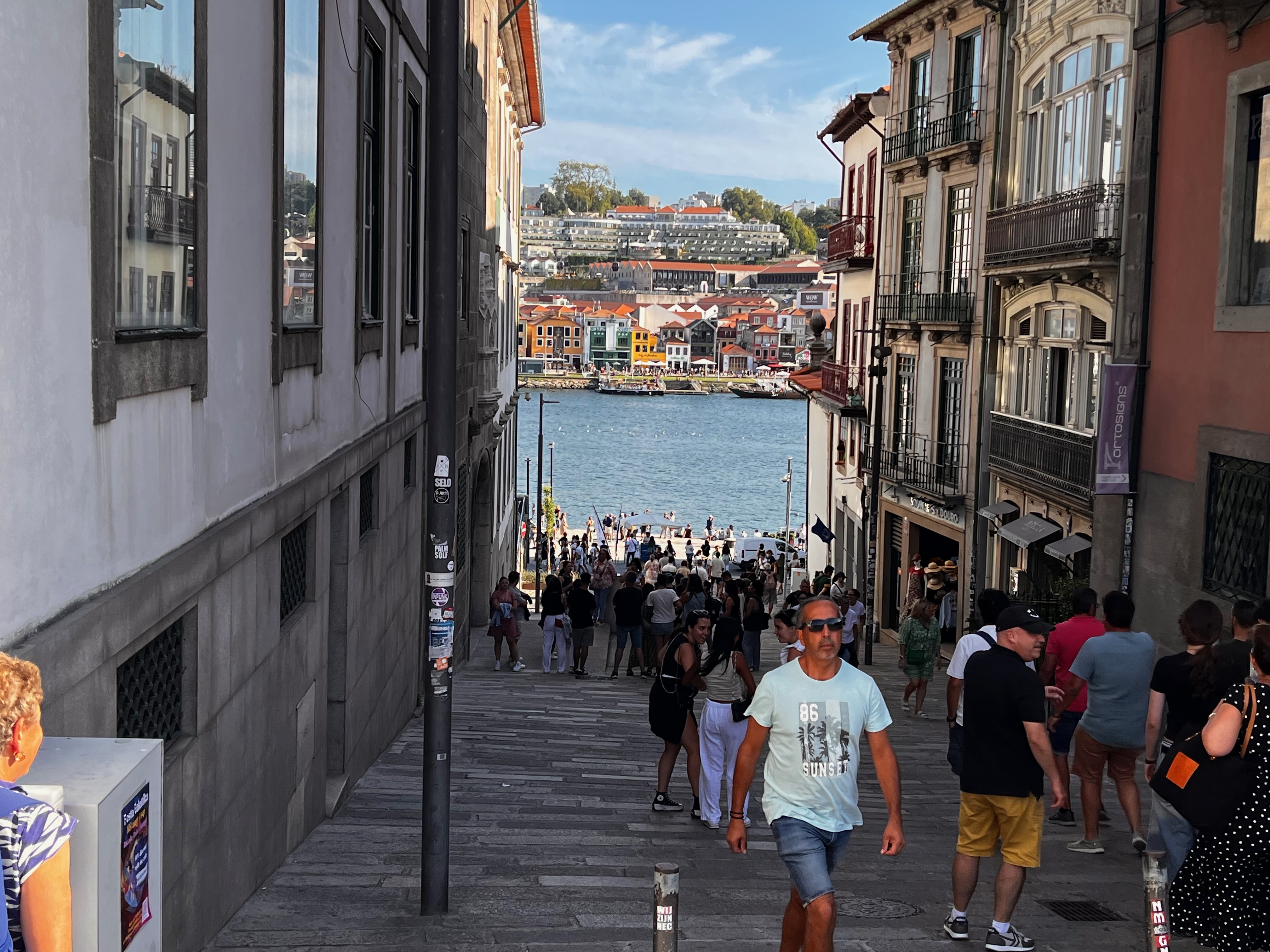
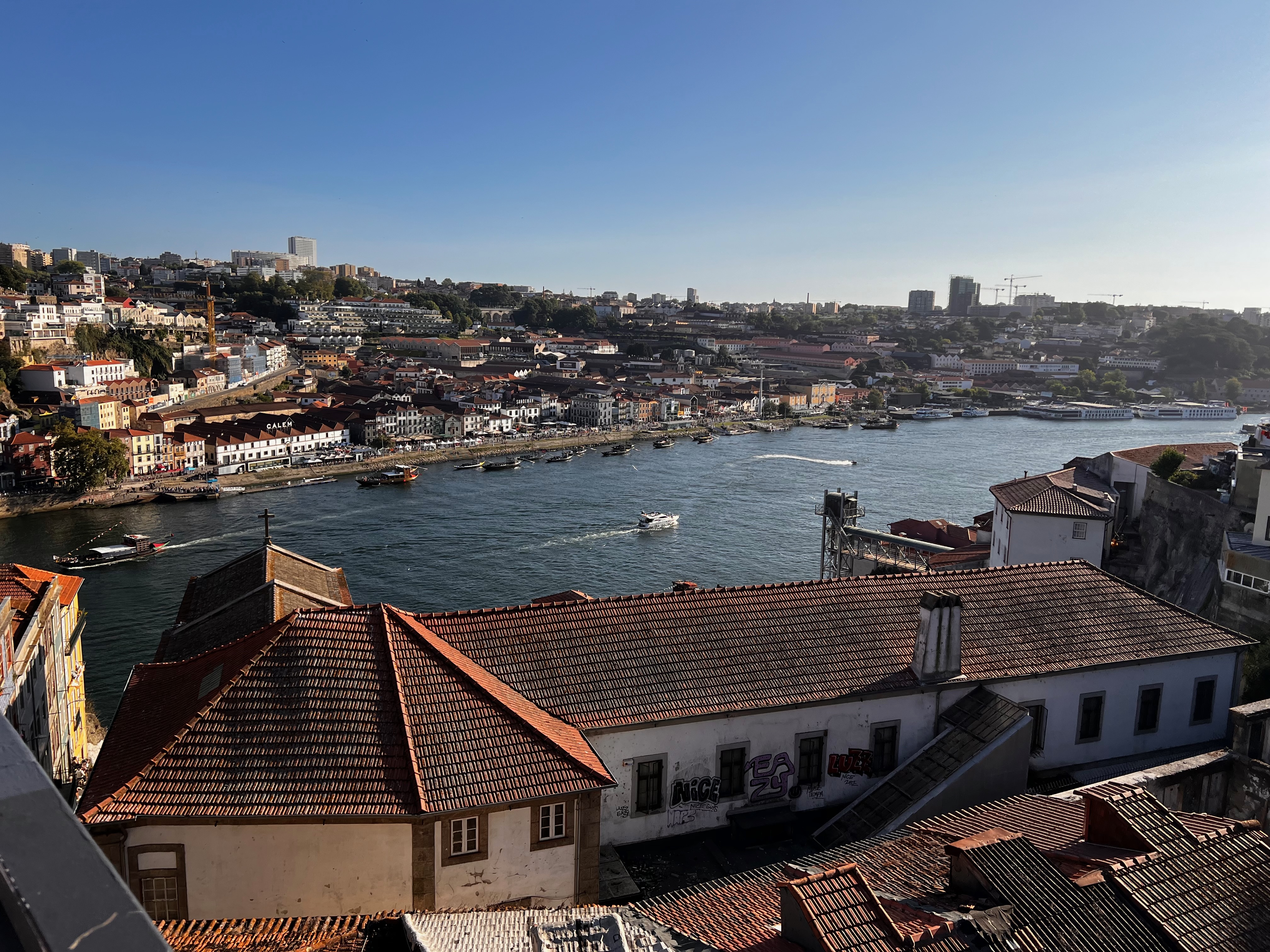
Steep hills, you’ll soon discover, are a feature of Porto. The city is built on a steep incline leading down to the river Douro, but that’s just the start: the topography just seems crinklier than other places, and you’re continually going up and down vertiginous inclines to get from one place to the next. It makes for spectacular views across the city from all manner of places, with most of the best viewpoints occupied (of course) by the many churches.

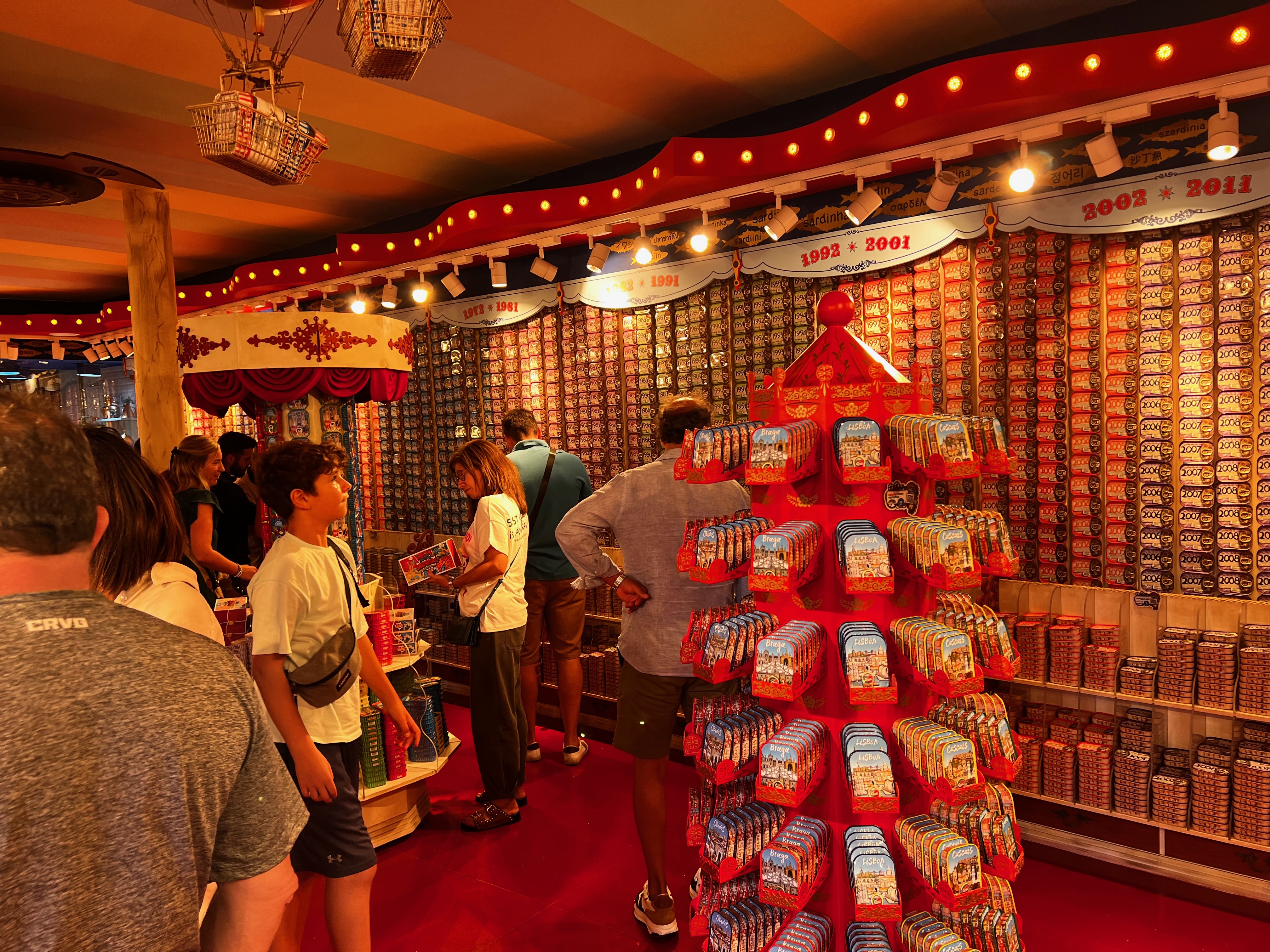
Working your way downhill from the Igreja do Carmo or the Livraria Lello and keeping the Sé (the cathedral) on your left, a maze of streets leads you down to the waterfront, known here as the Ribeira. On your way, you’ll see Porto in its full incarnation as a tourist centre, at all levels of the market. There are sleek, trendy-looking hotels, either new steel-and-glass or conversions of old buildings. Ordinary mid-priced hotels abound. You’re awash in  tourist-oriented “sample the local food” eateries offering pastéis de nata (the iconic Portuguese custard tarts), pastéis de bacalhau (rissoles filled with a white sauce made with salt cod and cheese) and other Portuguese staples, not to mention port and tonic for your aperitif. We found one shop entirely dedicated to attractively decorated tins of sardines (O Mundo Fantástico da Sardinha Portuguesa, which turns out to be a nationwide chain which even has an overseas branch in New York).

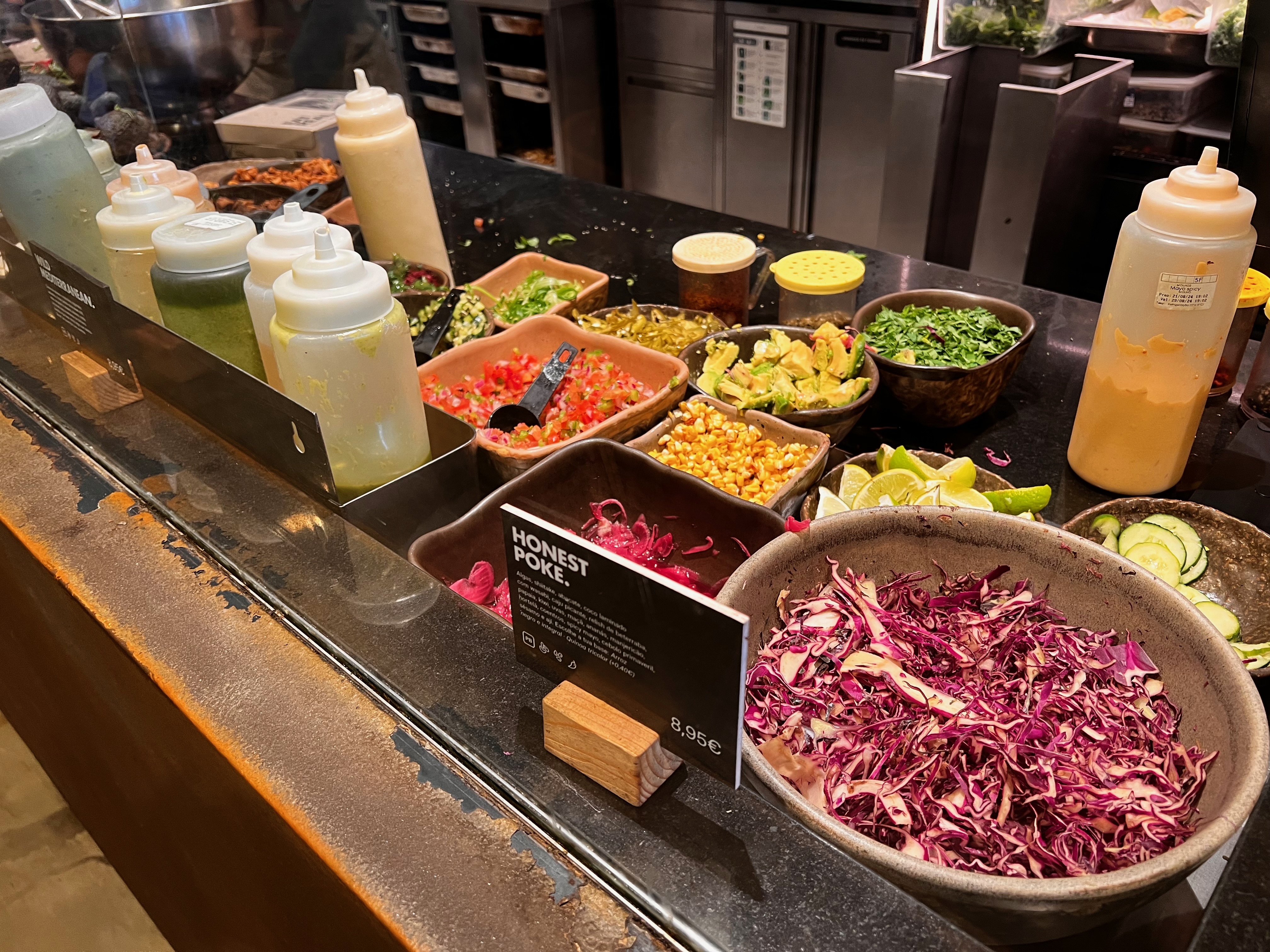
It wouldn’t be overly harsh to label a great number of the shops and eateries as standard tourist tat, with the concentration of those increasing as you approach the waterfront. But that would be to ignore the many places that are far more worthwhile. We ate fabulously inventive, modern cooking in a restaurant called Emcanto, recently opened by a couple of Brazilian chefs, that we came upon by accident (it didn’t seem to feature highly on the standard lists of TripAdvisor and friends). We saw it in a pretty cul-de-sac and were intending just to stop for a drink, but the welcome was so warm that we ended up staying for the food and were thrilled that we’d done so. As well as the traditional cafés, there’s an increasing number of the hipster variety: Nicolau was an excellent brunch place (we were lucky to get in, given that the place was packed to the gills shortly afterwards). But the place that epitomised the new Portugal for us – the one that’s attracting young people from all over the world to set up businesses – was Honest Greens, a chain with branches across Spain and Portugal. Its three founders were frequent independent travellers from France, Denmark and the US who were fed up with not being able to get healthy food; they’ve created the best places for a lunchtime salad that I know, with everything fresh, delicious and efficiently made to order (and at decent prices).

If, by the way, you go around the other side of the Sé (another steep climb, but you’re getting the idea by now), you can get phenomenal views of the city as you reach the spectacular Dom Luis I bridge towards Vila Nova de Gaia on the other side of the Douro, engineered by Théophile Seyrig, a disciple of Gustave Eiffel.

For fish and seafood, our hotel advised us to head in the opposite direction to the seaside suburb of Matosinhos, where there is a cluster of seafood places (the Portuguese name is “marisqueria”). It was about half an hour each way by car (the metro goes there but takes longer) and it was well worth the trip, with super-fresh fish cooked by people who evidently knew their trade. We were looking for simplicity and freshness rather than complex, fancy cooking, and that’s exactly what we got. By the way, the hotel warned us off any of the city’s options for tasting port, which it considered as all being tourist traps, recommending that we take a trip up the Douro river to the wine-growing region. It’s around 80 minutes each way and, sadly, we ran out of time to do it. Next time, hopefully, because it’s not just port that comes from the Douro region: we had some memorable red wines from there.

Our small hotel, the Jardins do Porto, was slightly north of the centre of Porto in an area whose economic state was decidedly mixed – at least as demonstrated by the state of repair of the buildings. The hotel itself had been beautifully done up and was being kept in immaculate condition. But that made it an exception compared to most buildings in the nearby streets, of which many needed a serious lick of paint at the very least and some looked quite dilapidated. We were told about two specific problems: firstly, too many landlords have tenants at very low controlled rents and hope to flush them out by leaving the properties to rot, and secondly, that the base value for property taxes gets updated only infrequently, so for many buildings, property taxes are so low that leaving a building empty is a viable option for the owner. One suspects that serious reform of the property tax regime is needed (as, to be fair, is the case in many European cities, not least my home city of London).

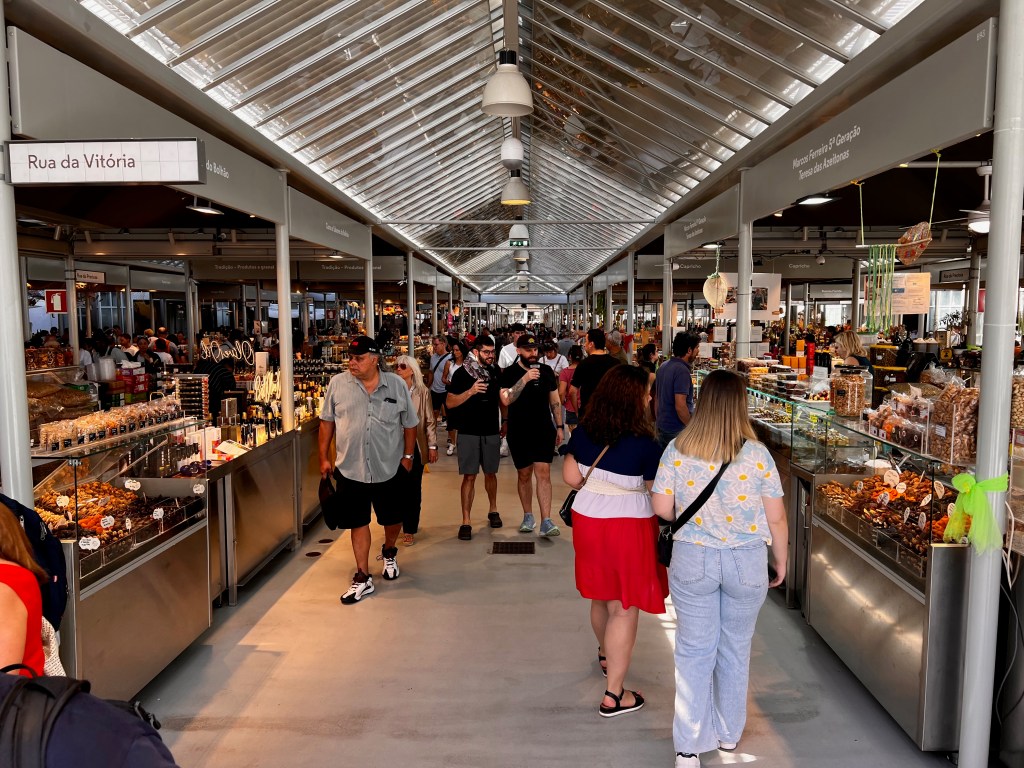
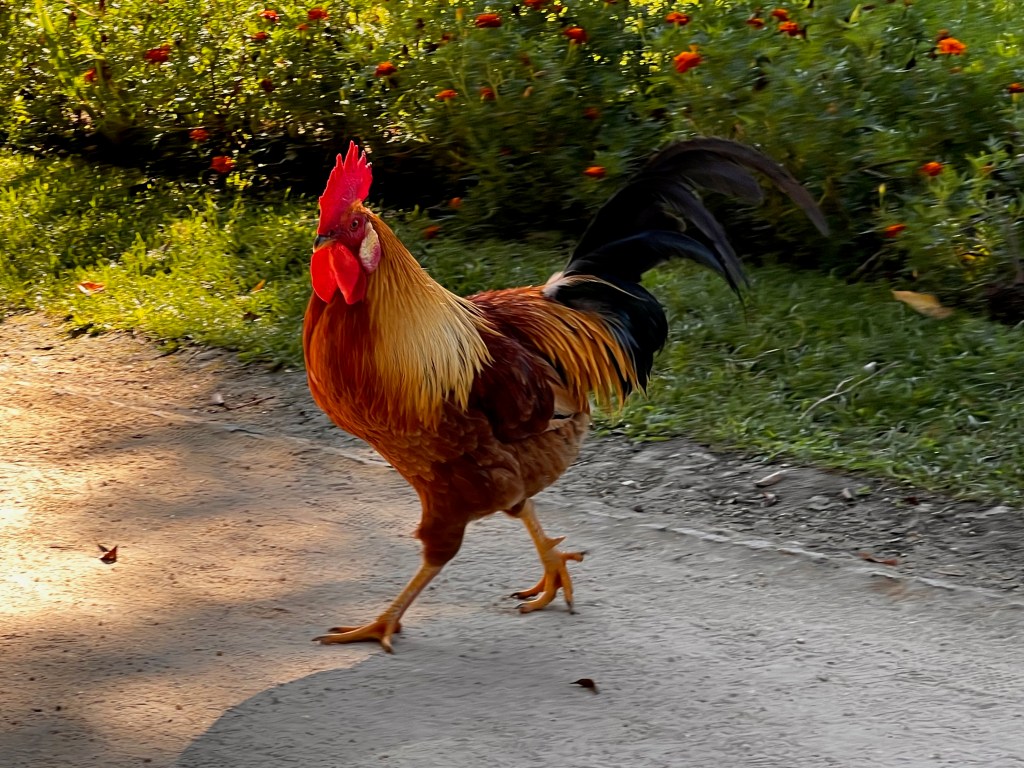
Away from the city centre, plenty of Porto is very modern. Just a couple of streets away from our hotel, the Trinidade shopping centre is suitably glitzy. A few streets away, in the main shopping area round the Rua de Santa Catarina, the Mercado do Bolhão (the historic market) has been done up beautifully. Half a kilometre west of the Igreja do Carmo, passing by a pleasant museum with more blue-and-white tiles, the Museu Soares dos Reis, the Super Bock Arena hosts all manner of music concerts, as well as (for a small fee) giving you the opportunity to take in a panorama of the city from the top of its dome. Next door to it is a pleasant small park, the Jardins do Palácio de Cristal, whose wandering cockerels and peacocks are a particular delight to small children. Walk north from there and you’ll pass a lot of modern apartment blocks and offices on the way to the city’s other big concert venue, the Casa da Música.

I’ve been in Lisbon and its surroundings relatively often, but this is the first time I’ve been to Portugal’s second city. It’s been a fascinating few days.

Going green(er): solar PV panels, one year in

Going green(er): solar PV panels, one year in

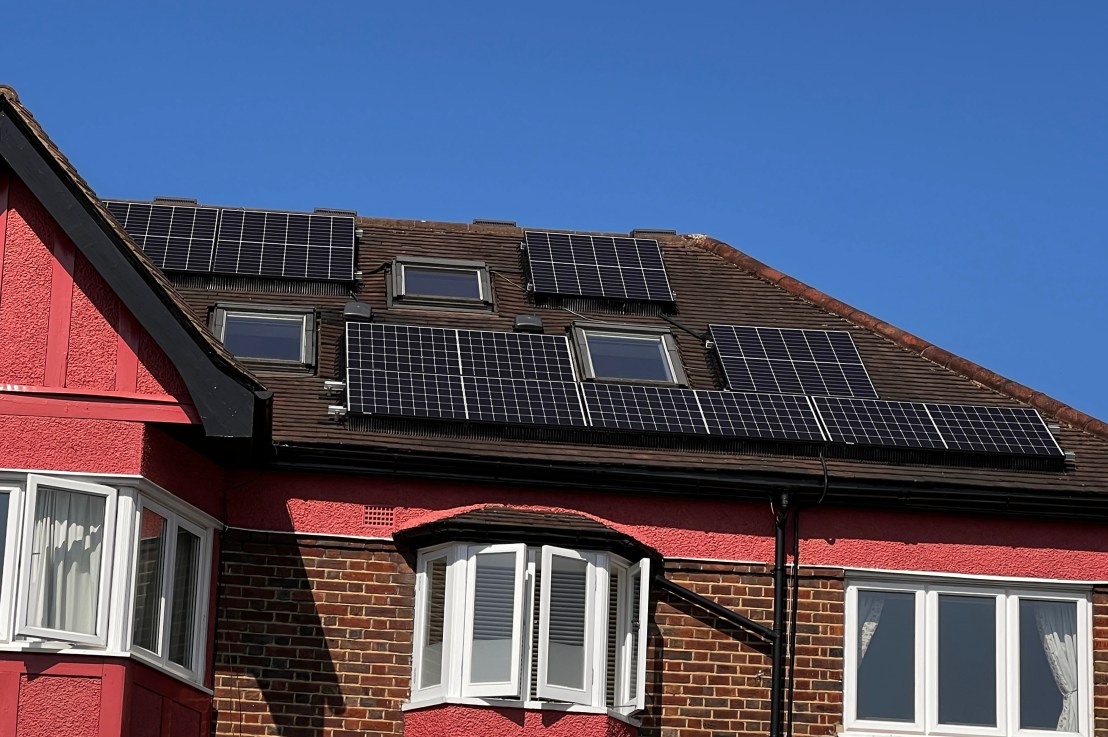
Our Solis system, comprising solar panels and battery, was installed in June 2023, so we’ve now had a full year’s usage. That makes it worth checking on the experience: what was it like using the system, and how much electricity did it generate?

On the good side: the system reached the “fit and forget” stage reasonably rapidly. There was a certain amount of flailing around required to understand the electrity tariffs from our supplier, Octopus Energy, both for import (we’re buying electricity from the grid) and export (we’re selling excess electricity to the grid), followed by some experimentation to see what was likely to work best. But given that I started from a position of total ignorance, I don’t think the amount of hassle was unreasonable.

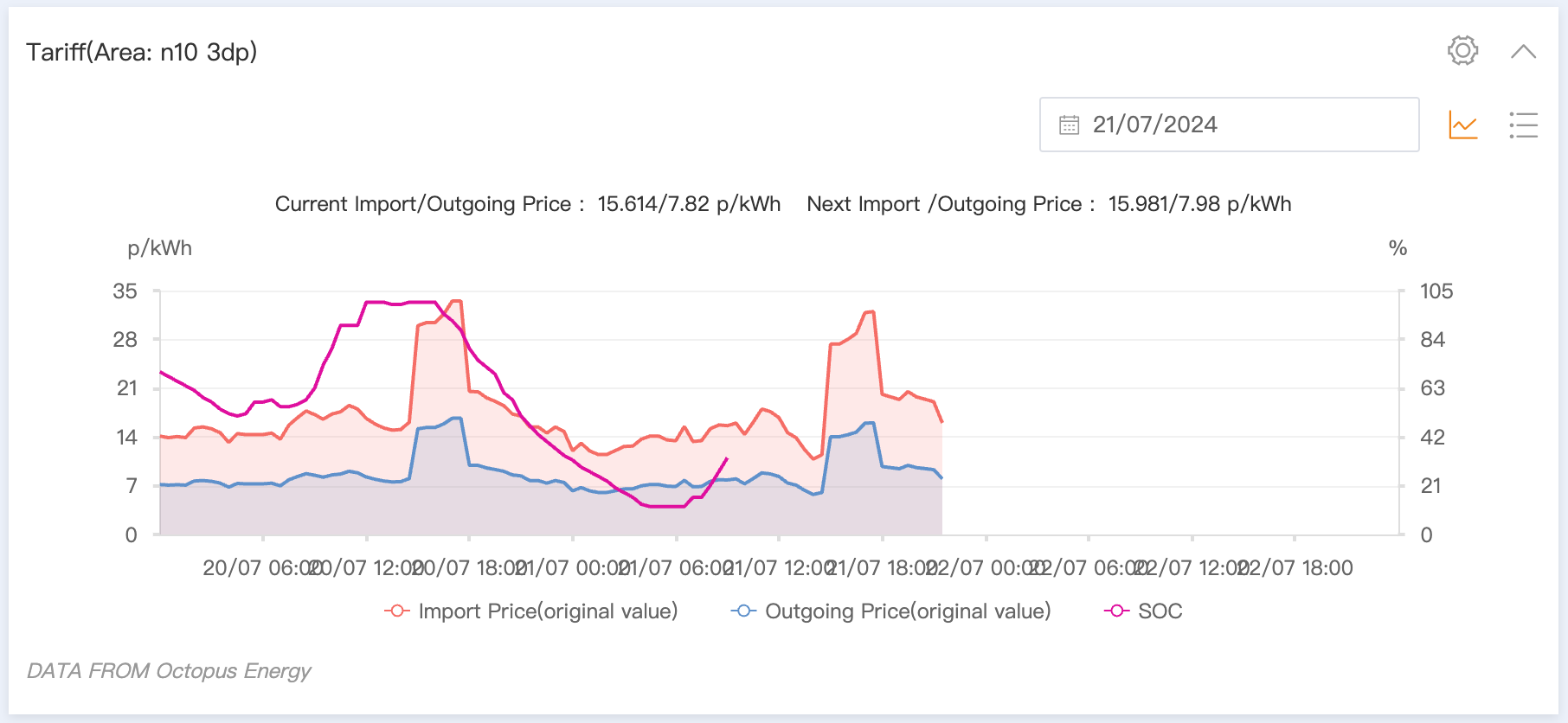
I’ve ended up settling on a plan called “Agile Octopus” for import, which varies the price considerably according to the time of day. The system seems quite good at avoiding importing energy in peak times, which means that the agile plan gives a reasonable import price: I’ve been paying around £0.165 / kWh (including 5% VAT). Since the import price varies between £0.156 and £0.31, I’d say the system is doing a good job here.

For export, however, I’ve settled on a plan called “Outgoing Octopus 12M Fixed”, which yields £0.15 per kWh: they have an agile plan, but that was yielding less revenue. The overall effect is that I’m only paying around 10% more for importing electricity than I am receiving when I export it.

In terms of how I use electricity, therefore, I’m now left with very little work. The car is set to charge at 00:30, when import tariffs are guaranteed to be around their lowest. The solar system’s 9.6 kWh battery does a good job of smoothing out everything else, so I’ve now stopped worrying about things like when’s the best time of day to put on the dishwasher, which was confusing, anyway, because it varies so much according to the seasons and according to whether the car needed charging.

The Solis system gives pretty good maxi-geeky graphs of everything it’s been doing. But to be honest, I hardly bother to look at them any more.

So much for the usability. But that leaves the elephant in the room: how much electricity are the panels generating, compared to what was expected when our installer did their estimates? Here, I’m afraid, the results are less favourable.

In the course of the year, the system yielded 5,259 kWh – that’s just 77% of what was predicted in our installer’s quotation. Now obviously, you expect there to be much variability according to the weather: last month, for example, the system reached its best ever yield of 885 kWh, which was 96% of the estimate. Still, I think I was hoping for closer to 85-90% than the 77% I got. 

In terms of value, that was £866 knocked off my electricity bill for a system that cost £22,520 to install. The payback is going to be more like 20 years than the expected 13, bearing in mind that energy prices have come down enormously from when the system was installed.

I certainly don’t regret installing the system. It was the right thing to do my bit for the environment and I never expected giant savings. However, I won’t pretend that I’m not mildly disappointed that the numbers don’t look a bit better.

Of course, things could easily change. The weather’s been pretty poor in London over the last year, so a sunnier year could yield a lot more electricity. And sadly, there’s likely to be another spike in energy prices at some point in the system’s lifetime, in which case it will look like a sounder investment. We’ll just have to wait and see, and attempt to feel virtuous in the mean time. (Of course, I haven’t computed the carbon footprint of getting the system installed – that’s another conversation in itself).