Our Solis system, comprising solar panels and battery, was installed in June 2023, so we’ve now had a full year’s usage. That makes it worth checking on the experience: what was it like using the system, and how much electricity did it generate?
On the good side: the system reached the “fit and forget” stage reasonably rapidly. There was a certain amount of flailing around required to understand the electrity tariffs from our supplier, Octopus Energy, both for import (we’re buying electricity from the grid) and export (we’re selling excess electricity to the grid), followed by some experimentation to see what was likely to work best. But given that I started from a position of total ignorance, I don’t think the amount of hassle was unreasonable.
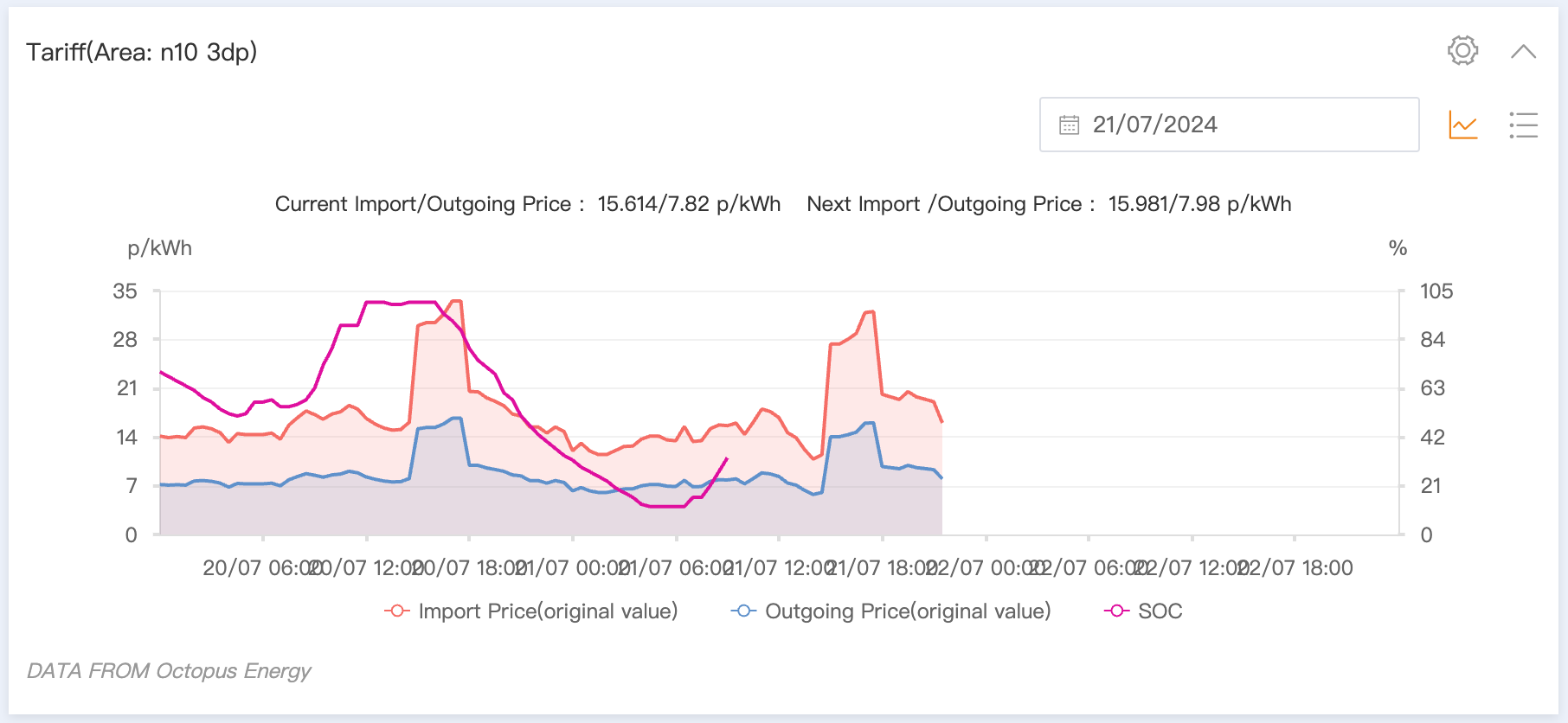
I’ve ended up settling on a plan called “Agile Octopus” for import, which varies the price considerably according to the time of day. The system seems quite good at avoiding importing energy in peak times, which means that the agile plan gives a reasonable import price: I’ve been paying around £0.165 / kWh (including 5% VAT). Since the import price varies between £0.156 and £0.31, I’d say the system is doing a good job here.
For export, however, I’ve settled on a plan called “Outgoing Octopus 12M Fixed”, which yields £0.15 per kWh: they have an agile plan, but that was yielding less revenue. The overall effect is that I’m only paying around 10% more for importing electricity than I am receiving when I export it.
In terms of how I use electricity, therefore, I’m now left with very little work. The car is set to charge at 00:30, when import tariffs are guaranteed to be around their lowest. The solar system’s 9.6 kWh battery does a good job of smoothing out everything else, so I’ve now stopped worrying about things like when’s the best time of day to put on the dishwasher, which was confusing, anyway, because it varies so much according to the seasons and according to whether the car needed charging.
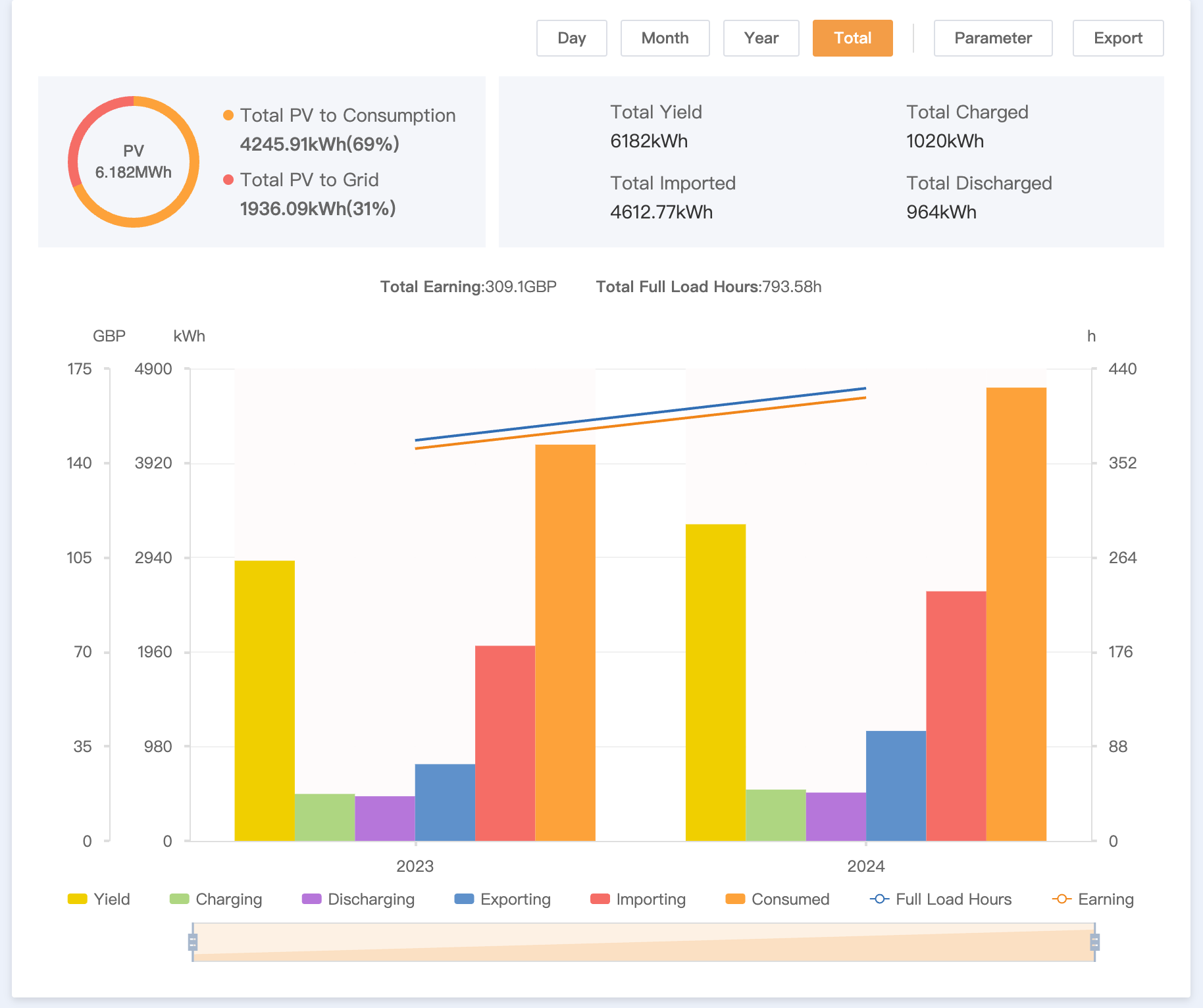
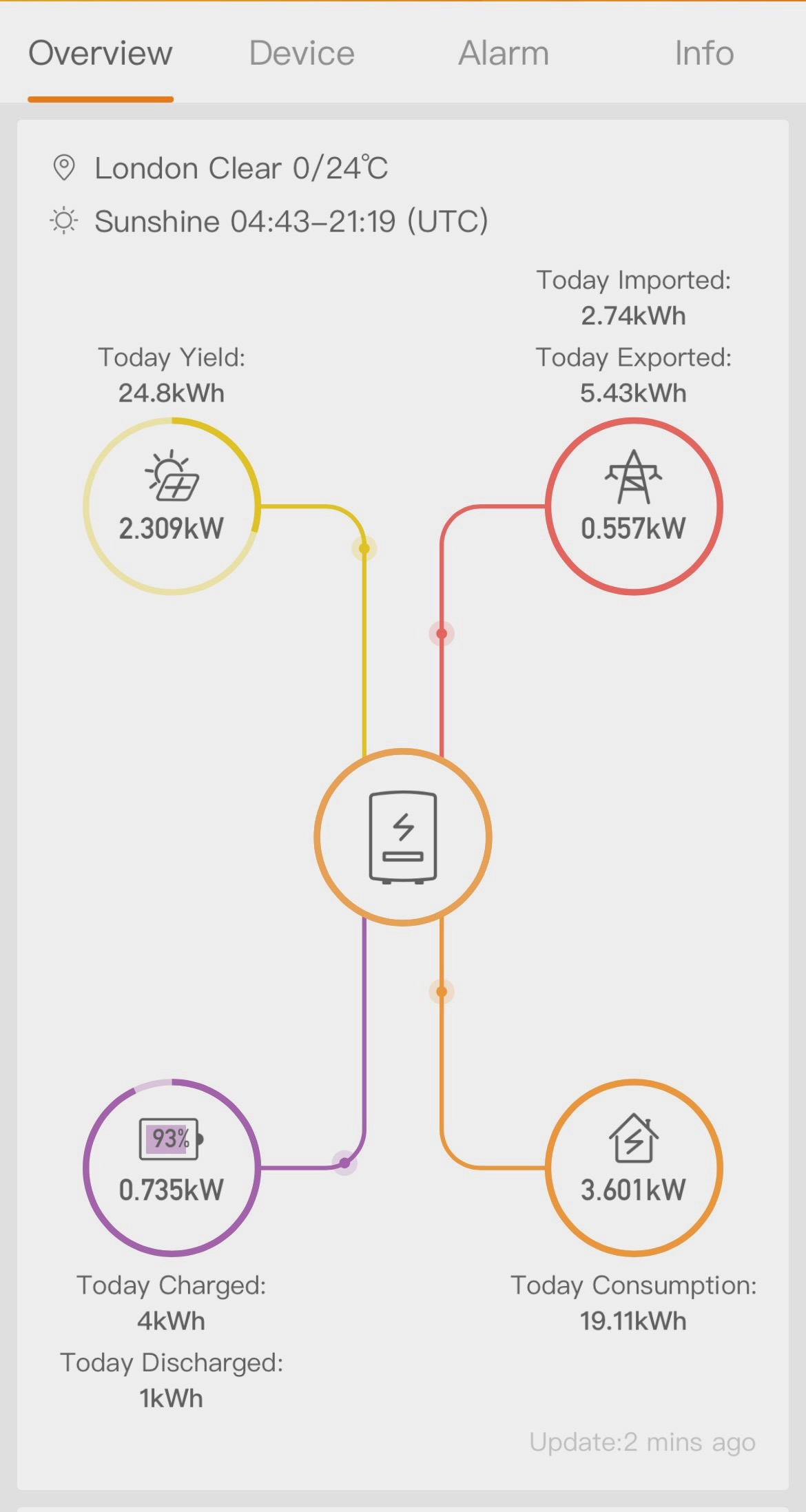
The Solis system gives pretty good maxi-geeky graphs of everything it’s been doing. But to be honest, I hardly bother to look at them any more.
So much for the usability. But that leaves the elephant in the room: how much electricity are the panels generating, compared to what was expected when our installer did their estimates? Here, I’m afraid, the results are less favourable.
In the course of the year, the system yielded 5,259 kWh – that’s just 77% of what was predicted in our installer’s quotation. Now obviously, you expect there to be much variability according to the weather: last month, for example, the system reached its best ever yield of 885 kWh, which was 96% of the estimate. Still, I think I was hoping for closer to 85-90% than the 77% I got.
In terms of value, that was £866 knocked off my electricity bill for a system that cost £22,520 to install. The payback is going to be more like 20 years than the expected 13, bearing in mind that energy prices have come down enormously from when the system was installed.
I certainly don’t regret installing the system. It was the right thing to do my bit for the environment and I never expected giant savings. However, I won’t pretend that I’m not mildly disappointed that the numbers don’t look a bit better.
Of course, things could easily change. The weather’s been pretty poor in London over the last year, so a sunnier year could yield a lot more electricity. And sadly, there’s likely to be another spike in energy prices at some point in the system’s lifetime, in which case it will look like a sounder investment. We’ll just have to wait and see, and attempt to feel virtuous in the mean time. (Of course, I haven’t computed the carbon footprint of getting the system installed – that’s another conversation in itself).
The climate crisis has made me steadily more interested in reducing my carbon footprint by putting solar panels on our roof. As well as being the green thing to do, the recent turmoil in energy prices has made it economically sensible, so I’ve taken the plunge: last month, a substantial system of photovoltaic (“PV”) panels was installed on our roof. Should you do the same?
When specifying a solar energy system, there are many possible choices of exactly what equipment to install. The decision-making is complex because there are a lot of variables: how much electricity you expect to use (which will vary according to the time of day and the season), how you think energy prices will change, interest rates, whether you’re going to charge an electric car at home… The list goes on.
Solar installers will give you all sorts of models to show your return on investment: these can be somewhat rosy-coloured and generally only tell part of the picture, so I thought it would be a good idea to talk you through what the various components do and why I made the decisions I did, in the hope that it might help with yours (or just pique your interest). Most of what follows will apply regardless of which country you live in, but a few points will be specific to the current regulations in the UK.
First, you need an approximate scale of what you’re trying to achieve. Electricity use is measured in kilowatt-hours (kWh): roughly speaking, 1 kWh will light a small room for a couple of days, boil an electric kettle ten times or run a load on a small dishwasher. An average detached house in the UK uses around 10 kWh per day, according to OVO energy. Your daily usage should be shown on your electricity bill: ours was 17 kWh. I’m not yet totally clear about why we’re so far above average, but I’ll be working on it.
The major components of the system are as follows:
The PV panels, which convert sunlight into DC (direct current) electricity
The battery, which stores electricity for later use
The inverter, which converts the DC into the AC (alterating current) electricity that your house will use and also controls how much electricity flows to and from the battery
All of these cost serious money, so it’s important to get their amounts and sizes right.
How many panels?
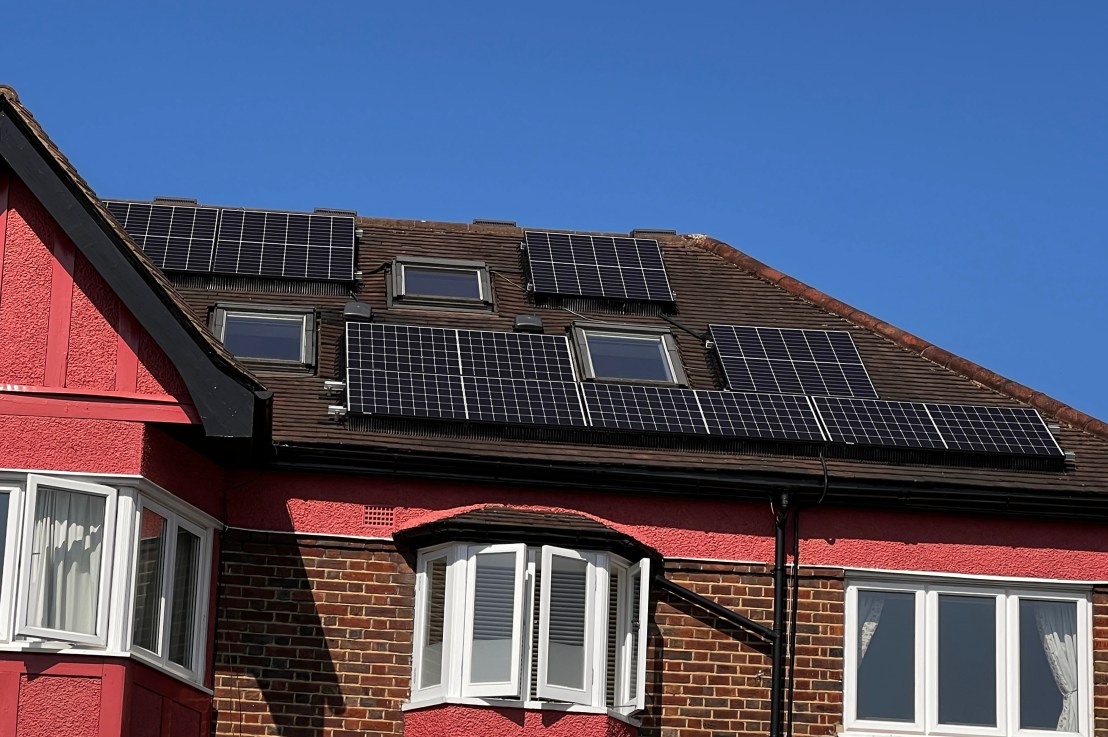
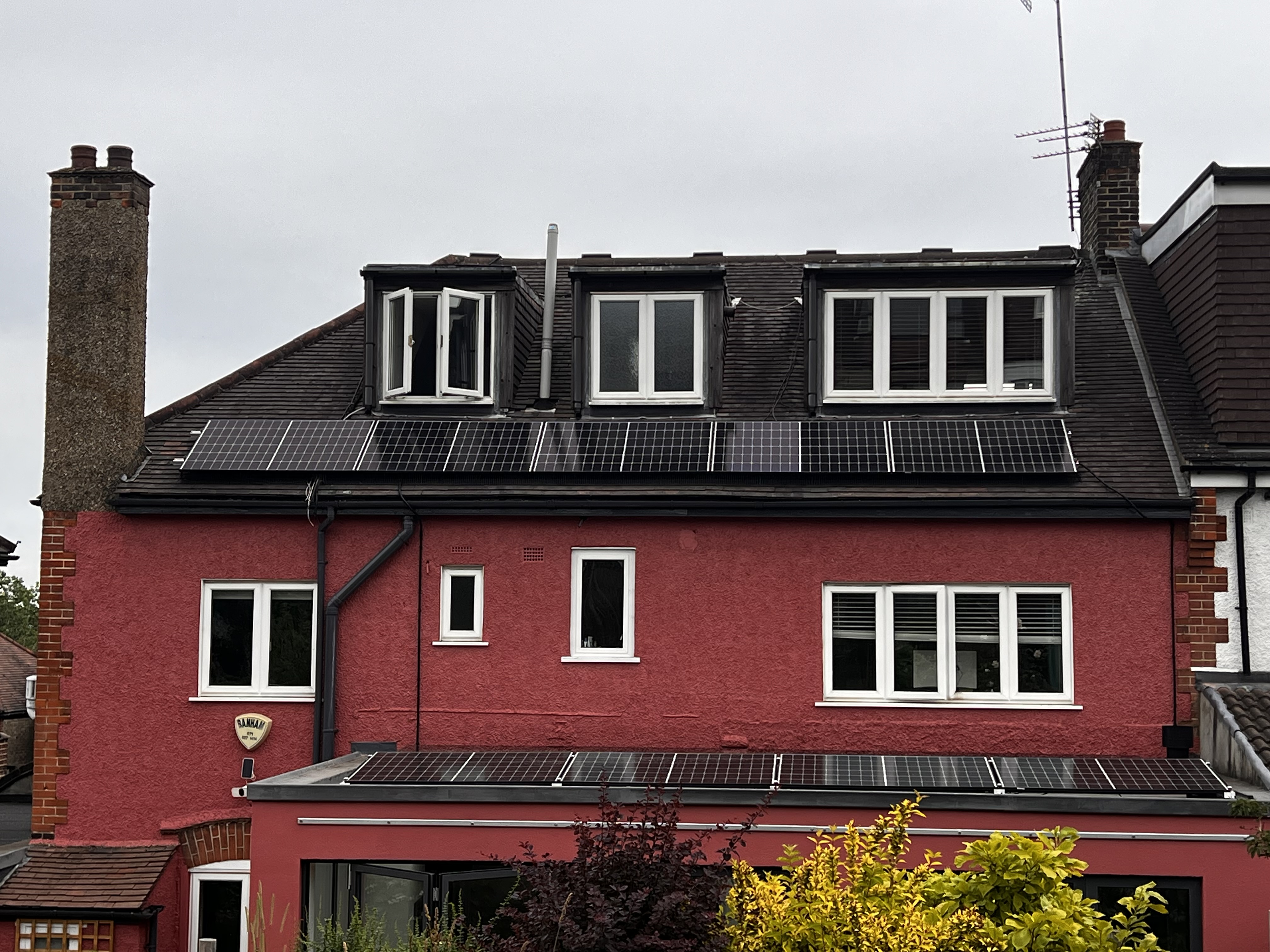
A typical rooftop might fit between 10 and 20 410W panels – I ended up with 19, giving a maximum rated power output of 7.79kW. At first sight, that sounds like massive overkill: a maximum rated output of over 90 kWh on an average day with 12 hours of sunlight, compared to the 17 kWh that I use. But that’s wrong, for a variety of reasons:
In winter, days get much shorter than 12 hours
If the weather’s cloudy, the panels will produce a lot less than their rated output
In my case, because my roof faces east-west, only half the panels (roughly speaking) are operating at any time: the east-facing panels in the morning and the west-facing ones in the afternoon
There are inefficiencies in the system anyway
So far, the best that my system has managed, on one of the longest and hottest days of the year, was just over 40kWh (which was actually pretty impressive). The predictions in my quote are that I will be generating 61% of my total electricity usage: we’ll see how that pans out over the course of the year.
How big a battery?
Of course, you could operate without a battery at all, selling any surplus electricity back to the grid immediately and never storing it. The trouble is, in the UK at least, many of the electricity providers have been paying a pretty inadequate rate (as low as £0.05). This does seem to be improving, though: my provider Octopus have a tariff where they will buy my surplus power at a fixed rate of £0.15 per kWh, compared to the £0.49 they have been charging me for supply (which, to be fair, is going down to £0.31 this month).
Particularly since we have no idea how any of these tariffs are going to change, it therefore makes sense to have a battery big enough to store your usual overnight consumption (if you haver a smart meter, you should be able to figure out what this is, or you can let your solar supplier guess based on your total consumption and national averages). My battery has a capacity of 9.6kWh, which means that I will be exporting electricity back to the grid at the height of summer or when we’re on holiday and the house is empty, but not at other times. The batteries are modular and we might add another module to increase capacity in future, if it looks sensible to do so.
The inverter
In practise, the inverter will be the model with which your installer is most familiar. The decision to be made will be its capacity for delivering power, which needs to be higher than the maximum amount your system will generate at any one time. In the UK, there is an important limit: if your inverter is at or below 6kW, your application to join the electricity network is granted automatically; above it and you could suffer delays. My inverter is exactly at 6kW: because of my East-West facing roof, we can be sure that my solar panels will never deliver more than that, by a safe margin.
With your inverter comes a suite of software for monitoring how your panels are performing, how much electricity they are delivering, how much you are using, how much is going to and from the battery. Staring at the control panel on my phone was pretty addictive for the first week or two: the novelty is beginning to wear off now and I’m more inclined to let the system get on with it. Of course, it would be possible to spend hours analysing data and tweaking the inverter setup to the nth degree, most notably the parameters about how much it decides to charge the battery. I haven’t bothered to learn the tricks for doing this.
If your house doesn’t have much unused space, you may struggle to find a suitable place to locate the inverter and batteries. They generate a fair amount of waste heat, so you have to leave quite a lot of space around them. The place you choose has to be well ventilated. They won’t like being in direct sunlight (because of the risk of overheating). And you need to be able to run DC cables from them to all the panels, and AC cables to your consumer unit (the place where your electricity is distributed to the building).
Weatherproofed inverters do exist, which you can install on an outside wall. They’re more expensive, and you still have to be sure to keep them out of the sun.
You also generally need to ensure that they have an Internet connection available (different inverters handle this in a variety of ways).
Other ways of using surplus electricity
If you live in a very sunny place with a large roof, you might end up with a lot of surplus electricity. Here are some of the things you might choose to do with it.
Charge an electric vehicle – just to give you an idea of scale, the battery in my Tesla is 75kWh, nearly eight times the size of the one in my house. A typical 100 mile recharge is around 30kWh. But you could be generating enough power to make a sizeable dent in that, and/or you may have pretty low mileage anyway. In this case, you can buy a special purpose diverter (the popular brand in the UK is called a Zappi), which figures out, reasonably intelligently, when it’s a good idea to pump surplus energy into your car rather than selling it back to the grid.
Use it to heat water. In many UK homes, your hot water is powered by gas or oil, which is a lot cheaper than electricity, but the tank has an electric immersion heater for use as a backup. In principle, you could send the surplus electricity to your immersion heater to reduce your boiler’s gas usage, effectively using your hot water tank as a form of energy storage (the Zappi has a friend called an Eddi which does this). Trouble is, you need the right hot water tank for this to work: most domestic systems run on a thermostat, so unless you’re running your bath at exactly the moment when your electricity generation is high, the Eddi won’t contribute much.
Use it to power a heat pump. Air-sourced and ground-sourced heat pumps aren’t all that popular in the UK yet, because of a variety of difficulties. But the technology is improving, gas prices might get another upwards shock, and regulations discouraging gas usage could come in. As a result, heat pumps may become the way to go for more houses. If that’s the case for you, a considerably larger solar setup may be desirable.
The economics
If we’re honest, the economic case is a bit marginal, even with the recent turmoil in energy prices. My system cost over £20,000 and my installer’s fancy proposal-creating software gave a payback time of around 10 years, but that needed to be taken with a serious pinch of salt given that it all relies on assumptions about what was going to happen to electricity prices and interest rates (obviously, it matters whether you’re financing the project by borrowing or whether you have the money and it’s simply reducing your investment income).
So the chances are that you’re not planning to install solar for the economic benefit alone: you’re doing it at least in part because reducing your carbon footprint is a good thing in itself, or possibly because you live somewhere which gets a lot of power cuts, so having a high capacity battery gives you much wanted immunity to these.
Finding an installer
Even before the Ukraine war, the increasing desire to go green, together with the steady improvement in PV system performance, meant that there weren’t enough installers to meet demand. The energy price shock brought on by the war made the situation worse. So in the UK at least, good quality installers can pick and choose which jobs they do – which means that they’ll choose the ones they can do with least effort, ones close to where they’re based which don’t suffer from obvious technical difficulty.
Don’t be surprised if you contact an installer, get a first off quote which has taken them 10 mimutes with a bit of software, and if you then never hear from them again. I’ve had that happen twice, with a third attempt where an installer based somewhat far away decided that my job was all a bit too much effort and declined to continue. What finally worked for me was to identify a company who had done a successful installation at another house in my road.
Finally, once your system is installed and you get the right certificates to allow you to connect to the grid, you’ll want to choose the best possible tariff and get your installer’s help to programme the inverter to make use of it (for example, Octopus Energy tell me that for them, you want to avoid taking grid electricity between 4pm and 7pm). But that’s a whole other story…
So should you invest in PV?
Every situation is different: your economic forecasts and financial situation will be different from mine, as will your expected energy usage, the orientation of your roof, the ease or difficulty of access to it, the value you place on reducing your carbon footprint and many other things. And of course, there important things we don’t know: how energy prices will change, and how the technologies involved will change (hopefully to improve, but maybe to become more expensive if there are materials shortages).
Anyway, I’ve done my best to give you enough background to properly critique your supplier’s proposal and estimates and come to an informed decision. Good luck with your solar power journey!
 Polything