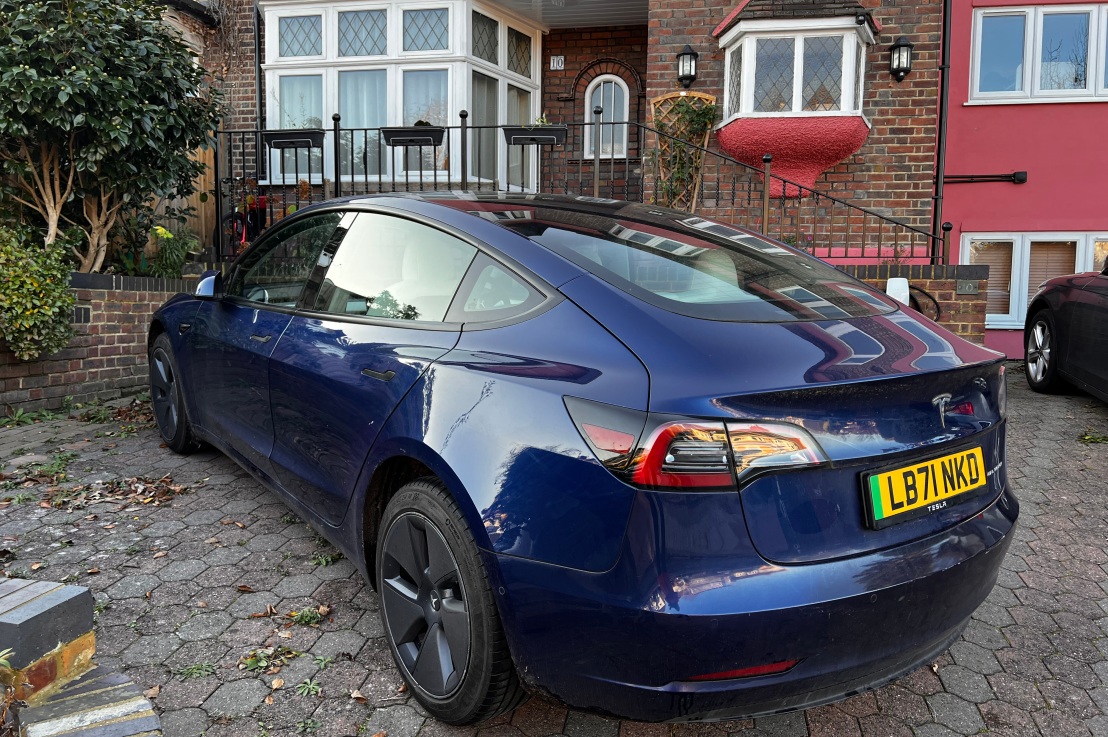
Like many people of our age, we’ve become more and more conscious of climate change and the world we’re bequeathing our children. We can’t claim to be paragons of green virtue – we’re still doing far too much flying to even approach this – but we have been taking some of the right steps, and two years ago, we made the leap and abandoned the internal combustion enging: our first electric car, a Tesla Model 3 Long Range, was delivered exactly two years ago, on 30th November 2021.
Here’s a potted assessment, not just of the car itself, but of the experience of owning and running a Tesla. The short answer is that I’ve loved it: the car is great and the charging infrastructure has worked superbly. That said, there’s plenty to criticise in the user interface, not in the basic “iPad on wheels” concept, but in many details which are either misconceived or just plain don’t work.
The car
The biggest surprise about the Model 3 was quite how good a car it is mechanically. Leave aside the technology bluster, the computer screen, the blistering acceleration: the Model 3 handles better than any other car I’ve owned. You get this overwhelming feeling that when you turn the wheel to point the car in a particular direction, the car will follow immediately and precisely. There’s no resistance to your hands, there’s no lag, there’s no discernible roll of the car’s body, not the slightest hint of uncertainty. The response to your control is precise and immediate.
The big point of difference between the way you drive a Tesla and the way you drive petrol or diesel cars is the regenerative braking. When you start taking your foot from the accelerator, once you get to the point where the car is no longer accelerating, it gradually starts to brake. This means that you don’t really use the brake pedal at all in normal driving: your right foot acts as both parts of the “go faster / go slower” control. You might think this takes some getting used to, but I didn’t find this: I was completely comfortable within minutes. And once you’re used to it, that combines with the car’s basic responsiveness to make it a real joy to drive.
As has been well documented, the acceleration is phenomenal. I’ve only floorboarded the car once, largely to see what would would happen – and the thing that transpired was the certainty that my back and neck would start complaining if I did it regularly. Effectively, you have an on-off switch which says “overtake now”. Weirdly, this means that I drive the Tesla far less aggressively than previous cars: knowing that I can overtake just about anything else on the road at will means that I don’t have to do any of the jockeying for position that drivers often do. There’s never a need to drive up close to someone’s bumper to prepare.
The modern features you expect work well, like electronic locking and remote boot opening (or trunk, as Tesla insist on calling it – one day, they might do a British English option). Having the car warm up to the right cabin temperature at the right time every morning is a genuine luxury. Admittedly, it took me a while to get used to abandoning the car key and simply wandering up to the car with a phone in your pocket, expecting it to unlock. And finally, we find the car very comfortable – the seats are supportive and adjust in all the right places.
Range anxiety – or not
Our biggest concern about going electric was range anxiety: we do a regular round trip to Devon of around 250 miles each way and we’re often a bit pushed for time, so spending hours charging the car en route isn’t an option. So before buying the car, we did the trip in a rented Model 3.
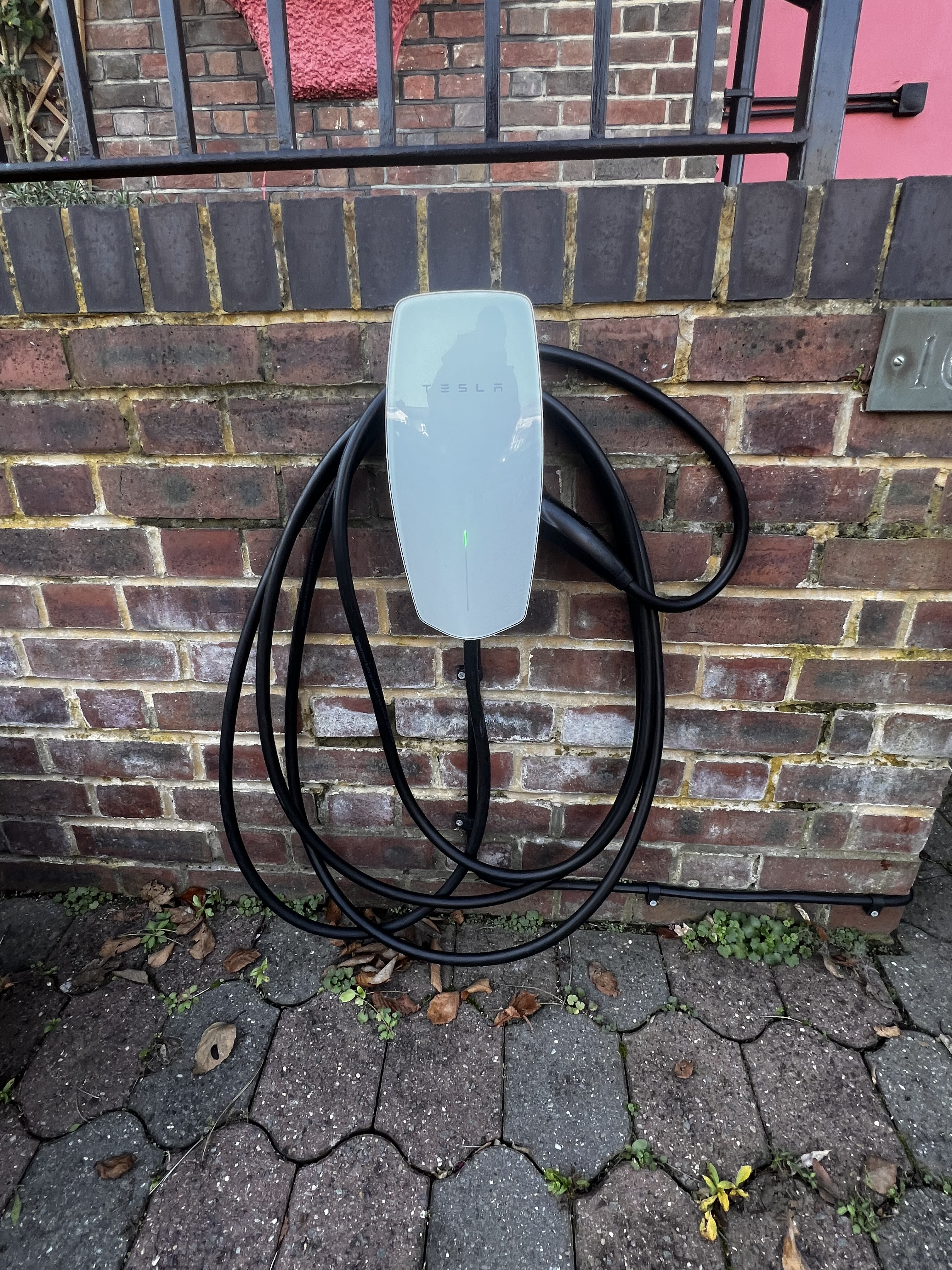
What we found is that the Tesla Supercharger network works extraordinarily well. The chargers are very fast indeed: it’s rare for us to spend more than 20 minutes charging the car. That’s a very small overhead on top of the ten minutes we’d spend on a stop for the toilet and either a drink or a brief stretching of legs (we’re old enough that any long car journey carries the risk of our backs stiffening up). Our overall journey time to Devon hasn’t changed materially.
The ultimate test of range anxiety was the 2,000 mile road trip we did around France this July. Supercharger coverage in France isn’t quite what it is in the UK, so we needed a bit more preparation in the shape of acquiring a Chargemap card, which gives you access with a single RFID card to almost all the other commercial chargers around. Several of the hotels we stayed at recharged the car for free overnight, and there was a nice surprise when it turned out that the city of Aix-en-Provence provides free EV charging in their public car parks (although, admittedly, these are pretty expensive in the first place).
The car’s satnav is particularly good at this: dial in your destination (or even a couple of destinations ahead) and it will plan your supercharger stops. Then, when you’re on the road and approaching your supercharger, it will precondition the battery for ideal charging performance.
When touring, it’s worth noting that some supercharger stops are far nicer than others in terms of what facilities there are in the environs. Our stop in Valence was perfect because it was at lunchtime and the Novotel has a really nice brasserie. The Beaune supercharger allows a lovely 10-minutes-each-way walk into the city’s gorgeous old centre. The Amiens supercharger was decidedly less pleasant, with a lot of car park to walk through to get to the nearest toilet, in a MacDonalds. We discovered, rather late in the day, that an icon on your satnav allows you to find superchargers on your route so that you can Google them and see which ones look more salubrious; similar functionality is available on the phone app if you know where to look, off the bottom of the Location tab.
The user interface
If the Tesla is an obviously good answer to the “EV versus petrol” debate, its user interface is far more controversial. Some people will love the clean design that results from getting rid of as many manual controls as possible and putting them into a single iPad-like flat screen to the right of the steering wheel. For others, this will be unfamiliar and thoroughly unpleasant.
I’m somewhere in between. I’m perfectly happy to have all the controls on single flat screen, but there are an awful lot of things wrong in the way Tesla have done it. The good thing is that for most routine stuff, whether it’s setting up the climate control, checking tyre pressures or playing music from a bewildering variety of sources, the functions are easy to find and all work pretty well.
The single biggest problem is that I’m 65 years old, so I need reading glasses (but not distance vision ones). The speed at which my eyes can refocus between the screen and the road is limited and most of the fonts are so small that there’s a great deal of the UI that I simply can’t use while the car is in motion. A couple of months after I bought the car, Tesla relased an upgrade to allow me to select a larger font size, but that made only a modest difference.
This would matter less if the voice recognition worked better. Whether because of my British accent or vocabulary or because of something more fundamental, most of the time, I simply can’t get the car to understand what I’m saying, even for apparently simple commands like “windscreen wipers off” or “play music from Tidal”. Worse, the car often misinterprets my commands and does something completely unexpected, which you really don’t want to happen when you’re driving at speed.
Even at rest with reading glasses, the font size is also an issue when doing satnav searches: too often, you get a list of choices which are too long for the search results box and therefore get abbreviated with a “…” on the end. The effect is that you’re being presented with up to a dozen search results which look identical and which, on a bad day, can be several hundred kilmetres away from each other.
Future self-driving
For me, the most blatantly stupid aspect of the UI is the decision to devote the most important real estate on the screen – the third of the screen on the side closest to the steering wheel – to a 3-D visualisation of the car AI’s view of its surroundings – vehicles, pedestrians and cyclists, lane or edge-of-road markings. I assume that the motivation is to encourage the idea that the car is so good at modelling what’s around it that one day, we’ll have enough confidence to let it drive itself for us (if any Tesla employees are reading this who know better, feel free to disabuse me and explain the reality).
The trouble is, the visualisation is comically inept. Cars and lorries appear and vanish at dizzying speed. There’s no consistency I can identify as to when I’m likely to see pedestrians and when I’m not. The effect is the exact opposite of what’s intended: if the current display is the best model Tesla can create of the car’s surroundings, I’m not going to touch self-driving with a bargepole. It really irks me that this useless display is taking up the prime screen real estate where what I actually want is a large, easily readable speedometer, with some extras like the current speed limit, my journey time so far, expected arrival time and expected battery level at arrival in a large enough size that I can read them quickly. And I really would have thought that after going to the same car park barrier every day for a year, the car would have learned that no, I’m not going to drive straight into its box of electronics, and no, it doesn’t need to beep at me.
Some statistics
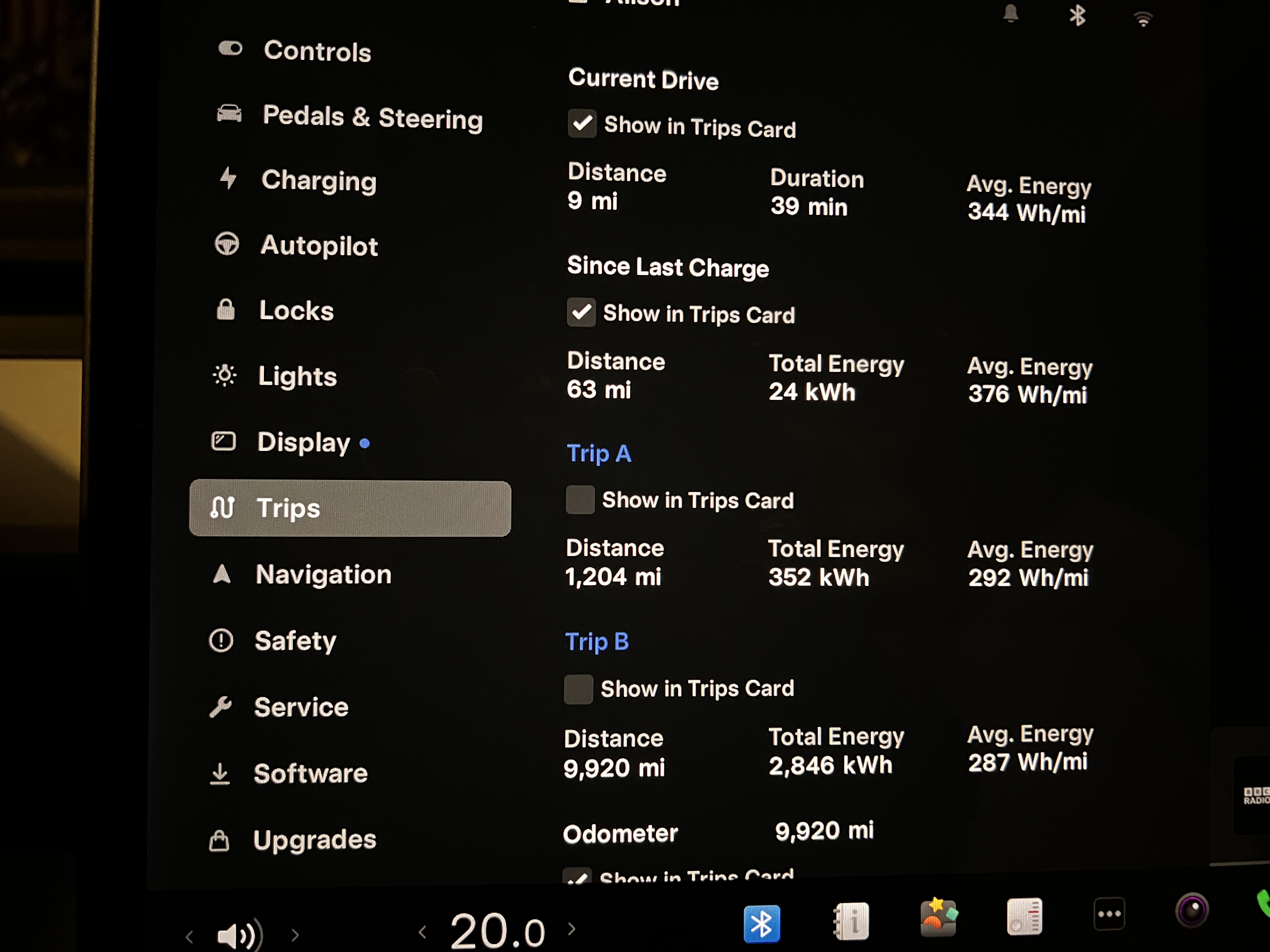
We’ve driven 9,920 miles in the two years we’ve had the car – a smidgin under 5,000 miles per year. The car reports our total energy use at 2,846 kWh, or 287 Wh /mile. At our current overnight electricity price of around £0.185 / kWh, that’s ust over 5p of electricity per mile, which strikes me as staggeringly good. To be honest, at our relatively low mileage, depreciation and insurance are going to be a far more significant cost than fuel.
For our France trip, a mixture of superchargers, other paid-for chargers and some free recharges, we ended up spending €0.09 per mile; if you ignore the free recharges, the figure goes up to €0.11.
The buying process
I need to mention that during the process of purchasing the car, Tesla’s customer engagement was dire. Sure, the online screen to set up your account and select the options you wanted worked fine. But navigating their phone system was horrific, there was really no idea given of when the car might arrive, and it wasn’t pleasant to discover that the pickup point closest to my home got mysteriously discontinued at some point during the ordering process. For a £50,000+ purchase, I’d have expected someone to answer the phones and give me a bit of TLC. They didn’t.
My overall impression is that their view of customer service is that it’s a cost centre: their strongest desire is to get you off the line and stop costing them salaries. Ensuring that you get a good experience to associate with their brand doesn’t seem to something that bothers them.
In summary
Quite simply, the Model 3 is the best car I’ve ever owned. It’s lovely to drive, staggeringly fast, practical, comfortable, reasonably attractive and its fuel costs are incredibly low (particularly since I have solar panels at home). Its charging network is second to none.
It would be great if Tesla had a serious rethink about their customer engagement and dealt with the dafter bits of the user interface. But I guess you can’t have everything. So far, therefore, all things considered, I’m not suffering from anything resembling buyer’s remorse.
 Polything